Stand for Jewish life. Fight antisemitism.
Jewish exclusion in the name of inclusion? No pride in Antisemitism!
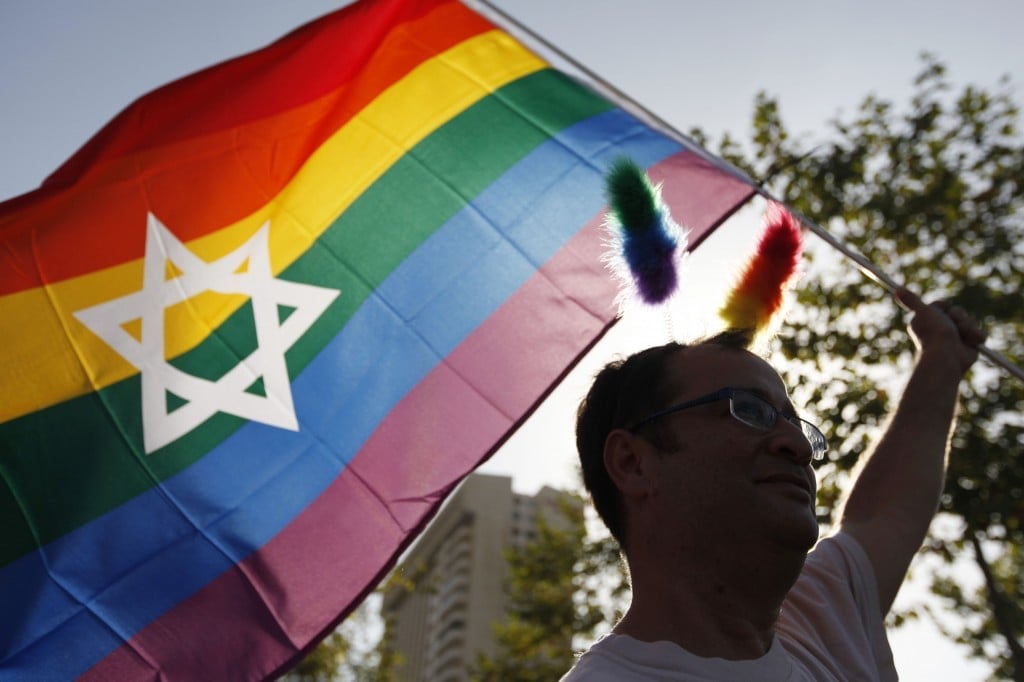
Jewish Pride flag (Miriam Alster/FLASH90)
In progressive spaces, diversity and inclusion are embraced as core values. But what happens when those very ideals are hijacked and used to justify the exclusion of Jews from spaces that claim to welcome all marginalized voices? This troubling contradiction was brought into sharp focus by recent events at a major LGBTQ+ gathering in Germany, where calls for “safety” and “solidarity” ultimately led to Jewish participants being told that their identity was incompatible with the event’s vision of “inclusion.”
When Berlin’s Community Dyke March organizers banned the Magen David from their protest march – while allowing Palestinian flags, kufiya, and red triangles – they inadvertently exposed perhaps the progressive movement’s most uncomfortable truth: the growing intolerance toward Jewish identity and symbols. This incident is far more than an administrative misstep or a misguided display of “solidarity” with Palestinians. It reveals how spaces that proclaim inclusion have begun to exclude Jews, and how anti-Israel sentiment has hardened into outright hostility toward Jewish people themselves.
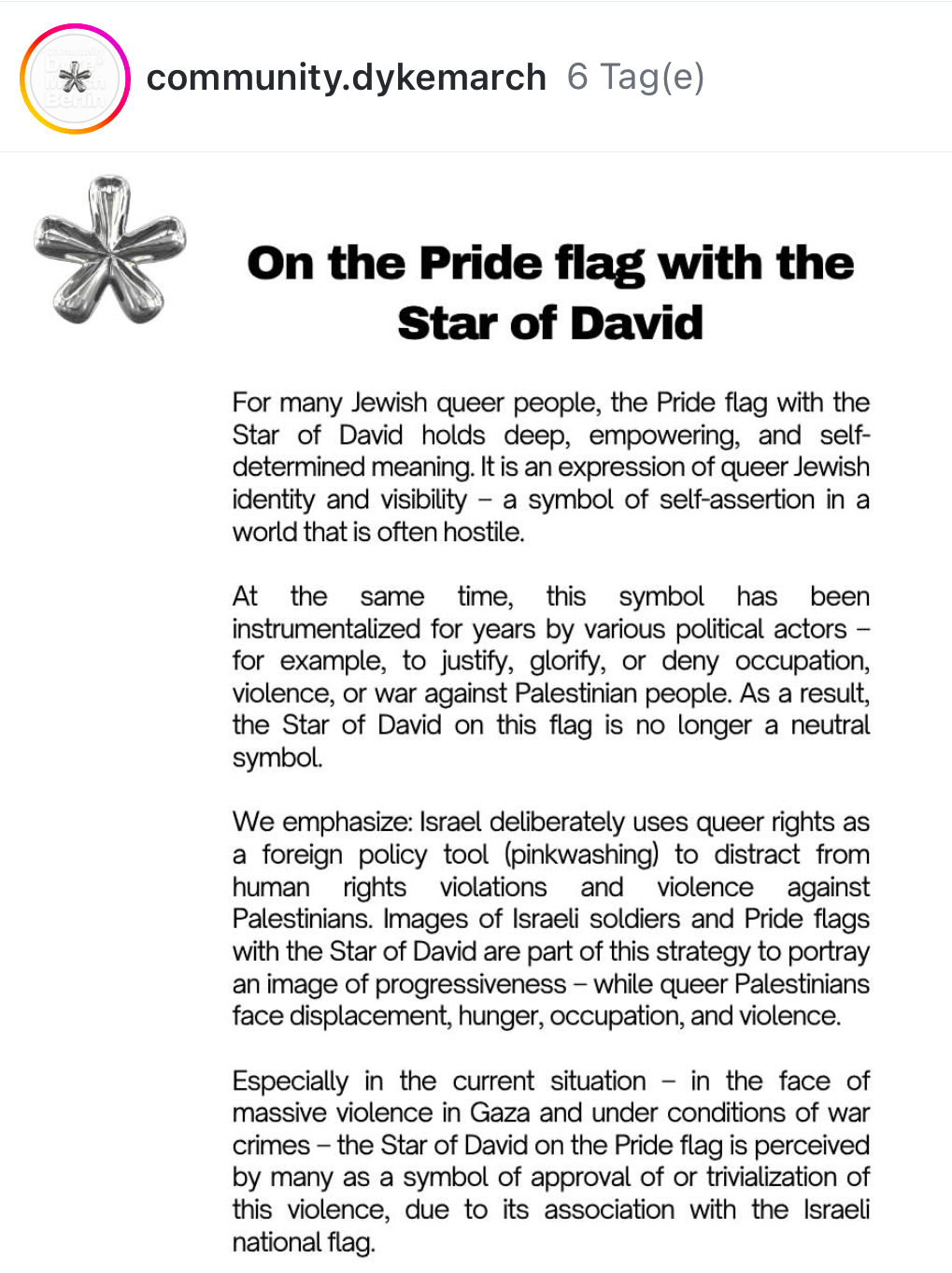
The Dyke March is traditionally a lesbian visibility and protest march running parallel to Berlin’s main Pride parade. The event has long prided itself on intersectional politics and promised to create “safe spaces” for marginalized communities. Yet when Jewish participants arrived wearing Magen David necklaces or carrying rainbow flags adorned with the Star of David, organizers told them their symbols were “unwelcome” and could “trigger” other attendees. Some Jewish marchers were asked to remove their jewelry or cover their tattoos if they contained Jewish imagery. The symbolism was unmistakable: at an event dedicated to celebrating identity and visibility, Jewish identity was singled out as too “dangerous” to display.
This exclusion is not just misguided – it is an act of erasure. By banning the Magen David under the guise of Palestinian solidarity, the organizers declare Jewish identity itself unwelcome. This reflects a dangerous distortion where any visible expression of Jewishness is automatically twisted into an endorsement of Israeli government policy. It weaponizes Jewish identity to exclude Jews from progressive spaces, ignoring the reality that Jewish connection to Israel is a fundamental part of identity – not a political position to be judged or rejected. This conflation is a form of antisemitism that turns Jews into scapegoats and denies their rightful place in movements for equality and justice.
What also makes this particularly insidious is the progressive façade under which this exclusion operates. March organizers likely believe they are advancing social justice by creating “Palestinian-safe spaces” free from “Zionist symbols.” They cloak their discrimination in the language of inclusion and trauma-awareness, arguing that Jewish symbols might make Palestinian allies feel unsafe or “triggered.” This represents a profound moral inversion: the very community that should understand persecution and marginalization has now decided that one minority group’s comfort requires another minority group’s erasure. It is a bitter irony: an event claiming to be progressive and inclusive, designed to celebrate those pushed to society’s margins, has instead singled out Jews as the only group deemed unworthy of inclusion.
The psychological impact on Jewish participants in Berlin’s Community Dyke March community is severe. Many navigate dual identities — as Jews and as lesbians or queer women. The Dyke March should be one of the few spaces where both identities can be celebrated at once. Being told that Jewishness makes someone unwelcome in this feminist and lesbian-focused space repeats the same exclusion and othering that these movements say they oppose. Forcing participants to choose between hiding a core part of their identity to join or staying true to themselves but being excluded goes against the heart of intersectionality. Acceptance must include every part of a person.
This exclusion also reveals how the meaningful concepts of diversity and intersectionality can be fundamentally misunderstood, undermined, and misused to perpetuate antisemitism. Intersectionality was originally meant to build coalitions by recognizing multiple identities and experiences. It was designed to highlight how systems of power create interconnected disadvantages, fostering solidarity across different marginalized groups. Similarly, Diversity initiatives aimed to foster inclusion by celebrating differences and addressing systemic biases that prevented full participation in society.
Yet these ideas have apparently been distorted into tools for antisemitism and the exclusion of Jews. The fundamental misunderstanding lies in treating diversity as a zero-sum game, where acknowledging Jewish oppression somehow diminishes other struggles. Rather than connecting Jewish experiences of antisemitism with other forms of discrimination – for instance, recognizing how both Jews and LGBTQ+ individuals have faced persecution, violence, and systematic exclusion – these so-called “activists” have created a hierarchy of victimhood. In this distorted “framework”, Jewish identity is framed as inherently “privileged” or “oppressive,” especially if connected to Israel, thereby rendering Jews ineligible for the protections afforded to other minorities.
This misuse turns intersectionality on its head: instead of amplifying marginalized voices, it silences Jewish ones by demanding the renunciation of aspects of Jewish identity to participate in progressive movements. The original goal of building bridges between communities is fatally reduced to a gatekeeping mechanism, deciding which identities deserve protection and which must be suppressed. This selective application reveals how deeply these concepts can be corrupted and transformed from tools of liberation into instruments of exclusion.
Diversity is seriously weakened when it becomes selective rather than genuine. Events like the Dyke March claim to support diverse communities but instead impose conformity by banning symbols that challenge a narrowly defined political agenda. This approach excludes Jews who refuse to reject Zionism or hide their Magen David. In doing so, it draws rigid boundaries around who qualifies as “diverse enough.” The result is a distorted form of diversity and inclusion that forces people to either conform or be erased. True diversity would recognize that Jewish participants can hold complex views about Israel while still deserving full acceptance in LGBTQ+ spaces. Instead, organizers demand ideological purity tests that fundamentally contradict the spirit of inclusivity they claim to embody.
These misuses are not accidental. They come from a wider ideological shift where anti-Israel activism has become a pathway to antisemitism. As Jews find themselves pushed out of the groups they helped create, they face a series of escalating, corrupt demands. These demands keep evolving: starting with opposition to Israeli settlements, then requiring full rejection of Israel, and finally insisting that Jewish symbols are inherently oppressive. With each new demand, the “standards” move further away, making it almost impossible for Jews to participate. In other words, to take part, Jews must give up their identity, accept Israel’s demonization, and stay silent about antisemitism.
The decision by Berlin’s Community Dyke March organizers also reveals a fundamental misunderstanding of what solidarity truly means. True solidarity does not demand erasing one group’s identity to validate another’s struggle. A movement that excludes Jewish symbols while claiming to support Palestinian rights is not practicing intersectionality – it is practicing full-fledged discrimination.
The Jewish LGBTQ+ community deserves better than erasure disguised as solidarity. Spaces should celebrate full identities, welcome core symbols, and protect safety and dignity. Until the progressive movements confront their own antisemitism problem – beginning with a proper understanding of diversity and intersectionality – they will remain a movement that preaches inclusion while perpetuating exclusion.
Diversity and inclusion are essential, and can be a powerful force for extraordinary social progress. But that promise is only real when they are implemented consistently, with a clear resolve to tackle antisemitism and all forms of prejudice. Only then will diversity have a sustainable future and fulfill its potential to create communities where every person, including Jews, can thrive authentically and safely.
Related Topics
Related Posts