
Jewish History Can Be Defaced, But It Will Never Be Erased
The art of archaeology is a painfully slow race against implacable time. It was the great archaeologist and Egyptologist Sir Flinders Petrie, appalled by the stunning decay of ancient artifacts — he described Egypt as “a house on fire, so rapid was the destruction” — who pioneered at the turn of the 20th Century the modern-day techniques of painstaking excavation, at a time when most amateur and professional archaeologists, digging hastily and carelessly, sometimes created more shards than they uncovered.
But sloppy archaeologists hacking away at buried gravesites and temples caused less destruction to our knowledge of ancient civilizations than grave robbers and black-market antiquities dealers, and they, in turn, have caused less damage to our connection to the ancient past, particularly in the Middle East, North Africa and Central Asia, than Islamist fanatics and terrorists.
The world was for a little while shocked by the dynamiting of the immense cliffside Bamiyan Buddhas in 2001 by the Taliban, intent on destroying objects of “idolatry.” (They turned to dynamite only when artillery and mines failed to do the job.) Afghan Foreign Minister Wakil Ahmad Mutawakel stated at the time that “we are destroying the statues in accordance with Islamic law and it is purely a religious issue.”
One cannot help but wonder, however, if part of the Taliban’s intent was to destroy for all practical purposes the once-universal knowledge, and the physical evidence thereof, that Afghanistan was formerly a Buddhist and Hindu country, and not a Muslim one. The human toll of terrorism is well-known and justly condemned; far less so the damage to our collective memories.
In any event, 9/11 happened about six months later, the destruction of the Bamiyan Buddhas was forgotten, and the world moved on.
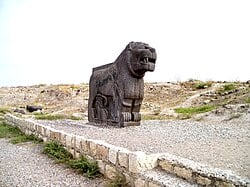
The world was similarly shocked, though, again, only briefly so, when ISIS barbarians partly destroyed Palmyra, the ancient trading center located in modern-day Syria, including the city’s major temples and tower tombs, and the beautiful and lovingly streamlined Lion of Al-Lāt, a First Century A.D. sculpture of a lion proudly sheltering a gazelle between its paws. The statue has since been refurbished and is temporarily on display in the National Museum of Damascus until it can be restored to its proper place in Palmyra.
This is both a victory and a defeat for the study of human history; it is a victory for those who prize the traces of the human past and yet, at the same time, this restoration and others like it create a cloud of forgetting around the nihilistic outrages that necessitate these restorations to begin with. This, in turn, leads us to recurring fits of temporary amnesia about the ever-present threat of violent fanaticism, at least until the next temple or civilization is destroyed.
One of the great heroes of modern archaeology is Khaled Al Asaad. He was the custodian and protector of Palmyra for his entire career, translated Aramaic texts and published scholarly works, and evacuated the Palmyra museum in advance of the ISIS takeover in 2015. The terrorists captured him shortly thereafter and tortured him for more than a month to force him to divulge the location of the hidden antiquities. He refused and was beheaded by an ISIS swordsman. According to the New York Times, his headless body was suspended by its wrists from a traffic light and then — in an obscene though probably unintentional parody of the Lion of Al-Lāt — his severed head was placed between his feet.
His sacrifice, which prevented the destruction of countless antiquities, should not be forgotten.
There are far too many other examples of the war of modern barbarity against ancient grace. Another beautiful sculpture of a lion, the giant basalt sculpture known as the Lion of Afrin, was stolen by Turkish-backed Syrian rebels in 2019 in the wake of Turkish bombings of the archaeological site of Ain Dara and its Hittite temple complex, built perhaps 1,000 years before the birth of Christ but largely obliterated in a matter of days. The lion’s fate is unknown. It was discovered only in 1955, so its existence in our modern era lasted less than the average lifespan of a human.
From a geopolitical perspective, the most significant modern attempt to erase history is the handiwork of the Palestinians, and its target is, of course, the Jews. Ekrima Sa’id Sabri, the Yasser Arafat-appointed Grand Mufti of Jerusalem from 1994 to 2006, stated in an interview published in the Jerusalem Post that “There are no historical artifacts that belong to the Jews on the Temple Mount,” and reiterated in a later interview that “The Temple Mount was never there…There is not one bit of proof to establish that. We do not recognize that the Jews have any right to the wall or to one inch of the sanctuary…Jews are greedy to control our mosque…If they ever try to, it will be the end of Israel.”
These rhetorical attempts to erase Jewish indigeneity have been accompanied by literal ones, not only in Jerusalem, but also in formerly Jewish communities throughout the Middle East. One of the most notorious examples was the Jordanian destruction of Jewish synagogues and cemeteries in Judea and Samaria when Jordan occupied that territory between 1948 and 1967. By some estimates, as many as 38,000 Jewish tombstones and grave markers were destroyed and, according to multiple reports, used as construction material for an Arab Legion training camp near Jericho — roads, buildings, even lavatories. This desecration, long rumored, was confirmed by Israeli soldiers when they reconquered Judea and Samaria in 1967, and explains why, when Israel pulled out of Gaza in 2005, Israeli soldiers and residents dug up their cemeteries and took them with them.
Between the ages of 14 and 18, I led a volunteer effort in my tiny settlement of Sinegorskiy, Russia, near the Ukrainian border, to protect a group of enigmatic Neolithic dolmen scattered around a nearby hamlet called Novyi. The dolmen, consisting of four immense vertical stones, front and back, topped with a fifth horizontal stone and resting upon a sixth ground slab — like crude huts for a race of departed giants — were so ancient that no one knows who created them, or what spiritual or practical purpose they served, though it is surmised that they had a funerary function. In modern-day Russia, their only “use” was as a canvas for obscene graffiti by the locals, as targets for paintball and pellet guns, as crude latrines and pissoirs, and as a challenge to local teenagers, who tried and failed to knock them over with their careening ATVs.
There wasn’t much else to do in Sinegorskiy, which was built as a leper colony during the Stalin era; practically everyone then or now was either a patient, or, like me, a worker or volunteer at the clinic. So in their spare time, the children of the clinic workers did their best to destroy the enigmatic structures, and I — all 108 pounds of me — stood guard in front of one dolmen or another in the evenings, and attempted to dissuade them. I did a bit of yelling at the swarming teens, and got a few beer cans thrown at my head in return, but mostly I was left alone to scrub the graffiti and piss stains off the stones.
It was an insignificant effort against drunken young men who were pests, rather than terrorists, and to the best of my knowledge, the dolmen remain standing to this day. But it was the beginning of my interest in ancient civilizations. I became fascinated by the question of what survived and what did not — whether artifact or city or civilization — and the universal human impulse to deface or erase what other human beings have created.
I was reminded of the ugly red and black slashes of Cyrillic graffiti not too long ago when I encountered photographs on social media of what had been done last year to a famous monument in Paris, created by Charles and Léopold Morice in 1883, called Monument à la République. Here, once more, was the identical spirit of bored and self-righteous destruction and defacement. The monument, built to honor Marianne, the personification of the French Republic, and incorporating sculpted symbols of the sacred French principles of Liberté, égalité and fraternité, had been defiled by protestors with the mis-shapen blood-red spray-painted slogans “ACAB” (“All Cops are Bastards”), “Free Rima,” (Rima Hassan, a Syrian-French politician who called the October 7 massacre “legitimate” and is, in fact, free) and, repeated obsessively in ugly scrawls, “Free Gaza” and “Free Palestine.” (There was no room, evidently, for any excoriations of France’s present-day crypto-colonialism in Africa.)
It must not be forgotten that the symbolic and actual degradation of “Liberty, Equality and Fraternity” will hurt the Jews first of all, and most of all, for as history has shown, it is only in free and democratic societies that recognize basic human rights, including the sacred rights of the individual, that Jewish life and worship is able to survive and thrive.
The monument has since been cleaned up and restored to its former immaculate appearance, but here again we encounter the same dilemma: When the broken fragments of a culture careening out of control are swept up and replaced too quickly, what remains to remind us of the madness that was responsible for the destruction?
But at least we have the photographs. My hope is that in decades hence, when we are again struck with the kind of hypocritical madness we have witnessed during the “Free Palestine” mania, and the movement behind it, murderous and mendacious, we will remember how far we teetered in the direction of anarchy, with all of the attendant worship of rapists, beheaders and other species of beasts. Apart from the horrifying images of October 7th and the subsequent war themselves, I hope this one image, of a violated Marianne, reminds us of what can go wrong in a society that has lost touch with what makes it great.
But it is far too soon to conclude that this madness will fade, because the scrawls, the graffiti and the vandalism continue to proliferate, perhaps to a greater degree now, during a shaky cease fire, than during the height of the Gaza War. Utility poles and kiosks throughout Europe and North America are covered with palimpsests, strata and scraps of handbills and posters advertising jihad and intifada, covering other posters saying much the same, and advertising year-old demonstrations calling for yet more intifada and jihad, and all these layers of hatred, in turn, are covered over by scrawls, swastikas and anti-Jewish slanders.
One would have to dig very deep indeed to find any of the original posters from the gloomy autumn of 2023 publicizing the plight of the hostages. At the same time, proud symbols of Jewish life in the diaspora, such as synagogues and community centers, are “greyed out,” made to appear inconspicuous, and hidden behind behind grim ranks of police officers and guards — when they’re not being firebombed.
And yet, seemingly all we hear about, day after day, everywhere in our culture, is related to the stubborn continuing existence of Jewishness, usually presented in a nefarious and libelous context. It is almost as if any traces of actual Jewish life have been covered up or obliterated, while an ubiquitous imaginary and purely symbolic “Jew,” designed to stand for everything the haters among us hate, takes its place. The actual living Jewish culture, heritage and ordinary daily existence has been replaced with a malign invented symbology.
The posters and scrawls, at least, are only temporary. Not so the physical damage done to the firebombed synagogues, and to the many magnificent edifices of higher education that have been damaged during the “pro”-Palestinian demonstrations and riots.
It is no coincidence that many such university buildings targeted by protestors were donated by Jewish philanthropists; as the founder of the Students Supporting Israel movement, Ilan Sinelnikov noted here, in the Blogs of The Times of Israel, “…some of the most iconic university buildings bear Jewish names — a testament to the generosity and deep commitment of Jewish donors to education, research, and progress. Yet, within these very walls, hatred toward Israel and the Jewish people is thriving. Universities that have benefited from Jewish philanthropy for decades have allowed their classrooms to become indoctrination centers, where anti-Israel propaganda is disguised as scholarship, and where Jewish students are increasingly marginalized, harassed, and silenced.”
Wealthy Jewish donors have in many cases responded by limiting or ceasing donations and demanding the removal of their names from prominent campus buildings whose supposed guardians, university administrators and security personnel, allowed antisemitic vandals to run rampant. While these defunding decisions are completely understandable, it is one more way in which the Jewish presence in our culture is being effaced.
Yesterday and today, much has been lost, and will continue to be lost, for lack of resoluteness, courage and fealty to our fading past. One of the greatest and most awe-inspiring of ancient structures, Pharaoh Ramesses II’s 13th Century Abu Simbel temple complex in Egypt, was gradually buried by sand dunes over the centuries, and is known to us today only because a Swiss explorer and writer, Johann Ludwig Burckhardt, investigated the still-visible remnants of the temple and discovered, purely by chance, a great face barely visible under the sand, leading in turn to the uncovering of the great rock sculptures of Ramesses and his wife Nefertari. Inattention is a factor, too, a lack of respect for the ravages of time and the amnesia that afflicts us all when we don’t strive mightily to preserve our religious and cultural legacies, destroys just as surely as the malignity of humans. Time is a vandal.
One wonders how many other temples are permanently entombed under even more massive sand dunes, for lack of other Johann Ludwig Burckhardts — who also, by the way, rediscovered Petra — and how many dozens of precious artifacts remain hidden away, stolen, or crumbling into dust for lack of other Khaled Al Asaads? I have no doubt that dozens of past civilizations, including once-thriving ancient metropolises, are as unknown to us today as the inhabitants of distant planets circling distant stars.
The same applies to the lost treasures of Judaism, of course, buried beneath the mosques of the Muslim conquerors, or destroyed, or, like the Mesha stele (testament to the existence of Israel 3,000 years ago), simply disregarded or denied. Will the same fate lay in wait for today’s great synagogues and cultural institutions that we take far too much for granted?
This is a question I think about often these days in connection with my studies of the ancient world, which will lead me, I hope, to a career in which, through translation of ancient texts, I can play my own minor role in uncovering, preserving and protecting the human past, and most particularly the Jewish past, against its enemies. Like the archaeologists I admire, my goal is to dig backwards, into the past, and against the currents of contemporary manias, to learn from the best and recognize the worst from our shared heritage.
A second question I often think about now, but one that never occurred to me at the time, is why on earth was a 14-old girl the one who protected and cleaned up the ancient dolmen, the only items of cultural significance in the backwater settlements of Novyi and nearby Sinegorskiy. Where were the adults?
There are a lot of terrorists, common vandals and complacent — or complicit — authority figures out there, and they vastly outnumber the protectors, the scholars, and the explorers — the adults, in other words. This is not a sustainable way of preserving our hard-won civilization, not even with brilliant stratagems such as the Jerusalem Temple Mount sifting project. (In which Israeli archaeologists, led by the late Gabriel Barkay, who were barred from excavating under the Temple Mount, cleverly undertook the close examination of hundreds of dump trucks of dirt from an illegal Muslim construction project and are, to this day, still finding ancient Jewish artifacts, more than a half million to date.)
But the sifting project, brilliant as it is, is ultimately only a workaround, one that is necessitated as a result of Muslim religious objections and political and practical obstacles. It is hard enough to preserve the past when these obstacles are merely legalistic or bureaucratic. It’s even harder when the vandals are self-righteous and convinced of the absolute goodness and virtue of their cause, and there are vanishingly few real adults remaining to stand in their way.
The fanatics who dynamited the Bamiyan Buddhas, and the hordes who partially obliterated Palmyra — essentially no different in kind if not in degree from the vandals of our contemporary monuments, synagogues and cultural institutions — genuinely were convinced that they too, after all, were “on the right side of history.” They are not, and they must be resisted — and their massive sand dunes of lies and libels must be obliterated — just as resolutely as the terrorists who have been firing rockets and drones at Israeli communities for decades.