
POST-HARMONY Special Project
June Birthdays. Reflections on Love and Humanity
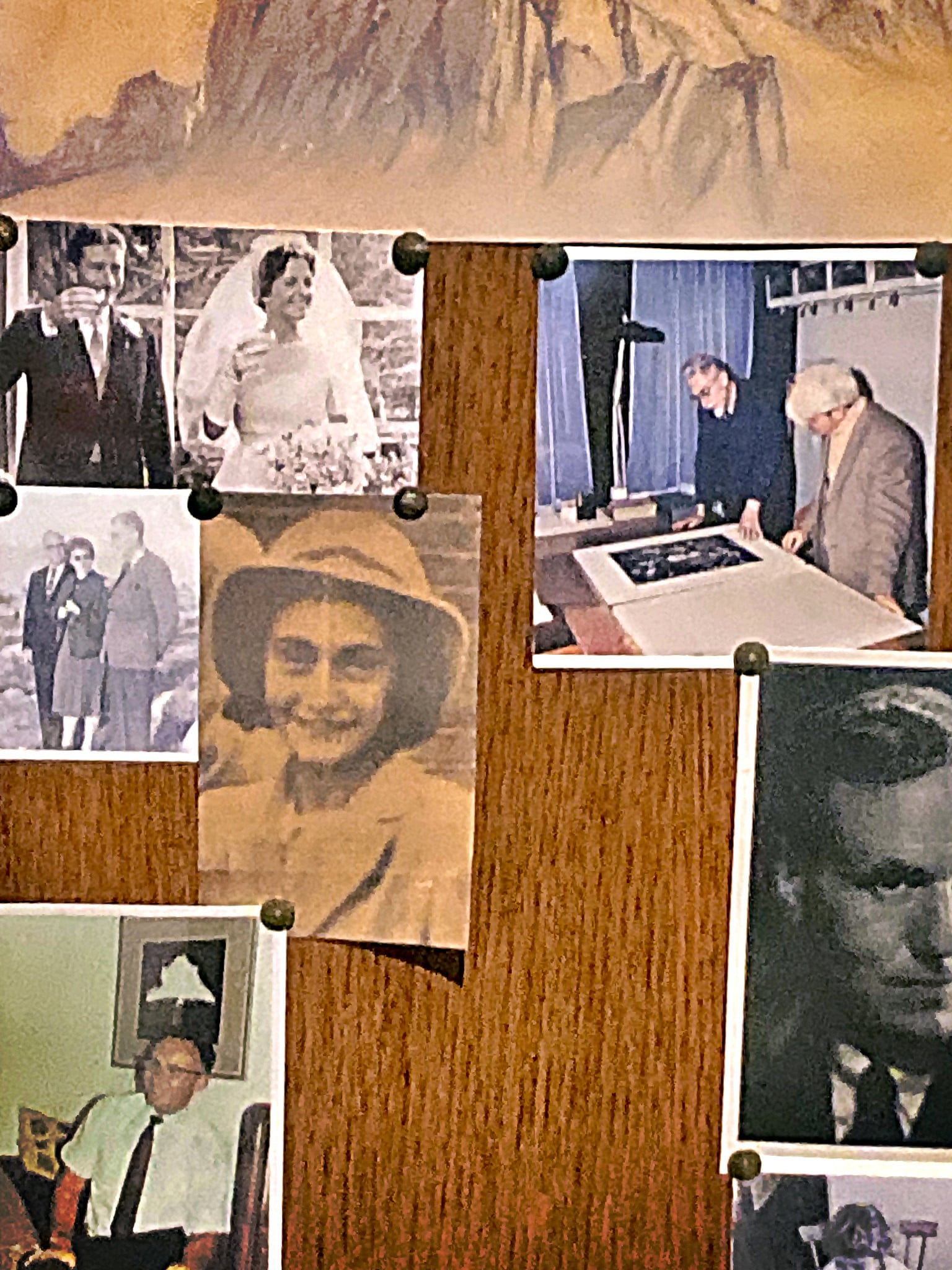
Anne Frank's photo at the M.C.Escher studio. (C) Inna Rogatchi
M.C. ESCHER and ANNE FRANK: Untold Story
June Birthdays
June has some special birthdays, including Anne Frank’s one, on June 12th. We think about it in an emphasized way because as it happened, eighty three years ago, a Jewish girl in the family that moved from Germany to Amsterdam in the run for safety, choose herself as one of the present for her forthcoming 13th birthday a nice looking red and white checkered scrapping book, which in just five years would become known to the world, with the girl died two years previously, along with her sister, in the most terrible, inhuman circumstances in Bergen-Belsen.
But back to 1942, young Anne, just before her 13th birthday, celebrated with the family in relatively normal circumstances, did cherish that red and white checkered book mostly of all her birthday presents. She had the reason for that. Anne dreamed of becoming a writer. I think she was rather confident that she would become one. She loved her new diary. She started to write there immediately. In less than two months, Frank’s family along with four more people went to that hiding place behind the book shelves where they spent more than two years and from where they were betrayed, and sent to death.
I will always remember as Simon Wiesenthal, with whom I and my husband were blessed to be friendly with for many years, told us how incredibly highly he held Anne’s diary. Simon had a very powerful mind, sharp as a razor. He was an engineer and architect, and his mind was of an exceptional quality. In the case of Anne Frank’s diary, he was emotional. Not only he took it very close to his heart, but he exalted this phenomenon as one of the most meaningful matters of remembrance and reminding of the terror of the Shoah. If only the world had a sincere interest towards that nice looking red and white checkered book, and what is behind it. As it happened, the essence of the phenomena reflected by the talented teenage Jewish girl did not disappear from life after the end of the Second World War. We know about it now. Simon Wiesenthal and M.C. Escher knew it always.
My mom’s birthday is also in June, just two days before Anne. My mom, who was three years younger than Anne, looked quite similar to her. I was always thinking about it. My mom survived the Holocaust, but many of her and my relatives did not, including my great-aunt Mina, after whom I was named, who was murdered alone with several other close family members in October 1941, being just 18.
Mom, Anna Pinsky-Chigrinsky-Bujanover, was a legendary teacher. She revered Anne Frank’s diary, and passed her deep and ever present empathy to Anne and everything that Jewish children of that generation and their families went through the Holocaust to myriads of her pupils. A tiny book , with grey cover and red title on it, was always in the front of heavily overcrowded bookshelves in our home. I grew up with it.
Two more birthdays happened in June, of the great artist and an exceptional man Maurits Cornelius Escher, on June 17th, and , on June 6th, the birthday of his Jewish teacher Samuel Jeshurun de Mesquita, whom he loved dearly, and whose awful murder, along with Mesquite’s wife and their only son, was harrowing Escher for the rest of his life.
Family and Beginning of Artistry Connection
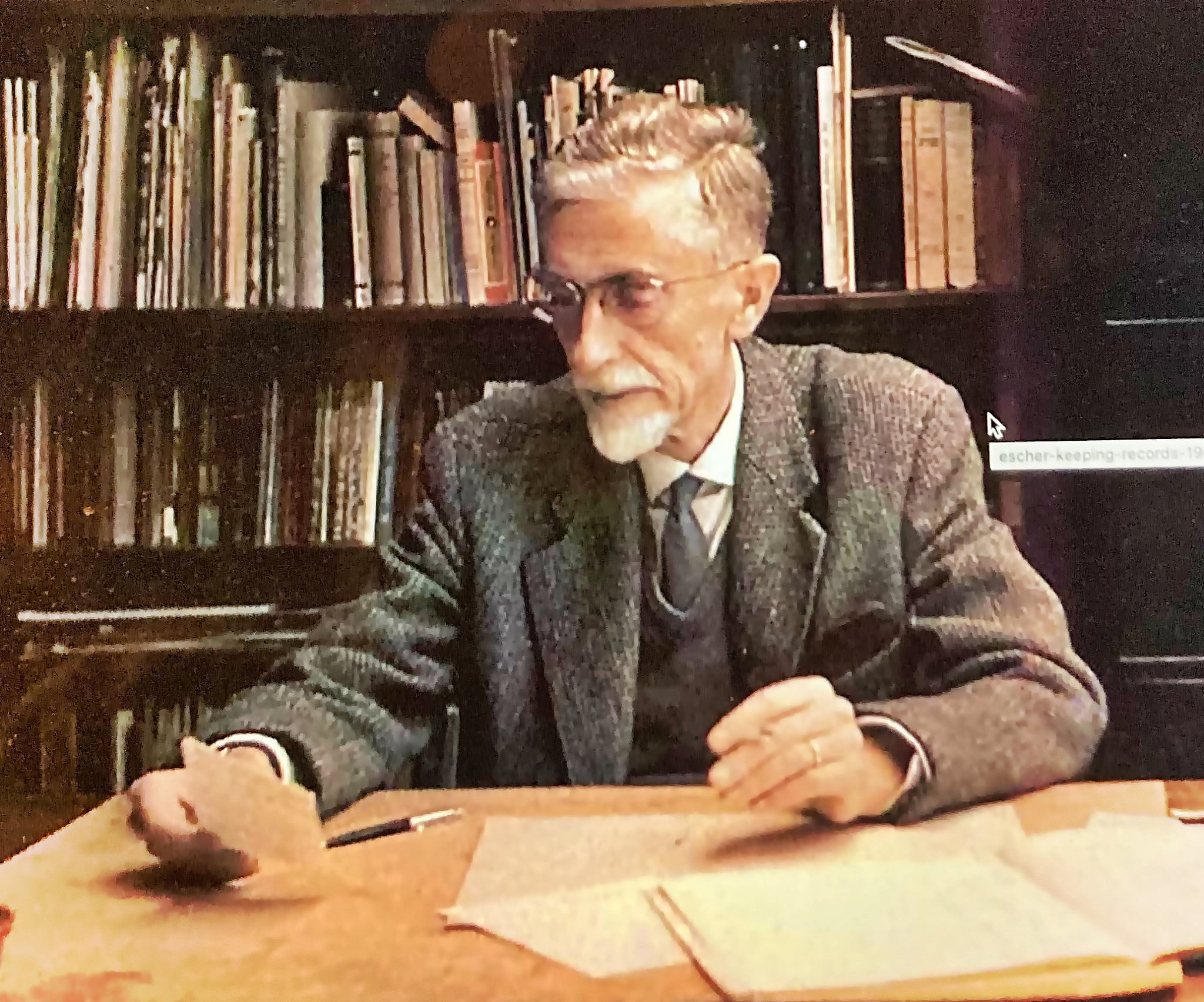
Great Maurits Cornelius Escher’s mother, Sara Gleichman was Jewish. Although Escher was brought up in a Christian faith, his attitude towards Jewishness was always decent, deep and dignified. It was an essential inner part of himself that he always bore with love and devotion.
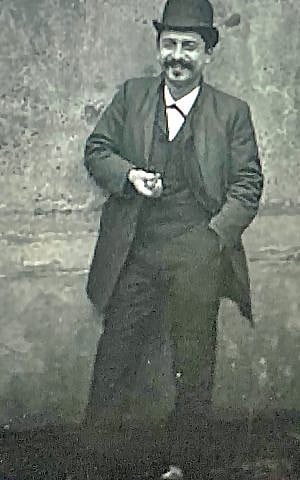
His beloved teacher, a very good artist Samuel Jeshurun de Mesquita, also was Jewish. Escher learned a lot from his teacher, the unique vision and the ever intellectually questing approach, which was with him all his life.
Escher’s mom died a few months after the Nazi occupation of the Netherlands. The artist, who lived in Switzerland at the time, was not able to attend her funeral, which haunted him for the rest of his life.
His beloved teacher, who was 76 at the time, was arrested by the Nazis in Amsterdam along with his elderly wife and only son, all of them being sent to the Nazi camps, parents to Auschwitz, son to Theresienstadt. The elderly artist and his wife were gassed upon arrival, the son died just two months later.
Noble Stand
Maurits Cornelius Escher’s stand during the Nazi reign in the Netherlands was exemplary. He very firmly distanced himself from everything and anything that would be any way of collaboration, acceptance, or agreeing with the Nazis. His stand was defined and strong. He never waived from it, not for an inch.
He was a very decent person, good son and devoted pupil. It all was not easy to project at the time. To our complete disbelief, nowadays, we can see what such a stand of decent people was, and we are seeing in a daily motion what it takes, very graphically, again. We are crossing the pattern which was overwhelming 80 years ago, in Europe, during the nasty, racist, and genocidal world war. But today, it is global and hysterical. The attitude towards the Jews anywhere and everywhere by too many people, institutions, and parts of society has become openly hateful – with intentionally massively perverted cause and reason ratio and narrative, all of it disgustingly unfair.
Post-War Never Seizing Pain
M.C.Escher was the one who saved his teacher’s important collection of works and arranged its acceptance and preservation at the Stedelijk Museum in Amsterdam immediately after the war. Thanks to him, the legacy of a highly talented Jewish master who was murdered with his family so barbarically, lives on. For himself, Maurits Cornelius kept just one drawing of his beloved teacher, the imprint of a German boot. That imprint Escher kept with him till the rest of his life.
He took the story of Anne Frank very close to his heart, keeping a small photo of her very near to him in his study for the rest of his life. At very important, largest to date, M.C. Escher exhibition at the Casa di Bonaparte in Rome in 2023- 2024, the artist’s study was fully reconstructed and installed in an authentic detail. On his cupboard, which was standing just less than a couple of meters from his working desk, Maurits Cornelius kept the images which were the most important for him. Photos of the family, his sons, his wife, his parents, his teacher, his son’s children drawings, a couple of black and white photos of fragments of the Renaissance artworks, both Madonnas with Child, large colored view of his beloved southern Italy, a shoreline near Amalfi (he met his wife in Ravello which always had a special mark for him), all together about thirty images. There was just one photo of a non-family member, a lovely smiling Anne Frank with a hat. Pinned on his cupboard’s door, Anne was always very near to the artist, literally on a distance of a stretched hand. A very telling detail.
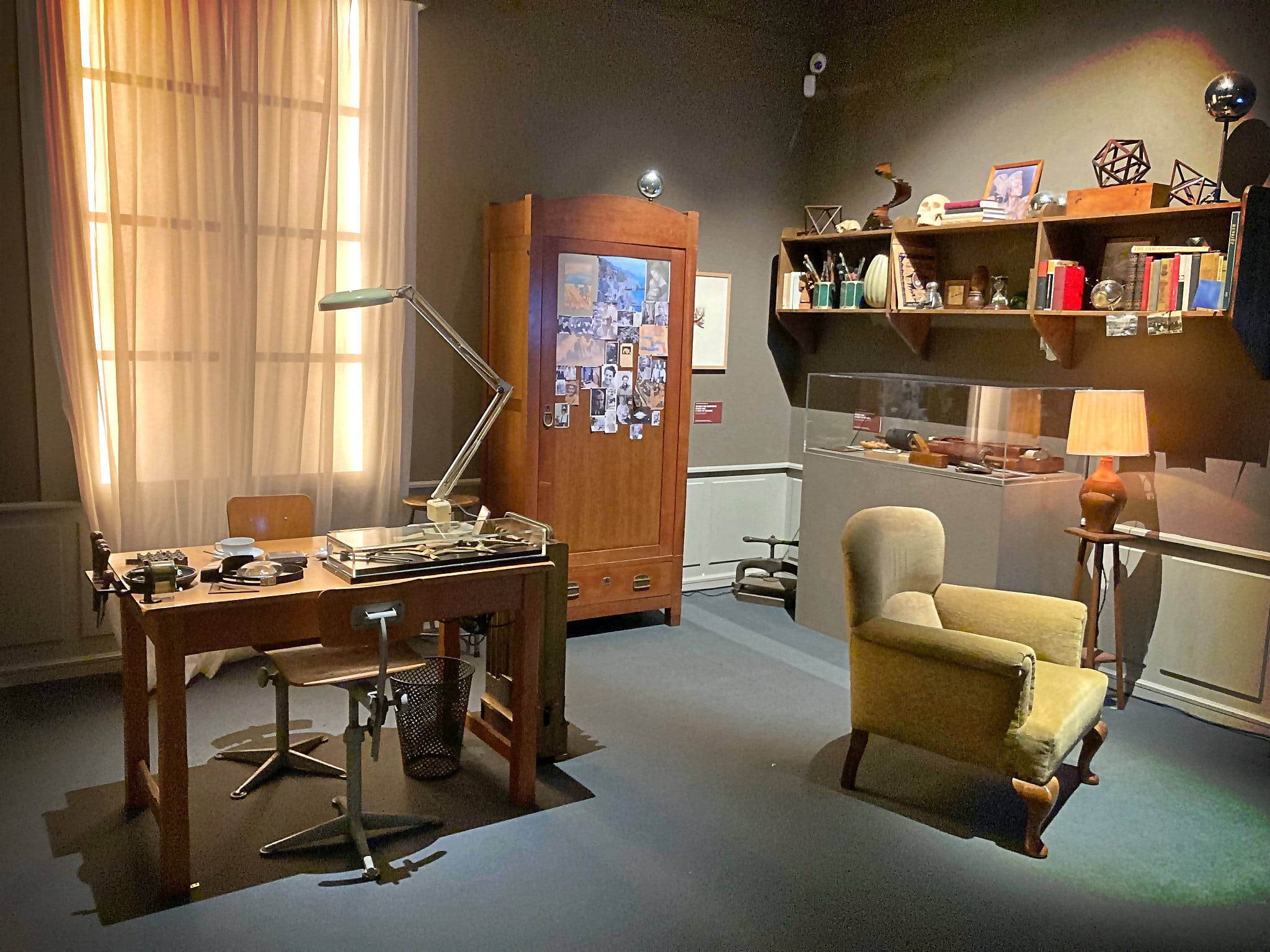
It was a huge and extremely elaborated exhibition of M.C. Escher works in Rome. Somehow, we were coming back to that installation of his reconstructed study several times, because of Anne smiling at him working, till the rest of his life. Heart-rendering experience. Doubly so, as M.C. Escher never elaborated a thing about all this.
M.C. Escher kept the smile of that girl very close to him in his working study for the rest of his life, with a fundamental reason, for him and for us.
Speaking Dandelions, Then and Now
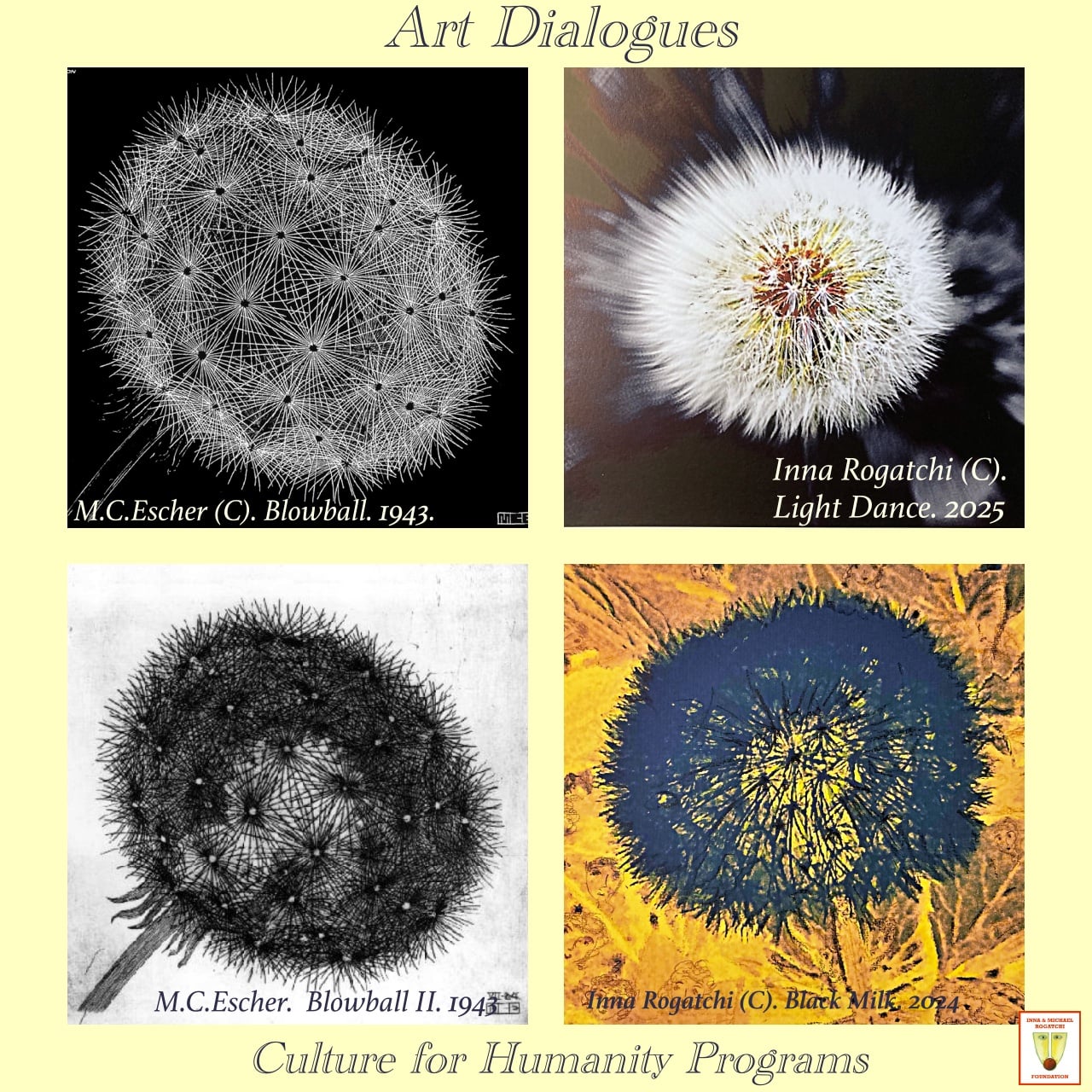
In 1943, Maurits Cornelius Escher created two telling works. The monologues of sorrow, powerful and quite articulated songs of tragedy that life has become under the Nazis. The first work, a negative-like portrait of a dandelion ( exploring the emphatically sharp contrast between the most gentle and almost ephemeral of flowers with the metaphor of the ultimate catastrophe that life has become in the 1940s) , the artist named Blowball.
The second one in which the dandelion, usually so very white, has been turned by the master into the black statement of the tragedy, was initially named by M.C. Escher simply ‘1943’, so very justly. Later on, the title Blowball II. 1943. was added, most likely, for more conventionality among the wide public, as people might mistook the name of the work as the date of its making. Interestingly enough, while the first Blowball with its flower in white is very widely known, and have been exhibited and reproduced all the time, the black one is publicized far less so. Perhaps, it is not easy for many to enjoy such openly tragic art statements.
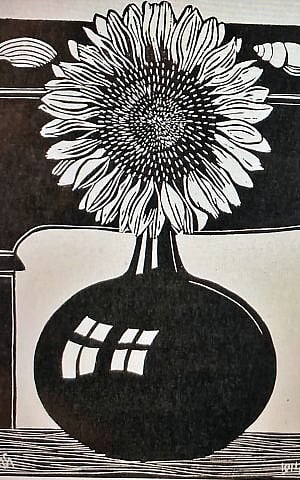
What is also meaningful in Escher’s motivations behind his important works, is his always-present bond with his teacher. The idea of a close-range single flower depiction traces back to Samuel Jeshurun de Messquita’s strong and beautiful Zonnebloem, Sunflower, created in 1914.
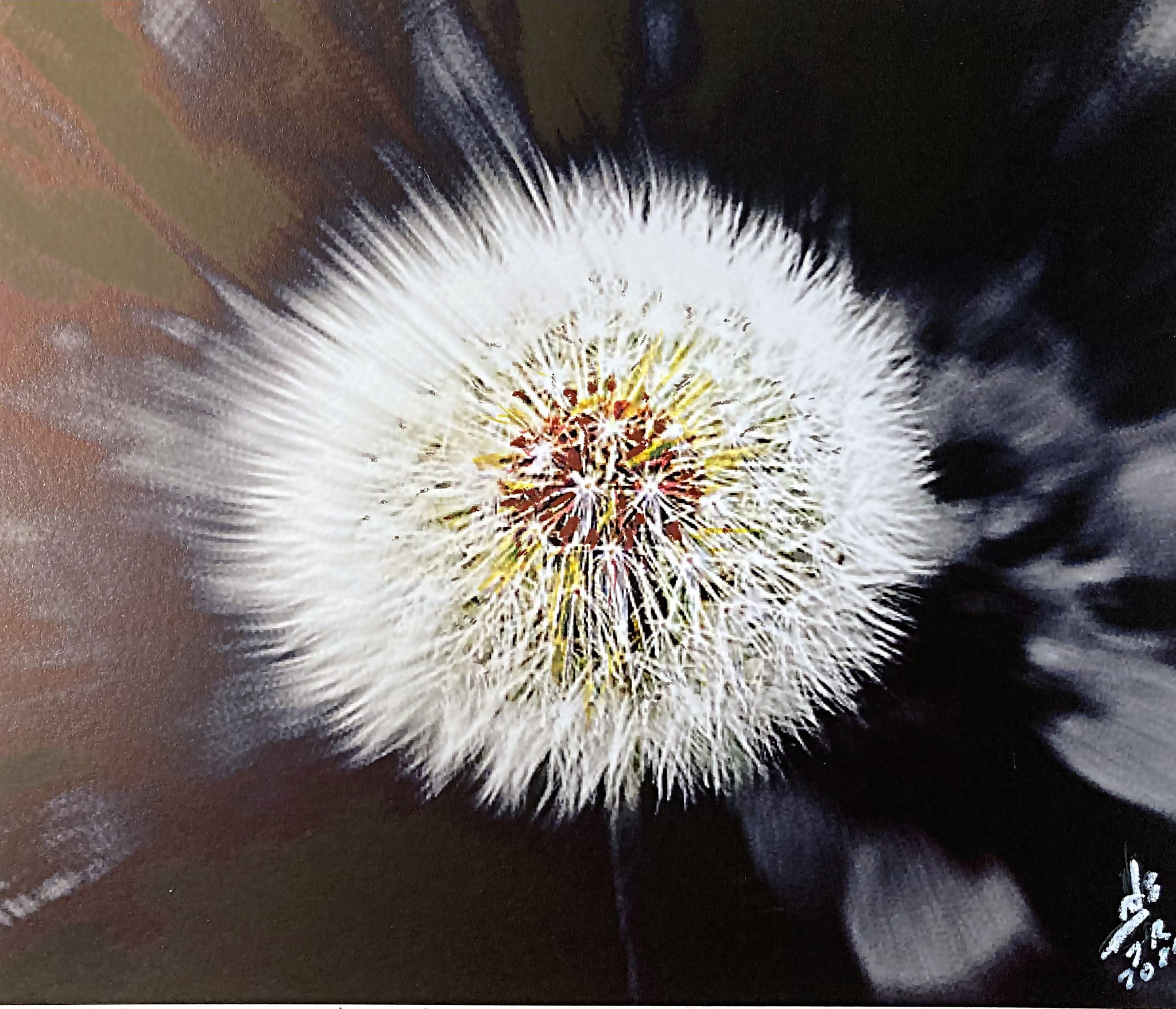
Many decades on, I started to work with a dandelion images in many of her works in different collections and genres, from conventional yellow ones in her artistic homages to Henri Matisse ( belonging to a notable European private collection in Vienna), to converting various dandelions into an array of colors, even to red, in special Dances in Color collection ( belonging to a private collection in Brussels). But the striking white appeal of a dandelion before its disappearance was my first dandelion art work in black and white version in the year 2020 ( exhibited internationally later on, including representative international exhibitions in Budapest and Barcelona).
While working on my Songs of Our Souls ongoing collections of a dramatic works which are the songs of memory to Jewish people in a different periods of our history, in 2024, I created the Black Milk artwork which was exhibited in Helsinki at the special exhibition commemorating the October 7th tragedy in the Autumn 2024.
Some time later, in 2025, a new version of super-white dandelion was created, Light Dance. This works states the will for overcoming, it emphasizes the strength of life and light in dispersing the darkness. It is my homage to a brave and talented Jewish girl, Anne Frank. The work belongs to a notable European private art collection.
Telling Eyes
M.C. Escher never discussed his family, and his personal trauma caused by the Second World War and the Holocaust. People of his generation mostly did not. We are experiencing a fraction of it in the current wave of insane antisemitism world-wide today, and we know that the last thing one wishes is to discuss this dirt and aggressive irrational negation.
Just after the end of the war, Escher created a very telling work, called simply, Eye, 1946. There is a well-known serious, sometimes huge difference between the artworks in real life and their reproduced images. When I saw M.C. Escher’s Eye. 1946 live, and I did it several times, its warmth and immense sadness has moved me deeply. This is one of the most ‘speaking’ works of the great artist, to me. I almost hear his voice coming out of it. No wonder. The eye portrayed on that mid-size piece of art paper is Maurits Cornelius’ own eye, and it is done with a rare intimacy of the highest order. The skull which replaces the pupil of the eye can be mentioned as a self-portrait of the thoughts of the WWII generation, among those people who survived, especially those from Jewish or partially Jewish families. That skull has never left their pupils. How could it?
The work is well-known, being one of the central images of M.C.Escher that has reached the wide public. Amazingly, but nobody ever made a direct connection between the year in which the artist has created his eye with its questioning and answering at the same time pupil-skull, with the time of its creation, just after the catastrophe which whipped away his mother, his teacher, his friends and acquaintances, Anne Frank, and so many others.
The artist himself was rigorously protective of his inner world. He was always dismissing any interpretations of his works, emphatically so. He just did not want the intrusion into his living post-Holocaust trauma. Which is completely understandable. But now we know the real meaning of the great Eye by M.C. Escher, created in 1946.
Almost a half of century after the creation of the Escher’s Eye, in 1993 Michael Rogatchi created his. The title of the work is Psalm 22, and it opened Michael’s well-known Psalms Country series over 30 years ago. During those over three decades, more works interpreting more psalms have been created by the artist. The series is ongoing. Thirty years ago, Michael had no reason for despair, the diagnosis which actually Escher’s Eye is. But there were many questions that bothered the artist, and which all were accumulated into that question mark replacing pupil in Michael’s work.
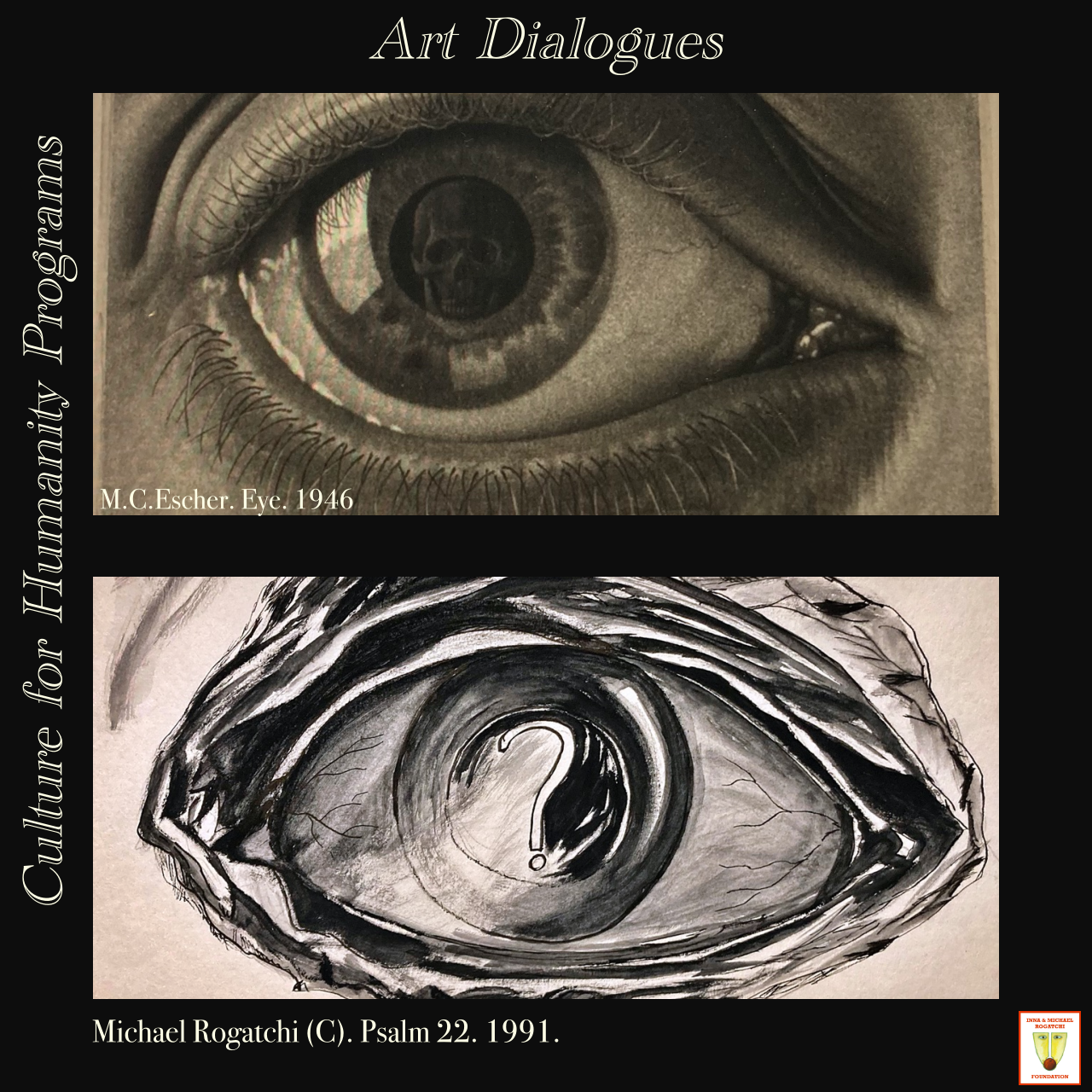
This work was also presented at the special exhibition in Helsinki in Autumn 2024 commemorating the first anniversary of the nightmare of October 7th. Ongoing nightmare, with so many standing questions popping more and more into our life today. Many visitors at the exhibition spent a lot of time looking at that picture in particular. It resonated with so many of us today. With all our pain translated into that question-mark pupil.

What is truly amazing is that more than eighty years on, artists are getting in a vivid and articulated dialogue, seeing the world around them even in similar images, and responding to the similar tendencies in the societies, as if there was not a single lesson after the nightmare of Nazism ever taken. But as long as we are continuing to bring the pained essentialities of life into the images which are speaking to many, we are actively conscious not to accept the breaks of darkness upon human beings, nor are we supporting irrational hate in any of its ugly grimaces, nor the animalistic nature that prompts it. Far from it.
With love to great Maurits Cornelius Escher, his mother and his teacher, and the girl in the charming hat , smiling on that photograph on the great master and noble man’s cupboard, in the month of their all’ birthdays, in loving memory of them all.
June 17, 2025.
Part of ART DIALOGUES. CULTURE FOR HUMANITY SPECIAL CULTURAL EDUCATIONAL PROJECT (C). The Rogatchi Foundation.
Related Topics