
Ki Tetze – Boaz: When Kindness Respects Dignity
This is a difficult parashah. Parashat Ki Tetze contains some of the Torah’s most challenging subjects: the woman captured in war, the unloved wife, the wayward and rebellious son, and the laws of yibum. These are halachic responses to complicated human circumstances, and some of them make hard reading for a modern audience. They deal not with life at its best, but with life at its most difficult and painful.
There is another side to these laws: the way they are lived. In this week’s role model, Boaz, we see a man confronting one of these situations with dignity, restraint, and chesed. That, perhaps, is the lesson Ki Tetze wants us to remember. The law matters, but so does the manner in which it is carried out.
The laws of yibum take me to one of my favourite books in Tanach, Megillat Rut. I have learned a great deal about Ruth over the years, but this time I found myself looking more closely at Boaz. And in him I found some beautiful lessons, both for understanding this week’s parashah and for navigating life itself.
Boaz was a man of wealth, influence, and considerable power. Yet the defining feature of his leadership was not authority but chesed. Megillat Rut presents a man whose kindness was almost institutional, woven into the way he ran his fields, treated his workers, and cared for the vulnerable.
More importantly, when confronted with Ruth’s vulnerability and Naomi’s loss, Boaz acted with extraordinary dignity and restraint. He fulfilled obligations, but he never lost sight of the people behind them.
In many ways, Boaz represents the human face of the laws found in Ki Tetze. The Torah gives us legal frameworks for navigating difficult situations. Boaz reminds us how those frameworks are meant to be lived. Because the Torah asks not only whether we fulfil our obligations, but how we treat the human being standing inside them.
This week’s parashah gives us the law of yibum:
כי ישבו אחים יחדו ומת אחד מהם ובן אין לו לא תהיה אשת המת החוצה לאיש זר יבמה יבא עליה ולקחה לו לאשה ויבמה
“When brothers dwell together and one of them dies and leaves no offspring, the wife of the deceased shall not be married outside to a stranger. Her husband’s brother shall unite with her: he shall take her as his wife and perform the levir’s duty.” (Devarim 25:5)
It is a strange law to modern ears, and the Torah knows it. The very next verses describe what happens when the brother refuses: the public ceremony of chalitzah, the removed sandal, the spit, and the shame.
But beneath the mechanics sits one of the Torah’s deepest commitments: no one is allowed to disappear.
A man dies childless and the Torah refuses to let his name be blotted out. A widow is left vulnerable and the Torah refuses to let her simply disappear into the cracks of society.
The law of yibum is, in part, the Torah legislating against oblivion.
And that is why Boaz belongs in this discussion. Because the greatest biblical story associated with this idea is not found in Devarim at all. It is found in Megillat Rut.
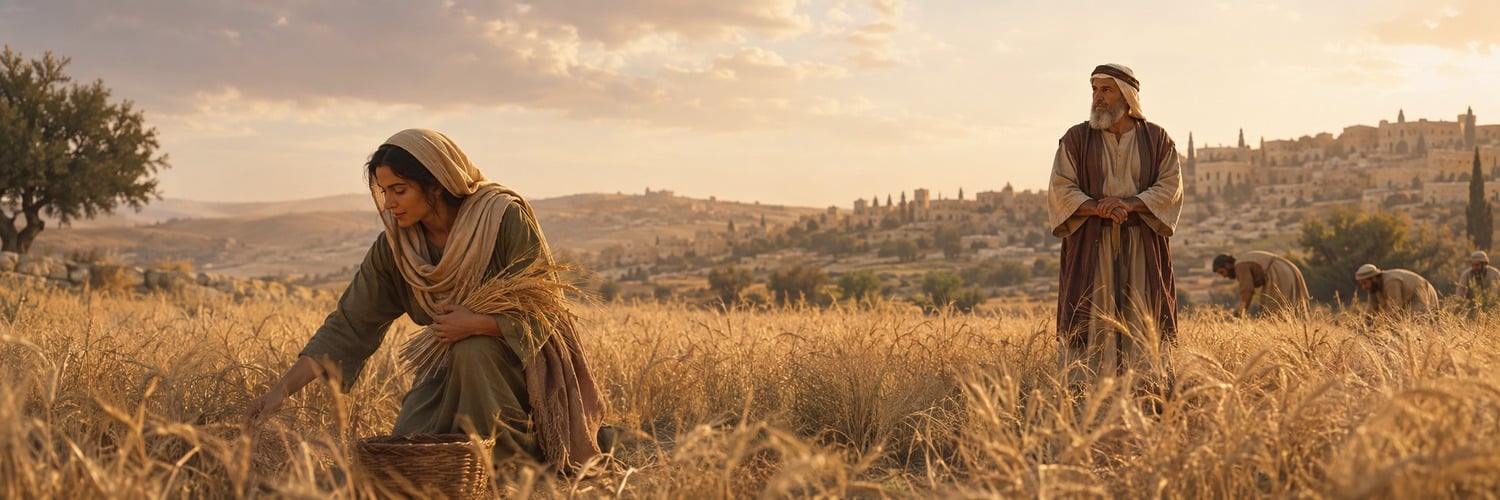
Boaz is introduced as an ish gibor chayil, a man of standing, and everything we see confirms it. He greets his workers with God’s name. He notices the foreign woman gleaning at the edge of his field and asks who she is. He knows her story: what she has done for Naomi, what she left behind, what she has risked.
He tells his workers to protect her. He instructs them to leave grain for her. He invites her to drink from their water. He feeds her at his own table.
This is not dramatic kindness. It is better than dramatic kindness. It is institutional kindness.
Boaz has built generosity into the way he runs his world. The poor are not an interruption to his success; they are part of his responsibility.
Yet none of this legally obligated him to go further.
Boaz was not the brother of Ruth’s deceased husband. The strict Torah law of yibum did not apply to him. Megillat Rut instead speaks repeatedly of geulah, redemption through the extended family.
Ramban, commenting on Bereishit 38:8, makes the connection explicit. He explains that the idea underlying yibum was once extended by the sages of earlier generations to other relatives who would inherit the deceased, where no prohibited relationship existed. They called this wider practice geulah, and Ramban specifically identifies Boaz as an example.
Boaz therefore stood within that wider circle of responsibility.
Close enough to act. Not close enough to be forced.
And that makes what follows so remarkable.
Boaz sees Ruth’s greatness long before the threshing floor. He praises her openly:
“It has been fully told to me all that you have done for your mother-in-law.”
He blesses her. Protects her. Supports her.
But he does not initiate the redemption.
At first glance, this seems surprising. If Boaz is as righteous as the Megillah portrays him, why wait?
The honest answer is that we do not know.
The Megillah never tells us why Boaz had not acted earlier. There was also a nearer redeemer whose rights had to be addressed, and Boaz may simply have refused to presume that Ruth wanted him to take this step.
But perhaps that uncertainty itself allows us to notice something important about the sequence of the story.
Ruth asks. Boaz responds.
And perhaps there is a profound lesson in that.
Not every problem should be solved by the strongest person in the room. Not every act of help should begin as an act of power.
Ruth has already demonstrated extraordinary courage. She left her homeland. She buried her husband. She chose Naomi, her people, and her God. She crossed boundaries of nation, family, and future through her own free will.
And at the crucial moment, the Megillah allows Ruth to speak for herself.
She comes to the threshing floor and says:
“Spread your wing over your handmaid, for you are a redeemer.”
She is not simply rescued.
She asks for redemption.
And once she does, Boaz moves immediately.
He goes to the city gate. He confronts the legal obstacle directly. The nearer redeemer declines. The elders witness and bless the arrangement.
And here we see another remarkable quality in Boaz: once it is time to act, he acts decisively.
Ruth 4:2 tells us:
וַיִּקַּ֞ח עֲשָׂרָ֧ה אֲנָשִׁ֛ים מִזִּקְנֵ֥י הָעִ֖יר וַיֹּ֣אמֶר שְׁבוּ־פֹ֑ה וַיֵּשֵֽׁבוּ׃
“Then [Boaz] took ten elders of the town and said, ‘Be seated here’; and they sat down.”
There is something wonderfully efficient about the verse. Boaz needs ten elders. He gathers ten elders. He tells them to sit. They sit. He understands what needs to be done and simply gets on with it.
But the Malbim sees something much deeper in the timing.
He explains that Boaz gathered the ten men before the question of Ruth’s eligibility became personally relevant to him. Chazal understood that Boaz taught before them the halachic principle of “an Ammonite, but not an Ammonitess; a Moabite, but not a Moabitess.” The Malbim explains that when a Torah scholar gives a ruling before a matter affects him personally, his ruling can be accepted. Once he has a personal interest in the outcome, however, his position becomes more problematic.
So Boaz acts now.
At this moment, the right of redemption still belongs to the nearer redeemer. Boaz does not yet know that Ruth will become his wife. He therefore resolves the halachic question before he can be accused of resolving it in his own favour.
The Malbim adds another beautiful detail. The ten men would also be required for the wedding blessings, and Boaz wanted them ready so that, if the path opened, the marriage could proceed immediately.
This is a man who understands both restraint and action.
He does not manipulate the process to reach the outcome he wants. He makes sure the law is settled while he is still personally outside the outcome.
But once the path is legitimately open, he is ready.
That does not prove that Boaz had deliberately been waiting for Ruth to ask. The text does not tell us that, and neither does the Malbim.
But it does reveal something striking about his character.
Boaz has considerable power, yet he seems deeply conscious of when that power should and should not be used.
And then comes the point that, for me, sits at the heart of the story:
When Ruth speaks, Boaz listens.
He does not dismiss her request. He does not exploit her vulnerability. He does not turn her dependence into his power. He hears what she wants, respects it, and then uses his strength to help make it possible.
That may be one of the Torah’s deepest lessons about chesed.
Most of us understand generosity. We know how to give money, offer help, express sympathy, and provide support.
What is harder is knowing how to help without taking over.
I find this lesson particularly challenging.
By temperament, I like solving problems quickly. When I see a need, my instinct is to step in, take charge, and move things forward. There is often value in that approach. Sometimes people genuinely need someone else to act.
But Boaz reminds me that not every act of kindness should begin with taking control.
Sometimes the greater kindness is patience. Sometimes it is listening. Sometimes it is creating space for another person to make the decision, take the initiative, or claim the dignity that comes from shaping their own future.
Having the power to act does not always mean that acting first is the right thing to do.
Perhaps this is also why Boaz belongs so naturally to Parashat Ki Tetze.
The parashah is filled with difficult human situations: the captive woman, the unloved wife, the wayward and rebellious son, and the widow awaiting redemption. The Torah legislates these cases because life is messy and people are vulnerable.
But running through these laws is an insistence that even in difficult circumstances, the human being must remain visible. The captive woman is given time to mourn. The vulnerable are protected. The widow is not simply forgotten. Human dignity remains present within the legal framework.
Boaz embodies that ideal.
His greatness lies not simply in fulfilling an obligation, but in seeing the person before him.
In an age that can easily confuse helping with controlling, Boaz models a rarer virtue. He shows us that genuine chesed does not merely ask, “What can I do for you?”
It also asks, “What do you want me to do?”
I had not given Boaz nearly as much thought as Ruth before writing this piece. Like many readers, I was drawn to her courage, her loyalty, and her extraordinary journey.
Looking more closely, however, I found myself increasingly impressed by the man standing alongside her.
Boaz’s greatness was not simply that he was willing and able to act. It was that he understood there is a time to wait, a time to listen, and a time to act decisively.
When Ruth spoke, he listened.
Sometimes, the highest form of chesed begins precisely there.