President, Kam Global Strategies
Kristallnacht: My family came home to an empty house
(Courtesy)
Two kitchen cupboards. One table. Six chairs. A bench. A lamp.
This is the start of a list in German that my great-aunt wrote after she made Aliyah. She was Rosa and Abraham Hacker’s daughter, and the list describes her parents’ kitchen in Dortmund. She wrote it in Tel Aviv in 1957, as part of a claim for reparations from Germany, and she put a price on that kitchen: 4,000 Reichsmarks. Cooking pots. Roasting pans. Curtains. Linens. Silver cutlery. Dinner services for 24 people. And separate dishes and utensils as they were kosher.
Their story, however, starts before the broken glass of Kristallnacht.
In late October 1938, Rosa and Abraham were expelled from Germany in the “Polenaktion,” the mass deportation of Jews with Polish citizenship. About 17,000 people were driven out, many of whom had lived in Germany for decades.
In Dortmund, the Gestapo began arresting Jewish residents at home on the evening of October 27. Around 600 men, women, and children were taken, and about half had been born in the city. The next day a train took them to Zbąszyń, on the Polish border.
The target was their citizenship. They held Polish passports, not German ones. Poland had introduced restrictions that could keep them from returning, and the Nazi government rushed to expel them before those restrictions took effect. These families were stuck between one country pushing them out and another refusing to let them in.
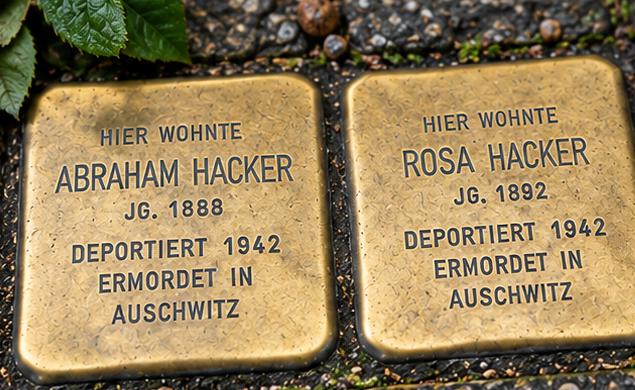
Rosa and Abraham were expelled on October 28–29 and held in Zbąszyń. Eventually, somehow, they got back to their apartment at Leopoldstraße 54, an apartment my survivor mother fondly remembers. By then, their home had been plundered during Kristallnacht, on November 9. Their belongings were stolen or destroyed.
Imagine, my family returned to their home and found a looted space, their belongings, amassed over 40 years, destroyed or simply vanished.
When I read the list, I think, my great-grandmother chose those dishes and the furnishings. The services for 24 tell me this was a home where family and guests were always welcome. The separate utensils tell me they were Jews who followed our traditions.
Then they were forced out, and while they were gone, their home was destroyed.
The anniversary of Kristallnacht, the pogrom of November 9–10, 1938, is here. Their story reminds me how much had already been done to Jews before that night. First the expulsion, then the looting. Each step took them closer to calamity.
When we say Kristallnacht, the “Night of Broken Glass,” most of us picture smashed shop windows and burning synagogues. My family’s story takes me inside a home.
Rosa and Abraham did not survive. After their return, they were forced into a ghetto on Dortmund’s Parsevalstraße, where Rose died on December 2, 1941. Abraham was deported to Theresienstadt on July 30, 1942, and died there on April 19, 1943. Both were in their seventies.
Almost 20 years after Kristallnacht, one of their daughters sat down in Tel Aviv and listed her parents’ kitchen item by item, then put a number on it. Germany had emptied that home, and now she had to prove to the German authorities what had been in it in order to receive some kind of measly compensation.
The details matter. The three pages of lists about the entire contents of the household prove that my family’s home existed, not just that a random Jewish family with six children once lived there.
They also remind me that the German people did this. Germans carried away what belonged to Rosa and Abraham. Probably some of their neighbors were perpetrators, not just Nazi authorities, and if not them, they likely looked away.
These next days I will be thinking about my great-grandparents Rosa and Abraham, expelled from Germany and coming home to find their house desecrated, in ruins.
And I will be thinking about everything a list of stolen possessions can and cannot ever tell us about lives destroyed by virulent antisemitic hatred just 88 years ago.
Related Topics
Related Posts