

Marc Weitzmann Interview | Alexandre Gilbert #309
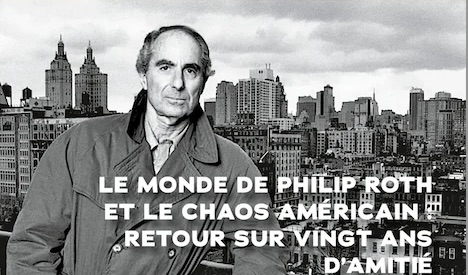
Marc Weitzmann won the 2025 Femina Essay Prize for La Part sauvage, a reflection on his friendship with Philip Roth and on the shifting landscape of the United States.
On France Inter, you described yourself as brushing up against delinquency, drawn to conflict, and seeing cruelty as salvational, concluding that you were arrogant and socially handicapped. One conflict involved your father’s cousin Serge Doubrovsky. With many new novels labeled autofiction, it seems the debate favors Doubrovsky. Do you agree?
Marc Weitzmann: Autofiction has largely run its course, but I don’t see it as involving such direct self-confrontation. What I said in the France Inter interview with Eva Bester wasn’t harsh—neither praise nor criticism, just a statement. When I say cruelty could be salvational, that’s exactly what I mean. The “inner delinquency” I describe at the start of the book can be destructive, but it also has a constructive side.
Years ago, I wrote a novel, Le Chaos, and realized I was really writing about my family. I then read Doubrovsky, whom I hadn’t encountered before, and found we fundamentally disagreed about the family—especially my grandfather, whom he viewed positively, while I was ambivalent. I structured the novel as an ironic fiction on the idea of autofiction: the plot is invented, but the names—including mine—are real. He reacted badly, and our relationship became strained. More broadly, my family relationships were complicated at the time, which inspired the book.
I’ve never been especially interested in autofiction and am unsure what the term truly means. It feels largely academic. For instance, I doubt Carrère would label himself an autofiction writer. Writing about oneself doesn’t automatically make it autofiction—by that logic, Montaigne, Dante, or Proust would qualify. Today, the term has largely become a marketing tool.
You anticipated Renaud Camus, when many dismissed him as marginal.
Marc Weitzmann: I was completely right, and it all started with a short 3,400-character article—three pages of sarcasm aimed at him and at Libération, which had published a glowing profile citing his “new reflections on the Jewish question” without explanation. I investigated and found the now-famous passages about Jewish journalists at France Culture and claims that French Jews couldn’t truly understand France even after a thousand years.
I wrote the article, sparking a three-month national debate that exposed a deep French unease around antisemitism. I was attacked mostly by the left, since Camus was then seen as a Barthes/Aragon disciple and a militant homosexual—essentially “leftist.” After 9/11, when he became anti-Muslim and pro-Israel, the same left attacked him again, overlooking his earlier remarks. What mattered was his anti-Muslim stance; everything else was ignored.
Michel Houellebecq, you also criticized early on, became prominent too.
Marc Weitzmann: Houellebecq is in a different league. He’s a genuine writer, and I never underestimated him. We simply drew different conclusions from the crisis of the 1990s. His worldview stems from a French anti-modern tradition, anticipating what’s now mainstream: identity politics, anti-globalization, critique of sexual liberation—all fueling today’s populism. I disagreed, and I detail my position in the book. Unlike Camus, though, he is not a symptom—he is a major novelist.
In Akadem you did not place Houellebecq among the losers.
Marc Weitzmann: Houellebecq wrote when France saw itself as defeated: grand narratives had vanished, communism had collapsed, and globalization weakened the nation-state. He shaped that narrative of defeat, touching on identity, masculinity, and despair. Meanwhile, American literature projected confidence, with Philip Roth exemplifying that—at least initially. Over time, things grew more complex. The Plot Against America, for instance, presented a strikingly pessimistic and unexpected vision at its publication, ultimately proving prophetic. Yet in that moment, there was something distinctly European about this approach: dark, even grim.
Marc Weitzmann: American Jews of his generation, in particular, had escaped the fate of their European relatives. They felt compelled to seize the opportunity America represented, especially if they had no surviving Jewish family. Yet, as he once told me, his true focus was probing the fragility beneath that apparent normalcy.
What if it stopped holding? If America fractured? If the miracle failed? The Plot Against America arises from that question. This anxiety—a central, enduring theme in his work—stems from his gift for revealing what lies beneath everyday normality: the simmering impulses and savagery waiting to erupt. This sensibility, essentially a tragic view of existence, came from the dual message he absorbed from his parents and upbringing—a deeply tribal connection to America.
On one hand: extraordinary luck to be here. Don’t end up like the cousins or great-aunts left behind in Ukraine or Poland. Make the most of it. Achieve something. That was the postwar Jewish ethos. At the same time, there was a fear it could all unravel—that unresolved forces might resurface.
This double mandate—advance, but stay alert—drove the young Philip Roth to rebel against his parents in life and on the page. Over time, it became the foundation for a universal, tragic reflection, giving his greatest novels their force. It shaped his view of history and the unpredictable forces I discuss in the book: the unexpected intrusions into a life—especially the lives of those who fought to build themselves and succeed.
And then, suddenly, something emerges to undo them, break them, unmake them. That “something” can take many forms. In The Plot Against America, it is history. In American Pastoral, history again. In Portnoy’s Complaint, impulse and absurdity. It can come from anywhere.
But inevitably, a moment arrives when the character realizes: you think you’re in control—just wait and see.
But Roth doesn’t depict a fascist Lindbergh.
Marc Weitzmann: Yes, absolutely. In that sense, he is closer to Trump. He’s an isolationist and makes two moves that, at first glance, seem minor—but both tap directly into Jewish historical anxieties. This combination—an isolationist policy leading America to a non-aggression pact with the Third Reich, and a forceful push for assimilation at home—is enough to make everything collapse. That’s the book’s power. Without the threat of a fascist America, it wouldn’t be nearly as compelling.
Does this capture the techno-fascist, and so-called dark enlightenment ?
Marc Weitzmann: He’s far too American for that. His relationship with corruption and narcissism begins and ends there. Beyond that, what he’s trying to achieve—time will tell—is more about managing chaos than anything else.
What is true, however, is that within the MAGA movement, factions openly embrace fascism and even Nazism, particularly among younger supporters. This is surfacing now around figures like Nick Fuentes, Tucker Carlson, and Candace Owens. Something is rising, and it isn’t coming from nowhere. Personalities like Carlson likely act as influence agents—his producer is Iranian, which is probably not coincidental. In some videos, when Carlson isn’t promoting Fuentes’ Nazi and antisemitic fantasies, he’s promoting sharia law or defending Mamdani.
Carlson is far right and extremely influential in the MAGA world. The U.S. political landscape is thus extremely complicated. There is a fascist tendency, but it appears on both right and left—Mamdani, for instance, is clearly Islamist.
The critique of modernity—the “black side” of the Enlightenment—didn’t start on the far right. It began in universities, on the far left, where people first claimed the Enlightenment was a product of slave-owning, heterosexual patriarchy and that science was worthless because of this. This anti-Enlightenment movement extends far beyond the U.S. We saw early examples in the 1990s with writers like Houellebecq, in Russia with Dugin, and throughout the Islamic world wherever strong Islamist parties exist. It’s a global phenomenon wreaking havoc across the U.S., regardless of politics.
All of this intersects with the technological revolution, which is, in my view, the deeper issue. We are entering—or already in—a post-literary, post-culture, even post-literacy society. Digital culture is essentially oral, and younger generations—Gen Z especially—often have no relationship to the book as an object. Almost no one reads anymore. Illiteracy statistics are collapsing even in elite universities like Princeton or Harvard; students struggle to read even basic texts on a screen. A paragraph by Mark Twain might as well be in another language.
This anti-Enlightenment trend isn’t just a fringe ideological movement—it reflects a structural shift across politics. We’ve moved from the death of the author to the death of the reader. The real future divide won’t be left versus right, but between those who preserve a connection to long-form time—narrative, continuity, print culture heritage—and those fully surrendered to the chopped-up temporality of digital media.
Platforms like Facebook and Twitter still host some connection to narrative, but the real rupture lies in Twitch and TikTok. In France, for example, polls show the two most popular figures among Gen Z are Bardella and Rima Hassan. Left or right doesn’t matter—they’re practically interchangeable. Their appeal isn’t ideological; it’s a connection to performative language.
After the death of the author came the death of the reader, the decline of narrative journalism—replaced by opinion-driven content (TikTok or CNews). You experienced it firsthand when your show, Signes des temps was cancelled.
Marc Weitzmann: I don’t believe the show was cancelled because of that. The crisis in information isn’t just TikTok versus narrative, or CNews alone. All media now chase a certain type of narrative that generates specific ideas—for example, Libération’s current coverage of U.S. municipal elections, which is essentially disinformation, though it’s perceived as opinion journalism. In reality, it’s a race for audience share.
With advertising no longer funding newspapers—or the media in general—outlets must rely on reader subscriptions, especially digital ones. That exposes them to the ideological and emotional expectations of their audience. If Libération, for instance, were to claim tomorrow that, according to Linda Sarsour, even Mamdani is funded by the Muslim Brotherhood, the paper would face serious financial consequences. That’s essentially what’s happening.
There’s a supply-and-demand dynamic: coverage increasingly reflects audience preferences. Yet paradoxically, the more media cater to their readers, the more they lose public trust. One might expect the opposite—that responding to readers would boost credibility—but it doesn’t. Meanwhile, the media landscape has grown sharply polarized, particularly after three major events: October 7, Trump’s election, and, in the case of France Culture, Trump’s attacks on universities. From that point, tensions escalated significantly.