
Russian-American-Israeli Palestinian. Palestine is Israel.
Mediterranean Chud
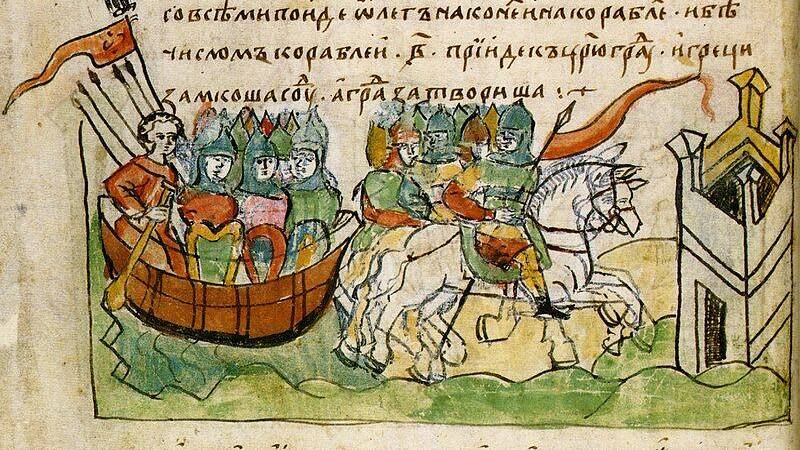
“Don’t sing Russian songs — a Russian will come and say, ‘Russian songs were sung here; this is my land.’” Illustration: Radziwiłł Chronicle miniature (15th century). Public domain. Source: Wikimedia Commons.
«Чудь начуди́ла, да Меря намерила…»
“Chud played her strange tricks, and Merya took her measure…”
— Alexander Blok, 1910 (translation mine)
From Russians to Arabs, From Chud to “Palestinians”
In my previous article, Arabs Are Those Who Forgot Their Roots, I explored how assimilation can become amnesia — and how amnesia, over time, hardens into denial.
There, I drew a parallel between the ancient inhabitants of the Land of Israel — Canaanites, Phoenicians, and Philistines — whose long-vanished identities are now rhetorically appropriated by the UNRWA clientele, and the extinct Finno-Ugric peoples of central Russia — the Merya, Muroma, and Meshchera — whose descendants today identify simply as Russians. In both cases, assimilation ran its course. Languages disappeared. Distinct tribal identities dissolved.
The point was to expose the absurdity of retroactively reassembling the identities of peoples history itself allowed to fade.
This essay takes that argument one step further.
If the previous piece examined the resurrection of extinct peoples, this one examines something even more fundamental: the transformation of labels into lineages.
Before ancestry is claimed, before continuity is asserted, before indigeneity is invoked, a label must first be repurposed. A geographic descriptor becomes an ethnicity. An administrative term becomes a lineage. An exonym becomes a nation.
There is a useful historical parallel here — one that becomes almost comic once you see it.
It comes, once again, from medieval Russia.
“Palestinians” as Chud
The word “Chud” today survives mostly in historical texts and folklore. It sounds archaic — almost mythic — to modern Russian ears.
Medieval Russians used the word Chud (Чудь, pronounced choodʹ) as a generic exonym: a broad, external label applied to multiple Finno-Ugric peoples with distinct identities of their own. It was not a self-designation. No one woke up in the morning thinking, “I am Chud.” The term was imposed from outside — a convenient umbrella for “those people over there.”
In a different context, Palestinian functioned for centuries in much the same way: a geographic and administrative label, likewise imposed from outside. It referred to the inhabitants of a territory rather than to a singular people with a shared national identity. Only much later was the term hijacked and repurposed as a specifically Arab national identity, retrofitted with ancestry, continuity, and indigeneity.
This is where the parallel becomes more than structural — it becomes linguistic.
The origin of Chud itself is uncertain, but several hypotheses are revealing. One traces it to the Slavic tjudjo, meaning “foreign” or “strange.” Another links it to the Sámi čuđđe, meaning “enemy” or “adversary” (Finnish: vainolainen). In other words, Chud may literally have meant something like those hostile outsiders.
That should sound familiar.
One of the etymological explanations of Palestinians traces the term to the Hebrew plishtim — commonly rendered as “invaders” or “intruders.” Different language, different era, same underlying logic: a name that begins not as a proud self-identity, but as a designation applied by others, often with adversarial overtones.
The humor here is unintentional but hard to miss. Centuries later, we are invited to treat these labels — once vague, external, and even hostile — as ancient, organic, and self-evident identities, complete with deep roots and uninterrupted continuity.
What changed was not the past.
What changed was the story told about it.
Woke Up As Chud-Palestinian?
As noted earlier, no one ever woke up in the morning thinking, “I am Chud.” Yet we are now asked to believe that this is precisely what happened elsewhere — that a population went to sleep with one identity and awoke with another, fully formed and ancient. One former PLO terrorist described it bluntly:
Why is it that on June 4th, 1967, I went to bed as a Jordanian and woke up as a Palestinian? We considered ourselves Jordanian until the Jews returned to Jerusalem. Then, all of a sudden, we were Palestinians.
— Walid Shoebat
This is not a confession of ancient continuity. It is a description of identity reassignment in real time. Not the survival of an old people, but the sudden activation of a name — a name that had existed long before, yet meant something entirely different.
Mediterranean Chud
Medieval Russian sources even distinguished between different Chud by geography — for example, Zalesskaya Chud, the “Chud beyond the woods.” The label was elastic enough to stretch across regions without ever becoming a self-identity.
By the same logic, “Palestinians” can be understood as a Mediterranean Chud — or a Jordanian Chud — depending on where they live geographically. The parallel is not ethnic. It is structural.
In my article The Clientele, I wrote:
Do not call the impostors ‘Palestinians.’ That is the root of the problem. Call them the Clientele. If you have sharper or more fitting terms for the Clientele — civil and suitable for wide public discourse — feel free to suggest them in the comments.
Now there is another term.
Mediterranean Chud.
Clientele was not a rhetorical placeholder. It named a concrete identity, hardened over nearly eight decades through institutionalization, dependency, and political reproduction. It describes a population defined not by lineage or continuity, but by permanent administrative status — an identity sustained by agencies, subsidies, and grievance rather than transmission.
Mediterranean Chud addresses a different layer of the same phenomenon.
Where Clientele names the condition, Mediterranean Chud names the mechanism: the transformation of a geographic exonym into a putative ancestry. One describes what the identity has become. The other explains how such identities are constructed in the first place.
The problem has never been a lack of names.
It has been the refusal to distinguish status from ancestry, and labels from lineage.
Exonyms Are Not Ancestry
Mediterranean Chud is not an insult; it is a diagnostic term. It names a process — the moment when a label outlives its original meaning and is retrofitted with ancestry it never possessed. It describes how geography begins to masquerade as genealogy, and how administrative terminology slowly hardens into claims of antiquity.
No one was ever born Chud. No one inherited Chud as a sacred lineage from time immemorial. It was a word applied from the outside — a convenient designation used by others. Only much later could such a word be mistaken for something ancestral.
The modern drama, then, is not about ancient peoples awakening after centuries of silence. It is about contemporary narratives retroactively manufacturing antiquity. A name that once described inhabitants of a territory becomes recast as proof of uninterrupted bloodline. A term of geography is reinterpreted as evidence of indigenous permanence.
But names do not create bloodlines. Labels do not generate ancestors. And repetition, however insistent, does not transform exonyms into civilizations.
What changed was not the past itself. What changed was the vocabulary through which the past is described. And once vocabulary shifts, memory begins to reorganize itself accordingly.
Related Topics
Related Posts