
Russian-American-Israeli Palestinian. Palestine is Israel.
The Clientele
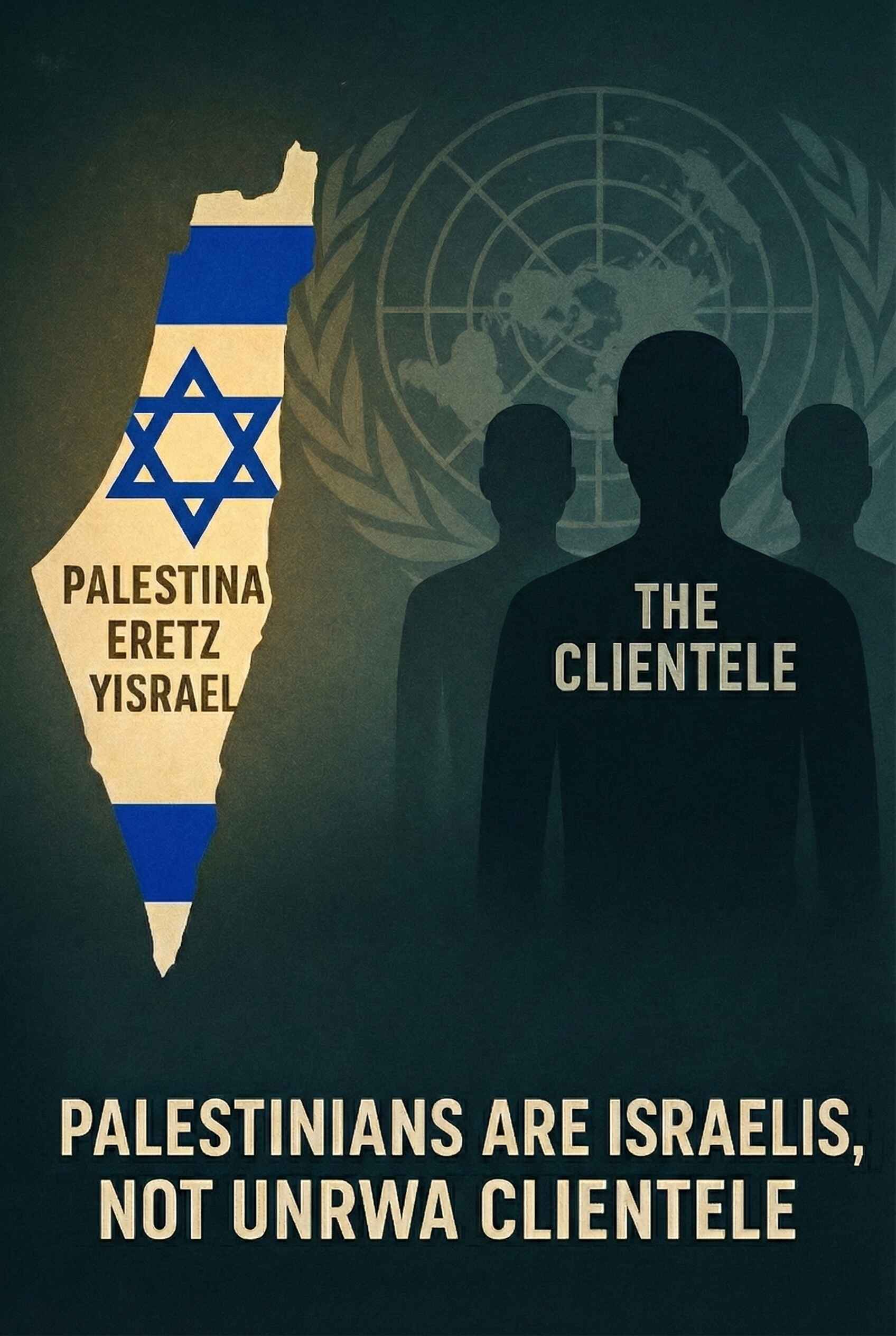
Separating history from propaganda: the real Palestinians are Israelis — not UNRWA Clientele. Image © Ivan Bassov, 2025. Licensed under CC BY 4.0.
Reclaiming “Palestine” from UNRWA’s Impostors
For decades, the world has been sold a myth: that there exists an ancient people called “Palestinians” whose homeland was somehow stolen by the Jews. Everyone knows this isn’t true — they simply choose to act as though it were. These people are not Palestinians. They are UNRWA Clientele, also called UN-Ruh Clientele — or simply the Clientele. And I explain why below. Keep reading.
The truth is simple: Palestine is Israel. Palestinians are Israelis. Insisting otherwise is not just historically inaccurate; it is a deliberate attempt to rewrite identity, history, and geography.
The Hijacking of Names and Narratives
The name “Palestine” and the term “Palestinians” were deliberately repurposed, especially after 1967. I have explored this in detail in my writings:
- The Palestinian Identity Manifesto
- Petition: Reclaim the True Palestinian Identity — End the Great Identity Theft!
- Palestine is Israel: The Truth They Tried to Erase
- The Battle for “Palestine”
- Hijacked Ideas and Stolen Names: The Meme of “Palestine”
- Wars Are Not Fought for Land. They Are Fought for Meaning.
…and more.
Of course, people of conscience avoid calling them “Palestinians,” because they know the truth and refuse to feed their narrative. Many put the term in quotation marks or state plainly that “the Palestinian people does not exist.” But that alone is not enough, and it doesn’t work. Israeli statespersons like Golda Meir — and even Arab leaders and historians — have repeatedly acknowledged this reality. Yet Ziophobes have built a counter-narrative, claiming that denying a “Palestinian people” amounts to ethnic cleansing or ethnocide — their latest newspeak invention.
The stronger approach is to reclaim the narrative. This is why my own tagline reads: “Russian-American-Israeli Palestinian. Palestine is Israel.” I urge all Israelis — Jewish and non-Jewish alike — to do the same. We are the real Palestinians. All Israelis.
Exposing the UNRWA Clientele
So what about those who falsely claim to be “Palestinians”? They are the undocumented Arab settlers in Judea, Samaria, and Gaza, as well as UNRWA “refugees” elsewhere — living in camps in Lebanon, Europe, and the US, including various public figures and even billionaires. What should we call them?
The answer is clear: they are UNRWA Clientele. That’s it. All these so-called “Palestinians” are officially registered as “refugees” with UNRWA. They are not Palestinians, never were, and even the UN itself acknowledges this. UNRWA is formally called the agency for “Palestine refugees,” not “Palestinian refugees,” because it recognizes that its clientele are not an ethnic or national group — they are a program category.
Calling them the Clientele is precise, factual, and fully consistent with the UN’s own terminology.
Interestingly, the entire population of the fictitious “State of Palestine” consists of UNRWA Clientele. In other words, the “State of Palestine” is, in practice, a UN agency masquerading as a state. Suddenly, everything falls into place: this is why the majority of UN member states recognize this fictional state. The fiction exists within the UN itself, and its supposed “citizens” are nothing more than its registered clientele.
The UN has spent nearly eight decades fueling and sustaining the conflict against Israel through UNRWA and its Clientele. UNRWA has held its Clientele hostage — without a future, without dignity — as pawns and tools in the orchestrated conflict against Israel. The UN should be held accountable for the proven multigenerational harm it has caused to both sides: to the Clientele and to Israelis.
The Hidden Truth Behind the Name “Palestine”
What is the origin of the name “Palestine”? The mainstream theory — that it derives from the Philistines — remains inconclusive. The phonetic similarity between “Philistines” and “Palestine” has encouraged some scholars to assume a connection, but it remains exactly that: an assumption, not a documented fact.
This “Philistia” narrative dominates today not because it is proven, but because it is politically convenient. It offers an easy way to detach the name “Palestine” from its long-standing Jewish usage and redirect it toward a storyline that obscures Jewish historical continuity in the land.
Ziophobes eagerly embraced this narrative, claiming that the UNRWA Clientele descend from the Philistines — along with the Canaanites and many other ancient, long-extinct peoples.
But why accept their framing when the historical record about the name “Palestine” is ambiguous?
There is an interesting alternative origin theory we can adopt. Since no conclusive evidence favors one explanation over another, we are ultimately left with interpretations — and the responsibility to choose which one to embrace.
The very word “Palestine” carries within it a hidden truth. One of the origin theories traces it to the ancient Greek Παλαιστῑ́νη (Palaistī́nē), first used in the 5th century BCE. This, in turn, is believed to derive from παλαιστής (palaistês), meaning “wrestler,” “rival,” or “adversary” — a direct translation of the Hebrew name Yisra’el (יִשְׂרָאֵל), which means “one who wrestles with God” (Bereishit/Genesis 32:28).
In other words, “Palestine” is essentially a Greek translation of “Israel”. The Greeks used it as a neutral geographical term, without political implications or any intent to erase Jewish identity.
This kind of linguistic translation is not unusual. Just as the original French name Côte d’Ivoire became Ivory Coast in English and Берег Слоновой Кости (Bereg Slonovoy Kosti) in Russian, so too did Yisra’el — “one who wrestles with God” — become Palaistī́nē, “land of one who wrestles,” in Greek.
The Narrative War
Those who tell the truth are often accused of “Hasbara” — redefined by Ziophobes as “heinous Zionist propaganda.” My work has been selectively quoted, misrepresented, and attacked. An author writing for the Egyptian Arabic-language site, Mobtada, falsely claimed about my blog:
This Zionist blog provides conclusive evidence that the primary aim of the displacement is to steal the identity of the Palestinian land, attempt to rewrite history, and define geography in the language of ‘memes,’ which the Zionists skillfully use to erase the idea of the existence of ‘Palestine.’
So reclaiming the stolen meaning of Israel is now labeled “stealing” by the thieves. This is exactly the narrative war of attrition I described in The Narrative War of Attrition — a battle over stories, names, and identity.
If my words ruffle Ziophobes, it proves I’m hitting the mark.
Conclusion: Reclaim, Name, Affirm
Do not call the impostors “Palestinians.” That is the root of the problem. Call them the Clientele. And remember: Palestina Eretz Yisrael is Israel. The real Palestinians are Israelis — and it is time we reclaim the narrative.
If you have sharper or more fitting terms for the Clientele — civil and suitable for wide public discourse — feel free to suggest them in the comments.
See Also
Trailer: UNraveling UNRWA
A good alternative title for this documentary would be “The Clientele,” like this eponymous article.
The film traces UNRWA’s 75-year evolution, from its post-1948 origins as a temporary relief organization for Palestine refugees to its pivotal and often controversial role amidst the decades-long Israeli-Palestinian conflict. It unravels new and surprising insights, offering an inside look at the only UN agency dedicated to a single group of people. With its three-year mandate expiring in December 2025, the UN General Assembly faces a crucial vote on whether to extend UNRWA’s mission.
Update: On December 5, 2025, the UN General Assembly overwhelmingly voted to renew UNRWA’s mandate for another three years.
Video credit: Zygote Films | Oct 11, 2025
Related Topics
Related Posts