
Former journalist, now a grumpy old man
Misappropriation and supporting very dubious causes
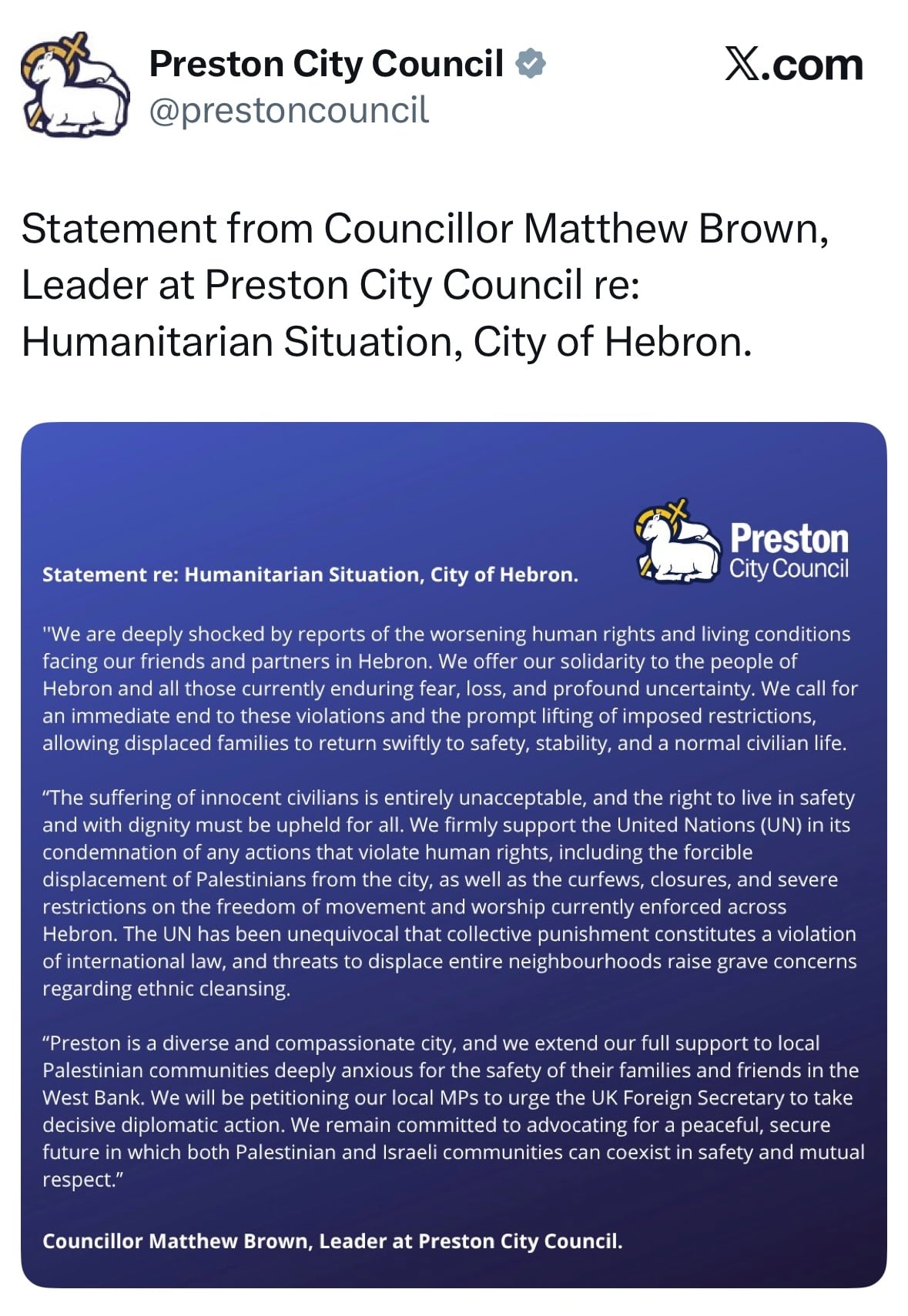
The UK City of Preston Council tweet
There is a difference between supporting a humanitarian cause and endorsing the methods, organisations or symbolism employed in its name. Good intentions, however sincerely held, do not automatically excuse poor judgement, inappropriate actions or a failure to consider the wider consequences. People need to actually think, rather than just “think they think”, to quote Dunning-Kruger.
Three recent examples illustrate this distinction. The first concerns the use of the traditional British Remembrance Day poppy in a politically charged fundraising initiative for one particular cause. One that has historically seen funding not always reach the intended “victims”.
The individual behind the creation and sale of the Palestine-themed poppy badge, often referred to in left-wing news coverage as the “Palestine Poppy”, Dr Abdul Qader Ismail, is an Oxford-educated NHS trainee paediatrician based in Birmingham. As a presumably well-educated individual, one would have thought he might have known better than to hijack a very emotive, well-established British symbol for not only those who lost their lives during the great World Wars, but for the victims and families of those left behind and affected by losing loved ones who served the British Armed Forces, helping in other conflicts abroad that threatened democracy.
The second concerns the decision by the prominent Irish author, Sally Rooney, to financially support Palestine Action, currently a proscribed organisation in the UK, whose activities have resulted in serious criminal allegations and, on one occasion, serious physical injury. I suggested that Sally Rooney should make a substantial donation to assist Police Sergeant Kate Evans of Avon and Somerset Police in the UK, who suffered a fractured spine in a sledgehammer attack on her by activist Samuel Corner (23) of Palestine Action at Elbit Systems in Filton in the UK. She is currently having great personal difficulties and continues to suffer trauma as a result of the attack.
I also asked Sally Rooney if we can expect her to reconsider her complete lack of vocality over the past three years, and longer thus far, for the Christians of Nigeria (nearly 20,000 churches destroyed since 2009), the oppressed entire female population of Afghanistan, the 35million starving in Yemen and Sudan, the 1 million Uyghurs in China and the Rohingya of Myanmar?
The third concerns an “informal friendship agreement” between Hebron and the city of Preston in Northwest England. There is nothing wrong with local councillors expressing concern about humanitarian crises overseas. Although it shouldn’t be at the expense of their local constituents, which sadly, it so often is. I am not too convinced that Hebron worries too much about the situation in Preston.
Preston has substantial, deep socioeconomic challenges of its own. The 2025 English Indices of Deprivation rank it 57th most deprived among 296 local authority districts and unitary authorities in England, while median weekly pay for full-time employees living in Preston remains below both the North West and Great Britain as a whole.
Compassion should not stop at geographical boundaries, and suffering deserves to be taken seriously wherever it occurs. But locally elected representatives also have a direct responsibility to the people and communities who put them in office. Yet the wider question remains as to how elected representatives should balance international advocacy with their responsibilities to the people whose everyday lives, livelihoods and prospects they have a direct duty to improve. It should certainly be a concern, but not a partisan one.
In all three cases, the questions are worth asking. Where does legitimate advocacy end and misjudgment begin? Do those lending their names, money or influence to a cause fully appreciate what they are supporting, the risks involved, and the potential consequences for others? My letters offered my perspective on these questions. They are not arguments against humanitarian concern. Rather, they are a reminder that supporting a cause should never mean suspending critical judgement.
But the misappropriation and hijacking of long-standing, recognised, and emotive symbols for the British public and people outside the UK, one in particular that represents core British values, and applying them in a partisan manner to one solitary cause, is one step too far and is simply wrong.
Related Topics