
Russian-American-Israeli Palestinian. Palestine is Israel.
Mizrahi Civilization
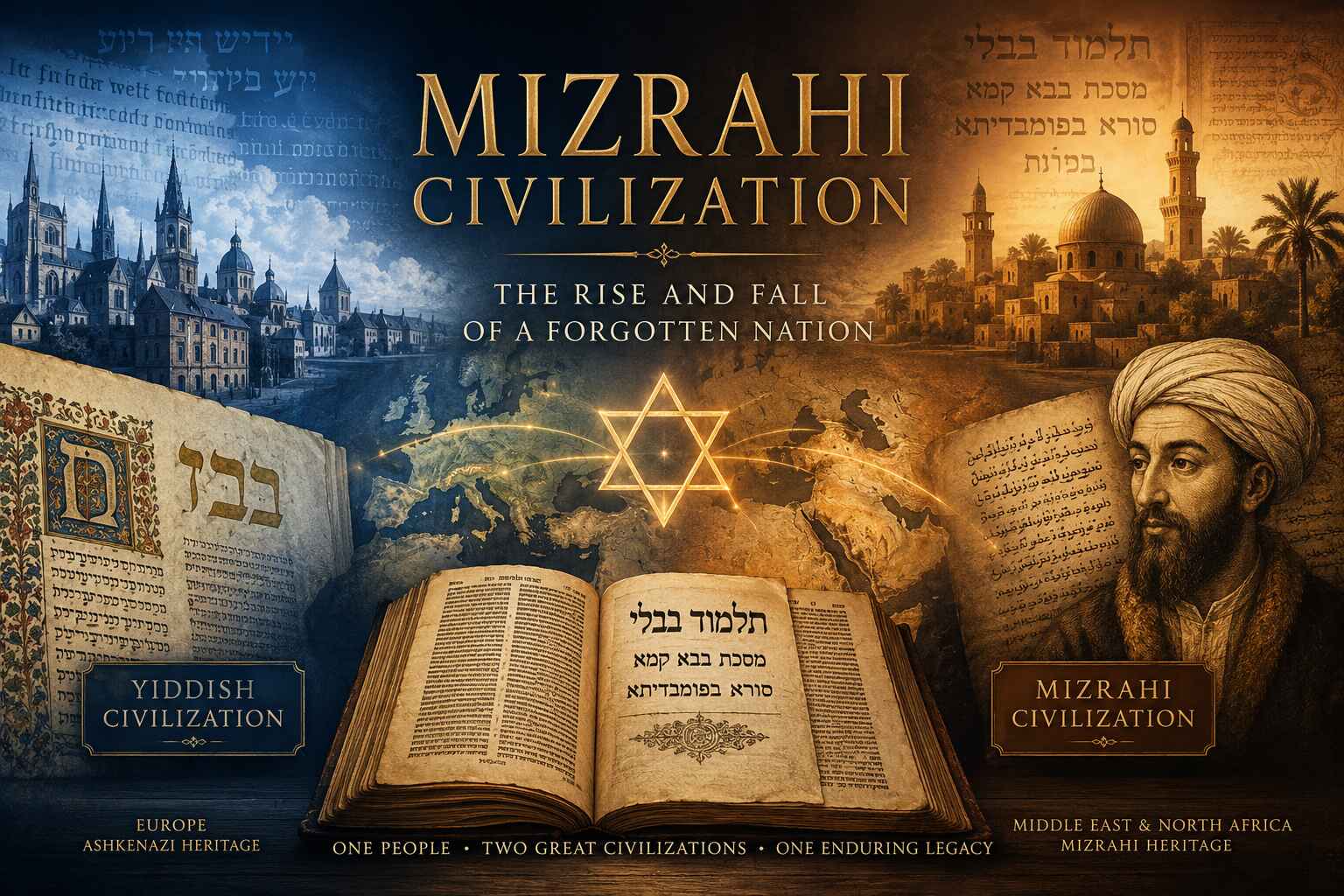
Mizrahi Civilization: The Rise and Fall of a Forgotten Nation. Image © Ivan Bassov, 2026. Licensed under CC BY 4.0.
“The Yiddish people must be counted among the founder nations of Europe.”
— Paul Kriwaczek, Yiddish Civilization
The Rise and Fall of a Forgotten Nation
In his acclaimed book Yiddish Civilization: The Rise and Fall of a Forgotten Nation, historian and writer Paul Kriwaczek invites readers to rethink the place of Jewish history in Europe. He argues that Yiddish civilization should be recognized as one of the civilizations that helped shape Europe. His striking assertion that “the Yiddish people must be counted among the founder nations of Europe” challenges the familiar perception of Jews as perpetual outsiders to European history.
As Kriwaczek explains:
The word Yiddish just means Jewish in the Yiddish tongue and, like English or French, refers equally to the language, the people who speak it, the culture it supports and the civilization its speakers built.
The book was brought to my attention by Boris Feldblyum, a renowned Jewish genealogist and author of Russian-Jewish Given Names: Their Origins and Variants.
He is also a professional architectural photographer, featured in One Photographer’s Journey.
After reading several of my essays, he suggested that Kriwaczek’s idea might have an equally compelling Middle Eastern counterpart, and encouraged me to write about it.
If Yiddish civilization deserves to be counted among the founder nations of Europe, what about the Jewish civilization that flourished throughout the Middle East and North Africa?
Why shouldn’t the Mizrahi Jewish civilization be counted among the founder nations of the Arab world?
The parallel is not immediately obvious. Yet the more one examines history, the more compelling it becomes.
This essay mirrors Kriwaczek’s title structure, extending his framing of Yiddish civilization to a parallel case in the Middle East and North Africa.
A Civilization Older Than the Arab World
Long before the rise of Islam, long before Arabic became the dominant language of the region, Jewish communities flourished in Babylon, Egypt, Yemen, Syria, Persia, and across North Africa.
The Babylonian Jewish community produced the Babylonian Talmud, one of the foundational works of Judaism, in the great academies of Sura and Pumbedita.
Centuries later, Saadia Gaon, head of the Academy of Sura, translated the Hebrew Bible into Arabic and emerged as one of Judaism’s greatest philosophers. Maimonides, writing in Judeo-Arabic while serving as physician to Saladin’s court in Egypt, produced works that influenced Jews, Christians, and Muslims alike.
Jewish merchants connected continents through vast trade networks. Jewish physicians served rulers and ordinary people alike. Jewish philosophers helped preserve and expand classical knowledge. Jewish poets enriched both Hebrew and Judeo-Arabic literature.
Jewish craftsmen, financiers, translators, diplomats, and scholars played integral roles in the societies around them.
When the Arab conquests transformed the Middle East in the seventh century, these Jewish communities did not disappear. They became part of the region’s emerging civilization. Many adopted Arabic as their everyday language while preserving their own religious, legal, and cultural traditions.
For more than a millennium, Jewish civilization was not merely present in the Middle East and North Africa—it became one of the region’s constituent civilizations.
A Constituent Civilization
Civilizations are not built by a single people.
They emerge through the contributions of many peoples whose ideas, institutions, languages, and cultures intertwine over centuries.
The Jewish civilization of the Middle East and North Africa was one of those civilizations.
From Baghdad to Fez, from Sana’a to Cairo, from Aleppo to Casablanca, Jewish communities contributed to commerce, medicine, science, administration, finance, philosophy, music, and literature. Their achievements were not confined to religious life. They helped shape the intellectual, cultural, and economic landscape of the region.
The flourishing of medieval Jewish thought would have been impossible without the broader Middle Eastern environment. Likewise, the history of the Middle East and North Africa cannot be fully understood without acknowledging the role of its Jewish civilization.
This was not the story of an isolated minority. It was the story of a mature civilization—one that sustained academies, courts, libraries, philosophy, poetry, commerce, and scholarship whose influence extended far beyond the Jewish world.
In that sense, Paul Kriwaczek’s observation about Yiddish civilization points toward a broader historical truth.
Just as Yiddish civilization helped shape Europe, the Jewish civilization of the Middle East and North Africa became one of the region’s constituent civilizations.
A Forgotten Parallel
The parallels between Ashkenazi and Mizrahi Jewish history are remarkable.
Yiddish civilization flourished in Europe for centuries. It developed its own language, literature, humor, scholarship, commerce, and social institutions. It became an inseparable part of European civilization.
Then came the Holocaust.
Mizrahi civilization flourished across the Middle East and North Africa for even longer. It developed rich traditions in Hebrew, Aramaic, Judeo-Arabic, Judeo-Persian, and other Jewish languages. It produced generations of scholars, merchants, physicians, poets, rabbis, and statesmen.
Then came the Nakba—the ethnic cleansing of the Jews of the Middle East and North Africa.
Within a few decades of the establishment of the State of Israel, ancient Jewish communities throughout much of the Middle East and North Africa were largely uprooted through a combination of persecution, discrimination, violence, state policies, fear, and mass emigration. Communities that had existed for centuries—or even millennia—were emptied.
One civilization was shattered by genocide.
The other was dispersed through ethnic cleansing of centuries-old Jewish life across the Middle East and North Africa.
Both deserve to be remembered.
And, of course, this Nakba did not end with the destruction of those ancient communities. It continues today through the delegitimization of Israel and persistent waves of antisemitic and ziophobic violence.
Further reading: For discussions of the ethnic cleansing of Jews from the Middle East and North Africa as the real Nakba, see:
- The Real Nakba Is What Happened to MENA Jews (Point of No Return)
- The Real Nakba (CAEF Bulletin)
The Missing Chapter of Middle Eastern History
Today, the history of Mizrahi Jews often occupies surprisingly little space in public discussions.
This is not accidental. We are witnessing the largest global surge of hostility toward Jews and the Jewish state since World War II. A recurring slogan directed at Jews in Israel is: “You do not belong here. Go back to Europe.” In that narrative framework, Mizrahi Jews are inconvenient to acknowledge. Their history disrupts the simple geographical story. It is far less convenient to tell them to “go back to Morocco,” “go back to Iraq,” or “go back to Yemen.”
When Jews from the Middle East and North Africa are mentioned at all, they are frequently treated as a footnote to the Arab-Israeli conflict rather than as heirs to one of the oldest continuous civilizations in the region.
That perspective diminishes not only Jewish history but also the history of the Middle East itself.
A civilization cannot be understood by remembering only those who remained.
It must also remember those who vanished.
The disappearance of nearly a million Jews from the Middle East and North Africa did not erase the centuries during which they helped shape the societies around them.
Two Civilizations, One People
The Jewish people originated in the Land of Israel while also creating remarkable diaspora civilizations across the world.
Among the greatest of these were Yiddish civilization in Europe and Mizrahi civilization in the Middle East and North Africa.
Together, they remind us that the Jewish story is both rooted and far-reaching.
The story of Yiddish civilization enriches Europe’s history.
The story of Mizrahi civilization enriches the history of the Middle East and North Africa.
The two histories are complementary rather than competing. Each enriches the history of its region.
Perhaps that is the broader lesson suggested by Kriwaczek’s insight.
Kriwaczek asks us to see Yiddish civilization as part of Europe’s story.
We should learn to see Mizrahi civilization the same way—not as a footnote to the history of the Middle East and North Africa, but as one of its constituent civilizations.
One civilization helped shape Europe.
Another helped shape the Middle East and North Africa.
Both were Jewish.
Both were destroyed within a single generation.
Neither should ever be forgotten.
—
See Also
November 30 — Nakba Day: The Jewish Expulsion and Flight from Arab Lands
Related Topics
Related Posts