

Geopolitical Analyst: Bridging Somaliland & Israel to the world
Mogadishu’s Growing Contradiction With Its Regional Security Partners
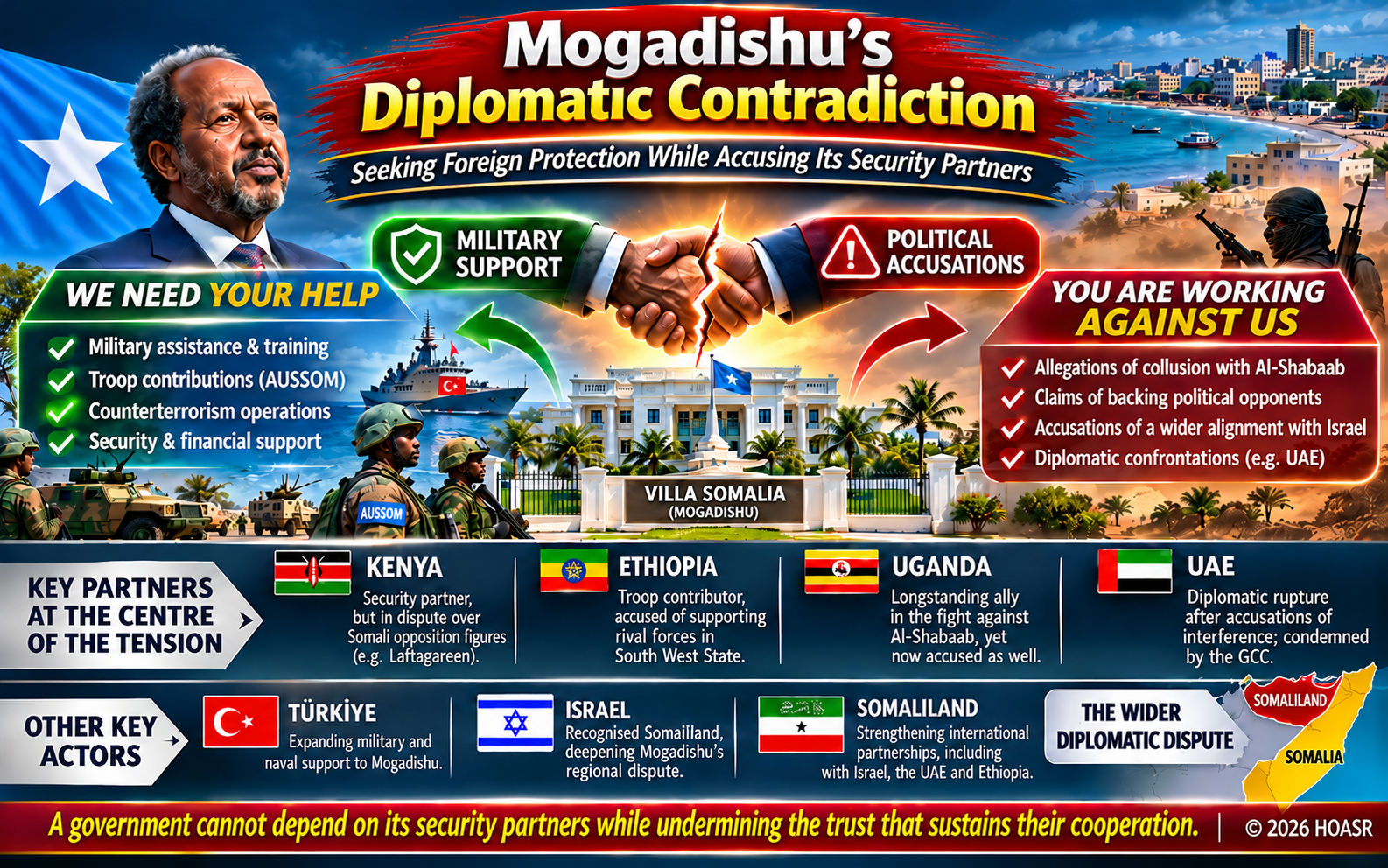
Mogadishu's diplomatic contradictions: military dependence, political accusations and growing regional security tensions.HOASR Original Infographics
Somalia’s growing diplomatic confrontations are testing the relationships that sustain its security.
The Contradiction at the Heart of Somalia’s Security Policy
Somalia’s federal government is facing an increasingly uncomfortable contradiction. President Hassan Sheikh Mohamud continues seeking military assistance, financial support and political cooperation from neighbouring countries, while senior figures in Mogadishu are accusing some of those same countries of supporting forces hostile to the federal government.
Kenya, Ethiopia and Uganda have spent years contributing troops and resources to the fight against Al-Shabaab. Yet Somalia’s parliamentary leadership has reportedly accused them of colluding with the militant organization and participating in a wider alignment involving Israel.
The timing could hardly be more revealing. On November 23, Hassan Sheikh Mohamud met President Yoweri Museveni in Entebbe to strengthen security cooperation and discuss the future of the African Union Support and Stabilization Mission in Somalia (AUSSOM).
The Ugandan presidency confirmed that both leaders reaffirmed their commitment to fighting terrorism and maintaining regional stability. One day later, reports emerged that Somalia’s parliamentary speaker had publicly accused Uganda, Kenya and Ethiopia of colluding with Al-Shabaab.
These allegations have not been supported by independently verified evidence. Nor has Mogadishu’s executive formally adopted them as government policy.
Nevertheless, accusations made by a senior parliamentary figure carry diplomatic consequences, particularly when directed against countries whose soldiers are helping protect Somalia.
Kenya: Political Sanctuary or Interference?
Kenya’s disagreement with Mogadishu centres partly on the presence in Nairobi of former South West State president Abdiaziz Hassan Mohamed Laftagareen.
Following his removal from power in March 2026 and subsequent disputes over the legitimacy of the regional administration, Laftagareen continued challenging Mogadishu’s preferred political arrangements from outside Somalia.
Somali officials have accused his supporters of destabilizing South West State and maintaining connections with armed groups. Nairobi, meanwhile, has faced demands to arrest or surrender him.
Kenyan reporting has examined how the dispute threatens relations between the two countries, including cross-border commerce and security cooperation.
But there is a fundamental difference between hosting a Somali political opponent and supporting terrorism. Kenya maintains its own legal and diplomatic responsibilities, and the presence of a former regional leader in Nairobi does not by itself prove involvement in militant activities.
Kenya has also been among the countries directly affected by Al-Shabaab violence. Its armed forces have operated in Somalia, while Kenyan border communities have experienced repeated militant attacks.
Accusing Nairobi of cooperating with the same organization raises serious questions about the political direction of Somalia’s regional relationships.
The potential consequence is not necessarily an immediate diplomatic rupture. It is the gradual weakening of confidence between security partners whose cooperation is essential along the shared border.
Ethiopia: The South West State Crisis Exposes Deeper Divisions
Ethiopia’s relationship with Mogadishu is even more complicated. Addis Ababa has deployed troops in Somalia for years, and have suffered heavy casualties; both under African Union arrangements and through bilateral security cooperation.
Ethiopian forces have played an important role in maintaining security in areas bordering Ethiopia, particularly Bay, Bakool and Gedo.
Yet the political confrontation in South West State has placed those troops in a difficult position. Mogadishu has been attempting to consolidate its authority over regional political institutions, while supporters of Laftagareen continue resisting the federal government’s preferred arrangements.
An International Peace Institute analysis suggests that Ethiopia may be providing tacit support to some armed groups opposing Mogadishu. The assessment connects this possibility to Ethiopia’s wider regional disagreements with Somalia and its growing concern over relations involving Eritrea and Egypt. However, there is no evidence to support that claim.
Ethiopia faces a genuine strategic dilemma. It wants to prevent Al-Shabaab from expanding along its borders, but it also has reasons to avoid becoming an instrument in Somalia’s internal political conflicts. Its own security interests do not always correspond with the political objectives of the federal government.
The problem becomes more serious when Ethiopian military restraint or independent political judgment is interpreted in Mogadishu as hostility. A neighbour contributing troops to counterterrorism operations cannot automatically be expected to intervene in every dispute between Somalia’s federal government and regional political authorities.
For Addis Ababa, the growing tensions reinforce the need to separate cooperation against Al-Shabaab from Somalia’s internal contest over political power.
Uganda: Praised by the President, Accused by Parliament
Uganda provides perhaps the clearest illustration of Mogadishu’s contradictory political messages.
President Museveni’s government has supported security operations in Somalia since 2007. Ugandan soldiers have served through successive African Union missions, suffered casualties and contributed to major operations against Al-Shabaab.
During the November 23 meeting in Entebbe, Hassan Sheikh publicly acknowledged Uganda’s contribution and reaffirmed Somalia’s commitment to continued cooperation. The joint communiqué emphasized the need for predictable international financing and stronger counterterrorism operations.
Yet the following day’s reporting attributed allegations to Somalia’s parliamentary speaker that placed Uganda alongside countries supposedly cooperating with Al-Shabaab.
That contrast raises questions about coordination between Somalia’s executive leadership and its parliamentary leadership.
Uganda has already announced plans to withdraw its bilateral deployment and subsequently its African Union mission personnel under a broader security transition. Those plans predate the latest accusations and should not be presented as retaliation.
Nevertheless, Somalia can ill afford additional political disagreements with Kampala while the international mission continues facing funding and operational pressures.
The issue is larger than diplomatic language. A government seeking continued military support must maintain a working relationship with the countries providing that support.
Whether Somalia can afford to turn those disagreements into confrontations with the very governments on which its security continues to depend remains to be seen.
The UAE Dispute Shows How Accusations Can Produce Diplomatic Consequences
The confrontation with the United Arab Emirates provides another example of how increasingly aggressive political rhetoric can produce an international response.
On November 19, Somalia ordered the UAE ambassador to leave within 72 hours, accusing Abu Dhabi of interfering in its internal affairs and supporting regional administrations outside federal control.
The UAE responded that its embassy in Mogadishu had already closed in January and that Somali officials were attempting to involve Abu Dhabi in Somalia’s domestic political struggles.
Reuters documented the diplomatic rupture, which followed growing disagreements over foreign partnerships, ports and relations with regional authorities.
The response extended beyond Abu Dhabi. The Gulf Cooperation Council’s secretary-general issued an official condemnation of statements by Somali government officials targeting the UAE.
The intervention demonstrated how a bilateral dispute could produce wider regional diplomatic consequences.
The parallel with Kenya, Ethiopia and Uganda is not exact. The GCC statement concerned a member state and did not establish a comparable African institutional response.
Nevertheless, it demonstrates that accusations against foreign partners can attract reactions extending beyond the original disagreement.
Somalia’s relationships with its African neighbours are especially sensitive because they involve active military deployments and counterterrorism operations. A breakdown in confidence could have direct security consequences.
Israel and Somaliland Enter the Regional Dispute
The latest accusations also introduce Israel into Somalia’s already complicated relationships with its neighbours.
According to Somali Guardian’s November 24 report, the parliamentary speaker alleged that Israel had assembled an alignment involving Kenya, Ethiopia, Uganda, Al-Shabaab and forces associated with Laftagareen.
The allegation has not been substantiated. It also combines fundamentally different relationships and interests into a single political accusation.
Israel’s recognition of Somaliland on December 26, 2025, has certainly changed the regional diplomatic environment. Mogadishu strongly opposes that decision, while Somaliland has welcomed new opportunities for cooperation with Jerusalem.
Ethiopia has its own commercial and strategic interests in Somaliland, particularly through Berbera. Kenya maintains relationships with a variety of regional political and economic actors. Uganda’s central involvement in Somalia remains its contribution to security and counterterrorism.
These different interests should not be mistaken for evidence of a coordinated alliance against Somalia.
For Somaliland, however, the controversy illustrates how its expanding international relationships have become part of Mogadishu’s wider regional diplomacy. The dispute increasingly involves disagreements over how neighbouring governments should conduct their own foreign and security relationships.
Somaliland’s diplomatic position is strengthened by its ability to develop international partnerships, but that does not require treating every disagreement between Somalia and its neighbours as an endorsement of Somaliland’s independence.
Türkiye’s Growing Role Does Not Remove Somalia’s Dependence on Its Neighbours
While Mogadishu’s relationships with several regional partners face pressure, Türkiye continues strengthening its military cooperation with Somalia.
The November 21 visit of Türkiye’s Chief of General Staff and the construction of new Somali naval facilities demonstrated Ankara’s long-term commitment to developing Somalia’s defence institutions.
Türkiye provides training, military expertise and maritime support. These capabilities are important to Mogadishu’s wider security objectives.
But Turkish military assistance cannot automatically replace the responsibilities performed by African Union troops, regional intelligence networks and neighbouring governments along Somalia’s extensive borders.
Kenya, Ethiopia and Uganda possess geographic proximity, established military relationships and direct security interests that cannot simply be substituted by another external partner.
Somalia’s security arrangements depend on cooperation among governments whose priorities are not always identical. The challenge for Mogadishu is managing those differences without turning them into additional political conflicts.
The issue is especially pressing as Al-Shabaab continues operating across substantial parts of southern and central Somalia.
The Soufan Center’s November 20 assessment highlighted the connection between Somalia’s political disputes, regional military pressures and the persistent threat posed by the militant organization.
Political confrontations that undermine security cooperation risk complicating the campaign against Al-Shabaab, regardless of how much assistance Somalia receives from Türkiye or other foreign partners.
The Scoop: A Government Cannot Afford to Alienate Its Own Security Partners
The contradiction now confronting Mogadishu is difficult to overlook.
Somalia depends on foreign soldiers, international funding and regional intelligence cooperation to maintain its security. Yet some of its most senior political figures are publicly questioning the intentions of countries providing that assistance.
The dispute with Kenya concerns the treatment of Somali opposition figures. The confrontation with Ethiopia involves regional political authority, troop deployments and competing security interests.
Uganda’s long military contribution sits uneasily alongside the latest accusations. The diplomatic rupture with the UAE has already produced a condemnation from the GCC secretary-general.
These are different disputes, but together they reveal the pressures facing Somalia’s regional relationships.
For Hassan Sheikh Mohamud, the immediate challenge is whether his administration can preserve the cooperation it needs while managing disagreements with governments that maintain their own independent interests.
For Kenya, Ethiopia and Uganda, the question is how far they should become involved in Somalia’s domestic political struggles while continuing to fight a common terrorist threat.
For Somaliland, the wider picture demonstrates that Mogadishu cannot dictate the foreign relationships of every government in the region. Hargeisa’s growing economic, diplomatic and security partnerships exist within a regional system in which individual countries make decisions according to their own interests.
Whether those accusations produce formal diplomatic retaliation remains to be seen. What is already clear is that maintaining effective regional security cooperation requires more than military assistance and diplomatic declarations.
It requires political trust.
And in Somalia’s increasingly complicated regional relationships, that trust is becoming an important strategic question. A government cannot depend on its security partners while undermining the trust that sustains their cooperation.”
Related Topics
Related Posts