
Russian-American-Israeli Palestinian. Palestine is Israel.
Money, Markets, and the Illusion of Ownership
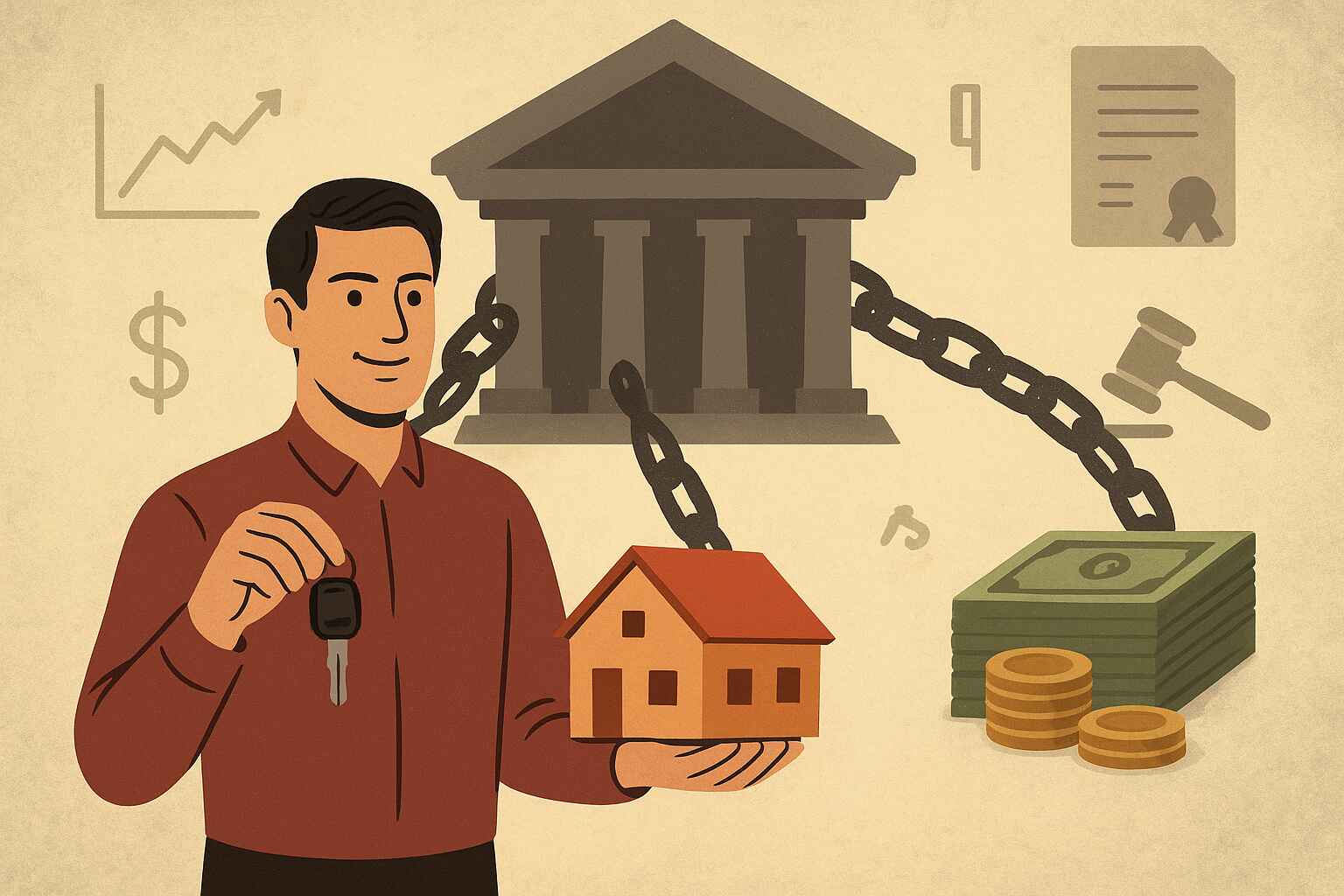
When someone brags, “I own this,” ask: “According to whose law—and under what rules?” Image © Ivan Bassov, 2025. Licensed under CC BY 4.0.
The Hidden Authority That Shapes What We Call Value
In the grand theater of history, we like to pit economic systems against each other — communism versus capitalism, public good versus private gain. Yet the truth is far less glamorous: in any society, money, markets, and property rights exist — or don’t — only because the sovereign says so and can enforce the rules.
The Real Source of Money’s Value
Let’s start with money. Why do we accept dollars, euros, or shekels as “worth something”? Sure, people believe in them, and markets treat them as valuable — but belief alone doesn’t make money. The value of money, whether modern or ancient, is not magical: it comes from the fact that the sovereign demands it for taxes and declares it legal tender. In other words, the state compels us to use its currency.
When a government requires that taxes be paid in its own currency, it creates an automatic demand for that currency. Owe taxes? You need dollars. Those dollars are valuable not because they are backed by gold or some other commodity, but because the state insists on them and enforces that insistence through its laws and institutions.
Legal tender laws reinforce this: if the state says, “You must accept dollars for payments,” then dollars become not just a social convention, but a legal necessity in transactions and debt settlements.
It’s not just a theoretical point. Governments are not begging you to pay taxes — they require it. This social and legal compulsion is the foundation of what gives money its core value.
Why the Dollar Is So Dominant
Some currencies are more equal than others — notably, the U.S. dollar. Why is the dollar so highly valued around the world? A large part of the answer isn’t purely market confidence; it lies in the unique reach and power of the American state.
- Citizenship-Based Taxation. (Remember, we discussed that taxes are what give money its real value?) The United States taxes its citizens on their worldwide income, even if they live abroad. This is extremely rare: unlike almost every other country, the U.S. doesn’t tax only based on residence — it taxes based on citizenship. As a result, many Americans overseas need to hold and transact in U.S. dollars, reinforcing global demand for the currency. Outside of the U.S., only Eritrea attempts anything similar, though on a far smaller scale and with little impact on global currency demand.
- Worldwide Enforcement Regime. The U.S. doesn’t just demand dollar payments for taxes; it enforces financial compliance globally. Tools like FATCA (the Foreign Account Tax Compliance Act) require foreign financial institutions to report on the bank accounts of U.S. persons. This keeps Americans abroad financially tethered to the U.S. banking system and ensures many of their accounts are maintained in dollars. That enforcement — combined with the threat of IRS obligations — gives real, structural power to the dollar. It isn’t just “preferred”; it is legally backed by a global enforcement regime.
This is not just soft power or confidence — it’s institutional. The U.S. state’s reach, combined with its tax regime and enforcement tools, helps make the dollar not only the world’s key reserve currency but also a kind of fiscal anchor.
In fact, the real goal of Citizenship-Based Taxation and the Worldwide Enforcement Regime may have been to make the dollar more valuable than it would be otherwise. Publicly, they were justified as measures to prevent tax evasion and increase compliance, not explicitly as a way to boost the dollar’s global value.
Could other countries replicate this? In theory, yes — but in practice, it’s very, very hard. You’d need not just a strong legal framework, but truly global reach and willingness to tax non‑residents, enforce cross-border financial reporting, and maintain a reserve currency. Few states have that kind of institutional muscle.
Authoritarian regimes can certainly imitate fragments of this model and make life difficult for their expats or dissidents, but coercion is not the same thing as a globally trusted currency. They can intimidate people — but they cannot intimidate markets into treating their currency like the U.S. dollar, nor can they intimidate the global banking system into compliance.
Functional Markets: Enforced, Not Spontaneous
Now, let’s turn to markets. Free markets are often portrayed as something organic and spontaneous. But in fact, markets are deeply embedded in — and protected by — state power.
- Contract enforcement. Markets function because the state enforces contracts. When you buy something, rent, or invest, the state ensures that promises are kept, payments are made, and disputes are resolved.
- Property protection. The state defines what property is, who owns it, and under what conditions. Without law, the idea of “buying” or “owning” something would be meaningless; at best, people could possess small personal items, but nothing resembling property in the economic sense.
- Regulation and legitimacy. The state also imposes rules: licensing, standards, zoning, inspections. These are not optional; they shape how markets operate in reality.
So, markets are not independent freedoms. They are state-enabled phenomena, built on legal infrastructure, often backed by coercion and enforcement.
Property Rights: The Illusion of Ownership
Let’s get to property — and here’s where things get more subtle: when most people say “I own something,” they speak as if ownership were absolute. But legal ownership is not the same as total control.
Ownership is a creation of the sovereign. The state defines who is the owner, under what terms, and what the owner may or may not do. Without a legal regime, the notion of “mine” becomes vague.
Consider some examples:
- You may think your car is yours. But do you actually have unlimited freedom with it? Of course not. You must:
- follow traffic laws
- pay vehicle registration
- pass inspections
- pay property or usage taxes
- obey parking rules
- abide by speed limits
Your “ownership” exists only within these boundaries. The notion that “I can do whatever I want with my car” holds true only inside the limits defined — and enforced — by the sovereign.
- Owning a house. Similarly, owning a home is not unfettered freedom. You pay property taxes, you must comply with zoning laws, you might not be allowed to use it for business, you may need permits to renovate, and at times the state can intervene or restrict certain uses. As the saying goes, stop paying taxes and you’ll quickly learn who really owns your house.
- Leasing vs. owning. In many cases, the difference between owning and leasing is more semantic than real. In rent-controlled or rent-stabilized dwellings (think certain neighborhoods in New York City), the “tenant-owner” might enjoy protections that blur the lines: they can treat a rented apartment very much like their own, while being subject to rent ceilings, renewal rights, and government oversight.
That’s why, in my article “A Return to the Golden Fields: The Ziophobic Utopia,” where I examine myths about absurd property claims, I noted:
The romantic notion that a farmhouse abandoned in 1948 remains ‘yours’ forever — regardless of political, legal, and demographic transformations since, and even if Jews legally purchased it decades earlier — exists in no functioning legal order on earth. A long-gone 1940s farm in Jaffa is no more a legal claim in 2025 than a plot now buried under an interstate in New York belongs to the great-grandchild of someone who once lived there.
The Hidden Truth About “Ownership”
The takeaway is uncomfortable for free‑market fundamentalists and communists alike: ownership is not an absolute natural right; it’s a legal privilege granted, regulated, and enforced by the sovereign.
When people argue about property rights, they often forget this: the “owner” is not omnipotent. Ownership comes with:
- Obligations – the duties that come with ownership, such as paying taxes, maintaining property, and complying with regulations.
- Limitations – the restrictions imposed on how property can be used, including rules, permits, and usage constraints.
- Contingency – the dependence of ownership on the state and the law: what counts as property, what rights you have, and what actions are allowed exist only because the sovereign defines and enforces them.
The same goes for markets: they are not wild gardens of voluntary exchange but carefully cultivated ecosystems built by law, backed by coercion.
Even Our Enemies Use Our Money
Notably, this dynamic is visible even in places that are politically hostile to the sovereign itself. In Judea, Samaria, and Gaza, the Israeli shekel remains the primary medium of exchange among non-Israeli Arab settlers. This isn’t an expression of allegiance — it’s the result of enforcement, infrastructure, and economic gravity. Goods and services flow through Israel; salaries, pensions, and social payments are issued in shekels; and local markets price everything in the currency that everyone must accept because it is the only stable, functional option. Without a sovereign-backed alternative, the shekel’s dominance persists despite political hostility.
The same pattern holds globally. People everywhere rely on U.S. dollars — including those who loudly profess to hate the United States. Political rage melts away the moment real purchasing power is needed. Once again, enforcement, stability, and sovereign backing triumph over hate and ideology every single time.
Conclusion: Power Behind Value
Across history, the value of money, markets, and property has never floated free. It is anchored in sovereign power. The state defines the rules, enforces debts, and shapes what “ownership” means.
Money’s worth does not come from any intrinsic quality; it derives from tax obligations and legal tender systems.
Markets function because the state builds, regulates, and enforces them. And property is never absolute — it exists only as defined and constrained by law.
When we talk about “the free market” or “private ownership,” we often forget who truly holds the reins: behind all apparent freedom lies the sovereign, quietly shaping the reality we call “wealth.”
So the next time someone brags, “I own this,” ask: “According to whose law — and under what rules?”
Even the holy language hints at this deeper truth. Hebrew has no verb meaning “to own”; instead, it uses relational forms like yesh li (יש לי — literally “there is to me,” i.e., “I have”) or sheli (שלי — literally “of me,” i.e., “mine”). Ownership is not expressed as an inherent state, but as a relationship — exactly as it exists in reality: something defined, recognized, and sustained only within the boundaries of law.
See Also
Related Topics
Related Posts