Greek Jewish roots. New York voice. Unfiltered perspective.
Moral Clarity: Put It All on the Board
Part IV
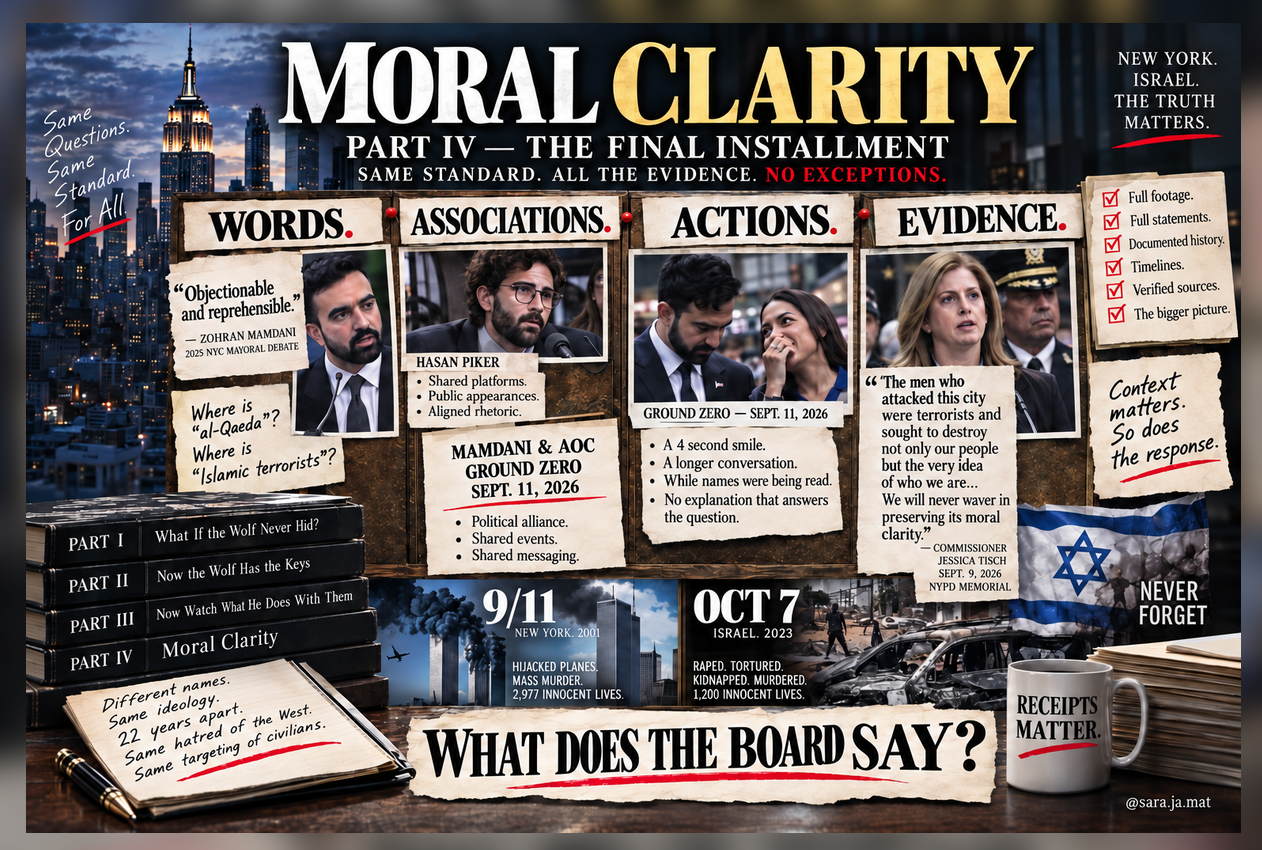
This is the fourth and final part of a series examining Zohran Mamdani’s political formation, record and first months governing New York City.
Terminology note: Wherever possible, I use “Gazans” when referring specifically to the people of Gaza. I use “Palestinian” primarily when quoting or referring to the terminology used by others. This is a deliberate choice and should not be read as my endorsement of the historical or political claims associated with the term “Palestinian.”
The hardest test of a principle isn’t whether you can say the right words.
It’s whether you apply the same standard when the evidence becomes inconvenient.
Since Part I, I have repeated the same rule:
If I can prove it, put it on the board.
If I can’t, it doesn’t go on the board.
Three articles later, the board is crowded.
So let’s actually look at it.
THE CLIP
And then there was the clip.
Four seconds from Ground Zero.
Mayor Mamdani standing beside Alexandria Ocasio-Cortez while the names of the dead were being read.
They speak.
They smile.
They appear to laugh.
And the internet explodes.
And yes—
I hated it.
The optics were awful.
Families were standing there hearing the names of the people they lost twenty-five years ago.
There is almost no circumstance in which I want to see the mayor of New York appearing to laugh during that moment.
But there is a problem.
The clip does not tell us what they were saying.
The viral video is four seconds.
Then I watched the longer footage and context.
It showed Mamdani standing solemnly as names were read before Ocasio-Cortez approached him. He remained at the memorial until all the names had been read, attended additional September 11 events and, two days earlier, referred to the attacks as terrorism.
Put that on the board.
Because if I’m going to spend four articles demanding that Mamdani look at all the evidence before reaching conclusions about Israel, then I don’t get to stop looking when the evidence becomes inconvenient for me.
So, Mayor Mamdani—
I’m going to do for you what I don’t believe you did for Israel.
I’M GOING TO GIVE YOU THE BENEFIT OF THE EVIDENCE.
Not the benefit of the doubt.
The benefit of the evidence.
There is a difference.
The benefit of the doubt asks me to assume something favorable when I don’t know.
The benefit of the evidence asks me to stop exactly where the evidence stops.
The video shows you smiling and appearing to laugh during the reading of the names.
It does not tell me why.
I’m not going to tell my readers that you laughed at the victims of September 11.
I’m not going to tell them what was inside your head.
Because I can’t prove it.
That’s not me defending Mamdani.
That’s me defending the standard.
Receipts don’t only count when they help you.
And now, Mayor Mamdani, I want you to do the same thing.
Because I’m about to put some very uncomfortable evidence about Israel in front of you.
And the question isn’t whether you like where it leads.
The question is whether you will give Israel the same thing I just gave you:
THE BENEFIT OF THE EVIDENCE.
THIS 9/11 FELT DIFFERENT
I already told you in Part III what September 11 means to me.
At 10 p.m. the night before, my best friend and boyfriend had finished helping me move into my first apartment entirely on my own.
I had lived there nine hours.
Most of my boxes were still sealed when I left for work the next morning.
I didn’t lose a husband, parent or child that day, and I would never pretend my trauma belongs in the same universe as the families who did.
But I am a New Yorker.
September 11 lives somewhere inside me too.
It always will.
Twenty-five years later, this anniversary felt different.
My father was in the hospital.
My phone would not stop.
But Gaza.
But Iraq.
America deserved it.
Israel did 9/11.
Mossad did it.
And somewhere between my father’s hospital room and watching the twenty-fifth anniversary of the worst terrorist attack on American soil get hijacked into another political argument—
I snapped.
Some of the responses that followed — including, because apparently the universe has a sense of humor, a commenter named “A Second of Clarity.”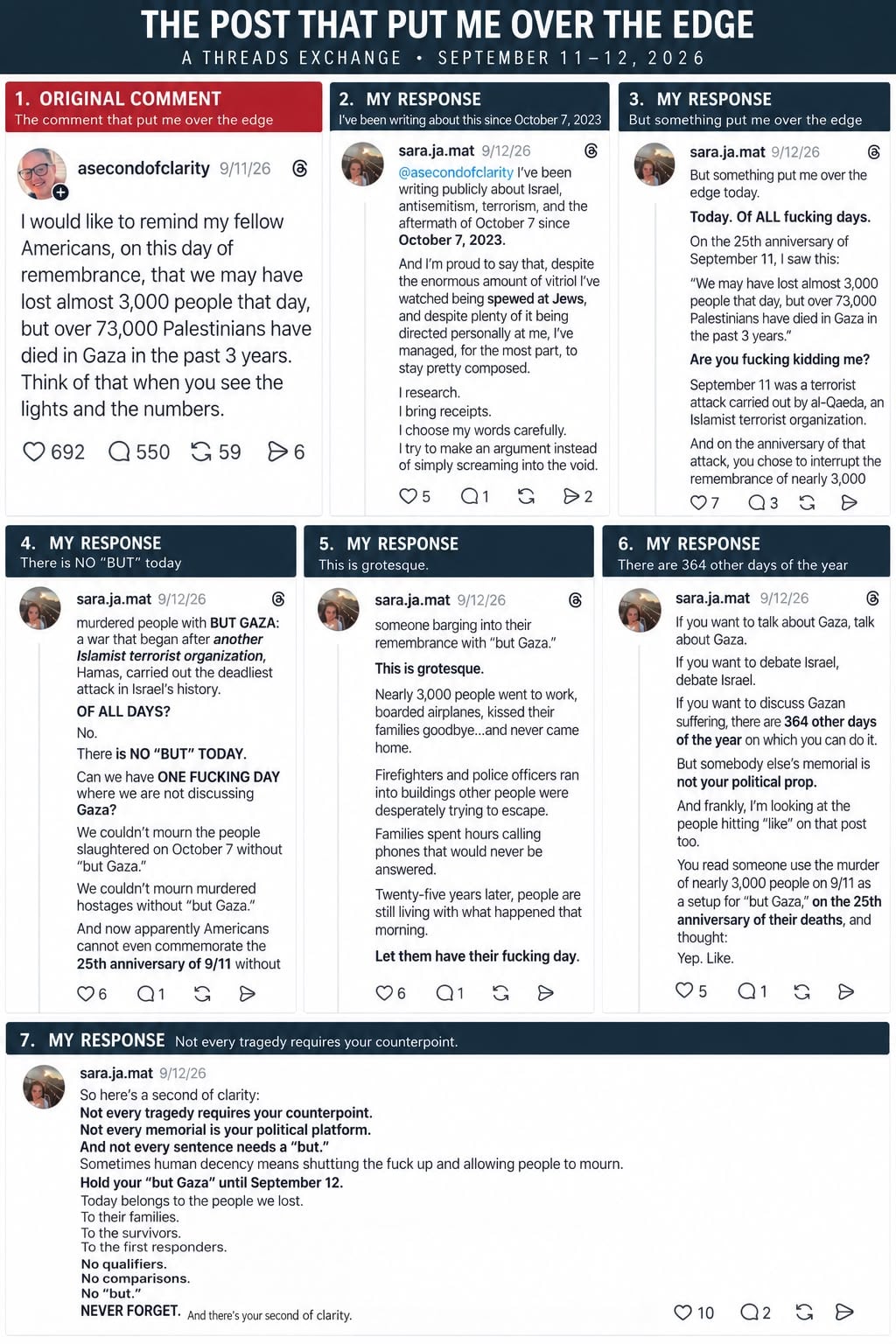
My objection wasn’t to empathy for Palestinians.
It wasn’t to criticism of Israel.
It wasn’t to examining American foreign policy.
It was considerably simpler:
Can the families of nearly 3,000 people deliberately murdered on September 11 have ONE FUCKING DAY without a “but”?
Apparently not.
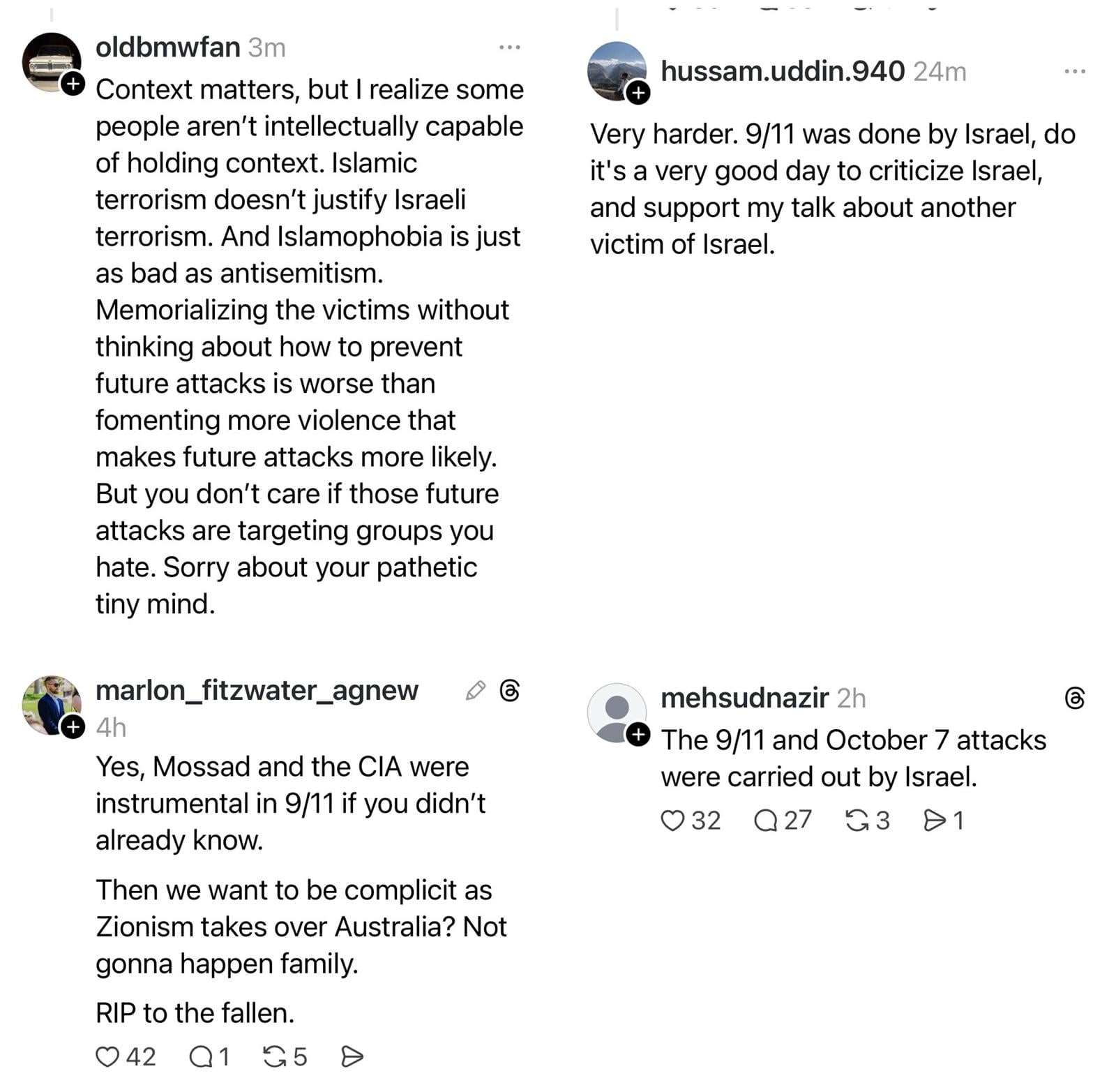 Some of what appeared on my feed on September 11, 2026.
MORAL CLARITY
Two days before the anniversary, Police Commissioner Jessica Tisch said something that stopped me.
“Preserving that history also means preserving its moral clarity.”
Then she said it plainly:
“The men who attacked this city were terrorists.”
Moral clarity.
There it was.
But context does not transfer responsibility for terrorism from perpetrator to victim.
Al-Qaeda carried out September 11.
Hamas-led terrorists carried out October 7.
Different organizations.
Different circumstances.
Twenty-two years apart.
In both cases, civilians were deliberately targeted.
And the board is useful precisely because it forces us to separate what is documented from what we infer.
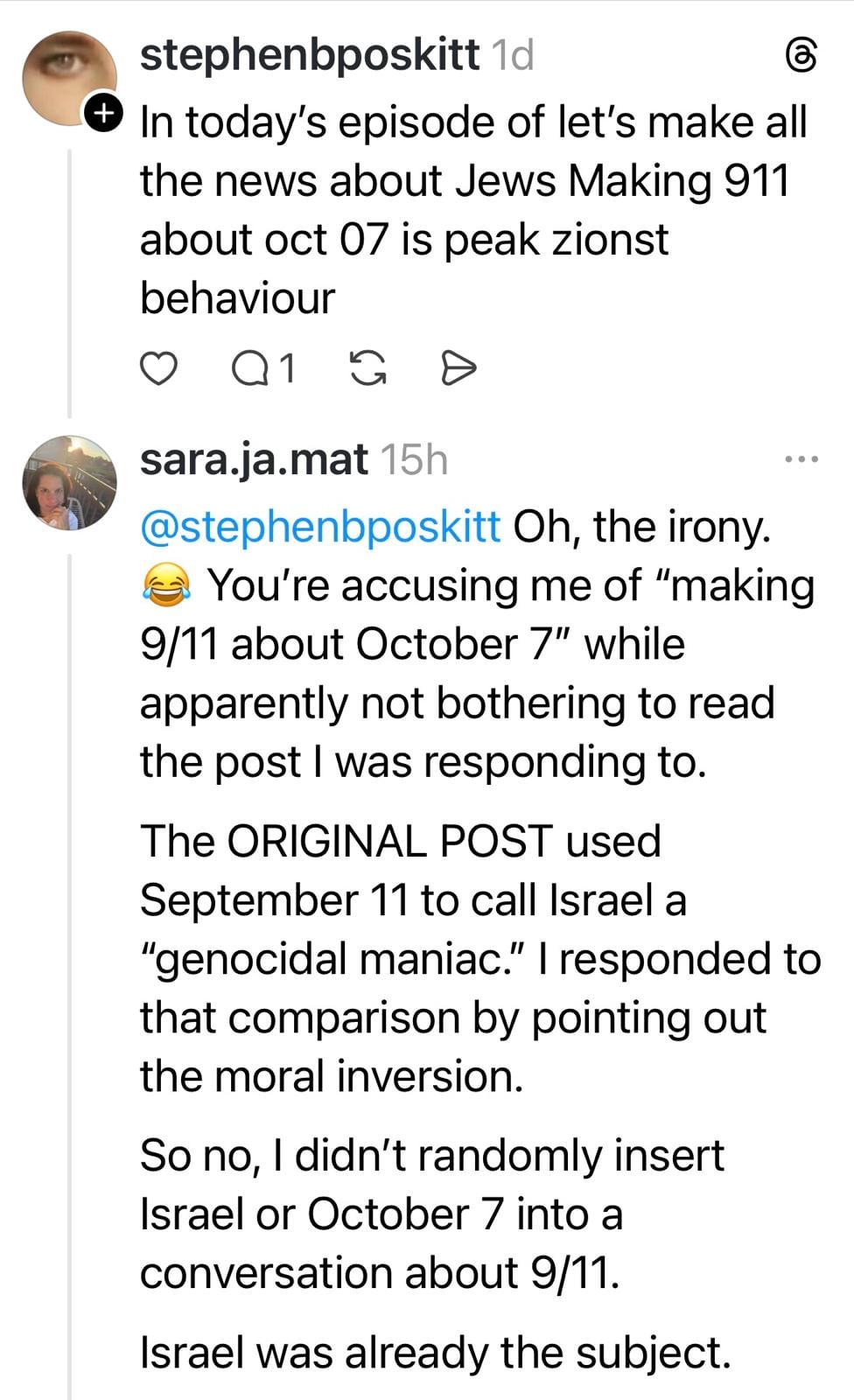
And neither does association automatically establish belief.
Which brings me back to one of the biggest receipts from Part III.
BOARD ONE: WHOSE “ASSOCIATION” COUNTS?
In Part III, I put two lawyers on the board: John Leventhal and Ramzi Kassem.
Mamdani rejected Leventhal over what he called “any association” with “the Epstein world.”
His own Chief Counsel, Ramzi Kassem, had represented an al-Qaeda member.
The full receipts are in Part III
Here, I only need Mamdani’s words:
“ANY ASSOCIATION.”
I’m sorry.
What am I supposed to do with that?
If the principle is:
Lawyers are not their clients.
Fine.
Then why was Leventhal rejected?
If legal representation itself can create an association significant enough to disqualify someone from sensitive government service—
why doesn’t that principle apply to Kassem?
You cannot give me both.
And there is another word on this board:
NEW YORK.
Because this isn’t Arizona.
This isn’t Idaho.
This isn’t some city whose relationship to al-Qaeda exists primarily in history books.
This is New York City.
Al-Qaeda attacked this city.
And twenty-five years later, families still stand at Ground Zero reading the names of the people they lost.
Again:
That does not make Kassem responsible for 9/11.
It does not make representing al-Darbi wrong.
But it makes Mamdani’s own “any association” standard impossible to ignore.
His words.
His appointments.
His board.
BOARD TWO: WORDS → CHALLENGE → RESPONSE
And once Mamdani gave that standard, I started noticing something else.
Not merely what he said.
What happened when someone challenged it?
2017 — HOLY LAND FIVE
Mamdani rapped:
“My love to the Holy Land Five. You better look ’em up.”
So I did.
Five former Holy Land Foundation officials were convicted on federal charges related to providing material support to Hamas.
Years later, the lyric was put directly to Mamdani.
I went looking for:
I was wrong.
I don’t believe that anymore.
My thinking changed.
I haven’t found it.
He was young.
People grow.
That’s precisely why the question isn’t only what he said then.
It’s what he says about it now.
“GLOBALIZE THE INTIFADA”
Mamdani initially declined to condemn the phrase.
Later, after conversations about how many Jews hear it, he said he would discourage its use.
Adjustment in language: YES.
Repudiation of the phrase: I haven’t found one.
Discouraging something is not the same as saying:
It is wrong.
I was wrong.
People should not say it.
Those are different things.
HASAN PIKER
During the October 2025 debate, Mamdani was asked about Hasan Piker’s statement that America “deserved” September 11.
Mamdani called it:
“objectionable and reprehensible.”
Condemned the statement: YES.
But months later, after an Eid dinner in 2026, Piker said Mamdani had not disavowed him.
Ended the association: NO.
I’m not saying Piker’s beliefs are Mamdani’s.
I’m asking something narrower:
What does “any association” mean when Mamdani himself gave us the phrase?
NOW GIVE ISRAEL THE BENEFIT OF THE EVIDENCE
In July, Mamdani called Benjamin Netanyahu the “architect of a horrific genocide against the Palestinian people.”
Genocide isn’t simply another word for enormous civilian suffering.
Under the Genocide Convention, it is a specific crime requiring prohibited acts committed with the intent to destroy, in whole or in part, a protected group as such.
So I want the analysis.
Where is your evidence of intent?
How did you weigh the evidence supporting that conclusion against evidence that complicates it?
What evidence could change your mind?
For example:
During the Gaza polio campaign, UNICEF reported that 558,963 children received a first vaccine dose during area-specific humanitarian pauses.
A second round reached 556,774 children.
Does that settle the genocide question?
No.
But if intent is an element of genocide, evidence potentially relevant to intent belongs in the analysis.
So does Hamas.
In 2023, senior Hamas official Mousa Abu Marzouk was asked why Hamas had constructed hundreds of kilometers of tunnels but not civilian bomb shelters.
He said the tunnels were built to protect Hamas fighters from Israeli aircraft and placed responsibility for protecting Gaza’s refugees on the United Nations. Read the CNN transcript.
Does one interview settle Gaza?
No.
That’s the point.
A conclusion this serious should survive the evidence that complicates it.
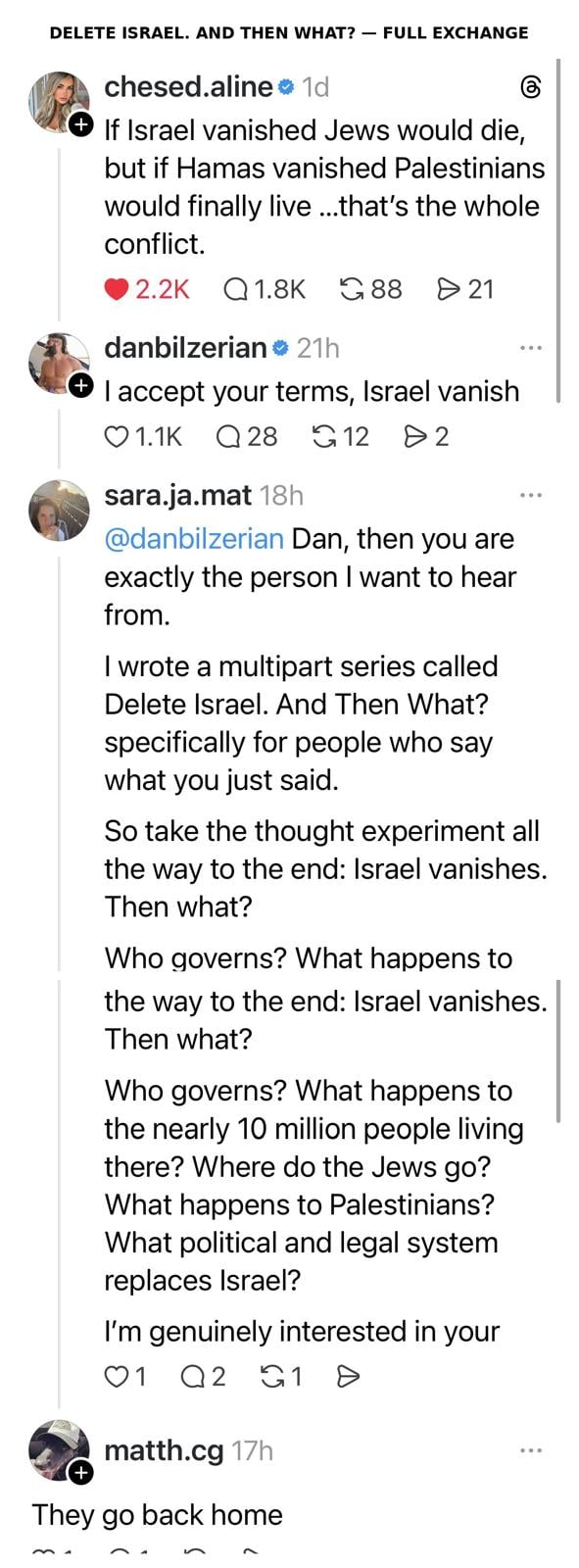 Delete Israel. And then what?
Which brings me to the question underneath almost this entire article:
WHAT EVIDENCE WOULD CHANGE YOUR MIND?
“I WILL PROTECT YOU.”
On January 1, Mamdani told New Yorkers:
“If you are a New Yorker, I am your Mayor.”
He promised to protect New Yorkers, celebrate with them, mourn alongside them and never hide from them.
MAY — ISRAEL DAY PARADE
Mamdani did not attend.
His administration and the NYPD prepared extensive security for the event.
Protection: YES.
AUGUST — THE RABBIS
Then Jewish leaders sat across from him at City Hall.
Rabbi Jonathan Leener said Mamdani was “genuinely engaging,” acting in good faith and listening carefully, particularly to their request to lower the temperature.
Rabbi Rick Jacobs said Mamdani’s rhetoric about Israel was causing Jews in New York to feel less safe and, in his view, putting them at risk.
Rabbi Rachel Timoner wanted Mamdani to make unmistakably clear that the Israeli government is not Jewish New Yorkers and that anger at Israel must never be directed at Jews here.
And Leener gave me the standard:
“Ultimately, I will judge him and his administration by their actions.”
So what happened after he listened?
SEPTEMBER 9
At the NYPD briefing ahead of the High Holidays, Commissioner Tisch put the antisemitism numbers on the record.
Confirmed antisemitic hate crimes were up.
Jewish New Yorkers—roughly a tenth of the city’s population—continued to represent a hugely disproportionate share of hate-crime victims.
Mamdani called the situation unacceptable.
His administration prepared additional security.
Condemnation: YES.
Security: YES.
And no—
those statistics do not prove Mamdani’s rhetoric caused an antisemitic attack.
I’m not going to make a causal claim I can’t prove.
What they do establish is the environment in which Jewish leaders were telling their mayor that they believed his rhetoric was adding to their vulnerability.
He met.
He listened.
Credit him.
But listening was never the final test.
SEPTEMBER 17
Ahead of Netanyahu’s expected visit to New York for the United Nations General Assembly, Mamdani said he would not participate in the anticipated protests.
But he also said:
“I’ve been very clear to New Yorkers about what I believe, what I see. I stand by what I’ve said.”
Because the rabbis weren’t merely asking the mayor to protect them from somebody else’s rhetoric.
They were asking him to examine his.
BOARD THREE: THE DAY-ONE PROMISE
“I WILL PROTECT YOU.”
Israel Day Parade security.
High Holiday security.
Condemnation of antisemitic attacks.
→ YES.
“I WILL CELEBRATE WITH YOU.”
Israel Day Parade.
His administration provided extensive security.
He did not attend.
His explanation:
“I’ve made my views on the Israeli government abundantly clear.”
He became the first sitting New York City mayor in more than 60 years to miss the parade.
→ PROTECT THEM: YES.
→ CELEBRATE WITH THEM: NO.
A mayor does not have to agree with a foreign government to show up for the New Yorkers whose heritage is being celebrated.
“I WILL MOURN ALONGSIDE YOU.”
September 11.
He showed up.
He remained through the reading of the names.
He attended additional memorial events.
He called September 11 terrorism.
→ YES.
“NEVER, NOT FOR A SECOND, HIDE FROM YOU.”
The rabbis challenged him directly about his rhetoric.
He met with them.
He listened.
Some credited him with engaging in good faith.
And later:
“I’ve been very clear to New Yorkers about what I believe, what I see. I stand by what I’ve said.”
→ HE LISTENED.
→ HIS STATED POSITION DID NOT CHANGE.
→ WHAT CHANGED?
SO WHAT WOULD CHANGE YOUR MIND?
Not one isolated quote.
Not one association.
Not one four-second video.
A series of moments in which a public position meets challenge, evidence or direct testimony.
Sometimes Mamdani changes the presentation.
Sometimes he condemns specific words.
Sometimes he listens.
Sometimes he provides security.
Sometimes he shows up.
All of that belongs on the board.
But after four articles, I keep looking for something different.
Where does new information cause the underlying conclusion itself to change?
Meeting is not reconsidering.
Listening does not tell me whether the underlying conclusion changed.
Discouraging is not repudiating.
Condemning somebody else’s statement is not ending an association.
Providing police protection does not answer a rabbi’s concern about your own rhetoric.
And after all of it:
“I stand by what I’ve said.”
So what evidence would change your mind?
You’ve seen the receipts. You’ve seen the sources. You’ve seen what helped my argument and what complicated it.
So here it is. All in one place.
THE BOARD
Four parts. His words. His record. His decisions. His responses.
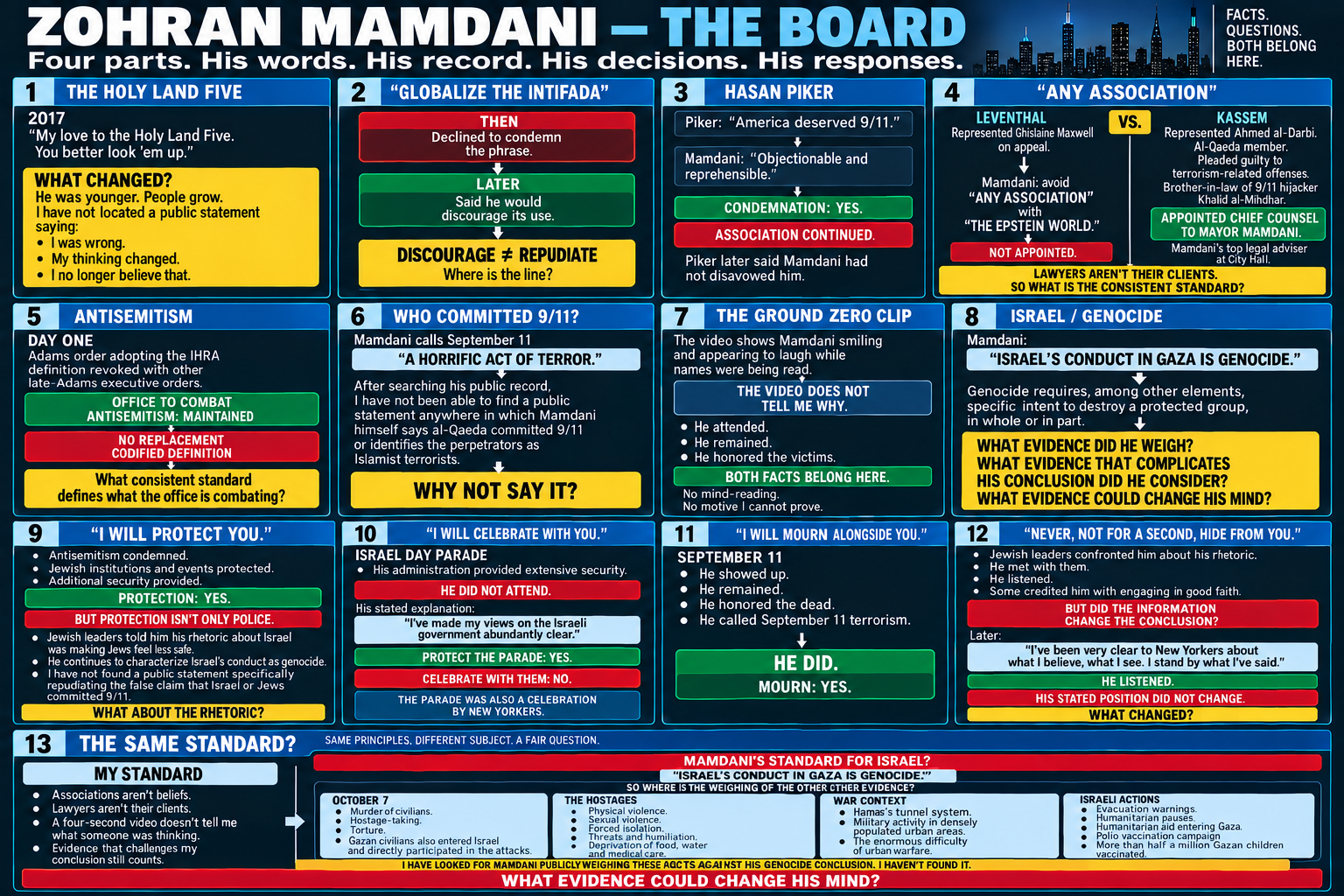 There it is.
Four parts.
One board.
The words.
The actions.
The decisions.
The questions answered.
And the ones that remain.
Some of that board supports what I have been questioning.
Some of it complicates it.
Good.
Because the board was never supposed to prove what I already believed.
It was supposed to keep me honest.
If the evidence helped my argument, it went up.
If it hurt my argument, it went up.
If I couldn’t prove it, it came down.
So now—
STAND BACK.
Look at the whole thing.
And maybe now you understand why I can spend hours staring at a single sentence.
Why I will change one word and then change it back.
Why I will follow a hyperlink to another hyperlink to an interview to a transcript because I need to know what someone actually said—not what somebody said they said.
Why something that would make my argument stronger sometimes has to come out because I cannot prove it.
And why something that makes my argument harder sometimes has to go in because I can prove it.
It can make me crazy.
It probably makes everyone around me crazy.
But I know exactly where I got it.
TRUTH MATTERS
There was supposed to be one more receipt in this article.
On September 11, my father was recovering from emergency surgery.
I sat beside him with my laptop open, still trying to finish Part IV.
 because apparently even my life comes with receipts.
When he woke up, one of the first things he asked me was:
“Did you get your work done?”
And then:
“How’s your article coming?”
I told him I was working on it.
I thought I had time.
Saturday, we brought him home.
A few hours later, an ambulance brought him back to the hospital.
Less than twenty-four hours later, my father suffered a massive heart attack.
He died before 2 p.m. Sunday.
I didn’t finish Part IV.
I wrote his eulogy instead.
I planned his funeral.
My daughter came home from college.
My son grieved his Papou.
We sat shiva for seven days.
For once, the article could wait.
My father was a Holocaust survivor and a professor.
He spent his life teaching history.
Not the history we wished had happened.
The history that did.
And somewhere in the middle of losing him, I finally understood why I can stare at one sentence for hours.
Why one word matters to me.
Why I need the original transcript.
Why I need the screenshot.
Why I need the receipt.
Why I will take something off the board that makes my argument stronger if I cannot prove it.
And why I will put something on the board that makes my argument harder if I can.
I got that from him.
When your father is a Holocaust survivor, history isn’t theoretical.
Facts aren’t decoration.
Words aren’t interchangeable.
My father understood what happens when facts are distorted.
When language is manipulated.
When repetition turns something false into something people simply accept as true.
He taught his students to question.
To check.
To look again.
And apparently, without ever announcing that he was teaching me the same lesson—
he did.
That’s why this board matters.
It isn’t there to make Mamdani look bad.
It isn’t there to make him look good.
It is there because it happened.
Because my father didn’t teach me how to win an argument.
He taught me that truth matters.
TRUTH MATTERS.
Not because truth guarantees agreement.
Because without it, disagreement is meaningless.
Mayor Mamdani gave New Yorkers a standard on Day One:
Protect you.
Celebrate with you.
Mourn alongside you.
Never hide from you.
Eight months later, there is evidence.
Some favorable.
Some uncomfortable.
Some contradictory.
Some still unanswered.
It’s all on the board.
And after four parts, I am left with the same rule I started with:
If it helps my argument, put it on the board.
If it hurts my argument, put it on the board.
If I can’t prove it—
take it down.
And then ask the question I’ve been asking since Part I:
Has Mayor Zohran Mamdani been the mayor he promised to be for all New Yorkers?
I told you I wasn’t going to tell you what to think.
I’m not going to start now.
New York, the evidence is yours.
And Dad—
I finished the article.
Related Topics