A Moroccan Journalist
Netanyahu wishes he were Israel’s Mahmoud Abbas
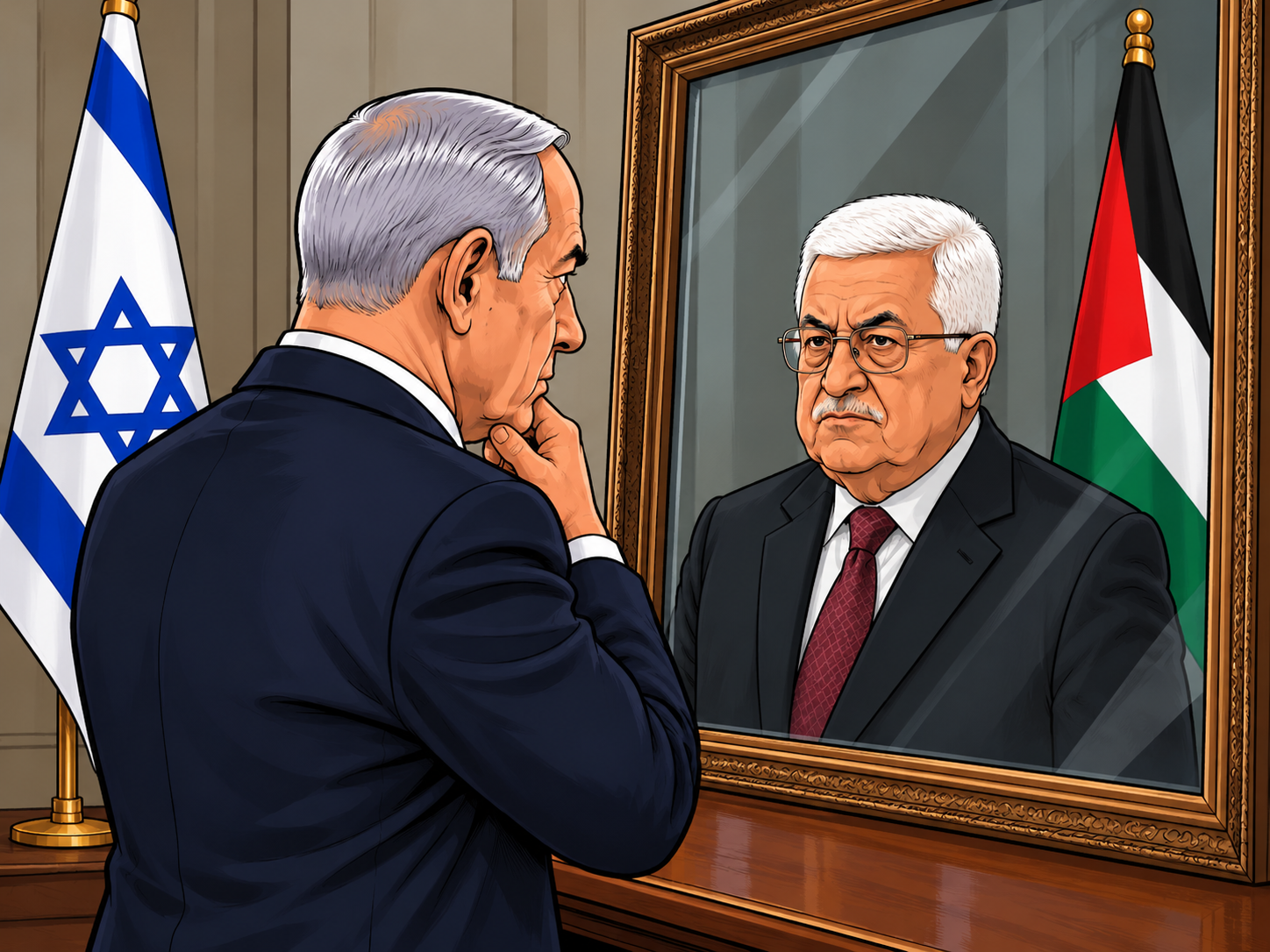
An AI-generated political illustration depicting Israeli Prime Minister Benjamin Netanyahu looking into a mirror and seeing Palestinian President Mahmoud Abbas, with the Israeli and Palestinian flags displayed behind them, respectively.
There is a quiet irony buried in the politics of this region, and it surfaced again this week. As Israelis cast their ballots in the Knesset elections still underway, Benjamin Netanyahu is doing the one thing the most powerful man in Israel cannot escape: standing before his own people and waiting to see whether they will keep him. Mahmoud Abbas, the man the world treats as the respectable face of Palestinian statehood, has not stood before his people in twenty-one years.
Think about that before anything else. Abbas was elected in 2005 to a four-year term. He is now in his third decade in office, ruling by decree; his original mandate expired so long ago that most Palestinians under thirty have never once had the chance to vote for or against the man who governs them.
This month he did it again. With a presidential and legislative vote finally scheduled, he signed a decree cancelling it and pushed the whole thing to September 2027. The Executive Committee of the Palestine Liberation Organization (PLO), headed by Abbas, said in a statement that the situation in occupied East Jerusalem, the West Bank, and Gaza did not allow for elections to take place. It also noted that Israel had prevented election materials and international observers from entering Gaza.
He had already scrapped a planned election in 2021, the moment polling suggested he might lose. The pattern is not subtle, and it does not require a generous reading or a hostile one. The man does not postpone elections because the conditions are wrong. He postpones them because the arithmetic is wrong, because somewhere a poll has told him what a ballot box would confirm, and he has decided he would rather govern without the answer than risk hearing it.
And so we arrive at the irony that should keep every honest observer awake. If Netanyahu could choose the political system he lives under, he would not choose Israel’s. He would choose Abbas’s. He would trade places in a heartbeat, for the arrangement where the leader never has to leave, never has to count the votes, never has to watch an opposition consolidate against him.
Netanyahu, for all the power concentrated in his office, still lives inside a democracy, which means the law sits above him and not the other way around. He cannot simply decree his problems away. There are courts he must answer to, a press that hounds him, a parliament that can collapse beneath him, and a date on the calendar he cannot move when it stops being convenient. Abbas answers to none of that. Netanyahu, right now, is being dragged in front of his electorate for the sixth time in a decade. Abbas has simply decided that elections are something that happen to other people.
I say this as a Moroccan, as an outsider to both societies, with no stake in which Israeli bloc wins tonight. What interests me is the thing underneath, this hunger for power that so many leaders display and that I confess I have never been able to understand.
Because power, stripped of its glamour, is just responsibility multiplied. A father lies awake over the weight of one household, the bills, the children, the thousand small fears of keeping a few people safe and fed. Multiply that by a nation. Multiply it by armies and borders and economies and the lives of millions. By every reasonable measure, winning an election should be met with dread, not celebration. It is the acceptance of an almost unbearable burden. Yet we watch these men weep with joy when the results come in, as if they have won something rather than shouldered something. I have never managed to make sense of it.
Netanyahu is 77 years old. He is already the longest-serving prime minister in his country’s history. He has held the office longer than some of the soldiers under his command have been alive. A reasonable man at that age, with that record, would be tired. He would want to rest, to hand it on, to spend whatever years remain as something other than a man perpetually campaigning for his own survival. Instead, he fights for one more term, and if the polls are to be believed, he fights uphill, against a public still carrying the wound of October 7 and the bitter aftertaste of the Iran war.
What is it for? What does a man that age, that decorated, that exhausted, still want from power that life has not already given him?
I have written before, and I will say it again plainly, that there is an argument Israel should simply have remained what the ancient Israelites once had, a kingdom, an openly hereditary throne. I do not mean this entirely as provocation. If a country is going to keep the same face at the top year after year, decade after decade, then at least a monarchy is honest about it. A monarchy does not insult you by staging a contest whose outcome somehow never changes. It says, this is our ruler, this is our line, and we make no pretense otherwise. There is a strange dignity in that honesty. What is harder to stomach is the democracy that performs the ritual of choice while delivering the same man forever, or worse, the Abbas model, which has dispensed with the ritual altogether and kept only the chair.
And I do not mean that the result is fixed in the crude sense, that something is rigged behind the curtain. I mean something stranger and harder to explain. Here is a man who has been investigated, indicted, blamed for the worst security failure in the country’s history, and governed through war after war, and still a large share of Israelis return to him, election after election, as though the country had run out of other names. At some point one has to wonder whether this is choice or something closer to a political Stockholm syndrome, a public so bound to its captor that it mistakes him for the only option left. A monarchy, at least, does not pretend the people keep arriving at the same man freely.
And here I will speak for more than myself. As Moroccans, as Arabs, as neighbors who have watched this region for a lifetime, we are simply tired of Netanyahu as the face of Israel. Not tired in the partisan sense, not rooting for one Israeli faction over another. Tired in the human sense. An entire generation on this side of the border has known no other Israeli prime minister who mattered. Give us a new face. Let the country show us that it can produce someone else, that the whole state does not rest on one aging man’s refusal to step aside. And if Israel genuinely cannot do that, if it is destined to keep returning the same leader regardless, then make it a monarchy and be done with it. At least then we would understand.
There is a deeper principle here that applies to leaders everywhere, not only in Jerusalem or Ramallah. You try a policy for a few years. That is enough time to learn whether it works. A term or two is a fair test of any leader, any program, any vision. By the end of it, the evidence is in, the record is written, and a healthy political culture reads that record and decides accordingly. What is unhealthy is the refusal to read it, the insistence on the same hands no matter what those hands have produced. Both of these men, in their different ways, embody that refusal. One by clinging past every expired mandate. The other by making himself so permanent that his country seems unable to imagine itself without him.
So let today’s vote in Israel be what it is, a rare and real thing in a region short on them. Whatever its result, the Israelis will at least have been asked. That alone places them ahead of the Palestinians under Abbas, who have not been asked in twenty-one years and will not be asked, if he can help it, for years still to come.
The bitter truth is that the leader so often painted as the regional strongman is the one who must bend to his people today. And the leader draped in the language of liberation is the one who has quietly made himself a king in all but name, without the honesty of a crown.
Netanyahu wishes he were Israel’s Mahmoud Abbas. The tragedy is that so many leaders, given the chance, would wish the very same thing.
Related Topics
Related Posts