Greek Jewish roots. New York voice. Unfiltered perspective.
NOW THE WOLF HAS THE KEYS
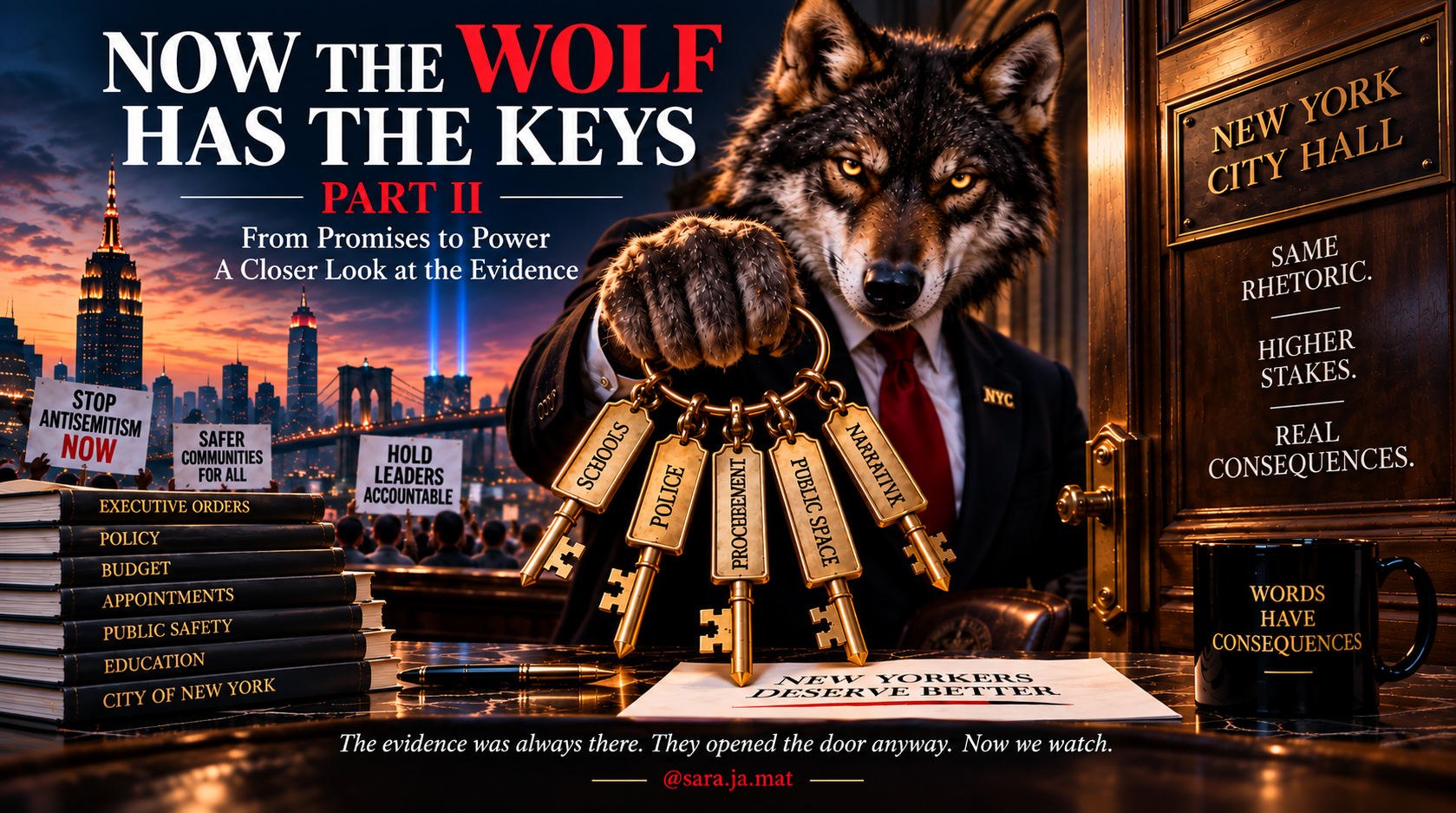
Zohran Mamdani spent years telling New Yorkers what he believed. Then New Yorkers gave him power. Now the question isn’t simply what he believes. It’s what happens when belief becomes government.
This is Part II of a four-part series examining Zohran Mamdani’s political formation, record and first months governing New York City.
THE HYPOTHETICAL IS OVER
Part I ended at the door.
New Yorkers opened it.
They handed him the keys.
So now we stop asking what Zohran Mamdani might do with power.
We look at what he did.
Actions are stronger evidence than associations.
DAY ONE
January 1, 2026.
Mamdani’s first day as mayor.
His first executive order, Executive Order 1, was broad.
It continued executive orders issued before September 26, 2024, unless later revoked, revised or superseded, and revoked those issued on or after that date that remained in effect on December 31, 2025.
That distinction matters.
Mamdani did not issue an order titled:
REVOKE JEWISH PROTECTIONS.
EO1 was a blanket, date-based repeal.
But blanket decisions still have specific consequences.
Among the Adams-era directives swept away was Executive Order 60, which prohibited discriminatory procurement targeting Israel, Israeli citizens or entities associated with Israel. It also directed mayoral pension representatives, consistent with fiduciary obligations, to oppose divestment undertaken for the purpose of discriminating against Israel.
Gone.
Also swept away was Adams’s adoption of the International Holocaust Remembrance Alliance working definition of antisemitism.
Gone.
And Mamdani did not replace IHRA with another codified definition.
Maybe you dislike IHRA.
Fine.
There is legitimate debate over whether some of its examples blur the line between criticism of Israel and antisemitism.
Then replace it with something better.
That didn’t happen.
Months later, Phylisa Wisdom, Mamdani’s appointee to lead the Mayor’s Office to Combat Antisemitism, testified that the administration did not believe a codified definition was necessary:
“We don’t believe that there needs to be a codified definition at all.”
Which leaves me with a very basic question:
How do you create an office to combat antisemitism without establishing a clear standard for what antisemitism is?
Seriously.
How do city employees know when they’ve encountered it?
Where does anti-Zionism cross into antisemitism?
And perhaps most importantly:
How do you know whether your own words or policies have crossed the line if your administration refuses to say precisely where the line is?
That makes no sense to me.
You can reject IHRA.
Fine.
Then give me your definition.
Draw the line somewhere.
Because “we combat antisemitism” means considerably less if nobody is willing to establish what qualifies as antisemitism.
And considering Mamdani’s longstanding positions on Zionism and Israel, New Yorkers are entitled to ask:
Why remove the existing definition at all?
What specifically was objectionable?
What standard should city agencies use instead?
And most simply:
What replaced the thing you removed?
PUT THE OTHER EVIDENCE ON THE BOARD
Because Mamdani did something else on Day One.
Executive Order 2 preserved the Mayor’s Office to Combat Antisemitism.
That matters.
Give him credit for it.
And he subsequently appointed Wisdom to lead it.
Don’t erase that because you dislike Mamdani.
And don’t use it to erase what EO1 did.
Both happened.
Wisdom previously led New York Jewish Agenda, a progressive Zionist organization that opposes BDS and supports Israel’s right to exist as a Jewish state.
Put that on the board too.
In August, Mamdani’s antisemitism office convened rabbis to discuss Jewish safety and the impact of his rhetoric. The room included Reconstructionist, Reform, Conservative, Modern/Open Orthodox and unaffiliated voices.
It wasn’t simply a room full of people agreeing with him.
Rabbi Rick Jacobs, president of the Union for Reform Judaism, came out with a rather extraordinary message for the mayor:
But major rabbinic bodies, including the New York Board of Rabbis, representing more than 750 rabbis across denominations, and the Rabbinical Council of America were not invited.
That raises a broader question:
How broad is the Jewish room?
Because diversity isn’t merely denominational.
It’s ideological too.
A progressive Jewish organization may hear anti-Zionism and draw one boundary around antisemitism.
A family whose son serves in the IDF may draw another.
A Holocaust survivor may hear it differently still.
You need the uncomfortable voices too.
The people who voted against you.
The people who believe your own rhetoric is part of the problem.
Especially them.
Otherwise you risk building:
An echo chamber with a mezuzah on the door.
THE ISRAEL GUARDRAIL
Now go back to Executive Order 60.
Mamdani supports BDS.
That’s not speculation.
He has supported boycotting and divesting from Israel for years.
And on his first day as mayor, a city directive specifically protecting Israel-related procurement and investments from discriminatory boycott and divestment disappeared.
That does not prove Mamdani ordered New York City to boycott Israel.
I found no evidence that he has.
Put that on the board.
But the removal isn’t politically meaningless either.
A mayor who supports BDS now leads an administration without a guardrail specifically designed to prevent discriminatory BDS activity in city procurement and pension policy.
Mamdani is entitled to oppose Israel.
He is entitled to support BDS.
But the mayor’s obligation is larger than his ideology.
If an Israeli company offers New York City the best product at the best price, his anti-Zionism should be irrelevant.
If an investment involving Israel is financially sound and serves New York City retirees, his support for BDS should be irrelevant.
Because once personal ideology begins determining how public money is spent, invested or withheld, it isn’t personal anymore.
It becomes government policy.
That’s when ideology stops being something Mamdani is entitled to believe and becomes something New Yorkers may be required to live under.
The question isn’t whether Mamdani is allowed to believe in BDS.
Of course he is.
The question is whether New Yorkers will ever be asked to pay for those beliefs.
In contracts.
In jobs.
In investment opportunities.
In pension returns.
And that is why the disappearance of this particular guardrail matters.
THEN CAME THE ISRAEL DAY PARADE
And since I am supposedly trying to keep this article contained, I’m not spending another 500 words telling you what I saw on Fifth Avenue.
I already did.
I posted about it publicly on Facebook that night, photographs and all. Days later, the same account appeared in my June 4 Nassau Herald column, “We Came to March, We Stayed to Shine.”
 Nassau Herald, June 4, 2026, p. 5. “We came to march, we stayed to shine.”
So I’ll let May 31 Sara tell you what the day felt like in real time.
Here is what matters now.
The NYPD showed up.
Governor Kathy Hochul showed up.
Senator Chuck Schumer showed up.
Tens of thousands of New Yorkers showed up.
The mayor did not.
Mamdani had announced beforehand that he would not attend, breaking with a decades-long mayoral tradition, although his administration provided extraordinary security for the event.
Give his administration credit.
Seriously.
I was there.
The security was extraordinary.
But security and presence are two different things.
Put his explanation on the board.
But the parade wasn’t Benjamin Netanyahu.
It was New Yorkers.
And this is where another dot matters.
On August 9, Mamdani personally attended Brooklyn’s Pakistan Day Mela.
He told the crowd he saw “a community of New Yorkers who have helped to make this city what it is,” praised their pride in their Pakistani roots and said:
“It is such a pleasure to be here.”
Good.
That’s exactly what a mayor should do.
He doesn’t have to agree with every action of Pakistan’s government to show up for Pakistani New Yorkers.
And he shouldn’t have to agree with every action of Israel’s government to show up for Jewish and Israeli New Yorkers either.
You’re allowed to hate Israel’s government.
You’re allowed to hate its policies.
You’re even allowed to believe Israel shouldn’t exist as a Jewish state.
But you’re still the mayor of the people marching up Fifth Avenue.
And that brings me to the New Yorker reading this who is thinking:
Fine, Sara. But I don’t care about Israel.
Fair enough.
Do you care about your paycheck?
Because this is where what looks like a foreign-policy argument becomes a New York City issue.
Israel isn’t merely a political argument happening thousands of miles away.
Israeli companies employ New Yorkers.
And once the mayor’s views about Israel intersect with procurement, investment and public money, the question isn’t only what you think about Israel.
It’s what those beliefs could mean for New York.
WHEN FOREIGN POLICY COMES HOME
In May 2025, New York City and Israel established the NYC-Israel Economic Council to deepen commercial relationships.
According to a 2025 economic-impact report cited by city government, 590 Israeli-founded companies operated in New York City.
They directly employed approximately 27,471 people.
They supported approximately 50,648 total jobs.
They generated approximately $8.1 billion in earnings and $17.9 billion in gross economic output.
Disclosure matters.
The underlying analysis came from the United States-Israel Business Alliance, an organization whose mission includes strengthening economic ties between the United States and Israel.
You should know that when evaluating the figures.
But you should also know that New York City’s own government cited them.
Israeli companies employ New Yorkers.
They pay New York salaries.
They rent New York offices.
Now the conversation about BDS becomes considerably closer to home.
YOUR PENSION IS NOT A PROTEST SIGN
Here’s another place where I need to correct an easy exaggeration.
The mayor cannot simply wake up tomorrow and decide:
Sell Israel.
That’s not how the pension system works.
And he cannot personally reach into every city agency and cancel every contract involving an Israeli company.
That’s not how procurement works either.
Good.
Put that on the board.
Because I don’t need Mamdani to possess powers he doesn’t actually have in order to examine the powers he does.
And he does have power.
Not unilateral control.
Influence.
A seat at the table.
Appointments.
Policy direction.
Mamdani appointed Ahmer Qadeer as his representative to the New York City pension systems. Those funds operate through boards and fiduciary structures; the mayor cannot unilaterally order divestment.
Your pension is not a protest sign.
But appointments still matter because the people sitting at those tables help shape discussions, votes and policy.
The same distinction applies to procurement.
The mayor doesn’t personally award every city contract.
But the Procurement Policy Board has five members.
Three are appointed by the mayor.
Two by the comptroller.
The mayor’s appointee serves as chair.
Again.
Not absolute control.
Influence.
And remember what disappeared on Day One.
Executive Order 60 had directed city agencies to avoid discriminatory procurement practices targeting Israel and directed mayoral pension representatives to oppose discriminatory divestment.
Mamdani’s blanket repeal removed that guardrail.
Does that prove New York City has begun boycotting Israeli companies?
No.
I found no evidence that it has.
Does removing the guardrail become irrelevant simply because no boycott has happened?
Also no.
That’s the point.
I am not asking what Mamdani has secretly done.
I’m asking what governmental architecture now exists around a mayor who has publicly supported BDS.
What protections remain?
Who has influence?
Who gets appointed?
What happens next?
Those are governing questions.
And unlike the questions in Part I, we don’t have to speculate forever.
We can watch.
Related Topics
Related Posts