Greek Jewish roots. New York voice. Unfiltered perspective.
October 7 Didn’t Give Me A Voice. It Taught Me What My Voice Was For
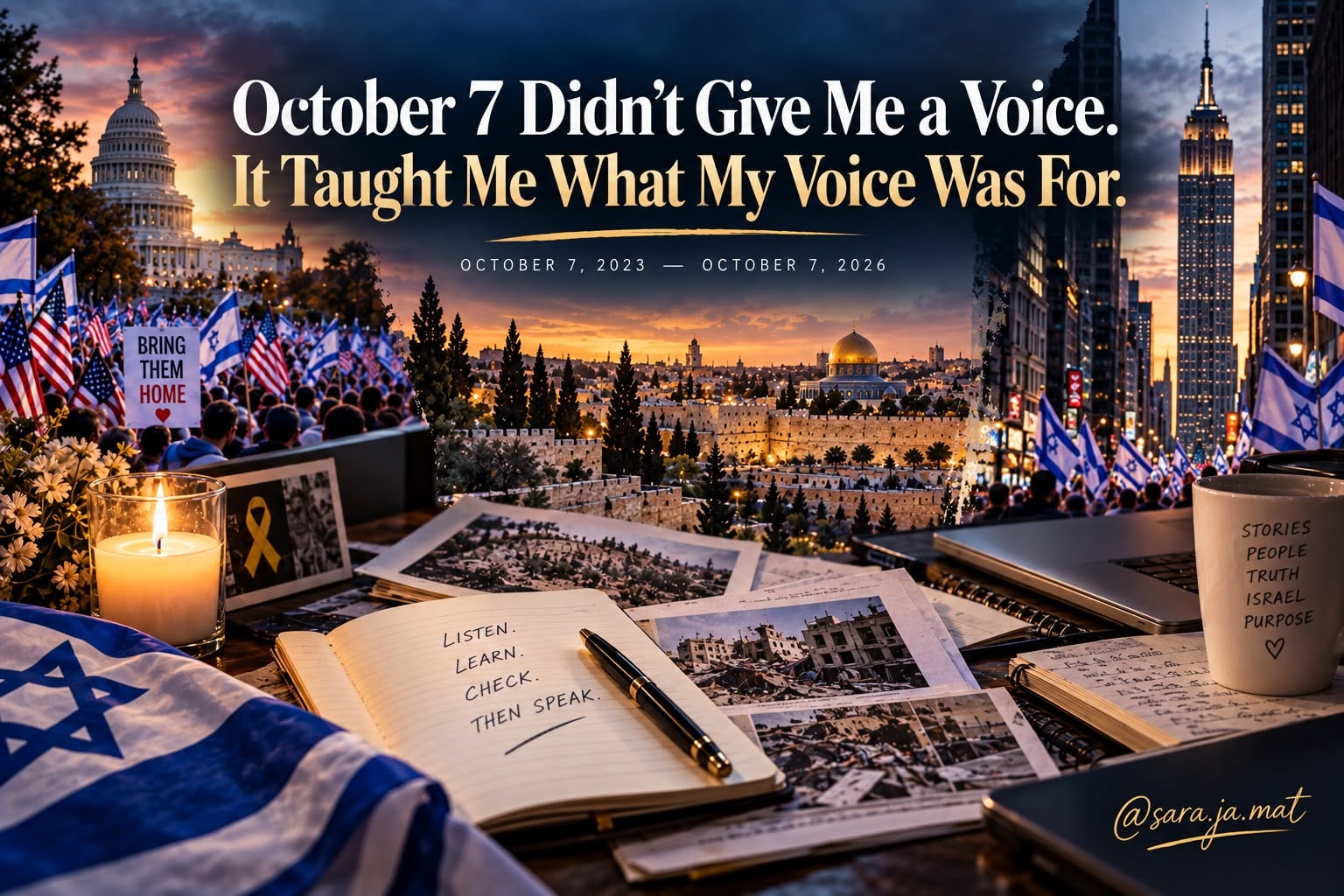
Three years ago, I wrote a sentence I did not yet understand.
“We must find our unique ways never to remain silent when faced with injustice.”
It was November 2023, weeks after October 7, and I had just returned from the March for Israel in Washington, D.C.
On November 14, my mother’s 73rd birthday, I boarded a bus for Washington despite people warning me not to go.
Their concern was not irrational.
In the weeks after October 7, we had already watched demonstrations across the country descend at times into intimidation, vandalism and violence. We had heard horrific rhetoric shouted openly in American streets. Being visibly Jewish in a public space suddenly felt different.
I was also the sole parent caring for two school-aged children at the time.
What if something happened?
I went anyway.
And what I found in Washington was something entirely different.
Nearly 300,000 people gathered peacefully on the National Mall. American flags. Israeli flags. Prayer. Tears. Singing.
Am Yisrael Chai.
Families of hostages stood before us and spoke about the people they loved who had been dragged into Gaza. And hundreds of thousands of people answered them with a chant that had nothing to do with killing anyone else.
Bring them home.
Bring them home.
Bring them home.
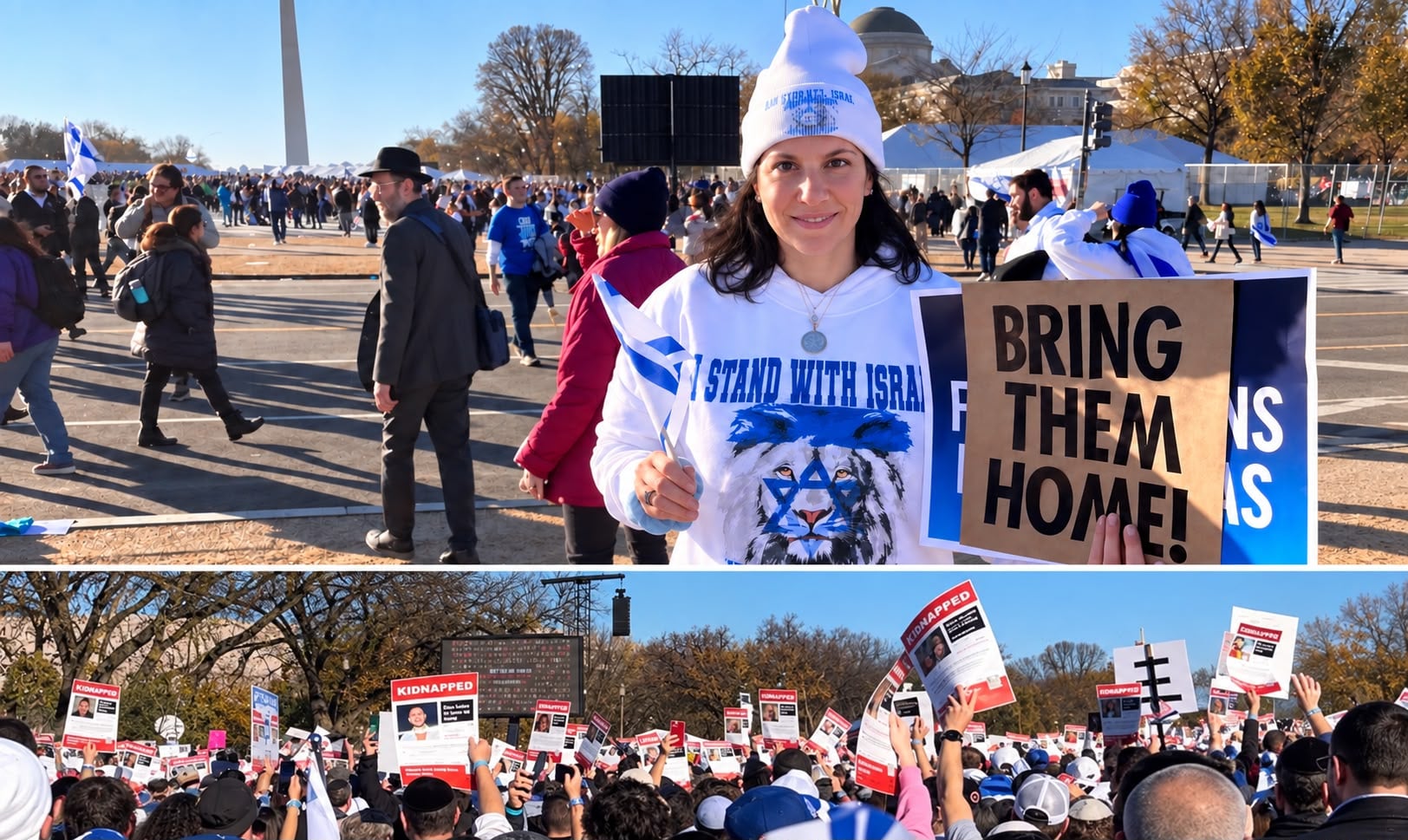
At the rally in Washington, DC., holding a message that brought us together: “Bring Them Home.” Below, my view from within the crowd, as photographs of the hostages were raised above our heads.
In the article I later wrote about that day, I began:
“I don’t know if there has even been a day in my life that I have been more proud of being a Jew than today.”
I wrote something else too.
I felt safe.
Actually, I wrote that I felt “a true sense of safety, a feeling not felt since Oct. 6.”
Looking back now, I realize November 14 was the beginning of something.
At the time, I thought I was writing about a rally.
I think I was writing instructions to myself.
People Warned Me Again
Eight months later, people warned me not to go to Israel.
There was a war.
It was dangerous.
Why would I go now?
But I knew I was going.
I traveled to Israel in July 2024 with TJJ for Moms – The Jerusalem Journey, an NCSY program that brings Jewish mothers to Israel to deepen their connection to the land, their Jewish identity and one another, and then bring that experience home to their families.
During the organized portion of our trip, we traveled with security. We met October 7 survivors, IDF soldiers and families whose loved ones had been murdered or taken hostage.
I stood at the site of the Nova music festival and tried to reconcile the quiet landscape in front of me with what had happened there.
Young people had gone there to dance.
To listen to music.
To be young.
At Hostage Square, I listened to families tell stories no family should ever have to tell.
At Har Herzl, I walked among graves so new that the men and women beneath them seemed barely old enough to have begun their adult lives.
In Sderot, I met Ayala Shakuri.
Her daughter, First Sgt. Mor Shakuri, had been killed fighting Hamas terrorists during the battle for the Sderot police station on October 7. I would later wake to the news that Ayala’s husband, Roni, had been murdered too.
At Yad Vashem, a question I had carried since childhood came back to me.
I am the daughter and granddaughter of Holocaust survivors. I grew up learning what happened to European Jewry and wondering the question children inevitably ask:
How could people have let this happen?
In a post from Israel that day, I wrote that I had finally come full circle in understanding the “how.”
Bystanders sit by.
People remain silent.
And suddenly the words I had written after Washington: “We must find our unique ways never to remain silent when faced with injustice” felt less like something I believed and more like an obligation.
But Israel gave me something else too.
Because after the TJJ Moms tour ended, I stayed.
For another month.
And I felt safe.
I walked the streets. I ate in restaurants. I sat in cafés. I went to the beach. I talked to strangers. I watched families live their lives.
I saw a country grieving and fighting and worrying about sons and daughters at war—and still living.
That month taught me something I have never forgotten:
Survival is not merely refusing to die.
It is insisting upon living.
Israelis are remarkably good at that.
Then I Went Back to Sheba
During my TJJ Moms trip, we visited wounded IDF soldiers undergoing rehabilitation at Sheba Medical Center at Tel HaShomer.
After the organized tour ended, I stayed in Israel. Later, I returned to Sheba with a friend.
Within seconds of walking in, I met retired IDF Major Sagi Dovev.
He offered to show us around.
I said yes.
And that yes would end up traveling all the way back to New York.
Sagi brought us through the hospital, and I met wounded IDF commander Omri. I listened to his story. I watched what Sagi was doing with wounded soldiers and began to understand that rehabilitation continues long after a battle disappears from the news.
Sagi would go on to found House of Heroes, dedicated to the physical and emotional rehabilitation of Israel’s wounded.
But standing in Sheba that day, I remember thinking something much simpler:
People back home need to hear this.
So I did something that, in retrospect, has become rather characteristic of me.
I invited Sagi to New York.
He came.
He stayed in my home.
And suddenly a story I had encountered thousands of miles away at Sheba Medical Center was sitting at my table on Long Island.
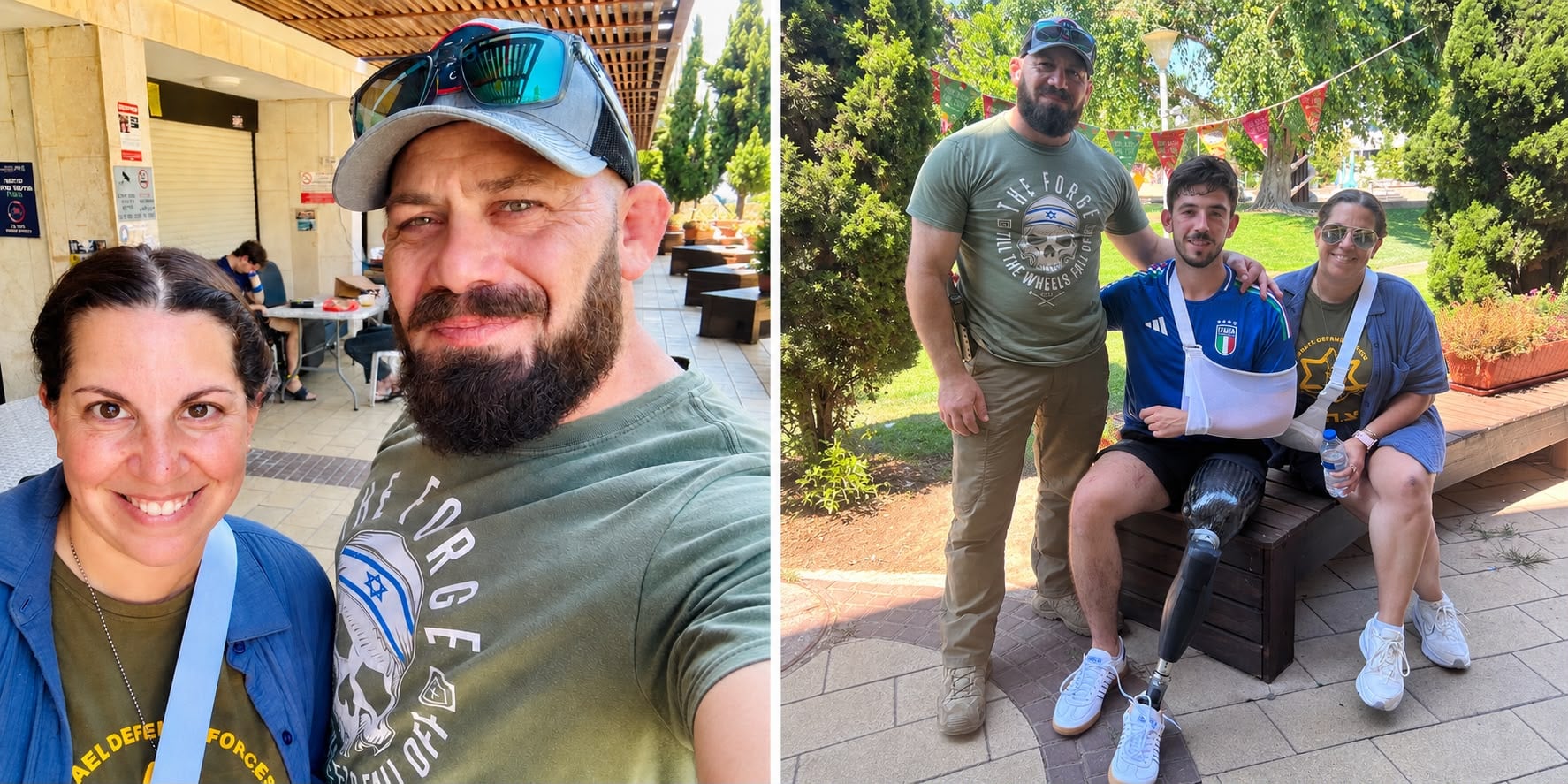 With Sagi at Sheba Medical Center, Tel Hashomer, in 2024. At right, Sagi and I visiting wounded IDF commander Omri.
On August 1, 2024, I helped bring that story into my community at the Israel Chesed Center in Hewlett. Sagi spoke alongside wounded IDF commander Yonatan Ben Hamou about October 7, injury, resilience and recovery.
The evening was later covered by the Nassau Herald in “IDF soldiers share stories of resilience at Hewlett Chesed Center event.”
But neither Yonatan’s story nor his work ended there.
His own experience navigating life after a devastating combat injury eventually led him to found https://care4heroes.org, which helps wounded Israeli soldiers access rehabilitation, prosthetics, surgeries and long-term support as they rebuild independent lives.
In a coming Times of Israel piece, I will tell you much more about Yonatan.
For now, meet him here.
Because the newspaper clipping was never the point.
The point was that people listened.
Something had begun to repeat itself.
I would meet someone, listen and learn. Then I would find a way to bring the story home, put people in a room, raise money, write, speak.
And then do it again.
I began to understand that activism does not always begin with a grand plan.
Sometimes it begins by recognizing the person standing in front of you and asking one question:
What can I do with this?
Sometimes, apparently, my answer is: Come stay at my house. We’re doing an event.
People Warned Me Again
By June 2026, I had heard the warning before.
When I planned to attend the Israel Day on Fifth parade in Manhattan, people once again worried about whether it was safe.
I went.
Surrounded by people openly carrying Israeli flags and celebrating their Jewish identity, I reported afterward that I had never felt safer.
 At the Israeli Day Parade in New York City, wrapped in the Israeli flag and singing along with Israeli singer and IDF paratrooper reservist Noam Buskila, a moment of joy, pride and togetherness.
Three years.
Three warnings.
Washington.
Israel.
Fifth Avenue.
And each time, I went.
Not because danger is imaginary. My family knows better than most what happens when danger to Jews is dismissed.
But there is a difference between recognizing danger and allowing fear to determine the boundaries of your life.
I refuse to give fear that much power.
Then I Started Writing
Somewhere along the way, speaking became writing.
And writing became something more than expression.
It became responsibility.
I began writing publicly about Israel, antisemitism and Jewish identity with increasing frequency after October 7. Eventually that work brought me here, to The Times of Israel.
The subjects changed, but something underneath them did not.
In “What Does Free Palestine Actually Look Like If It Wins?”, I took a slogan I kept seeing, “Delete Israel,” and asked what it would actually mean if carried to its conclusion.
In “The Celebrity Megaphone and the Morning After”, and later in the sequel I apparently needed to write, I asked what responsibility comes with broadcasting claims about Israel to millions of people.
For Israel Votes, Part II, I asked Israelis in Israel and abroad; soldiers, immigrants, first-time voters and people who had been voting for decades, what they actually wanted from their country after October 7.
And while examining politics in New York, I developed a rule that has become almost annoyingly simple. I eventually put it plainly in “Moral Clarity: Put It All on the Board.” If I can prove it, put it on the board.
If I can’t, take it down.
If evidence helps my argument, it goes on the board.
If it hurts my argument, it goes on the board too.
Because being loud is easy.
Being accurate requires work.
That distinction matters to me.
I have no interest in being loud simply for the sake of volume.
Listen.
Learn.
Check.
Then speak.
And when you speak, don’t whisper simply because someone would prefer that you did.
My Parents Gave Me My Voice
There is something I understand now that I could not have understood when I boarded that bus on my mother’s birthday in 2023.
October 7 did not make me Jewish.
It did not make me a Zionist.
And it did not teach me to stand up.
My parents had already done that.
My father, Professor Asher J. Matathias, was born in Greece in 1943 while his parents were hiding from the Nazis.
He survived because people made choices.
His parents chose to hide. Greek Christians Phroso and Yiorgos Stamos chose to protect them. And when a Nazi soldier discovered my father and his mother hiding in a cave, he made a choice too.
He looked away.
My father lived.
He grew up, came to America, became a professor, wrote, taught and sang.
G-d, did he sing.
Together with my mother, Anna, he raised three daughters who were never confused about who they were.
We were Jews.
Loud and proud ones.
For most of my life, that was simply part of my identity.
After October 7, it became an assignment.
On September 13, 2026, my father died.
Twenty-four days before the third anniversary of October 7.
Only days later, while sitting shiva, I wrote “Ha’azinu: When The Song Doesn’t End”.
My father had been known as “The Singing Professor.”
That week, the Torah gave me Ha’azinu.
Listen.
I wrote then that a person can leave this world, but the song does not.
Three weeks later, approaching October 7 without my father for the first time, I understand something else.
Neither does the responsibility.
Dad, I Have It
On November 14, 2023, Mom’s birthday, I stood in Washington with both of my parents still alive.
In the article I wrote afterward, I said that being there affirmed “my family’s legacy of resilience and strength.”
I ended that piece with words I could not have known I was writing to myself:
“We must find our unique ways never to remain silent when faced with injustice.”
For three years, I thought I was finding my voice.
Now I understand that I was learning what to do with the one my parents had already given me.
Listen.
Learn.
Ask questions.
Check the facts.
Tell the stories people entrust to me.
And then speak.
Sometimes loudly.
Okay, usually loudly.
My parents would expect nothing less.
October 7 did not give me a voice.
My parents did that.
October 7 taught me what my voice was for.
My father spent his life telling the story of where he came from, teaching his students, defending the Jewish people and making sure his daughters understood what had been entrusted to us.
Now it is my turn.
The torch does not disappear when the person carrying it dies.
Someone else has to pick it up.
Dad, I have it.
Related Topics
Related Posts