
Russian-American-Israeli Palestinian. Palestine is Israel.
Palestine Is to Israel What Persia Is to Iran
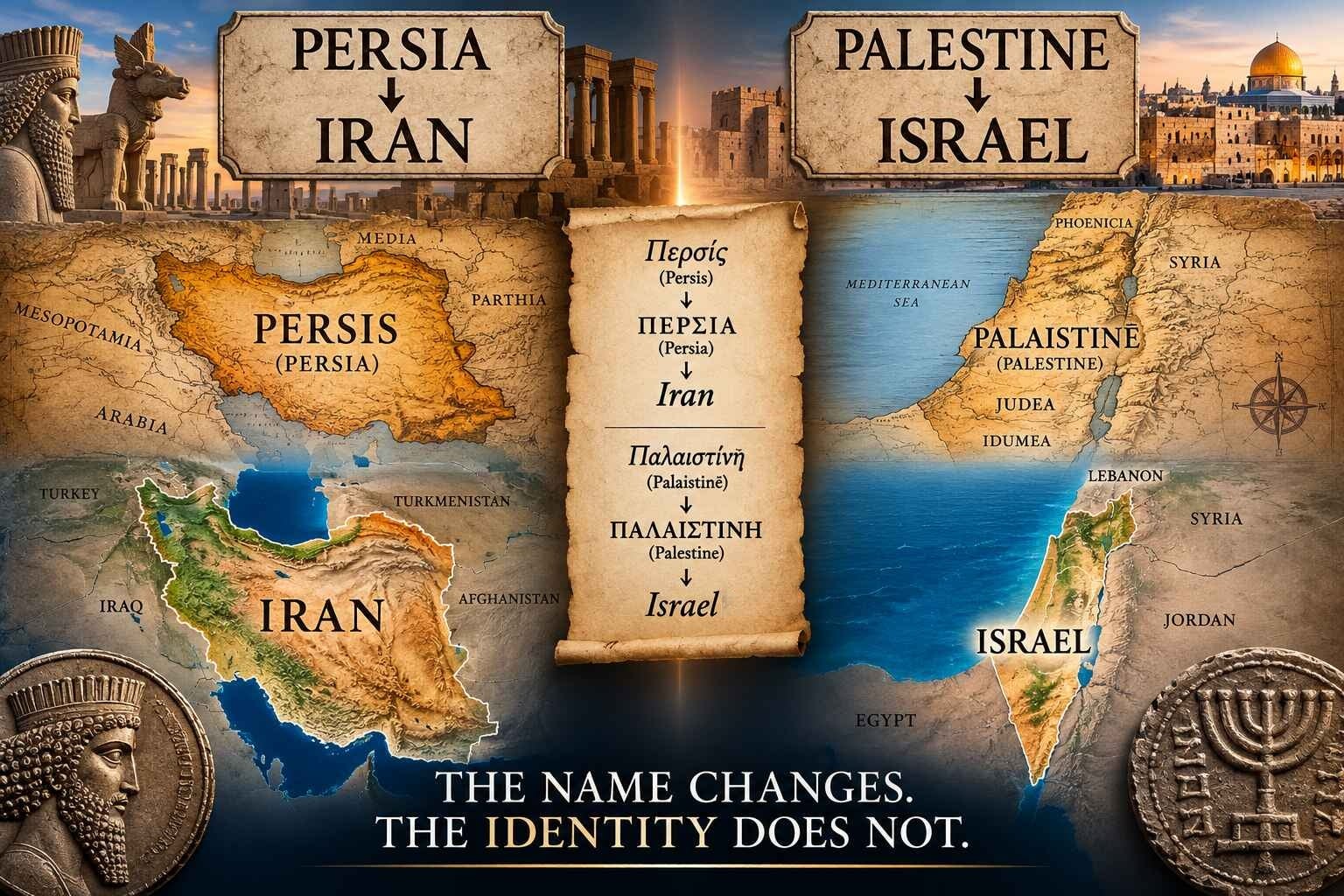
Palestine is to Israel what Persia is to Iran. The name changes. The identity does not. Image © Ivan Bassov, 2026. Licensed under CC BY 4.0.
Palestine Is Israel. Persia Is Iran. And Cows Eat Hay.
Palestine is to Israel what Persia is to Iran.
That simple parallel exposes one of the greatest identity distortions in modern history.
Persia = Iran.
Palestine = Israel.
Different names. Same land.
And in both cases, the name used by outsiders obscured the name by which the people themselves understood their country.
Persia Was Iran
For centuries, Europeans called Iran Persia.
The name came through the ancient Greek Persis, associated with Pārsa and the region of modern Fars. Greeks used it. Romans used it. Western civilization inherited it.
But the country itself was Iran.
The name Iran has ancient Iranian roots and is traditionally understood as meaning the land of the Aryans.
Aryan, meaning “noble,” was an ancient Indo-Iranian self-designation, later transformed by 19th- and 20th-century European racial theorists and ultimately adopted by the Nazis as a supposed biological racial category representing a “master race.”
Whatever the history of the competing names, the historical point is simple:
Persia was the foreign name. Iran was the native name.
In 1935, Reza Shah Pahlavi formally requested that foreign governments use Iran rather than Persia in official international communications.
Iran did not suddenly appear in 1935.
The Iranian people did not suddenly appear.
The land did not move.
The civilization did not disappear.
The name changed.
And everyone understood what happened:
Persia was Iran.
The old name did not create a different country.
The new name did not create a new people.
It simply restored the country’s native name to international usage.
Now Look at Palestine
The same principle applies to Palestine.
The ancient Greek Palaistinē was used for the land. The Romans adopted Palaestina. Western civilization inherited the name.
But the Jewish people had their own name for their homeland:
Eretz Yisrael — the Land of Israel.
That name did not originate with political Zionism.
It did not appear in 1948.
It did not appear in the nineteenth century.
It reaches back to the Bible, Jewish prayer, Jewish law, Jewish literature, Jewish memory, and Jewish identity.
For Jews, this was never an abstract geographical label.
It was home.
And there is a remarkable fact that modern history has largely forgotten:
Before Israel was established in 1948, Jews in the land proudly called themselves Palestinians.
They were Palestinians.
Their institutions were Palestinian.
Their newspapers were Palestinian.
Their organizations were Palestinian.
Their schools were Palestinian.
Their sports teams were Palestinian.
Their political representatives were Palestinian.
The Palestine Post was a Jewish newspaper.
The Palestine Symphony Orchestra was a Jewish institution.
The Jewish population of the land was widely known as Palestinians.
The word belonged to them.
Who Stole the Name?
This is the heart of the matter.
The Palestinian identity was never an Arab identity.
The Jewish inhabitants of Palestine were Palestinians.
They used the name openly and proudly.
Meanwhile, Arab political identity was generally expressed through broader Arab and Syrian frameworks, including Bilad al-Sham — Greater Syria.
At the 1919 Arab Congress, Arab representatives demanded that Palestine be incorporated into an Arab Syrian state.
The political landscape was not:
Jews = Israelis
Arabs = Palestinians
That is a later construction.
The older reality was radically different:
Jews = Palestinians
Arabs = Arabs
The Jews of the land were Palestinians.
“Palestinian” did not mean “Arab.”
Then the identity was stolen.
The word remained.
Its meaning was inverted.
And the history of the word was twisted accordingly.
This is the Great Identity Theft.
The Hidden Israel in “Palestine”
The identity theft becomes even more ironic when we examine the word itself.
Just as Persia derives through Greek Persis from the ancient Iranian Pārsa, one theory connects Palestine to the Greek Palaistinē and ultimately to Philistia and the Philistines. This explanation rests primarily on the phonetic similarity between the names Philistines and Palaistinē.
But that is not the only linguistic possibility.
Another important linguistic theory connects the ancient Greek Palaistinē not merely to the Philistines, but to a Greek rendering of the meaning of Yisra’el.
In Genesis 32:28, Jacob is told:
Your name shall no longer be called Jacob, but Israel, for you have striven with God and with men, and have prevailed.
The Hebrew name Yisra’el is associated with wrestling, striving, contending, or struggling with God.
Greek palaistēs means a wrestler, competitor, rival, or one who engages in physical struggle.
Under this interpretation:
Yisra’el → “one who wrestles” → Greek palaistēs → Palaistinē.
In other words, Palestine may itself preserve a Greek rendering of Israel.
The name that is now presented as evidence against Israel may actually contain a linguistic connection to Israel.
The irony is extraordinary.
Palestine does not stand against Israel.
It may literally carry Israel inside the name.
Just as Côte d’Ivoire becomes Ivory Coast in English and Берег Слоновой Кости in Russian, names can cross languages without changing the underlying place.
A name translated into another language does not create another homeland.
Yisra’el does not cease to be Yisra’el because Greeks translate its meaning into their own language.
But is this kind of semantic translation actually how Greek handled foreign names?
Yes.
Why Greek Names Followed Meaning
The argument that Palestina may preserve the meaning of Yisra’el becomes much stronger when placed in the broader context of how Greek handled foreign names.
As I explained in my article “Palestina, Zoe, and the Greek Art of Translating Meaning,” Greek translators often rendered foreign names by meaning rather than by sound.
This was not an isolated phenomenon.
It was a documented translation practice.
The clearest example comes from the Septuagint, the ancient Greek translation of the Hebrew Bible.
In Hebrew, Adam’s wife is Chavah — Eve. But the Greek Septuagint renders her name as Ζωή (Zoe) — Life.
Why?
Because Genesis explains her name through her role:
“because she was the mother of all living.”
The Greek translators therefore preserved the meaning rather than merely reproducing the sound.
Just as Zoe did not replace Eve but revealed her, Palestina did not erase Israel — it named it in Greek.
That is the significance of the Greek linguistic tradition.
A name can cross languages without changing the identity behind it.
A Hebrew name can acquire a Greek form.
A Greek name can acquire a Latin form.
The language changes. The identity does not.
Palestine and Persia
Now the parallel becomes unmistakable.
The Greeks called Iran Persia.
The Romans inherited the terminology.
Western civilization continued using it.
But Iran remained Iran.
The Greeks called the Land of Israel Palaistinē.
The Romans called it Palaestina.
Western civilization continued using it.
But Eretz Yisrael remained Eretz Yisrael.
In both cases:
A foreign name became internationally familiar.
The native name survived.
The underlying homeland remained.
And eventually the native name returned to the center of political reality.
In 1935:
Persia → Iran.
In 1948:
Palestine → Israel.
Not because a new land appeared.
Because sovereignty was expressed through the historic name of the people whose homeland it was.
The Name Did Not Create the Reality
This exposes a basic historical fallacy.
A name appearing on a foreign map does not create a country.
A Roman administrative designation does not erase an indigenous identity.
A Greek geographical term does not establish ownership.
And a name used by outsiders for centuries does not become the eternal property of a terrorist organization simply because it later claims it.
Otherwise we would have to say:
Iran cannot be Iran because Europeans called it Persia.
That is absurd.
Yet precisely the same logic is applied to Israel:
Israel cannot be Israel because Europeans called the land Palestine.
That is equally absurd.
The name Palestine does not invalidate Israel.
It never did.
Reclaiming Palestine
The solution is therefore not to surrender the word.
It is to reclaim it.
If Palestinian was the historic identity of the Jewish people in the land, then that identity belongs to them.
If Palestine was the name under which Jewish institutions, Jewish communities, and Jewish national aspirations operated, then Palestine cannot be retroactively confiscated from them.
If the land was Eretz Yisrael, then Palestine does not negate Israel.
It describes Israel through another linguistic and historical tradition.
The answer to identity theft is not abandonment.
It is reclamation.
We should not allow a stolen definition to dictate our vocabulary.
We should not reinforce the theft every time we speak.
We should use the correct terminology even when doing so initially feels unfamiliar.
Because language does not merely describe reality.
Language helps construct reality.
If we continue using stolen terminology, we continue reproducing the theft.
If we reclaim the terminology, we begin reversing it.
Palestine Is Israel
This is why the formula is so simple:
Persia = Iran.
Palestine = Israel.
Persians are Iranians.
Palestinians are Israelis.
“Persia = Iran” and “Persians are Iranians” are accepted without controversy.
“Palestine = Israel” and “Palestinians are Israelis” have been made to sound outrageous only because the identity theft has been so successful.
But changing the meaning of a word does not change history.
Calling a homeland by another language’s name does not transfer ownership of that homeland.
And projecting a modern political narrative backward does not make that narrative ancient.
The Jewish people did not become connected to Israel in 1948.
Israel did not begin in 1948.
The Palestinian identity of the Jewish community did not end in 1948.
And the word Palestine did not belong to Arabs.
The identity was stolen.
The history was rewritten.
The name was captured.
Now it is time to take it back.
Persia did not cease to be Iran.
Palestine did not cease to be Israel.
And Palestinians did not cease to be Israelis.
Palestine is Israel.
Palestinians are Israelis.
The task is not to surrender a stolen identity.
It is to reclaim it.
That is the meaning of Reclaiming the True Palestinian Heritage.
That is the purpose of The Palestinian Identity Manifesto.
And that is how the Great Identity Theft ends.
—
See Also
Related Topics
Related Posts