
Russian-American-Israeli Palestinian. Palestine is Israel.
Palestine, That Is Israel
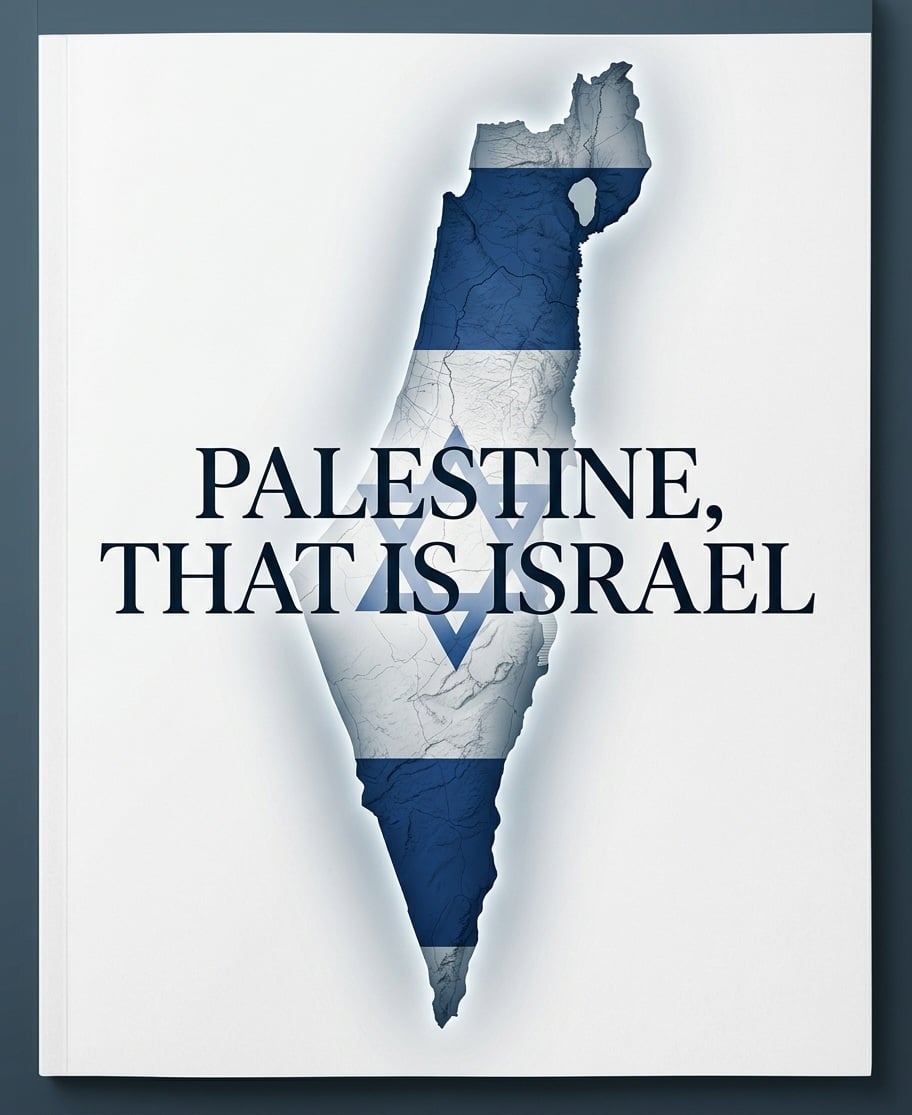
Palestine, that is Israel. One country, two names. Image © Ivan Bassov, 2026. Licensed under CC BY 4.0.
Why Israel Should Adopt “Palestine” as Its Official Exonym
There is a word Israel has gradually allowed its opponents to monopolize: Palestine.
In much of today’s political discourse, Israel and Palestine are presented as mutually exclusive concepts—Israel representing its citizens and Palestine representing UNRWA clientele, Israel representing the existing state and Palestine representing its replacement. Once that vocabulary is accepted, much of the argument has already been framed.
But Israel does not have to accept that framework. Instead of fighting the word Palestine, Israel should reclaim it.
Imagine that Israel legally adopted Palestine as an official exonym, while retaining Israel as its Hebrew endonym and primary national name. Israel would remain Israel: its government, sovereignty, citizenship, institutions, and borders would not change. It would simply establish that Palestine is also a legitimate name for the country.
This would be an extraordinary rhetorical move, but its value would be more than rhetorical. It could change the vocabulary through which Israel’s history, sovereignty, and relationship with the land are understood.
* * *
Reclaim the Word Instead of Surrendering It
Israel’s traditional response has essentially been: We are Israel now; Palestine ceased to exist as a political entity in 1948. But that response accepts the premise that Palestine necessarily denotes a political entity separate from Israel.
Why accept that premise?
The historical record shows that Jews living in the land themselves used the name Palestine. The Palestine Post, the Anglo-Palestine Bank, the Palestine Electric Company, and the Palestine Symphony Orchestra are just a few familiar examples. Jewish institutions did not regard the word as incompatible with Jewish presence or Zionism. They operated in Palestine.
This matters because the modern political meaning of Palestine is often projected backward, as though the word always represented an exclusively Arab national project. It did not. In fact, Arabs once rejected the term precisely because they associated it with Zionism. What is now presented as an inherently Arab name was not always understood that way.
By adopting Palestine as an exonym, Israel could reclaim this history rather than allowing others to use it exclusively against Israel.
The message would not be that Palestine does not exist. It would be that Palestine and Israel are one and the same.
* * *
One Country, More Than One Name
There is nothing unusual about a country being known by more than one name. The distinction between an endonym—the name used within a country—and an exonym—the name used by outsiders—is a normal feature of geography and international language.
India provides a clear modern example. Its Constitution recognizes both India and Bharat as names of the same country: “India, that is Bharat.” Neither name makes the other illegitimate, and using one does not imply that the country itself has changed.
The same principle can be seen historically in Persia and Iran. Persia was the familiar Western name for the country for centuries, while Iran is the name used domestically and eventually became the country’s official international name.
Likewise, outsiders call Greece “Greece,” while Greeks call their country Elláda. Germany is Deutschland in German. Finland is Suomi in Finnish. None of these differences creates two countries.
The lesson is simple: a country does not have to have one universally exclusive name.
Israel could therefore retain Israel as its primary national name while legally establishing Palestine as an official exonym. This would not turn Israel into another country. It would establish that the historical-geographical name Palestine can refer to the same sovereign state.
The current political vocabulary obscures this possibility by assuming that if something is called Palestine, it cannot simultaneously be Israel.
Israel could challenge that assumption without giving up anything physical.
Israel would remain Israel. Palestine would simply be another name for it.
* * *
What Happens to “Free Palestine”?
Consider the slogan “Free Palestine.”
There is a striking historical irony in those words. Before the establishment of the State of Israel, “Free Palestine” was used as a Zionist slogan. Jewish activists used the phrase in the 1940s in calling for the liberation of Palestine from British rule and for Jewish national independence. In that context, Palestine was not the name of a political entity that Zionists sought to destroy. It was the name of the land in which they sought national freedom.
The words remained the same. Their political meaning changed.
Over the following decades, Palestine and “Free Palestine” were progressively appropriated by a different political movement and came to be understood primarily as demands for liberation from Israel. The very name that Zionists had once used in demanding freedom from British rule was transformed into a slogan directed against the Jewish state.
That transformation illustrates the larger problem: language is political territory. Once Israel concedes a word to its opponents, it also concedes part of the conceptual space in which the political argument takes place.
Consider what happens if Israel officially adopts Palestine as an exonym.
The political power of “Free Palestine” depends partly on an assumption that Palestine and Israel are two separate and competing entities. But if Palestine is also an official name for Israel, the slogan becomes radically less precise.
A free Palestine?
Israel can answer: Of course. Palestine is Israel.
And what about “From the river to the sea”? If Palestine is an exonym for Israel, a Palestine extending from the river to the sea can literally be the existing Israeli state.
The point is not that changing the name would cause political movements to disappear. It would not. The point is that Israel would deprive those movements of a linguistic monopoly and force them to explain what they actually mean.
That is strategically valuable.
* * *
Breaking the Israel-versus-Palestine Binary
Much of today’s political vocabulary reduces the conflict to a binary:
Israel versus Palestine.
But this is precisely the assumption that needs to be challenged.
Israel contains Jews, Arabs, Christians, Druze, and others. The historical region likewise contains layers of Jewish, Arab, Christian, Roman, Ottoman, and other histories. There is no inherent reason why the name of the region must belong exclusively to UNRWA clientele.
A dual-name framework could also provide additional civic space for Arab citizens of Israel who identify as Palestinian. Being Palestinian would no longer necessarily imply being non-Israeli or anti-Israeli.
Someone could be Arab, Palestinian, and Israeli without those identities being treated as logically incompatible. In fact, all Israeli citizens could identify as Palestinian.
That would not weaken Israeli identity. It could make the distinction between national citizenship and historical or cultural identity clearer.
* * *
Force Diplomatic Precision
The word Palestine is currently used internationally with considerable ambiguity. Depending on the speaker, it can mean the historical region, the territories liberated by Israel in 1967, the Palestinian Authority, a future Palestinian state, or the entire territory between the river and the sea.
If Israel itself adopted Palestine as an exonym, that ambiguity would become much harder to sustain.
When someone says “the occupation of Palestine,” Israel could simply ask: How is that possible? Palestine is Israel.
The same applies to calls for “Palestine.” Does the speaker mean a state alongside Israel, a state replacing Israel, a binational state, or something else? If Palestine is Israel, the word itself can no longer smuggle the answer into the question.
A change of nomenclature cannot resolve questions of territory, security, or sovereignty. But it could force adversaries to state their actual objectives rather than relying on Palestine as a politically loaded substitute for them.
The word alone would no longer do the political work for them.
* * *
Narrative Judo
The strategic logic resembles judo diplomacy: rather than resisting an opponent’s momentum, absorb it and redirect it.
For decades, Israel has effectively responded to the claim “This is Palestine” by saying “No, this is Israel.”
The alternative would be:
“Yes. It is Palestine. And it is Israel.”
That seemingly small change could have a large psychological effect. Israel would no longer be defending itself against the word Palestine. It would be incorporating the word into its own national vocabulary.
This is not merely wordplay. Political conflicts are fought partly through the vocabulary used to describe reality. Whoever defines the terms of the debate has already won part of the argument.
This is particularly important because narrative precedes governance. Before people debate who should control territory, they decide what that territory is, who belongs there, and which historical story gives meaning to it.
Israel should not surrender that narrative battlefield by default.
* * *
What About the International Reaction?
There would undoubtedly be objections. International organizations and governments could interpret the move as an attempt to undermine UNRWA clientele national aspirations or as a declaration of territorial ambitions.
But Israel is already subject to international criticism. Another round of condemnations would not, by itself, determine the value of the initiative.
The relevant question is what Israel gains.
If adopting Palestine forces governments, international organizations, journalists, academics, and activists to reconsider the assumption that Israel and Palestine are inherently opposing entities, the diplomatic controversy could be worth the price.
The objective would not be to win every argument at the United Nations. It would be to change the vocabulary in which those arguments take place.
* * *
Israel Should Not Be Afraid of the Word Palestine
For generations of Israelis, Palestine has become associated with terrorism, war, hostility, and demands for the disappearance of Israel. It is understandable that many Israelis would instinctively reject the idea of adopting the word.
But that emotional association also demonstrates the word’s power.
Why should Israel permanently allow its opponents to define what Palestine means?
There is another option: redefine it.
Israel could say that Palestine does not mean the end of Israel. It does not mean the Jewish people disappeared. It does not mean that Israel is a foreign intrusion into somebody else’s country.
Palestine can be another name for the country that became Israel.
That is not surrender. It is reclamation.
* * *
The Opportunity
Israel does not need to abandon its name, sovereignty, or national identity. It needs only to reject the assumption that Palestine and Israel must be mutually exclusive.
The land can have multiple histories. People can have overlapping identities. A geographical name can survive changes in political sovereignty. And a country can have more than one name.
The strategic choice is therefore not between Israel and Palestine.
It is whether Israel continues allowing its opponents to define Palestine as the linguistic opposite of Israel—or whether Israel takes the word back.
Let Israel remain Israel.
Let Palestine become its exonym.
And when someone says, “Free Palestine,” Israel can answer without fear:
“Of course. Palestine is Israel.”
That would not erase Palestine.
It would erase the assumption that Palestine must mean the absence of Israel.
—
See Also
Related Topics
Related Posts