
Parashat Ki Teitzei
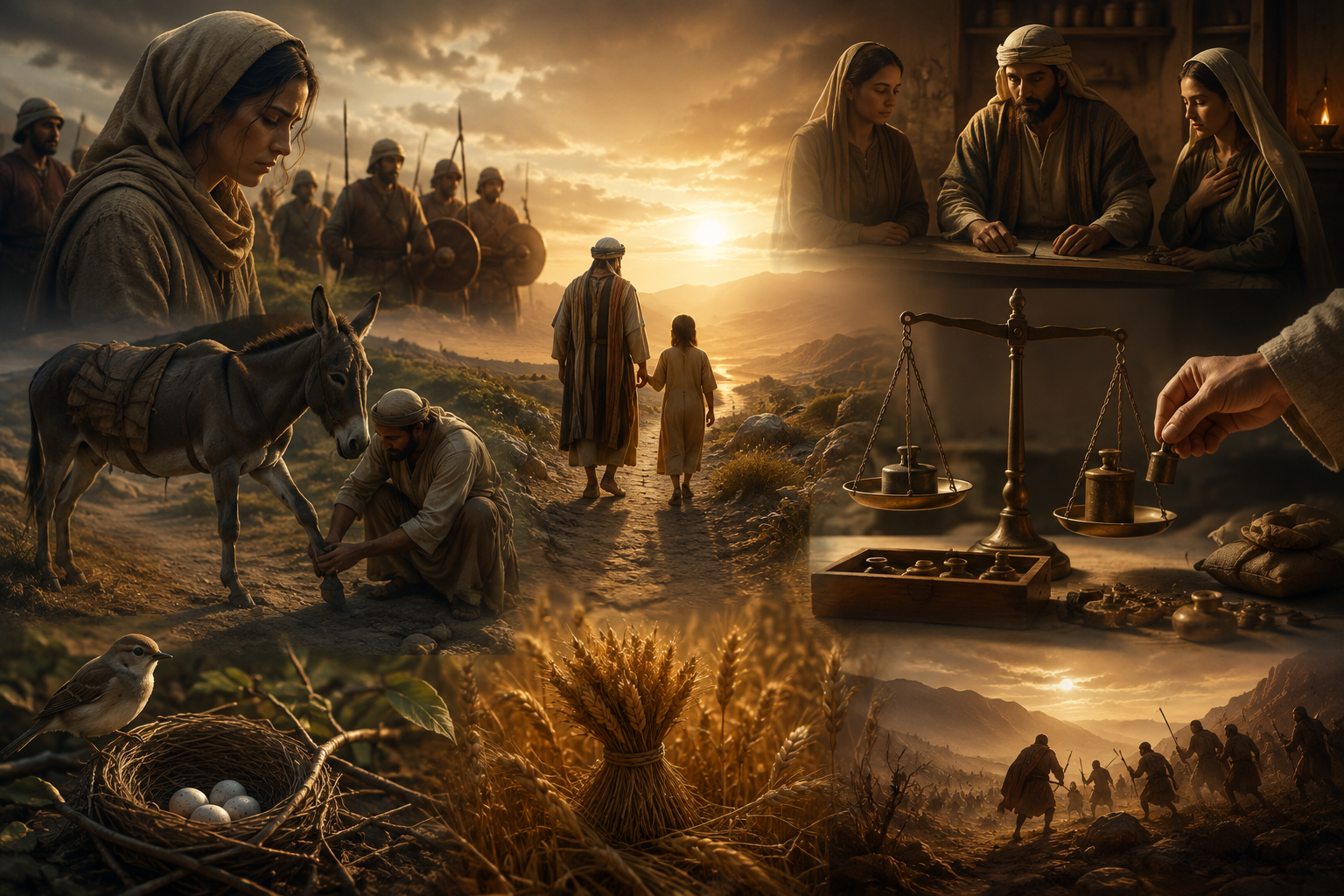
When the Soul Goes Out to War
Ki Teitzei begins in war.
“When you go out to war against your enemies … and take captives.”
The first person to whom the parashah then turns its attention is not the victor. It is the captive woman. She stands at the furthest edge of power: uprooted, defeated, subject to another person’s decisions. It is precisely there that the Torah begins to place limits on the freedom of the stronger party. The woman may not be taken at once. She is given time to mourn. And if the man later no longer wants her, he may neither sell her nor treat her as property.
This is no incidental opening. It sets the tone for the whole parashah.
Ki Teitzei returns again and again to what a person does when given the chance to override another.
Not only in moments of great violence. Also where almost no one is watching.
THE LIMIT OF POWER
From war, the Torah leads us into the home.
A man has two wives, one loved and one unloved. His feelings are real, but they may not alter what is right. If the son of the unloved wife is the firstborn, the father may not, out of personal preference, put the son of the woman he loves in his place.
Again, power meets a boundary.
The Torah does not demand that a person have no preferences. It demands that those preferences should not rule over another person’s dignity and rights.
This distinction runs through Ki Teitzei: what I feel is not automatically what I may do. What I can do is not automatically mine to do.
Between possibility and action stands responsibility.
YOU CANNOT HIDE YOURSELF
Then something seemingly small appears.
A lost animal. An object belonging to someone else. An ox or donkey that has collapsed on the road.
The Torah demands the return of what has been lost and help for the fallen animal. But its language goes further: you may not withdraw, may not behave as though you had seen nothing.
Here lies one of the quietest demands of Ki Teitzei.
Responsibility begins the moment I have seen.
From that moment, I am no longer the same person I was before. I know. And knowledge creates a relationship between me and what now stands before me.
The donkey on the road is not my donkey. That is precisely what makes the passage difficult.
It would be easy to walk on.
The Torah does not allow that ease.
A WORLD WITHOUT LIMITLESS CLAIMS
A bird’s nest. A parapet on a roof. Different seeds in a vineyard. An ox and a donkey before the same plough. Wool and linen in the same garment.
Ki Teitzei moves from one sphere of life to another, drawing boundaries.
To a modern reader, some of these laws may seem strange, others immediately intelligible. Yet beneath them lies a common tension: not everything that is possible is to be joined, used or exhausted without distinction.
The Torah recognizes boundaries between things, between people, between rights and needs. It also recognizes the limits of one’s own power of disposal.
The roof belongs to you. Yet you are responsible for the person who might fall from it.
The field belongs to you. Yet ownership cannot mean exhausting every last possibility of possession.
The other remains other.
Their existence does not disappear into my freedom.
THE DIGNITY OF THE VULNERABLE
As Ki Teitzei moves forward, people whose position is precarious come increasingly into view.
The escaped slave may not be handed back to his master. He is to be allowed to live where he chooses, where it is good for him, and he must not be oppressed.
The debtor does not lose all his dignity because he owes a debt.
The day laborer depends upon his wages.
The stranger, the orphan and the widow must not become the invisible people of a society.
The Torah does not wait to protect them until everything has collapsed. It intervenes beforehand — in the forms of commerce, ownership, law and daily encounter.
That matters.
Justice in Ki Teitzei does not appear as a grand declaration about humanity. It appears as a limit on what the stronger person could do at that particular moment.
THE FIELD MUST NOT BE LEFT BARE
At harvest, something remains.
A forgotten sheaf is not to be gathered up again. The olive tree is not beaten until nothing remains. Something in the vineyard is left for the stranger, the orphan and the widow.
The field itself thus carries a boundary.
Not everything is recovered.
Not everything is taken.
Something remains.
And what remains is not left to chance. It becomes space for another human being.
A society may reveal itself not only in what it produces, but in whether it is still capable of leaving anything behind.
Ki Teitzei knows this remainder.
THE WEIGHT IN THE BAG
Shortly before the end of the parashah, the language becomes almost frighteningly simple.
You shall not have two different weights in your bag, one large and one small. You shall not have two different measures in your house. You shall have a full and honest weight.
The Torah needs no grand stage here.
A bag is enough.
A pair of scales.
A few grams.
The buyer trusts that the weight is true. The seller knows whether it is. There is already an imbalance of power in that: one possesses knowledge and control that the other does not.
The temptation is small. Perhaps the gain is small as well.
That is precisely why the passage is so unforgiving.
A person can speak publicly of justice and still use the smaller weight in private.
Truth is sometimes decided in grams.
AND THEN COMES AMALEK
Immediately after the false weights comes Amalek.
“Remember what Amalek did to you on the way.”
The text recalls how Amalek met Israel on the road and attacked from behind those who had fallen back — weary and exhausted.
And suddenly the beginning of Ki Teitzei looks different.
There, Israel is the victor.
A captive woman lies at the victor’s mercy.
Here, at the end, Israel itself is exhausted. The weak fall behind. And someone else seizes that very moment.
At the beginning, you possess the power.
At the end, you discover what it means when someone else sees your weakness and exploits it.
Between those two points lies the parashah.
The unloved wife. The firstborn. The lost animal. The fallen donkey. The stranger. The slave. The debtor. The day laborer. The widow. The orphan. The weight in the bag.
Again and again, the same test, but never the same situation:
What do you do with the advantage you happen to possess?
ZACHOR — REMEMBER
The remembrance of Amalek does not, therefore, stand apart from the other commandments.
It takes them to a dangerous point.
Amalek sees weakness and turns it into opportunity.
Ki Teitzei demands the opposite movement.
When you possess strength, limit it.
When you have the advantage, do not abuse it.
When someone falls behind, do not simply walk on.
When a false weight could bring you profit, do not use it.
When the field is yours, still leave something behind.
When another person depends upon your decision, do not forget that a human being stands before you.
This is not a demand for heroism. Often, these are not heroic moments at all.
It is about the weight.
The sheaf.
The wage.
The animal on the road.
The person who has less power than you.
✡
Ki Teitzei begins with one person who is strong and another who lies at the mercy of that strength.
It ends with a people grown weary, forced to learn what happens when someone sees another’s weakness as an invitation.
Between them, the Torah teaches a form of strength that places a limit upon itself.
Perhaps that is where the dignity of which this parashah speaks is found.
Not in never possessing power.
But in what we do when we possess it.
זכור — Zachor. Remember.
And do not forget.