Pesach, AI and the War with Iran
The Art of Living in the Middle of a Story
Both as individuals and as communities, people have always wanted to control what happens to them. We have an innate drive to preserve and better ourselves, and doing so often depends on asserting our ability to shape our surroundings.
What has changed over the millennia, and especially in the last century, is how much of that desire has been actualized, certainly in those parts of the world where almost all of us Jews live. Though we are not in full control of our health or all potential threats, we do control our environments in unprecedented ways. In our homes, we control the temperature and the lighting, we control who we speak to or what music we can listen to; we can identify anyone who is coming our way long before they reach our door. Higher income levels, norms of financial planning and reasonably stable economies have likewise given us a great deal more control against the threat of poverty. Moreover, the countries we live in today enjoy a combination of strength, good sense and a fortuitous balance of power that allows us to assume, if not necessarily plan for, our basic security.
The fact that we have so much more control than ever before makes lack of control all the more unbearable. When things don’t go as planned, we sometimes feel as if it is an affront to our very dignity. In this regard, the last few years have been more of an affront than we have experienced in a very long time. If we are still largely able to live and plan our futures in much the same way we have done in the past, we have nevertheless arrived at a period of instability the likes of which most of us have never known.
The decade began with an unexpected and unpredictable pandemic that spread far beyond our control. It was followed by several wars that should not have happened and which lasted long after they made any obvious sense. And even as these disturbing events were unfolding, we were busy developing a technology whose effects its developers admitted they could not predict. Almost more of an affront, none of us even has any way of knowing the next thing our AI agents might say. The New York Times Magazine recently quoted software veteran Kent Beck, who aptly described its unpredictability as “addictive, in a slot-machine way.” In only a few short years, then, we have moved from the stable calm of advanced calculators to the frenetic exhilaration of slot machines.
Last month, I wrote about the need to (also) read Biblical stories as if we were in the middle of them. For those who actually lived it, being in the middle of the story was arguably its most important component – not knowing how the story would end and the resulting need to trust God to lead them to the right ending, even if it wasn’t always what they would have chosen.
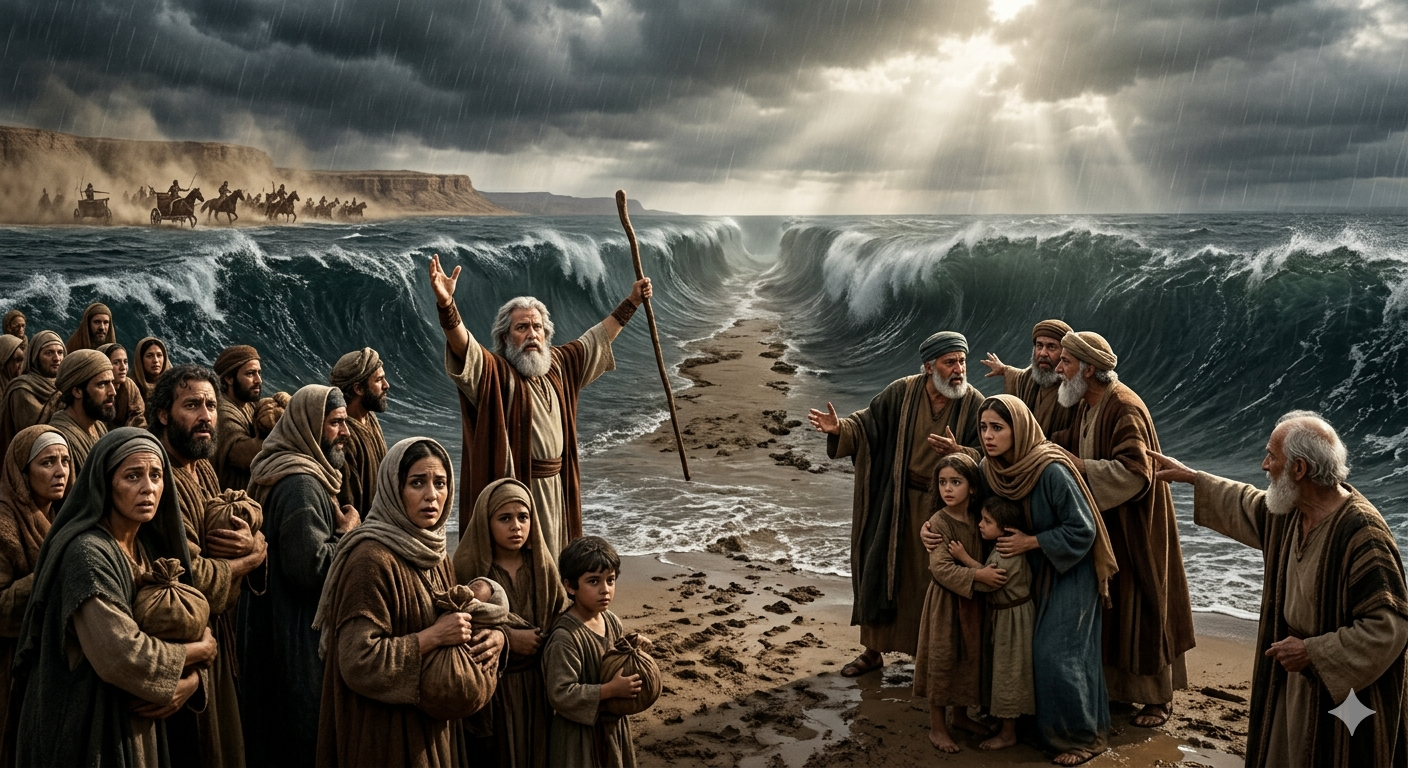
The story of Pesach is probably the most dramatic example of people needing to come to terms with the almost total loss of control over the events shaping their lives. Through the plagues and the splitting of the Red Sea, God had asserted His power over every element of reality. In that context, the most powerful man in the world was rendered totally helpless in a grandiose display of man’s ultimate inability to rely upon his control of events.
Of course, God still expected the Israelites to do their part; God told Moshe to order the Jews to march forward into the Sea. Yet even that act was totally predicated on trusting God. With the Egyptian army coming towards them and the Sea to their back, there was no doubt in anyone’s mind as to Who was in control.
We should not forget, however, that for those who lived it, the trust God required of the Jewish people was not easily attained. There are different midrashic renditions of what happened at that time, but the actual verses indicate near panic. God’s command to Moshe was to take charge and get them to control their emotions, even as they ultimately controlled nothing else.
The verses further point out that full trust in God did not come until they had safely crossed the Sea and all the Egyptians chasing them were dead. Though the Jews were praised for that faith, the more compelling act of faith was to listen to God’s command to go into the Sea and give up any sense of control.
Like the midrashic angels who wondered why God found the Israelites more worthy than the Egyptians, the Israelites may well have entertained the same thoughts. That being the case, they could not be certain that a trap was not being laid out by God’s command. Rav Shagar presents Avraham’s greatest test of faith in a similar vein. The Midrash depicts Avraham’s understandable doubts that God actually commanded Him to do what was against almost everything He knew about God as embodied by various antics of the Satan, trying to convince him that he misunderstood. The greatest expression of faith is listening to the voice of God precisely when we cannot be certain why.
Most of us don’t always see the world through Rav Shagar’s post-modernist lens of uncertainty. Whatever our philosophical leanings, we take an umbrella when the weather report says it is going to rain. Yet relying on our weather reports and the million other ways we have come to control our environment has not done a great deal for our relationship with God.
Though I personally prefer calculators to slot machines, that is not the story we find ourselves in right now. It is not only about trying to make the best of it, but also about understanding that we have been given an opportunity: Precisely because we don’t know what tomorrow will bring, it is time to let go and seek to listen to the voice of God.