Geopolitical Analyst: Bridging Somaliland & Israel to the world
President Irro at Hudson: Somalia Has Allies. America Still Has Choices.
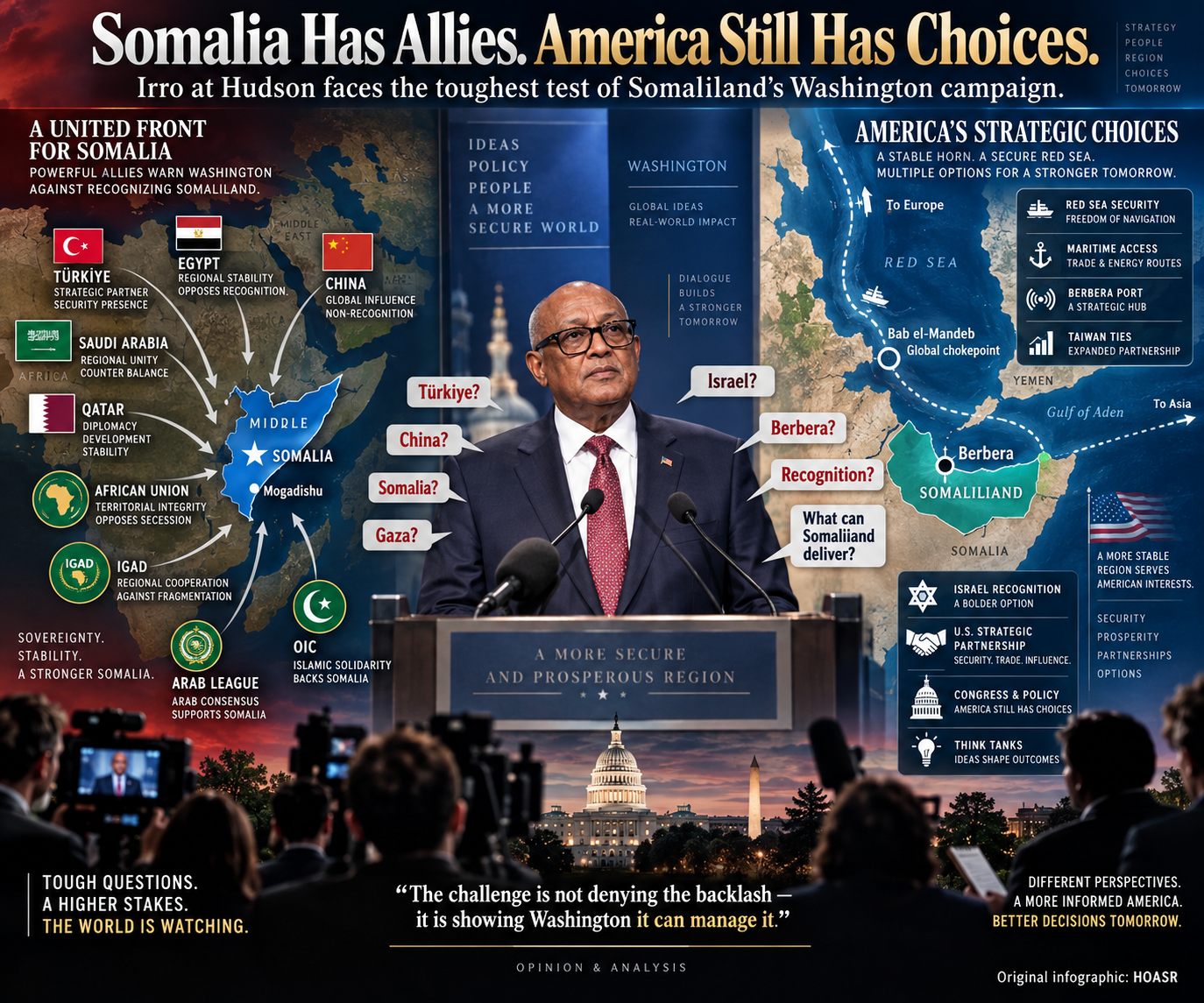
HOASR geopolitical infographic illustrating the competing pressures around President Irro’s Hudson Institute appearance, including Somalia’s support from Türkiye, Egypt, China, Saudi Arabia, Qatar, the African Union, IGAD and the OIC, versus Somaliland’s case based on Berbera, Red Sea security, Taiwan, Israel, U.S. strategic access and congressional support.
Why September 14 could test whether Somaliland can turn strategic momentum into a durable Washington coalition.
President Abdirahman Mohamed Abdullahi Irro’s September 14 appearance at the Hudson Institute could become one of the defining moments of his Washington visit. Can Irro persuade the part of Washington that tests difficult foreign-policy ideas before they become congressional pressure, executive options or presidential decisions.
A strategic opportunity – and a consequential test
Irro will have the chance to explain why Somaliland should be treated as a strategic partner. He will also face the harder questions that come with that claim: Israel, Gaza, Türkiye, Egypt, Saudi Arabia, Qatar, China, Somalia, the African Union, military access, Berbera and the diplomatic fallout that recognition could produce.
How he answers may matter as much as the speech itself. He is no longer speaking only to Somaliland supporters. His words will be watched in Mogadishu, Ankara, Cairo, Riyadh, Doha, Beijing, Jerusalem, Addis Ababa, Djibouti and European capitals. Every sentence can be quoted, translated and repurposed out of context by supporters and opponents alike.
Washington is no longer asking whether Somaliland deserves recognition
Hudson has titled the September 14 event “Somaliland as a Strategic Partner in the Horn of Africa.” That framing reflects a wider shift. For years, Washington discussed Somaliland mainly through Somalia policy: territorial integrity, negotiations between Mogadishu and Hargeisa, African Union consensus and the risks of recognition. [Hudson event]
The vocabulary is changing. Berbera. Bab el-Mandeb. The Houthis. China in Djibouti. Taiwan. Israel. Maritime security. Critical minerals. Military access. Regional stability. Somaliland is increasingly entering conversations that extend well beyond the legal argument over recognition.
Joshua Meservey, who will host Irro’s discussion at Hudson, helped build that strategic case years ago. At Heritage, he argued openly for recognition and linked Somaliland to democratic governance, Taiwan, Berbera and growing Chinese influence in Djibouti. [Heritage report]
Somalia’s strongest weapon is diplomatic cost
Mogadishu no longer needs to convince Washington that Somaliland has failed. After more than three decades of separate government, elections, security institutions, foreign relations and relative internal stability, that argument is irrelevant today.
Somalia has a stronger strategy. It can tell Washington that recognition is simply too expensive diplomatically. Türkiye will oppose it. Egypt will oppose it. China will oppose it. Saudi Arabia and Qatar can bring considerable political and financial influence to bear. The African Union, IGAD, the Arab League and the Organization of Islamic Cooperation have repeatedly defended Somalia’s territorial integrity. [OIC position]
That is a formidable coalition. Irro should not dismiss it. If he does, he risks looking politically naive at exactly the moment he is trying to convince Washington that Somaliland can operate as a mature strategic partner. His task is to convince Washington that opposition can be managed.
Allies have interests. Washington has its own.
Türkiye’s position is understandable. Ankara has invested heavily in Somalia’s security establishment, economy and political relationship. It has built one of its most important African partnerships in Mogadishu. Türkiye therefore has much to lose from a diplomatic shift that strengthens Hargeisa.
But Turkish interests are not automatically American interests. The same is true of Egypt. Cairo’s relationship with Somalia is increasingly connected to its confrontation with Ethiopia over the Nile and Addis Ababa’s search for Red Sea access. Washington should listen carefully to Egypt. It should not automatically allow the Ethiopia-Egypt rivalry to determine American policy toward Berbera or the Gulf of Aden.
Saudi Arabia presents another complication. Riyadh supports Somalia’s territorial integrity, yet it is simultaneously confronting an expanding Houthi threat across the Red Sea. A stronger US relationship with Somaliland could improve surveillance, logistics and maritime access along the Gulf of Aden. Saudi Arabia may therefore dislike recognition politically while benefiting from some of its strategic effects.
China is easier to address. Beijing supports Somalia, maintains its first overseas military base in Djibouti and has repeatedly pressured Somaliland over its relationship with Taiwan. Somaliland resisted that pressure. Washington wants smaller partners willing to resist Chinese coercion, Hargeisa has already done that and can point to its record rather than a promise.
Irro must be ready for the Israel question
This may be one of the hardest parts of the Hudson appearance. Israel’s recognition transformed Somaliland’s diplomatic position. It also made Somaliland more controversial.
Irro will be scrutinized on how far the relationship goes, what Israel expects in return, whether Somaliland would permit an Israeli security presence, whether Berbera could support operations against the Houthis, and whether Hargeisa is moving too close to Israel at the expense of relationships across the Arab and Muslim worlds.
He should expect those questions. Avoiding them would be a mistake. The strongest answer is not that Somaliland has chosen Israel against the Arab world. It is that Somaliland intends to conduct foreign policy according to its national interests while keeping channels open across political divides.
Somaliland does not benefit from becoming part of an ideological contest between pro-Israel and anti-Israel blocs. Its diplomatic value comes from being able to work across them. Recognition by Israel should not be allowed to become evidence that Somaliland has surrendered control of its own foreign policy.
Gaza will bring even greater scrutiny
Irro’s willingness to consider contributing up to 2,000 troops to a future international stabilization force in Gaza has already attracted attention. The statement can help his Washington campaign because it presents Somaliland as a government prepared to contribute to international security rather than simply request diplomatic rewards.
But it also creates political exposure. Somaliland is overwhelmingly Muslim. Any deployment involving Gaza would be scrutinized intensely at home and abroad. Arab media may portray Somaliland troops as supporting an Israeli security architecture. Somalia and other opponents could use the issue to argue that Hargeisa is trading Palestinian interests for recognition.
Any Somaliland participation should be described as conditional on a legitimate international stabilization arrangement, a clearly defined mission, appropriate legal authority and a role compatible with protecting civilians and maintaining peace. A conditional offer should not become an unconditional commitment through careless wording. Irro therefore needs precision.
Every sentence will now be examined
This is the larger challenge surrounding Hudson. Somalia-oriented media will search for evidence that Somaliland is surrendering sovereignty to foreign powers. Anti-Israel governments and commentators will look for signs that Hargeisa has become part of an Israeli military strategy. Recognition supporters will search for evidence that Washington is moving closer.
American national-security officials will ask a different set of questions: are Somaliland’s promises realistic, are its institutions durable, can it protect foreign investment, and can its security forces sustain the commitments its leaders discuss publicly?
That changes the demands on Irro. He cannot speak as though every audience is friendly. Nor should he respond defensively when challenged. The most effective posture is disciplined confidence: acknowledge risks, avoid exaggerated promises and show that Somaliland understands the consequences that come with recognition.
The multilateral institutions should be respected, not feared
The African Union remains a serious obstacle. Its concern about border revision is understandable. Africa has paid a heavy price for territorial conflict. Irro should acknowledge that instead of treating the AU as hostile. [AU position]
Then he should explain why Somaliland considers its history exceptional. British Somaliland became independent on June 26, 1960 before entering union with the former Italian-administered Somalia. Somaliland’s case therefore rests on the collapse of a union between two previously separate territories, followed by more than three decades of independent government.
Somaliland’s case should be traeted differently from a conventional secessionist movement. The AU, IGAD, Arab League and OIC opposition creates diplomatic costs. But political organizations representing the particular interests of its member governments should inform American policy, not automatically determine it.
Kosovo offers a lesson in managing fallout
Kosovo can help answer the diplomatic-backlash argument if Irro uses the comparison carefully. Somaliland is not Kosovo. The historical, legal and military circumstances are different.
But the Bush administration’s handling of Kosovo offers a useful lesson in statecraft. When the United States recognized Kosovo in 2008, Serbia objected fiercely. Russia opposed the decision. Several European governments refused recognition. Washington acted anyway. [US recognition of Kosovo]
It did not pretend that the backlash did not exist. It prepared for it. The administration coordinated with European allies, described Kosovo as a special case rather than a universal precedent, and continued dealing with Serbia after recognition. [Bush White House remarks]
That is the relevant lesson for Somaliland. Diplomatic opposition can be contained when Washington believes the strategic case justifies the cost. Irro can apply that principle without pretending the two cases are identical.
Recognition need not mean abandoning Somalia
This is another argument Irro should make clearly. Washington does not have to choose between Somaliland and Somalia in every area of policy.
The United States could recognize Somaliland while continuing counterterrorism cooperation with Mogadishu. It could continue humanitarian assistance, support the fight against al-Shabaab and maintain diplomatic relations with both governments.
Recognition would alter their relationship. It would not require Washington to turn Somalia into an enemy. Counterterrorism cooperation is valuable, but it should not become a veto over unrelated American strategic decisions.
Berbera should be presented as an option, not a transaction
Irro’s positive argument should remain grounded in geography. Berbera is crucial, it gives Washington additional options along the Gulf of Aden.
That does not mean Somaliland should offer Berbera as payment for recognition. That would reduce the relationship to a transaction and create unnecessary domestic and regional suspicion.
The stronger argument is strategic redundancy: maritime surveillance, logistics, air access, humanitarian response, commercial infrastructure, counterterrorism cooperation and monitoring of the Bab el-Mandeb approaches. Djibouti remains important. Somaliland could give Washington another option.
Think tanks can change what Washington considers possible
Hudson’s importance lies here. Think tanks do not make recognition decisions. They shape the intellectual environment around those decisions.
Meservey has testified repeatedly before Congress. Former senior Africa officials including Tibor Nagy, Jendayi Frazer, Herman Cohen and J. Peter Pham have challenged aspects of the traditional policy. Ted Cruz has taken the recognition argument directly to President Donald Trump. Israel has already recognized Somaliland. Foreign Policy is carrying the debate into the wider Middle East and Red Sea strategic conversation. [Hudson biography] [Cruz recognition letter] Ideas move through think tanks, congressional offices, former officials, media, allied governments and national-security agencies. Then a president decides whether the moment has arrived. Irro’s job at Hudson is to make that decision easier to imagine.
His success may depend on difficult questions
The September 14 appearance should not be judged by applause. The most revealing moments may come when Irro is challenged.
What does he say about Israel? What does he say about Gaza? What does he say about Turkish and Egyptian opposition? Would he permit American or Israeli forces in Somaliland? How would he prevent recognition from destabilizing relations with Somalia? What protection would he offer communities in disputed areas? What could Somaliland realistically provide the United States militarily? What happens if recognition provokes economic or political retaliation from Arab governments?
Those questions should not be feared as they are evidence that Somaliland is being treated seriously. If Irro answers them with discipline, acknowledges risks and avoids exaggerated promises, he can strengthen the image of Somaliland as a government capable of strategic partnership.
If he treats difficult questions as hostility, overpromises military access or presents recognition as inevitable, the same event could create problems. That is what makes Hudson consequential.
Somalia has allies. America still has choices.
Mogadishu has built a powerful diplomatic shield around the existing policy. Somaliland should not underestimate it.
Türkiye has interests. Egypt has interests. Saudi Arabia and Qatar have interests. China has interests. The African Union has institutional concerns. Somalia has every right to defend its own position. The United States also has interests.
Irro’s challenge at Hudson is not to persuade Washington that those other interests do not exist. It is to show that America can manage them.
Somaliland can offer Berbera without surrendering control of it. It can work with Israel without becoming hostile to the Arab world. It can cooperate with Washington without demanding that Washington abandon Somalia. It can remain close to Taiwan without making its entire foreign policy about China. It can contribute to international security without promising more than its military can sustain. And it can seek recognition while acknowledging that recognition will carry costs.
That is the level of argument Irro now needs. He is entering a stage where every statement will be quoted, translated, challenged and interpreted by governments far beyond Somaliland.
The diplomatic opportunity is larger. So is the margin for error. Hudson gives him a platform to demonstrate that Somaliland is prepared for both. Steven A. Cook, “Why the United States Should Recognize Somaliland,” Foreign Policy, September 4, 2026
Related Topics
Related Posts