
Middle East Analyst
Saudi Arabia: The Mecca Pact’s Mecca Test
a
The Maritime Pincer Closes: Bab el-Mandeb, the Pipeline, and the Mecca Test
Five days after posting my blog Key Strategic Issues in the Escalating Saudi-Houthi Conflict, every hedge in that piece has resolved, and mostly in the direction that piece flagged as the dangerous one. What follows updates the record and pushes the analysis into territory that essay left open: what the Mecca Pact is actually for, what options Riyadh realistically has left, and how seriously to take the idea of an Israeli-Saudi threat convergence over Yemen.
The strait has changed hands
As of this week, the Houthis control every strategic feature that matters at the southern mouth of the Red Sea. Mocha fell first, then Dhubab, then the crossing to Perim, then — according to a Yemeni military official — Greater and Lesser Hanish. A senior figure in Yemen’s own Presidential Leadership Council has acknowledged the loss and attributed the offensive to Iranian planning and backing. This is no longer a contest for access to Bab el-Mandeb. It is settled control, with the only open question being how the Houthis choose to exercise it.
That question has an answer in progress. The Houthis have long tried to draw a distinction between Saudi shipping, which they blockade, and everyone else’s, which they say is safe. Reuters-sourced reporting this week adds a third tier: Houthi officials reportedly met US representatives in Oman and pledged not to strike American or Israeli vessels. If that holds, the group is now running a three-tier maritime regime — hostile to Saudi Arabia, permissive toward international shipping, and actively reassuring toward Washington and Jerusalem. That is a considerably more disciplined signaling posture than “indiscriminate blockade,” and it suggests the Houthis are managing their leverage over the strait as a political instrument aimed with some precision at isolating Riyadh specifically, not at maximizing chaos generally.

From redundancy to simultaneous vulnerability
The September 10–11 drone strikes, launched from Iraqi territory and attributed by Washington to Iran-aligned proxies, hit pumping infrastructure on the East-West Pipeline seriously enough that Saudi Arabia shut the line down entirely. The numbers here are the story. The pipeline’s rated capacity is 7 million barrels a day; it had been carrying somewhere in the range of 4 to 5 million bpd of the crude that would otherwise have moved through Hormuz. Yanbu’s storage — roughly 35 million barrels — gives Riyadh only about five to seven days of export cover before the port runs dry, and repair estimates for the pumping stations run three to six weeks. Saudi crude production has already fallen from roughly 10.9 million bpd in February to 6.2 million bpd in August; the IEA now puts Saudi crude supply at its lowest level in more than three decades. Brent moved above $108 this week.
This is the “strategic maritime pincer” argument from the prior essay, but it has moved from thesis to fact pattern faster than the essay itself anticipated. The point worth adding now is that the pipeline and the strait are not two separate vulnerabilities that happen to coincide — they are increasingly the same vulnerability. Even a fully repaired pipeline now feeds oil toward a Red Sea corridor the Houthis control at its narrowest point. Saudi Arabia’s geographic redundancy — its historic ability to reach both the Gulf and the Red Sea — was built on the assumption that a threat to one route left the other intact. That assumption no longer holds. Both routes now terminate in contested space.
Mecca and the limits of the Mecca Pact
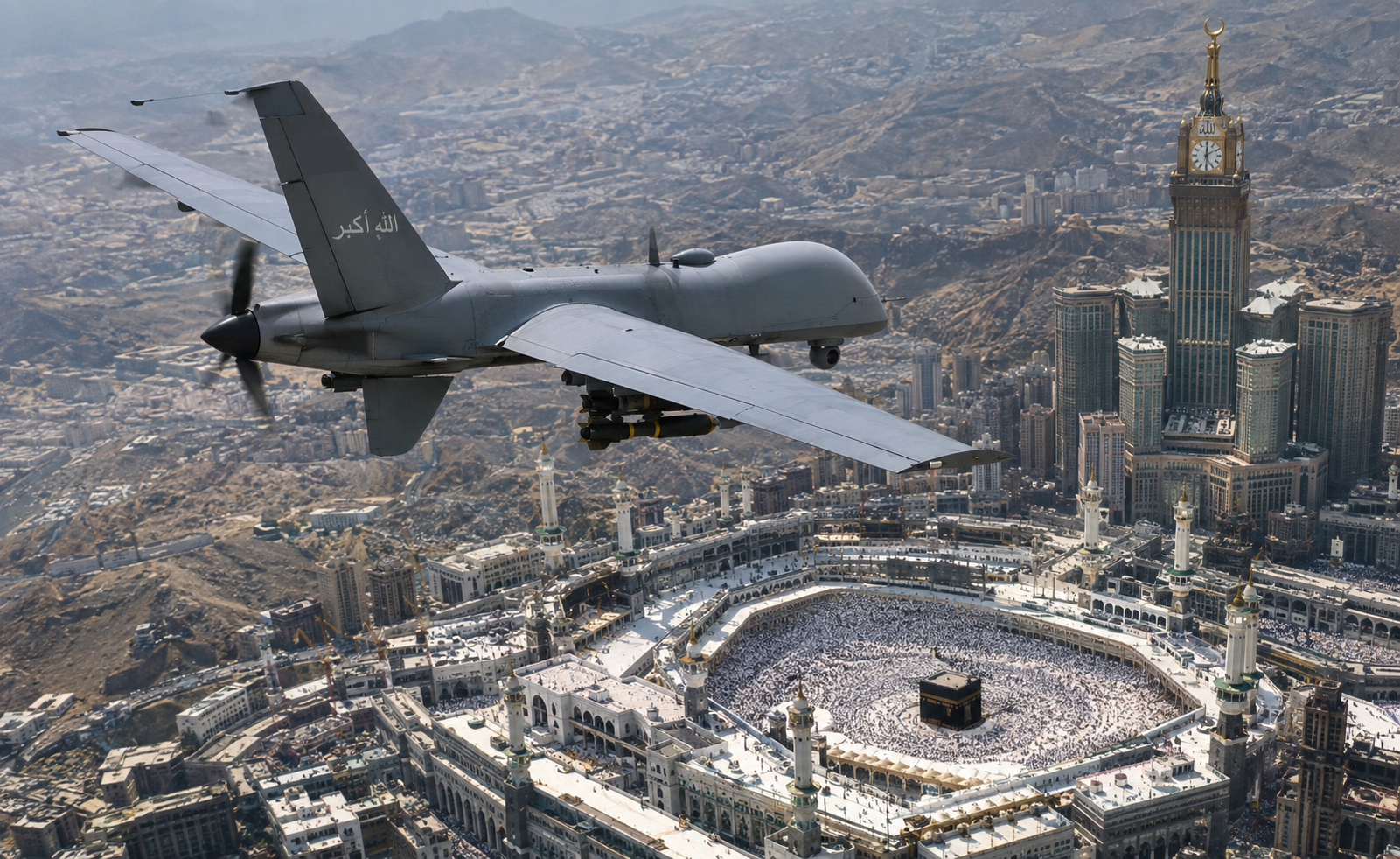
On September 16, Saudi Arabia said its air defenses intercepted a Houthi drone approaching restricted airspace over Mecca — the first alleged attempt since a 2017 ballistic missile launch — and called the security of the holy sites a red line. The Houthis immediately and flatly denied it, saying their operations that week were aimed at oil facilities and military targets “far removed” from the city. Whether the drone was genuinely Mecca-directed or a near-miss along a flight path aimed elsewhere may not be resolvable soon, and arguably does not need to be resolved for the incident to do its political work. The claim itself accomplishes what the Houthis would presumably not want accomplished if it were false: it forces Riyadh into an emotionally and religiously loaded escalation frame it cannot easily walk back from, whatever the truth turns out to be.
What it exposes with more clarity is the credibility gap in the Mecca Joint Defense Agreement. Pakistan’s own foreign ministry spokesperson said this week there is no active discussion of a military response under the pact, only that Islamabad will act “when the time comes.” Turkey has issued condemnations of the Houthi attacks, not mobilization. Yoel Guzansky at Israel’s INSS was blunt in calling this a strategic embarrassment for Riyadh, and he is not wrong to be blunt: a defense pact signed a month earlier, invoking NATO’s Article 5 logic and named for Islam’s holiest city, has so far produced statements rather than capability.
The incentive structure explains why. Turkey’s strategic bandwidth runs through its Kurdish file and its position inside NATO facing Russia; provoking the Houthis and, by extension, Iran over an unconfirmed drone incident buys Ankara nothing it needs and risks a front it does not want. Pakistan’s strategic bandwidth runs through India; committing forces to a Red Sea contingency thousands of miles from its own frontier, on behalf of a partner whose defense spending dwarfs its own, is not a trade Islamabad’s domestic politics reward. Neither country’s leadership faces a public that would punish inaction here. Riyadh’s does. That asymmetry, not bad faith, is what is producing the gap between the pact’s Article 5 language and its Article 5 behavior.
If the pact will not defend Mecca, what will it defend?
This is the question the alliance now has to answer, and there is no comfortable answer available. A collective-defense pact that does not activate over an attack — real or alleged — on Islam’s holiest city, an attack that is by design maximally provocative and maximally unifying across the Muslim world, has set itself an almost impossible bar for any future trigger. If Mecca does not qualify, it is difficult to construct a scenario short of a conventional cross-border invasion of Saudi territory that would. That leaves the Mecca Pact functioning less as an operational security guarantee and more as a diplomatic signaling device — useful for deterrence messaging and for demonstrating Sunni-state alignment against Iran, but not, at least not yet, as a mechanism Riyadh can actually draw on when it needs force on short notice.
Saudi Arabia’s narrowing menu
That leaves Riyadh with a genuinely thin set of realistic options. Washington’s appetite for direct intervention in Yemen is visibly limited — the administration is already managing a six-month-old war with Iran it cannot easily escalate given Hormuz’s economic bind, and taking on a second active front in Yemen is not a position any near-term domestic audience would reward. Riyadh can continue its own unilateral counteroffensive inside Yemen, but that risks the overextension problem flagged in the prior essay: fighting a ground war while simultaneously defending the homeland and protecting a damaged export corridor. It can lean harder on the Mecca Pact partners for symbolic and intelligence support even where military commitment is unavailable. And it can quietly explore Israeli assistance — missile defense, intelligence sharing — which regional diplomats cited by the Jerusalem Post say is already under discussion, and which Guzansky has now said openly should be offered discreetly rather than publicly.
Is there a real Israeli-Saudi threat convergence on the Houthis?
The honest answer is partial, not full. Both states have a genuine, overlapping, and immediate interest in degrading Houthi capability: Israel has been a direct target of Houthi missile and drone fire since 2025, and Saudi Arabia is now the group’s primary target of choice. That is real convergence, not manufactured. But it is convergence on a tactical problem, not a strategic one. Israel’s calculus on Yemen is shaped by its own deterrence logic against the wider Axis of Resistance; Saudi Arabia’s is shaped by its economic exposure and its domestic legitimacy, which — as Riyadh’s own posture on Gaza and normalization has made clear — cannot be decoupled from the Palestinian question no matter how urgent the Houthi threat becomes. Guzansky’s own formulation is telling: he wants Israeli help delivered quietly enough that Riyadh is never seen to need it publicly. That is not the language of an alliance. It is the language of two governments willing to trade narrow, deniable assistance around a shared irritant while keeping the underlying relationship exactly where it was before the Houthis forced the conversation.
Iran and the Houthis: command is the wrong question
Iran’s denial that it controls the Houthis is technically defensible and analytically beside the point. The relevant fact is not whether Tehran issues orders the Houthis mechanically execute — it is that Iran’s influence over the movement is historical, deep, and in practice usually determinative, because the interests of the two parties overlap almost completely rather than merely aligning. The Houthis do not need Iranian command to act in ways that serve Iranian strategy, because Iranian strategy and Houthi strategy are, at this point, close to the same strategy. And the dependency runs both directions in a way that gets underweighted in the “puppet versus autonomous actor” framing. The Houthis’ position in Yemen — their weapons pipeline, their financing, their diplomatic cover against isolation — rests on a functioning, resourced Iranian regime on the other end of that relationship. A degraded or collapsed Iran is not a scenario the Houthis can treat as strategically neutral; it is a direct threat to the position they have spent a decade building. That mutual stake, not a chain of command, is why Tehran’s denials should be read as legally and diplomatically accurate while remaining strategically almost irrelevant.
Bottom line
The Saudi-Houthi conflict has moved past the point where its trajectory is genuinely uncertain. The strait is held, the pipeline is down for weeks with no fully compensating alternative, and the Mecca Pact has been tested by the single scenario best designed to activate it and has not activated. What remains uncertain is not whether Riyadh is exposed, but how far it will let that exposure run before it accepts either a costlier unilateral military response inside Yemen, a quieter security relationship with Israel than its public position on Palestine allows it to admit to, or a negotiated accommodation with an adversary it has spent a decade failing to defeat by force.
Related Topics
Related Posts