The views expressed herein are solely mine.
Saudi Tabuk Action Prevents an Israeli 9/11
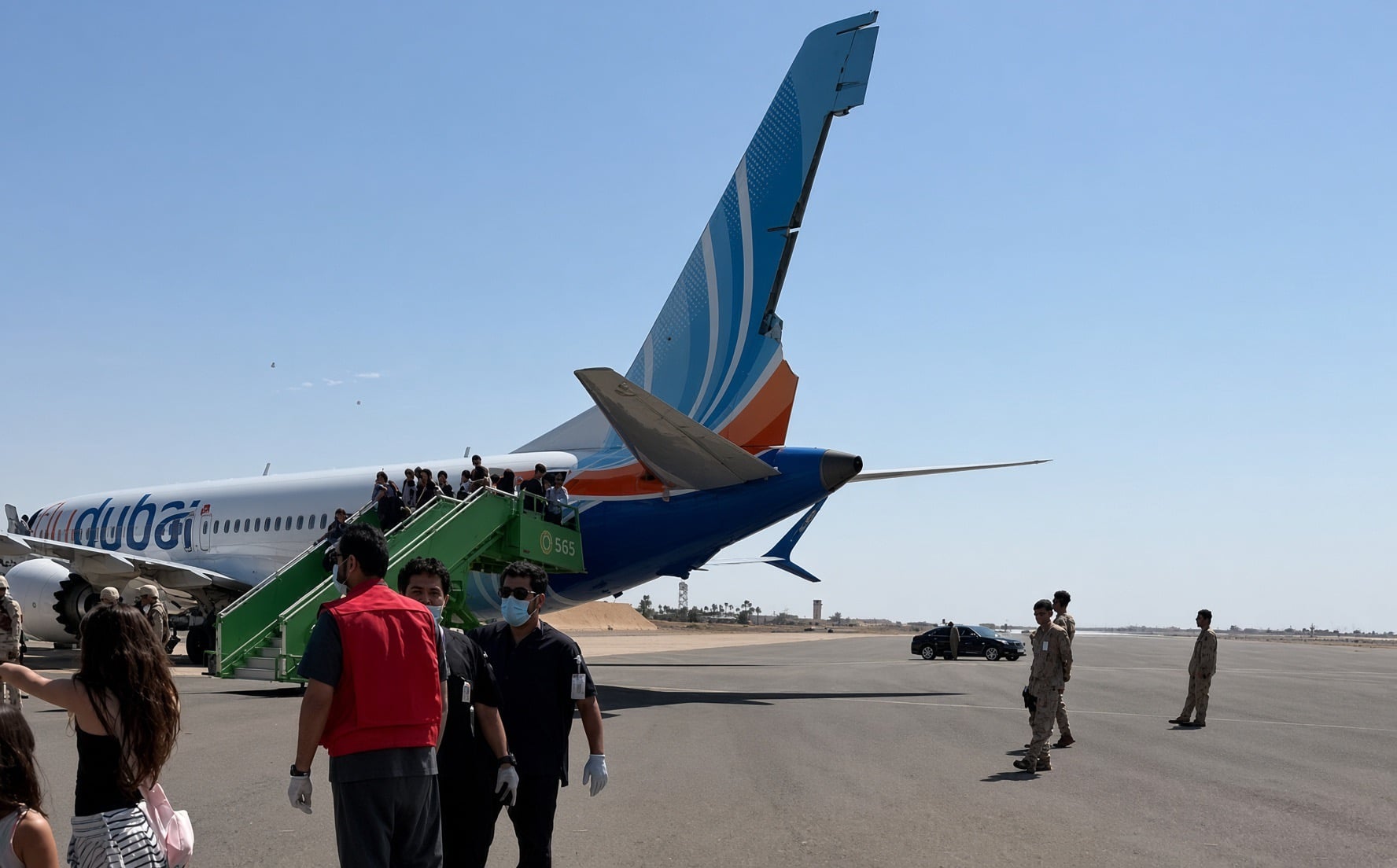
Passengers disembark from a flydubai Boeing 737 MAX from Dubai to Tel Aviv which landed at Tabuk Airport in Saudi Arabia, September 30, 2026. The rudder shows damage. The flight suffered an emergency mid-air, with the co-pilot subdued after stabbing the captain in an alleged attempt to crash the plane full of Israelis, September 30, 2026 (Social media: used in accordance with Clause 27a of the Copyright Law).
Netanyahu’s disastrous wishful thinking routinely leads our country to misread the Middle East, treating fleeting tactical relief as a geostrategic victory. The catastrophic vulnerability of this regional security architecture became undeniable on September 30, 2026, when Flydubai flight FZ1073 plummeted 14,000 feet toward Tabuk. Complacency, however, is not a strategy, and counting on off-duty personnel to serendipitously subdue a rogue crew member represents catastrophic statecraft. Although pragmatism ultimately prevailed when Saudi authorities averted an Entebbe-style hostage crisis (or G-d forbid, an Israeli 9/11-like episode), by providing a strict security ring and a swift evacuation, delusion remains the domain of pro-Netanyahu analysts, whose persistent fecklessness left them blind to Riyadh choosing regional stability over ideological temptation.
Tehran’s regional proxies ensure that the Islamic Republic and its Houthi assets actively engineer a bloody Jewish massacre on an Arab tarmac. This specific near-miss serves as a chilling indictment of the structural fragility undergirding the air bridge connecting Israel to the Gulf, and the challenges that Islamism still poses to the Jewish state, even after peace. Commercial aviation protocols currently permit ten daily Flydubai flights into Tel Aviv, funneling thousands of Israeli passengers into the hands of foreign pilots who bypass rigorous domestic vetting. Corporate negligence has effectively transformed civilian aviation into the soft underbelly of Israeli national security. Terrorist tactical innovation means that one unstable pilot can easily replicate the destruction of September 11 without ever smuggling weapons past terminal screening lines. Systemic inertia, therefore, cannot delay the immediate overhaul of defensive frameworks required to neutralize this shifting threat.
Consequently, the Knesset must legislate stronger security mandates instead of relying on regional goodwill or the boilerplate of traditional diplomacy. Every foreign airliner entering Israeli airspace should carry two type-rated, plainclothes security pilots in the cabin. These officers need explicit cockpit-override authority and direct links to the Israeli Air Force; relying on incidental intervention invites a national catastrophe. Lawmakers must codify this defense protocol immediately to secure passengers in Israel’s highly contested airspace.
Furthermore, security protocols demand a trilateral vetting mechanism encompassing Israel, the United Arab Emirates, and Saudi Arabia. Regional intelligence services must subject foreign flight crews to continuous financial audits, biometric tracking, and behavioral monitoring. Any anomalous data pattern within thirty days of an Israel-bound flight must trigger an automatic 72-hour grounding. Bureaucratic inertia cannot dictate commercial passenger safety when the stakes remain existential for the Jewish state.
Conversely, relying on flawed technological integration invites catastrophic human error or insider malice at the most critical phases of flight. Ergo, the Israeli Civil Aviation Authority should deploy artificial intelligence to monitor cockpit voice stress and control column resistance. In tandem, uncommanded, rapid descents must trigger automatic autopilot overrides that lock the aircraft into a safe altitude corridor while alerting air defense consoles. If regional security is to survive, remote operators must possess the power to override rogue cockpit behavior before catastrophe strikes; automated intervention is no longer a policy luxury, but the only durable defense against airborne terrorism.
Finally, Jerusalem should acknowledge Saudi cooperation through quiet diplomatic channels while expanding backchannel security coordination. The infamous 1970 Dawson’s Field demonstrated that hostile host nations can turn hijacked airliners into political theater, while the Tabuk incident showed that responsible governance can neutralize a crisis.
The time has come for the State of Israel to formalize these emergency protocols with the Gulf states immediately; relying on luck only constitutes a strategy for failure. Netanyahu’s predatory government must now institutionalize these strict aviation mandates, sensor arrays, and regional intelligence pacts before the next 9/11 cockpit compromise occurs.
Related Topics