Should I Keep It Light — or Tell the Truth?
A gentile’s moral dilemma before introducing a Jewish comedy
Tags: Sweden antisemitism, Jewish life in Europe, October 7 impact, media bias, moral clarity.
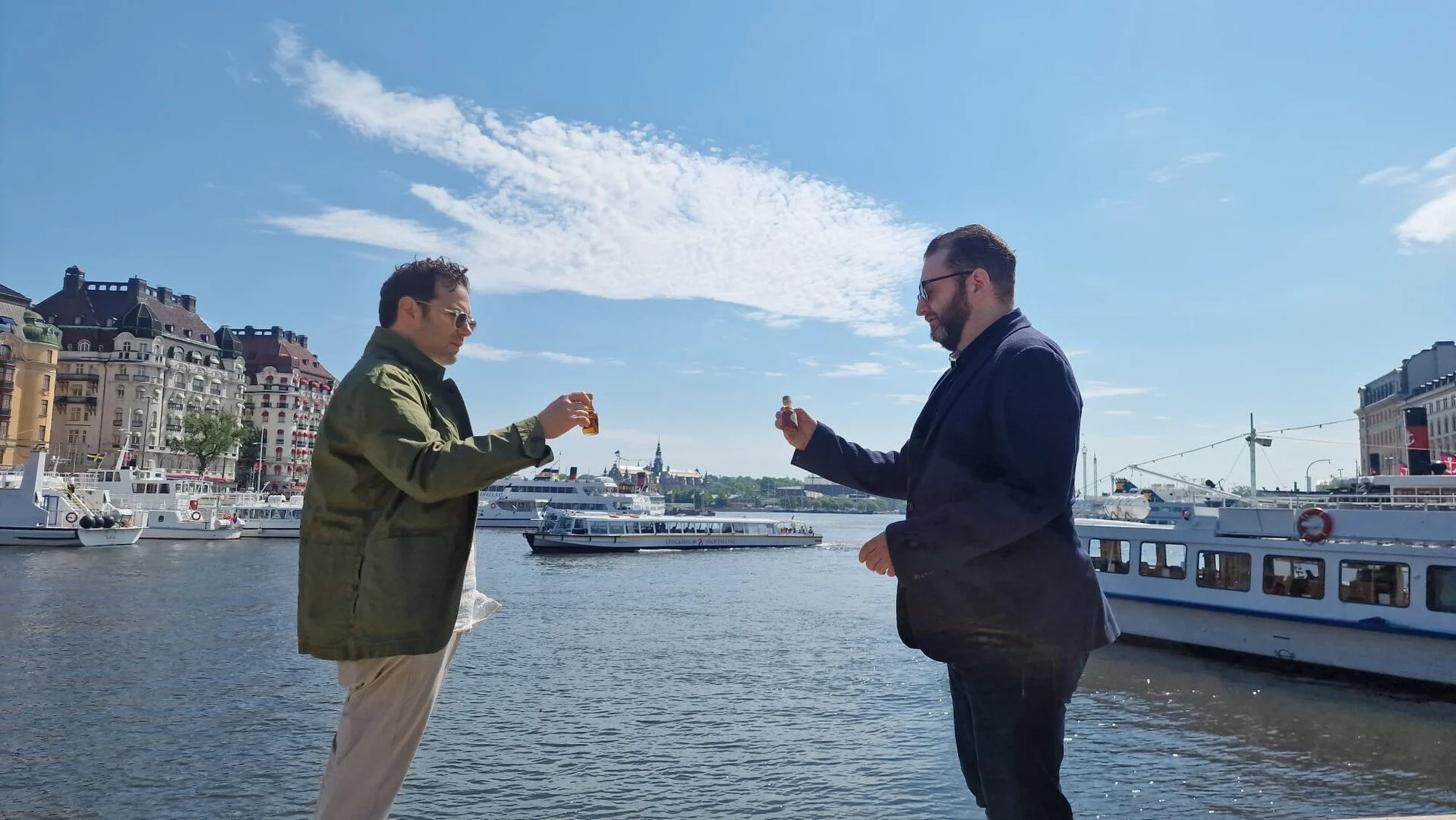
In a few days, I’ll step up to a microphone to introduce a film called Swedishkayt — a witty, self-mocking, very Jewish comedy about life in Sweden. It’s light, clever, and full of the kind of humor that only a people acquainted with absurdity can produce.
And yet, I find myself wondering whether to break the mood before it even begins.
I was invited to give a few cheerful remarks — a warm-up act before the laughter. But over the past several years, as I’ve read about what is happening in Sweden and beyond, I keep asking myself: Is it right to keep it light? Or would that be another small act of silence at the wrong time?
Swedishkayt is, at heart, a love letter to the Jewish experience in a secular, socially cautious Sweden. It pokes fun at cultural misunderstandings and the gentle awkwardness of coexistence. But beneath that gentle humor, there’s a reality that isn’t funny at all.
In the past decade — and especially since October 7, 2023 — antisemitism in Sweden has risen sharply. Jewish families are leaving Malmö and Gothenburg, no longer feeling safe in their own neighborhoods. Synagogues and schools operate under constant protection. Surveys show that four in five Swedish Jews now say they feel unsafe wearing visible Jewish symbols in public.
It is not just the far-right behind this hostility. In Sweden’s academic and media circles, “anti-Zionism” has become a socially acceptable form of antisemitism — one that speaks the language of human rights while targeting Jews as stand-ins for Israel. Some Swedish papers that once prided themselves on moral clarity now publish pieces so biased, so vitriolic, they border on libel. It’s a kind of moral slippage: prejudice disguised as conscience.
So again — how can I step up before the screening and simply say, “Enjoy the film.”
I should also be clear: I am not Jewish. I’m a gentile — and a Swedish one at that. I know that for some, that may make my voice here feel misplaced. There’s an intimacy to Jewish suffering, and a long history of outsiders interpreting it clumsily. I’m conscious of that line, and I don’t want to cross it carelessly.
But I also believe there are moments when silence becomes a form of consent.
In early 2020, I traveled to Israel. I visited Sderot — a small town living under rocket fire — and Kibbutz Netiv HaAsara, which looks across the fence into Gaza. I remember the humor of the people there, the unpretentious courage, the Yeshiva, the coffee offered without hesitation.
Then came October 7.
Those same names — Sderot, Netiv HaAsara — suddenly appeared in headlines drenched in blood. I realized that some of the faces I had photographed, the voices I had heard, might be gone.
And then came another shock — this time not from terrorists, but from the West. I heard university students and public figures saying things like, “None of this has been verified,” or “We need to understand the context.” The eagerness to rationalize, to doubt Jewish pain before acknowledging it — it chilled me. It was a moral reflex that revealed something broken in our culture: an instinct to withhold empathy from Jews until proven deserved.
Sweden, my birthplace, has long prided itself on tolerance, neutrality, and humanitarianism. But that identity has become a kind of moral fog — a reluctance to take sides, even between victims and aggressors.
As recent academic work and NGO reports show, Islamist networks connected to the Muslim Brotherhood have gradually embedded themselves within Swedish civic life, shaping public narratives around religion and identity. At the same time, open antisemitism is dismissed as “anti-Zionist critique,” and the Jewish minority’s concerns are too often treated as political inconvenience. The result: Sweden still calls itself tolerant, yet many Jews there no longer feel welcome in public life.
In this same landscape of moral confusion and shifting public boundaries, consider the case of Greta Thunberg — once Sweden’s most admired export, now a deeply polarizing figure. Once the face of global climate activism, she has joined anti-Israel demonstrations where slogans and imagery have crossed the line from solidarity into hate. Jewish advocacy groups such as StopAntisemitism have labeled her “Antisemite of the Week,” and members of Israel’s government have called her recent statements antisemitic.
Her evolution is emblematic of a larger trend: how fashionable movements of compassion can, when untethered from moral consistency, turn a blind eye to antisemitism in their own ranks. Thunberg’s shift is not unique — it’s part of the cultural drift in Sweden and the West, where empathy for Jews seems to require a disclaimer.
So now I have a choice. Before I introduce the film, do I acknowledge this darker reality, or do I play my part and move quickly to the humor?
If I remain silent, the evening will go smoothly. But I will leave feeling complicit in the silence that allows this moral decay to spread.
If I speak, it may make some uncomfortable. It may seem “political” in a setting meant for art and laughter. But if art and laughter cannot coexist with truth, then what are they for?
Jewish humor, it seems to me, has always been the defiance of despair — the act of saying, “We will laugh anyway.” Swedishkayt belongs to that lineage — not as escapism, but as resistance.
So yes, I will speak. I’ll apologize for breaking the mood, but I’ll tell the truth anyway. Because truth deserves its moment, even before the laughter begins.
And then I’ll step aside, dim the lights, and let the film play — because laughter, too, is faith. It’s proof that even under pressure, Jewish life, humor, and humanity endure.
That’s not a contradiction. It’s the balance of conscience and courage — the same balance the world is once again asking Jews to hold.
About the author:
Magnus Torén is a Swedish-born writer and cultural curator based in California. He is the longtime director of the Henry Miller Memorial Library in Big Sur and writes on art, morality, and conscience in a polarized age.