Past President, Hadassah Southern Seaboard
Silence to Strength: Honest Talk on Antisemitism
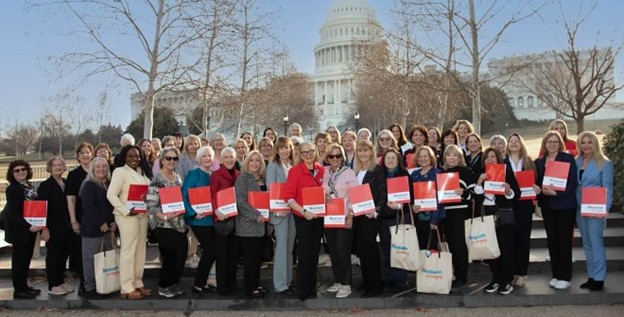
Member of Hadassah 2026 National Advocacy Team gather with National President Carol Ann Schwartz and Executive Director / CEO Ellen Finkelstein for the 2026 Day on The Hill Meetings.
In June of 2024 during Pride Month, I was invited to Washington, D.C., as a Hadassah representative to a reception at Adas Israel Congregation, co-hosted by Michael Herzog, Israel’s Ambassador to the US, along with A Wider Bridge an organization that mobilizes the LGBTQ+ community to fight antisemitism and support Israel. It was a demonstration of unity. I wrote an article about the event, LGBTQ+ Pride – Where Do We Belong? It was published in The Times of Israel Blogs on Aug 14, 2024. I had no way of knowing the impact that this article would have on my life.
I am a licensed clinical social worker by profession and worked as an adjunct professor for 17 years at a large urban state university. Just one week after the article appeared, I started the semester teaching a first-year graduate course, essentially an introduction to clinical social work theories.
The class met at 8 am on Thursday mornings. While I am often more awake than the students, they seemed bright and interested, and we were seamlessly moving along. I am at my best in front of a class: funny, excited and passionate. I interact easily, ask and answer questions, give clinical examples and, each week, involve the students in hands-on assignments.
Midway through the semester, something shifted. The class grew quiet. Participation declined and, at times, the students were openly dismissive. Despite my efforts to reconnect, the distance widened. Eventually, I discovered that all but five students had dropped my section for the following term. One previously engaged student later told me that, after I spoke openly about my Jewish faith, a classmate searched my name, found my article on The Times of Israel Blogs and labeled me a “Zionist.” From that point on, the students effectively boycotted me.
I later learned that deeply hurtful comments about me were circulating on a student WhatsApp thread. Not one student approached me directly to discuss his or her concerns. When I understood what was happening and told the members of my family about it, they urged me not to confront the class out of concern for my safety.
Equally painful was the sense that I had no ally among the faculty with whom I could safely process the experience. By the time I met with the dean, who was kind but limited in what he could offer, the semester had ended.
I honored my contract and returned the following term, but I was not the same. I never wore my Star of David or made the warm, gentle jokes I like about being a Jewish grandmother. At the end of the semester, I decided to leave the classroom for good.
It took time, but I began sharing my story when I felt safe and understood. I am deeply grateful to be part of Hadassah’s National Advocacy team, where I began to process what happened—not as an isolated experience, but as part of a broader reality affecting our entire community. These Hadassah women needed no explanation. Instead, they helped ask –and answer—the important follow-up question: How do we transform helplessness into action?
The answer is advocacy. Through Hadassah, members across the country engage with lawmakers, send action alerts, participate in Jewish Advocacy Days, meet with state and national elected officials in Hadassah’s Day in the District and Day on The Hill and collaborate with like-minded partners to confront the growing reality of antisemitism.
On March 10, 2026, more than 150 Hadassah members traveled to Washington, D.C., and met with our congressional representatives, senators and their staff members to share our experiences and advocate for change.
We began each meeting by educating them — sharing real stories that illustrated the financial, social and emotional toll of antisemitism. We shared Hadassah’s survey, “From Fear to Resilience: Women Facing Antisemitism” and urged them to support S.2947, the Pray Safe Act, which strengthens funding for FEMA’s Nonprofit Security Grant Program to help protect vulnerable Jewish communities as antisemitic threats rise.
Nearly two years later, my heart is not broken; it is rearranged. I have returned to my core belief: The most powerful response to antisemitism is to keep speaking out. One conversation, one article, one interaction at a time. While safety matters, true strength lies in connection and open dialogue. Education, even in small nuggets, can make a meaningful difference.
Gail is a member of the Hadassah Writers’ Circle, a dynamic and diverse writing group for leaders and members to express their thoughts and feelings about all the things Hadassah does to make the world a better place. It’s where they celebrate their personal Hadassah journeys and share their Jewish values, family traditions and interpretations of Jewish texts. Hadassah members are proud of their Zionist mission and their role as keepers of the flame of Jewish values, traditions and beliefs as well as advocating for women’s empowerment and health equity for all. Since 2019, the Hadassah Writers’ Circle has published nearly 800 columns in The Times of Israel Blogs and other Jewish media outlets. Interested in writing? Please contact hwc@hadassah.org.
Related Topics
Related Posts