
Something Fishy
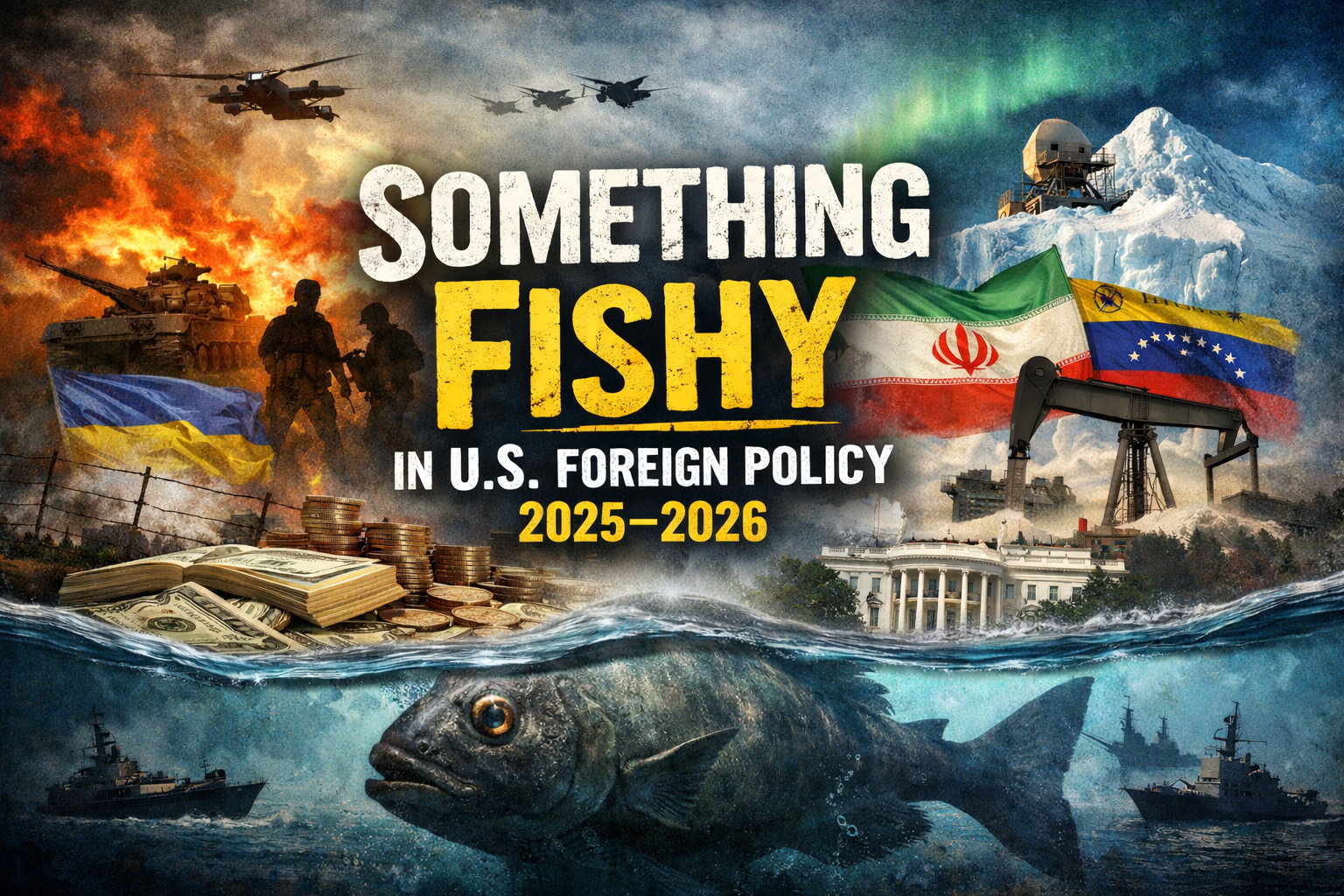
Why US Foreign Policy Doesn’t Add Up (2025–2026)
Between 2025 and 2026, the United States has found itself involved, all at once, in Gaza, Ukraine, Venezuela, Iran, Nigeria and Greenland. Having many fronts open at the same time is not new in history. What feels strange here is simpler than that: nothing gets resolved, everything costs money, and something fishy is going on.
Normally, when a country acts abroad, there is at least a basic logic behind it. Clear priorities. Defined goals. Some calculation of costs and benefits. And, at the very least, an idea of how the situation might eventually be brought to a close. In this case, that logic is hard to find.
Gaza is the clearest example. There is intense military activity, but the core problem remains untouched. Hamas is still there. Israel keeps accumulating military, social and economic costs. No political exit is in sight. The conflict generates constant headlines and moral tension, but no real progress. Gaza has become a permanent battlefield with no ending.
Ukraine has settled into a long war of attrition, with no realistic exit strategy on the table. Venezuela absorbs political energy, legal effort and money, without it being clear what concrete benefit this brings to the average American citizen.
Greenland—and earlier, even Canada, at least rhetorically—makes the absurdity especially visible. Public statements, threats, diplomatic trips, displays of power… and yet nothing actually changes. There is no transfer of sovereignty. No new treaties. No real strategic control. No clear objective, no workable plan, no cost–benefit logic. Greenland functions mainly as a screen onto which geopolitical language is projected, not as a strategic issue that is seriously being worked on.
The common pattern is simple: a lot of action, no closure.
The Real Costs
Meanwhile, the costs are very real. Public spending keeps rising. National debt grows. Inflation refuses to ease. On top of that come tariffs, which for ordinary people work like a hidden tax. Imported goods become more expensive, prices rise along the supply chain, and purchasing power falls.
For most Americans, foreign policy is not an ideological debate. It shows up as less money in their pocket, higher bills, and growing economic uncertainty.
The usual explanations—classic geopolitical interests, institutional incompetence, competing actors, shifts in doctrine—do explain parts of what is happening. But they do not explain the full pattern: many fronts at once, no results, high costs, and constant media noise.
If you strip things down and rule out what does not fit, one explanation remains that makes better sense of what we see. All this external activity keeps attention focused outward and delays the moment when people are forced to confront internal economic realities: inflation, loss of purchasing power, higher prices driven by tariffs. This does not require a grand master plan or permanent deception. It only requires buying time—long enough for political cycles to pass before reality hits home.
That is where the feeling of something fishy comes from. What leaders say they are doing does not match what is actually happening, yet the side effects—noise, distracted attention, time gained—line up perfectly with the overall pattern. This is not a conspiracy theory; it is a simple diagnosis. The system is not behaving the way it claims to behave, so something else must be going on beneath the surface.
No one knows exactly what is hidden there, or when it will fully come into the open. But one thing is clear: this isn’t normal, and it won’t explain itself.