
Starvation in Gaza
We all know starvation when we see it. After the release of the videos of Rom Braslavski and Evyatar David, no one in Israel doubted that they are being deliberately starved. From the nightmarish experiences of the other hostages who have returned, we believe that it is very likely that the other remaining living hostages are receiving similar treatment from their terrorist captors. This inhumane behavior should be condemned by every government and every human being on the planet.
While we all know starvation when we see it, in Israel we have a hard time admitting that Palestinian non-combatants in Gaza are starving. The Integrated Food Security Phase Classification (IPC) Famine Review Committee (FRC), made up of UN agencies and international NGOs, has just determined that Famine (IPC Phase 5) is currently occurring inside of Gaza. When we see horrific pictures of starving children or hear reports of famine, many Israelis will say that the pictures are fabricated by Hamas or their supporters, and the reports are produced by biased international agencies. The common Israeli counter argument to the reports of widespread famine is that a) it is not true or b) it is Hamas’ fault and often, it is both not true and Hamas’ fault.
I am certainly not saying that the Israeli government is deliberately trying to starve the civilian population of Gaza. I believe however, that a combination of misguided policies and erroneous priorities of the Israeli government have caused indescribable misery for hundreds of thousands of Palestinians in Gaza while making an “own goal” in our struggle for international legitimacy and support. It is understandable that the Israeli government has prioritized preventing Hamas from seizing humanitarian aid. It is unforgiveable that the Israeli government has prioritized preventing Hamas from seizing humanitarian aid over delivering humanitarian aid to the people of Gaza.
In their attempt to prevent Hamas from stealing humanitarian aid deliveries from the various international non-governmental organizations (INGOs) operating in Gaza, the Israeli government first stopped all aid from entering Gaza, on March 2nd for 2 1/2 months. On May 19th the Israeli government began to allow food to go into Gaza exclusively to the Israeli American “Gaza Humanitarian Fund”. This method quickly proved to be faulty and inadequate since there were only four distribution points, three in the south and one in the center with none in the north where 1 million Palestinians remain. The GHF distribution centers were established far from centers of population (for security reasons), requiring Palestinians to walk 8 to 12 kilometers each direction carrying 18 kilos of dry food packs on their backs for their families.
The lack of food, the extreme heat, the long wait to receive food packages, and the ongoing conflict created an atmosphere of chaos which led to the deaths of hundreds of Palestinians. Reports by Palestinians that Israeli soldiers fired into the crowds killing people waiting to get food spread throughout Gaza dissuaded many from attempting to access food from GHF distribution centers. In the meanwhile, the IDF has now begun to allow INGOs to bring trucks of food into Gaza. However, the IDF has created new obstacles and bottle necks, by opening only two border crossings into Gaza and by creating a stricter and more complicated registration process for INGOs which has stopped many from operating.
The result has been that according to the IDF’s Coordination of Government Activities in the Territories (COGAT) website, 10,000 trucks of food have entered Gaza since May 19th. Therefore, an average of a little over 110 trucks of food per day have entered Gaza since the IDF allowed food aid in again. The Palestine Logistics Cluster of the World Food Program says that only 3,750 trucks have entered Gaza in this three-month period, though they are not counting the trucks sent to the GHF distribution centers. Even if we accept COGAT’s numbers, I will point out that prior to the war, 500 hundred aid trucks on average entered Gaza daily. INGOs say that a minimum of 500 to 600 trucks a day are needed to meet the needs of the displaced war weary population. An average of 110 trucks a day is clearly not adequate.
Things have improved in recent weeks as more food has been allowed to be brought in daily. One measure of this improvement is the cost of flour in Gaza. Flour is obviously a basic food item for people all over the world and its price can be reflective of overall food prices in a given market. Over the period of the Israeli government’s humanitarian aid blockade, the price of flour in Gaza rose to 20.00 to 30.00 USD per kilo and in some parts of Gaza the price rose even higher as reported in multiple news outlets like the NYT, The Free Press and the Jerusalem Post. The price has steadily come down and is now about 5.00 USD per kilo. In comparison, the price of flour in Israel is about 1.50 USD per kilo. While it is heartening to see the situation stabilizing, we must keep in mind that the aid blockade lasted for over 2 months and during this time, food became extremely scarce as evidenced by the skyrocketing price of flour and other food items. Most displaced Palestinians in Gaza have not worked in almost 2 years and their ability to pay anything for food on the black market is extremely limited, especially since basic food item prices rose hundreds of percent.
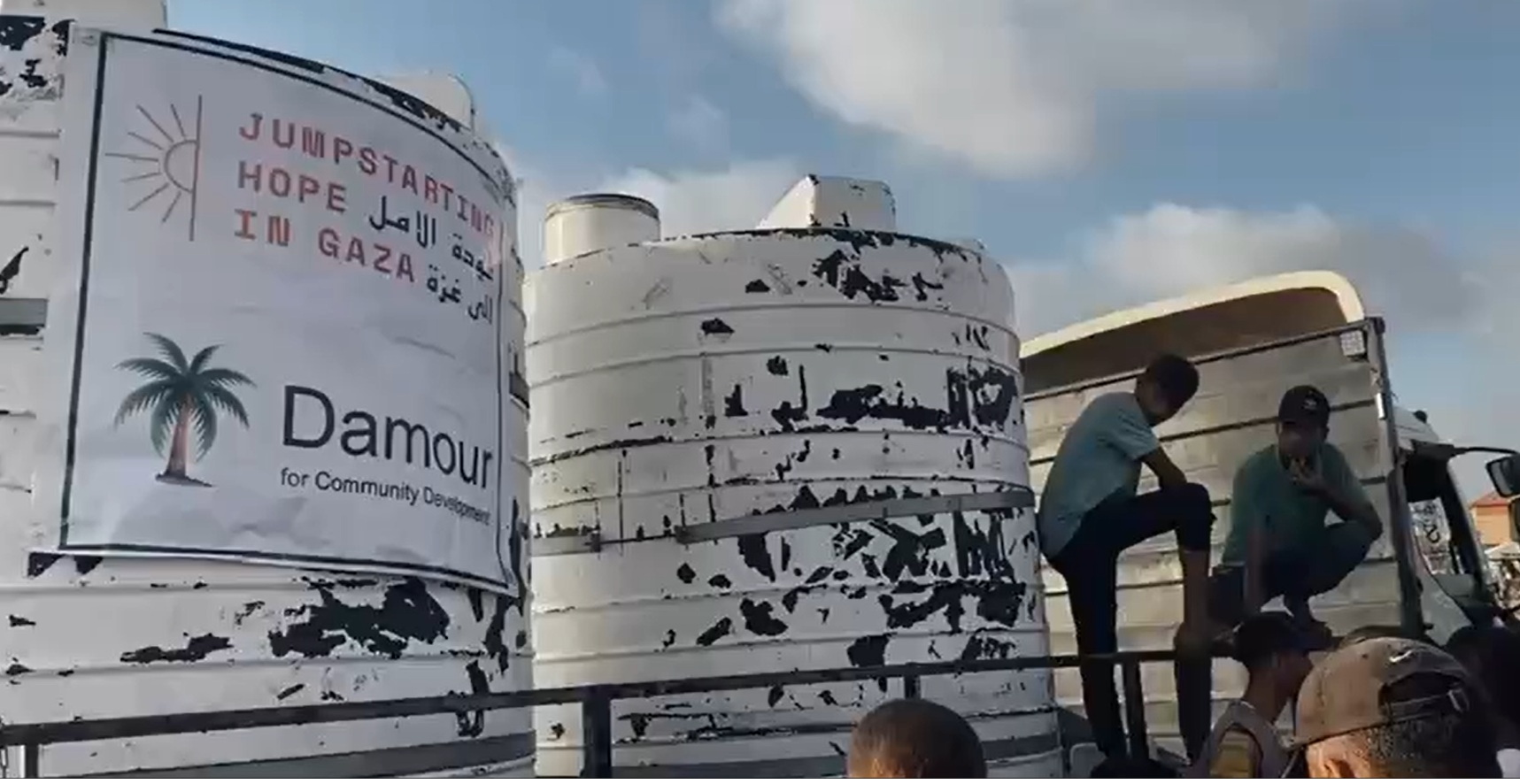
During this period of extreme food shortage, the Palestinian staff of Jumpstarting Hope in Gaza (JHG), a joint Israeli-Palestinian effort to address the humanitarian and environmental crisis in Gaza, managed by Damour for Community Development and the Arava Institute, called our main offices in desperation because they had given out all of the food in the JHG warehouse and had no food for themselves. They went for several days without eating before we were able to provide them with funds to buy food. JHG is now providing water from water trucks in the displaced persons shelters which have no other sources of water.
Currently, an inadequate amount of food is going into Gaza, about 1/5 the amount compared to before the war. The operations of food distribution by INGOs inside of Gaza are completely disrupted due to new IDF regulations on INGOs, ongoing fighting, and the massive destruction of distribution infrastructure such as roads, warehouses and markets. Therefore, even if more food is now entering Gaza, it is inadequate for the needs of the population and not evenly distributed, so large sections of the population, especially vulnerable populations such as children, elderly and sick, are not able to access food. For thousands who suffer from extreme malnutrition and starvation, the refeeding process is dangerous in and of itself and requires special medical treatment which is almost completely unavailable in Gaza. We may therefore continue to see food shortage related deaths even as more food becomes available.
A friend of mine, who is an officer in the IDF stationed on the border overlooking the Kerem Shalom crossing told me that from his observation post, he can see clearly what happens to the food trucks entering Gaza. The area he observes is a Hamas free zone because the IDF is right there and would fire on any Hamas terrorists who tried to come close to the trucks. What my friend observed however, as the trucks entered Gaza, was crowds of desperate Palestinians fighting with each other to grab food off the truck, willing to do about anything to get the food. My friend’s conclusion is that this behavior can only be explained by extreme food shortages and starvation.
I shutter to think of what will happen in Gaza to the Israeli hostages and the Palestinian civilian population if the Israeli government goes through with its plan to conquer all of Gaza. The suffering being caused by this seemingly endless war is unfathomable. This war must end now. The Israeli hostages must be freed from the Hamas underground concentration camps now. The Israeli government must stop prioritizing preventing Hamas from getting food over enabling Palestinian civilians from accessing food. The IDF and the INGOs must work together, not at cross-purposes, to ensure that much more humanitarian aid is entering Gaza and reaching the civilian population. The Israeli public must stop looking away from the suffering in Gaza but must demand that this suffering ends.