
Support Staff
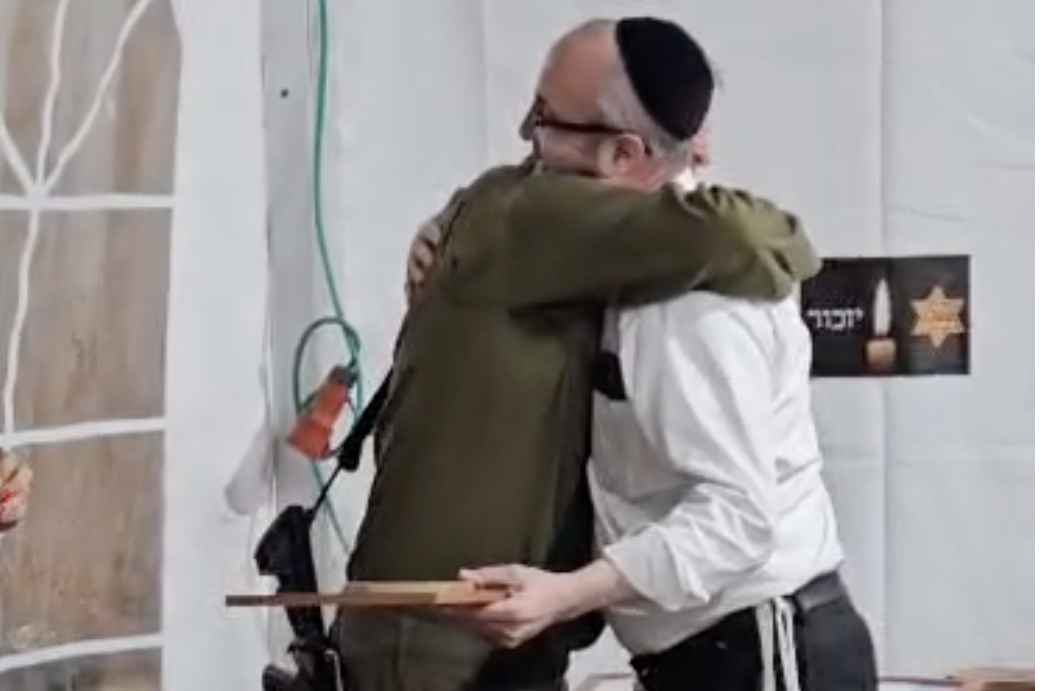
Gedaliah is quick with numbers. If I had to guess, I’d have pegged him for an accountant (though it turns out he’s a lawyer).
• 127 weeks
• 20,000 coffee pods
• 1,733 shekels spent just this past Friday at one bakery; more than 1,500 at another; over 1,300 on nuts and sweets; and more than 500 for ice cream.
Those are just a few of the stats that Gedaliah rattles off when he talks about his volunteer work bringing food and friendship to an IDF base in the Beit Shemesh area.
—
My son Avi completed his regular service in the Israel Air Force. While that may sound glamorous, only about one in 60 Air Force personnel ever fly a plane. His service was decidedly more mundane than a scene from Top Gun: he taught English to promising high school cadets whose aptitude marked them as having such bright military futures that they were already enlisted and in uniform by their mid-teens.
Every branch of the military relies on people in many different roles—mechanics and electricians, secretaries and physicians among them. These support staff are the backbone of military operations, silent partners in the success of our efforts on the ground, in the air, or at sea, in both war and peace.
—
Every weekday morning, Gedaliah Krainess and his volunteers take on the role of unofficial IDF support staff, hopping into their cars for a quick drive to help make a morning minyan on a nearby army base. He began this routine once the war broke out, with the conviction that if the soldiers are out there for him, he needs to be there for them.
Almost three years later, the fire in his belly has only grown.
Like the support staff of my son’s unit, the volunteers far outnumber the soldiers. The first time I attended, I counted 16 community members and three enlisted men. But for the servicemen dressed in green who make it a point to be there, this minyan is a chance to take a deep breath, connect, and start their day in a sanctified way.
Don’t think that Gedaliah’s service ends with the minyan. He has furnished the shul with a well-stocked coffee corner, complete with a Nespresso machine—hence the 20,000 pods he has purchased over the past couple of years—drawers bursting with snacks, a refrigerator stuffed with cakes, and a full complement of delicious food every Shabbat.
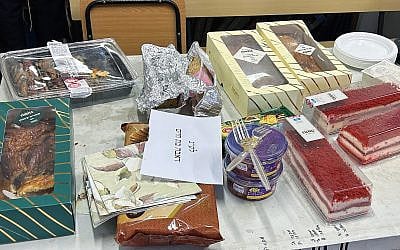
He’s quick with a hug and a smile and makes every soldier feel like family, or perhaps even better than family! The soldiers feel the love. One remarked, “I don’t think there’s another base in the country with a kiddush like the one we had on Shabbat—with sushi and herring, cakes and homemade foods. Keep it coming!”
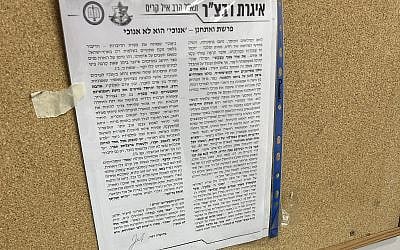
From the outside, the shul is a makeshift caravan, typical of structures on an army base. Inside, however, it has been tricked out with a full Aron Kodesh and shelves of sefarim. The bulletin board displays a parsha sheet published by the army rabbinate, a flyer for the WhatsApp group used to coordinate the minyanim, and an annual calendar of Shabbat times.
When I joined the minyan recently, I met Ari (not his real name), an oleh from Maryland. He told me enthusiastically how wonderful it is to be on base for Shabbat. For context, in army parlance, “you’ve got Shabbat” is actually a punishment. It means that you are not allowed to go home and must stay on base for Shabbat. Ari told me that staying on this base for Shabbat was no punishment at all. Thanks to Gedaliah, it was a special experience.
“People think I’m a big organization,” Gedaliah told me with a laugh. “It’s just me. When the bill for supplies is greater than what people have donated, the difference comes out of my pocket.”
If you live in Ramat Beit Shemesh, you might have spotted Gedaliah in the shopping area on a Friday morning, dressed in his unmistakably chareidi white shirt and black pants, pitching his cause to passersby and asking them to contribute to the soldiers. Challenging common stereotypes and pervasive media messaging, chareidi residents are among his biggest donors, with many of them recording messages thanking the soldiers.
That’s where I first met Gedaliah, in one of the stores that supplies him with nuts and candies and even helps him collect donations at the register. He’s so well known, loved, and trusted that some of the stores let him go right behind the cash register and handle the transactions himself. “I can even check out customers!” Gedaliah proclaimed.

“Would you like to help provide treats for our soldiers?” I’ve often been asked at Mini-Machaneyuda. I have contributed several times and often wondered how those treats actually reached our dedicated soldiers. Now I know: the store credits the donations to Gedaliah’s tab.
As Gedaliah put it, “The war is not over and our brothers and sisters in uniform need our support. Everyone is able to help out with something. If everyone works together, not only do the soldiers benefit, but our entire society benefits. We are one nation and one people. We are family. We might have differences, but we have so much more in common than people tend to believe.”
—
After October 7, I thought I had something to offer the army and tried to get a foot in the door. Honestly, the thought of joining my two boys in uniform, albeit not anywhere near combat, pulled at me like a magnet. I could only picture my father, who was himself a WWII veteran, looking down from above, beaming with pride.
Alas, at the age of 62, I couldn’t get a return call. As I reflect on it now, my romantic notion of donning an IDF uniform was naive, if not downright foolish. But that does not preclude me from assisting our holy soldiers in various ways outside of the formal military, and I’m privileged that Gedaliah has offered me another avenue to do so.
—
Moshe (not his real name), a commander formerly stationed at the base, but who is now serving up north, called Gedaliah twice in recent months. The first call was six months ago.
“I need something from you. I’m making a wedding in two weeks, and I need you to be there. It wouldn’t be the same without you!” Of course Gedaliah showed up, honored to be a part of the simcha.
Last week came the second call: “I need something from you. I have 100 of my boys ready to go into Lebanon, and they want army-green moisture-wicking tzitzit. Can you help?”
“Of course!” Gedaliah replied without hesitation, though he had no clue where he could actually find them. No worries—Gedaliah is on the job. He quickly found a source and will make sure the soldiers receive their tzitzit.
After all, that’s what you do for family!
—
To help Gedaliah continue his work with a tax-deductible donation (made possible through Lema’an Achai), visit: www.lemaanachai.org/en/project/operation-homefront/
To join the minyan or assist in other ways, call Gedaliah in Israel at 053-708-8987, or WhatsApp +1-216-410-2046.