
Writing from the fault lines of Israeli society
Take the penny: What Jewish Israelis owe Arabs choosing political participation
What Jewish Israelis owe Arabs who choose political participation
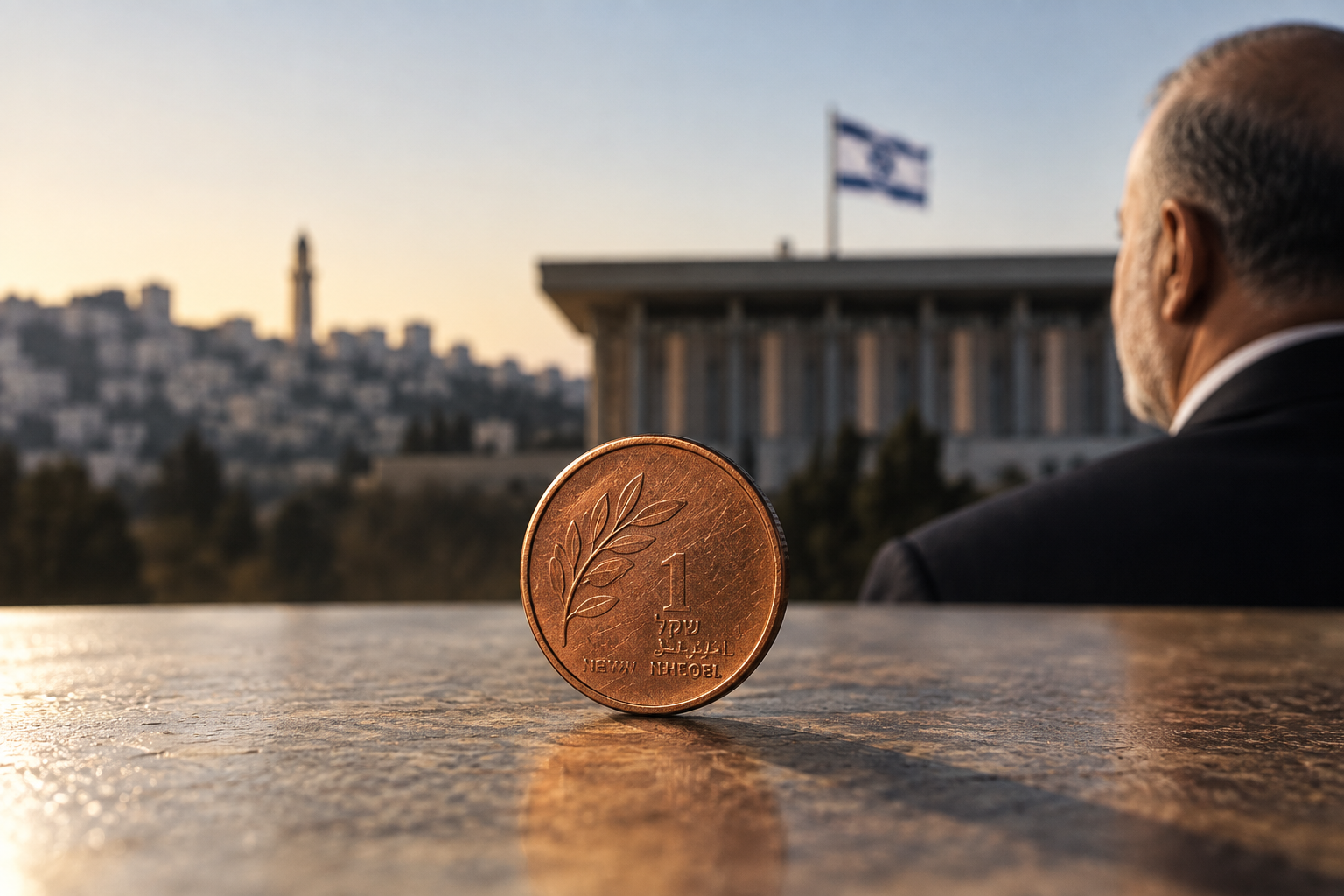
If Arab citizens choose to take the penny, are Jewish Israelis prepared to let them spend it?
Take the penny:
What Jewish Israelis owe Arabs who choose political participation
If Arab citizens choose to take the penny, are Jewish Israelis prepared to let them spend it?
Last week, Palestinian political activist Waseem Hosary published an essay in +972 Magazine about the debate unfolding within Arab politics in Israel. At its center is a question about the price of political participation: What must Palestinian citizens be willing to concede in order to gain real influence within a Jewish state? Hosary argues that Mansour Abbas and Ra’am have accepted a bargain that asks too much of them.
To make that argument, Hosary reaches back to a story told in 1944 by Palestinian educator and intellectual Khalil al-Sakakini, responding to David Ben-Gurion’s claim that Jews wanted “understanding” with the Arab nation.
A priest offered a penny to any student who could answer a simple question: Who is the person one should love completely?
The children tried. One said his father. Another his mother. Another his brother or sister. All wrong.
Finally, one boy understood what the priest wanted to hear.
“Jesus,” he answered.
The priest handed over the penny and asked the boy his name.
“Mordechai.”
A Jewish child saying what the Christian authority wants to hear in exchange for money carries a deeply problematic antisemitic trope that is hard to miss. Not exactly surprising in a political parable from 1944, and still jarring to read today. Yet the argument Hosary builds around the story now, weeks before Israel’s 2026 election, is worth engaging with.
The joke isn’t that Mordechai has become Christian for a penny. It’s that the priest never really wanted to know what Mordechai believed. He had already decided the correct answer. Mordechai understood the rules, gave him what he wanted, and collected his coin.
For Sakakini, this was the problem with Zionist talk of “understanding.” The Jews were willing to hear from Palestinian Arabs, he argued, as long as the Arabs gave them the answer they wanted: This is your country. You have returned home. Only then do you get the penny.
Hosary argues that Mansour Abbas and Ra’am have, in effect, taken the penny.
The disagreement within Arab politics is about more than coalition arithmetic. It is about the price of political participation. How much should Palestinian citizens be willing to set aside in order to gain political influence? When does pragmatism become accommodation, and when does accommodation become erasure?
Hosary is writing from within that debate. I am not.
But reading him, I found myself asking a different question.
What if I want them to take the penny?
I am a Zionist. I believe the Jewish people have the right to national self-determination here, and I want Israel to remain the Jewish state.
Ten years of working closely with Arab society have not made me less certain of that. They have changed what I think follows from it.
I no longer think an Arab citizen has to accept my account of this country in order for me to recognize his belonging here.
That means taking Palestinian identity seriously, including the parts of it that are difficult for me to hear. A Palestinian citizen can tell me what happened to his family in 1948, mourn the Nakba, describe discrimination he experiences in Israel, and vote for politicians who will fight policies I support.
I can hear those things without assuming they mean he wants me gone. And I can do that without agreeing that Jewish national self-determination is illegitimate.
That distinction wasn’t always simple for me. For a long time, certain words came with conclusions attached to them. “Palestine” meant Israel shouldn’t exist. “Nakba” meant my Independence Day was a crime. Palestinian national identity meant rejection of Jewish national identity.
Actual relationships complicated those equations. I discovered that someone could call this land Palestine and still care deeply about me and my family. Understanding why someone believes something does not require me to believe it too.
I became more capable of hearing the Palestinian story without becoming less Zionist.
Ra’am has chosen what it calls a politics of influence, putting greater emphasis on the immediate problems facing Arab citizens – crime, housing, infrastructure, education, employment and budgets – rather than making resolution of the Palestinian national question a condition for political cooperation.
Mansour Abbas has not been coy about what that entails. In 2021, he said publicly that Israel “was born as a Jewish state” and “will remain” one. The question, he said, was not the identity of the state but the status of Arab citizens within it. He made similar comments in Arabic as well.
Lately, Abbas has made the cost of his position more explicit. Last month, he wrote that Israel’s Jewish character is a reality “imposed upon us” by the Jewish majority and that Arab parties have been compelled to accept it in practice in order to participate in elections. At the same time, he rejected the idea that political participation requires denying the Nakba, Palestinian displacement or the Palestinian narrative.
Abbas is not claiming that Mordechai has come to believe what the priest believes.
He is saying, in effect: I understand the room I am in. I want to be in it anyway.
And yesterday, the Central Elections Committee voted 18-5 to disqualify Ra’am from running in the October election. The decision will now be reviewed by the Supreme Court, which has historically set a high bar for disqualifying parties.
What, exactly, have Jewish Israelis spent decades saying we want?
Accept that Israel exists. Participate in its institutions. Work within democratic politics. Pursue equality and change through elections, legislation, budgets and government.
Then an Arab political movement attempts precisely that, and the possibility that it might wield real political power is still treated with suspicion.
We cannot demand integration and then retreat when integration produces power.
And we cannot ask them to take the penny and then refuse to let them spend it.
That is why I see value in the Ra’am experiment itself.
This election has made that experiment even more interesting. Yoav Segalovitz, a Jewish Zionist, former senior police commander and former Yesh Atid MK, is now number two on Ra’am’s electoral slate.
Segalovitz is not trying to convert Mansour Abbas, and Abbas is not trying to convert Segalovitz. Their political, ideological and national identities remain different. They are betting that shared citizenship is enough to build something on.
What happens if Arab political power becomes normal?
That question matters to Jewish Israelis at least as much as the question Hosary is asking Arab society.
We are asking Palestinian citizens to participate fully in a state that is explicitly Jewish – its flag, anthem, calendar and national story are mine far more than they are theirs. So I have to ask something in return:
What do I owe the person whose belonging here I recognize, even when I don’t accept his account of what this country should be?
I don’t think I owe him agreement.
But Jewish sovereignty does not require Palestinian citizens to shed their Palestinian identity. It doesn’t require me to pretend their families’ experience of 1948 was the same as mine. And it certainly doesn’t require their political powerlessness.
Perhaps we have the order backward.
Perhaps Jewish society does not first resolve its fears about Palestinian identity and then become capable of accepting Arab political participation. Perhaps participation is part of how the fear eventually changes.
That is closer to what happened to me. Proximity changed what certain words meant. People who had existed in my political imagination became colleagues, friends and people I cared about. The disagreements didn’t disappear. But they stopped being entirely theoretical.
Ten years of personal experience is not a theory of social change. But I wonder what happens when Arab citizens cease to be an abstract demographic or political problem and become ordinary participants in power. Citizens helping to run the state.
Maybe that creates room, eventually, for the harder conversations.
And this is where I come back to Mordechai.
The priest thinks he controls the transaction. He asks the question. He decides what answer counts. He holds the penny.
Sakakini wants us to notice the arrogance in that arrangement.
We should.
But I also notice Mordechai.
He knows who he is. He understands the room. He understands the priest. And he knows what the penny is worth.
Whether Palestinian citizens should take it is ultimately their argument to have.
But if they do, Jewish Israelis have an obligation of our own.
We have to let them spend it.
Related Topics
Related Posts