
From Kibbutz to the global stage
Tehran After Khamenei: Iran’s Escalation and the Risks of Regime Change
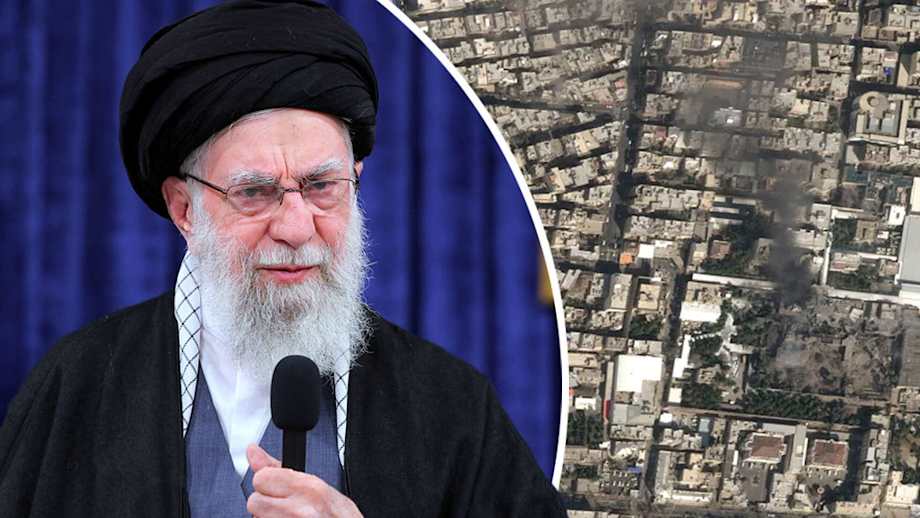
Image:Iran’s Supreme Leader Ayatollah Ali Khamenei and a satellite image showing damage to his Tehran compound following US-Israeli strikes. The attack intensified questions about Iran’s leadership succession and the risks of regime change during wartime. (AP)
The current Iranian escalation and the widening attacks against multiple states in the region — including Gulf countries and even Cyprus — raise a strategic question: why would Iran act in a way that unites a growing number of states against it, despite its military inferiority to the United States and Israel?
These actions have already begun to reshape the regional balance. Several Gulf states that previously tried to avoid direct confrontation with Iran — and in some cases even served as mediators — have shifted from a largely passive position to a more active one. This change is reflected not only in joint condemnations but also in military actions, such as the recent Qatari strike against Iranian targets.
At the same time, attacks against Cyprus have altered the position of several European states. Britain, Germany, France, Italy and Greece have all increased their involvement, with some even deploying forces to help defend the island.
This raises a central question: why would Iran expand the conflict and attack countries that were previously not directly involved and, in some cases, even tried to prevent escalation?
Even Oman — which for years played a key mediating role between Iran and the United States — found itself under attack.
Several explanations may help explain this seemingly puzzling behavior.
One possibility is the deliberate creation of global economic disruption. By targeting energy infrastructure, oil production and key transportation routes, Iran may hope to generate economic pressure that could eventually affect the United States and Western economies.
A second explanation may lie in religious and nationalist motivations. The killing of Supreme Leader Ali Khamenei — who for many Iranians symbolized both religious authority and national leadership — may create powerful internal pressures for revenge.
A third and perhaps more significant explanation may be an internal succession struggle. The removal of Khamenei and other senior figures may have created a leadership vacuum inside Iran. In such circumstances, competing factions may adopt increasingly hardline positions in order to strengthen their standing in the struggle over succession.
Even if one of the candidates — possibly Khamenei’s son — eventually consolidates power, he may initially feel compelled to demonstrate strength and revolutionary commitment in order to legitimize his leadership.
Over time, however, the new leadership will likely face the difficult task of reaching painful compromises in order to stabilize the situation. A new and inexperienced leader may struggle to make such decisions, especially if real power shifts toward the Revolutionary Guard, a development that could prolong the current confrontation.
If Iran’s current escalation is indeed the result of internal political instability, the situation may be even more dangerous than a calculated strategic decision. Internal regime instability can easily trigger broader regional escalation, severe economic consequences, and even the risk that the conflict may gradually acquire stronger ideological or religious dimensions.
The discussion also raises the broader question of regime change as a war objective. When regime change is declared as one of the goals of a military campaign — particularly when the country’s top leader is killed during the conflict — it becomes difficult to describe such actions merely as attempts to influence political outcomes. Rather, they amount to a deep external intervention in the political structure of that state.
Yet history in the Middle East suggests that removing regimes through war does not necessarily produce stability, and sometimes leads to the opposite outcome.
The overthrow of Saddam Hussein in Iraq led to years of political chaos, instability, and the rise of Shiite militias closely aligned with Iran.
The killing of Muammar Gaddafi in Libya resulted in the fragmentation of the state and ongoing internal conflicts that continue to this day.
The death of Yasser Arafat contributed to the political split between Hamas and Fatah, the division between Gaza and the West Bank, and ultimately the establishment of Hamas rule in Gaza — developments that formed part of the chain of events leading to the October 7, 2023 catastrophe.
For this reason, extreme caution is required when external actors seek to shape or replace political leadership in other states.
Another factor that deserves attention is the definition of war objectives themselves.
When regime change becomes an explicit goal of the conflict, the room for political compromise may shrink dramatically. A leadership that believes its very survival is at stake is far more likely to escalate its positions and expand the conflict, as the range of available options rapidly narrows.
In such circumstances, actions that may appear externally irrational — such as widening attacks against additional countries — may in fact reflect an internal political logic aimed at altering the balance of pressures or reshaping the strategic environment.
In other words, when regime survival becomes the central issue, decisions that appear irrational from the outside may be driven by internal political logic — a logic that can prolong and expand the war.
Related Topics
Related Posts