Reasonable Judaism: Torah for an Age of Outrage
Featured Post
10 stories about my grandfather-in-law, Rabbi Norman Lamm
Known for his ideas, Rabbi Lamm was also a grandson, a disciple, an embattled university president, and a caring person who never lost sight of the individual
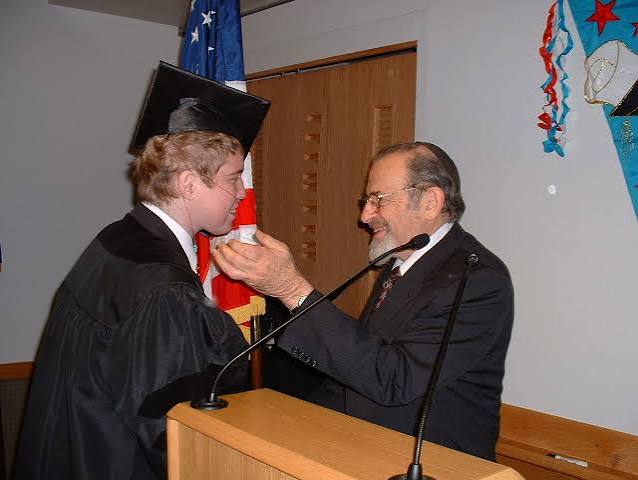
Rabbi Lamm with Yeshiva University student Mikey Butler. Courtesy of the Lamm Legacy. Used with permission.
Rabbi Dr. Norman Lamm was one of the most influential leaders of 20th-century Modern Orthodoxy: a congregational rabbi, theologian, educator, rosh yeshiva, and president of Yeshiva University for more than a quarter century. He was also a gifted storyteller who lived a remarkably eventful life.
As director of the Lamm Legacy, I have spent the past several years working with his writings, correspondence, recorded interviews, and archival materials. I also write about him regularly on my Substack. Much of my work has focused on his ideas, but the stories of his life reveal another side of him: devoted grandson, independent-minded disciple, embattled university president, and, perhaps above all, caring rabbi who never lost sight of the individual. Here are 10 of my favorite stories and recollections. I hope you find them as varied and revealing as I do.
1. When Albert Einstein Met Willy Frank
One of Rabbi Lamm’s closest childhood friends was Willy Frank, the son of a janitor and one of the most extraordinary young minds Rabbi Lamm had ever encountered. By age 12, Willy had written a critique of Kant’s Critique of Pure Reason and an analysis of Einstein’s theory of relativity. He later attended MIT and worked at the US Naval Observatory. He seemed destined for an extraordinary career before developing MS and dying tragically young (Rabbi Lamm’s poignant eulogy for Willy is here).
Willy was exceptionally quirky and possessed a tremendous wit. He could never resist a good pun or practical joke. Rabbi Lamm’s favorite example ran as follows: Dr. Samuel Belkin, Yeshiva University’s president at the time, was once showing Albert Einstein around the university – I assume this was when YU was courting Einstein to lend his name to its medical school – when he introduced Willy as one of the most brilliant young scientific minds at Yeshiva. Einstein extended his hand to greet him. Willy obliged by extending his hand toward Einstein and releasing a yo-yo.
2. Rabbi Lamm’s First Rebbe
One of the most important figures in Rabbi Lamm’s life was his maternal grandfather, Rabbi Yehoshua Baumol (1880–1948), the author of the two-volume responsa collection Emek Halakha. Rabbi Baumol was a distinguished Torah scholar and a Hasid.
Every Shabbat morning, the young Norman Lamm would go to his grandfather’s home to learn over coffee and cake (since Rabbi Baumol was a Hasid, they ate before davening), after which the two would walk together to his grandfather’s shul. Rabbi Lamm continued learning with his grandfather throughout his youth, and Rabbi Baumol became one of his two most decisive influences, alongside Rabbi Joseph B. Soloveitchik.
In 1944, Rabbi Lamm spent a “gap year” after high school dividing his time among three pursuits. In the mornings, he continued learning at Torah Vodaas. In the afternoons, he learned with his grandfather. In the evenings, he went to the local public library, where he read voraciously. Over the course of that year, he read all of Freud, Plato, Aristotle, and much, much more.
Rabbi Baumol insisted that his grandson never rely uncritically on a quotation or a secondhand account. Whenever Tosafot cited and critiqued Rashi, for example, he directed Rabbi Lamm to open Rashi and verify that Tosafot had cited him accurately. He would say that faith in the sages has no place in the realm of Torah study.
Although he had little formal secular education and was not a devotee of Torah Umadda, a philosophical approach that values both Torah study and secular education, Rabbi Baumol also played an important role in his grandson’s decision to attend Yeshiva University. Rabbi Lamm’s teachers at Torah Vodaas strongly opposed the choice. His grandfather, however, was more moderate and was open to the idea. At some point, he read some of Rav Soloveitchik’s Torah and was so impressed that he insisted Rabbi Lamm attend YU to study with the “young rabbi.”
3. A Few Recollections of Rav Soloveitchik
Rabbi Joseph B. Soloveitchik, known as the Rav, delivered shiur on Tuesdays and Wednesdays, and Rabbi Lamm found the experience so intimidating that he did not eat lunch beforehand because he was afraid he would not be able to keep his food down if the Rav called on him and he answered incorrectly.
But the Rav, as it turns out, believed in Rabbi Lamm. Rabbi Lamm’s oral examination for semikha (ordination) was conducted by Dr. Belkin, Rav Moshe Shatzkes – the bochen, or examiner – and the Rav. During the examination, the Rav turned to the others and said, “He knows.” Rabbi Lamm could not describe just how much those two words meant to him. Until that moment, he had assumed the worst about the Rav’s opinion of him as a student.
But Rabbi Lamm’s reverence for the Rav never prevented him from disagreeing with his rebbe. He acknowledged that they differed on a number of issues, including whether RIETS should be separated from Yeshiva University so that YU could become eligible for federal funding. Rabbi Lamm once added, “I blame it on the Rav. He’s the one who taught me to think for myself!”
4. The Rambam That Awakened the Rav
When the Rav was gravely ill, Rabbi Lamm traveled to Boston to visit him. The family warned him to prepare himself. Rabbi Lamm went upstairs and said, “Rebbe, it’s Norman Lamm.” There was no reaction. He tried speaking to him, but the Rav stayed silent.
A family member had suggested that Rabbi Lamm engage him in learning. And so Rabbi Lamm mentioned a passage in the Rambam (the medieval scholar, Maimonides). Suddenly, the Rav came alive. A torrent of Torah poured forth, largely in Yiddish. The Rav began citing sources from everywhere, one after another. The references came so fast that Rabbi Lamm could hardly follow.
Then, as suddenly as it had begun, it ended. The Rav lowered his head and was silent again.
5. The Graduate-School Interview That Was Cut Short
After graduating from Yeshiva College, Rabbi Lamm interviewed for graduate study in chemistry at a prominent university. Rabbi Lamm recalled that when he walked into the room, the interviewer did not bother asking him to sit down. The interviewer looked at Rabbi Lamm’s papers, then looked at him and asked, “Why do you people want to come here?” Rabbi Lamm asked whether he meant Jews. The interviewer answered, “Yeah.”
Although Rabbi Lamm was generally quite mild-mannered, he was livid. He grabbed his application papers, tore them in pieces, threw them toward the interviewer, and walked out, declaring that he would never set foot in the school unless the university invited him back.
The next time Rabbi Lamm set foot on that campus was many years later, when its president invited him to visit as a fellow university president.
6. My Wife Will Not Work for the Synagogue
When Rabbi Lamm interviewed for the pulpit at Congregation Kodimoh in Springfield, Massachusetts, in 1953, he was engaged but not yet married. During the interview, a committee member asked what his wife would do for the synagogue.
Rabbi Lamm responded by clarifying that the congregation was not hiring a chauffeur-and-maid team. His wife would participate fully in the community, but she was not a professional rebbetzin and would not serve as an unpaid synagogue employee.
The committee accepted his terms and hired him.
7. The Secret Bullet Factory in the Catskills
(This one is fairly well known – Rabbi Lamm shared it himself – but it’s a good one regardless.) In 1948, the YU students knew that the Jewish forces in Israel were badly outnumbered. Many volunteered to pack blankets to ship overseas, with rifles concealed between the blankets and smuggled to the Haganah. Rabbi Lamm participated, but he started to wonder whether, as a chemistry major, he could make a unique contribution.
He gathered a few scientifically gifted friends, including Willy Frank, Shmuel Sprecher (later rector at Bar-Ilan), and his roommate Matthew Katz, and contacted the Jewish Agency. When Rabbi Lamm began describing his idea over the telephone, the man on the other end – Professor Chaim Leib Pekeris – abruptly told him to stop talking and come immediately.
When they met, Pekeris apologized for his brusqueness. The telephone lines might be tapped, he explained, and what they were doing was none of the FBI’s business.
Rabbi Lamm and his friends were sent to a clandestine laboratory in East Fishkill, New York. They worked with a group of scientists, including Ernst David Bergmann, who would later head Israel’s Atomic Energy Commission. Their mission was to develop ammunition that could be manufactured from materials available to the Jews in Israel.
When Rabbi Lamm first entered the laboratory, he saw a small man lying on his back beneath a bed frame and painting it. The man looked up and asked in a thick accent, “Hello, zis is okay, no?” Rabbi Lamm jokingly answered, “No, it’s not okay.” The man became upset before Rabbi Lamm explained that he had been joking. Afterward, he learned that the man under the bed was Professor Bergmann.
One day, they received word that the FBI was coming. The weapons research and chemicals disappeared into drawers, and books and papers about fertilizer came out. The agents apparently understood the charade but left without interfering. As soon as they walked out, the fertilizer research vanished and the real work resumed.
Rabbi Lamm’s own assignment included burning the laboratory’s refuse. At first, he resented the task and wondered whether he had studied chemistry for four years to burn garbage. He threw the refuse outside and tossed a match onto it. The engineers began screaming at him to run. Seconds later, the combustible chemical waste exploded, and Rabbi Lamm barely escaped being injured.
After several weeks of work, the group developed the necessary formula, which enabled the Israelis to manufacture the bullets they needed.
Rabbi Lamm later described the work as his introduction to a different kind of Zionism. As he put it, no one danced the hora or sang Hatikvah. They simply rolled up their sleeves and got to work.
8. Sleeping Like a Baby
Rabbi Lamm’s first few years as president of Yeshiva University were extraordinarily difficult. He had moved from the rabbinate to running a sprawling and complex institution. Shortly after he began his tenure, the faculty sued for the right to unionize, and the university fought the case all the way to the Supreme Court. Around the same time, the severity of YU’s precarious financial condition was becoming clear.
At Rabbi Lamm’s investiture in November 1976, New York State Education Commissioner Ewald Nyquist welcomed him to the community of university presidents. From that point forward, Nyquist promised, Rabbi Lamm would sleep like a baby: he would sleep for an hour, cry for an hour, sleep for another hour, and cry for another hour. And so it was.
9. When YU Nearly Declared Bankruptcy
During Rabbi Lamm’s second year as president, he discovered the true magnitude of YU’s financial crisis. The school carried tens of millions of dollars in debt and had only a paltry endowment. His advisers concluded that there was no realistic alternative to bankruptcy.
Rabbi Lamm was prepared to follow their advice and, one evening, began signing the necessary papers. At one point, his hand froze, and he could not finish signing. He wondered whether it was a psychological block or a sign from heaven. Whatever the explanation, he stopped.
An emergency fundraising meeting was subsequently convened in the office of Herbert Tenzer, chairman of the board. In the middle of the meeting, at Rabbi Lamm’s invitation, Rabbi Soloveitchik suddenly entered the room. He took out a piece of paper and read a brief statement describing his debt to YU. Whatever he had accomplished, he explained, would have been impossible without Yeshiva. His children and grandchildren had also been deeply blessed by the institution. The Rav finished reading and walked out. By the end of the meeting, donors had committed some $10–15 million, and YU was on its way toward solvency.
10. How Mikey Butler Got His Diploma
Mikey Butler was born with cystic fibrosis (his story is here). He took more than 70 medications a day, required oxygen, and spent nearly half his life in the hospital. Despite his precarious health, he had one great dream – to attend Yeshiva University.
Mikey arrived for freshman year carrying an oxygen tank, suffering from a severe cough, and bringing what his father described as a pharmacy’s worth of medicine. He had never expected to manage four full years, but by the end of his first week, it had become clear that even completing a single semester would be difficult. He returned home to Pittsburgh and went directly into the hospital.
Two weeks later, Mikey returned to YU to collect his belongings. He found a note on his dormitory door directing him to see the dean. After he finished packing, he went to the dean’s office. The dean looked across his desk at the thin young man with blue fingernails from insufficient oxygen and told him that he was going to graduate from Yeshiva University. Whatever it took, the university would find a way to get him through.
Over the next four years, Mikey alternated between approximately three weeks at Yeshiva and three weeks in a Pittsburgh hospital. When Rabbi Lamm met Mikey’s father, Judge Butler, at a wedding in Memphis during Mikey’s freshman year, he immediately recognized the name and asked whether he was related to Mikey. YU had thousands of students, but its president knew Mikey’s entire story. When Mikey’s father tried to thank him for everything the university was doing for his son, Rabbi Lamm looked puzzled. “But that’s who we are,” he responded.
By the end of Mikey’s fourth year, his classmates had elected him vice president of the student body. He had declined to run for president because he did not think it would be fair to hold the position while spending half his time in the hospital. He still needed to complete one final semester, but before it ended, his lungs began to fail. He returned to an intensive care unit in Pittsburgh, where it became clear that he needed a double lung transplant.
With Rabbi Lamm’s blessing, YU chartered a bus and offered students the opportunity to make an 800-mile round trip on a Sunday to visit Mikey in the hospital. The university even supplied sandwiches. His father later said that the visit was better than the best drugs.
About a week later, Rabbi Lamm flew to Pittsburgh. Mikey was brought by ambulance from the intensive care unit to the executive offices of Greater Pittsburgh International Airport. Before a hastily assembled group of family and friends, Rabbi Lamm awarded him his diploma from Yeshiva University.
A few months later, Mikey received the double lung transplant. Although he had technically graduated, the YU Student Council amended its constitution so that he could remain vice president through the end of the academic year. That June, he returned to graduate a second time with his classmates at Madison Square Garden. When his name was called, Rabbi Lamm handed him his diploma and embraced him. The two received a standing ovation.
Several months later, Mikey developed post-transplant lymphoma. After chemotherapy, radiation, and stem-cell transplants failed, he died in 2004. Despite the snow, several busloads of YU students traveled to Pittsburgh for the funeral, along with a delegation that flew in with YU’s new president, Richard Joel.
At Rabbi Lamm’s direction, Yeshiva ended its Torah classes early that morning so the students could gather in the main auditorium for a video connection to the funeral. The technology failed, but the university held its own memorial service. Rabbi Lamm opened it with a eulogy for Mikey.
During shiva, Rabbi Lamm flew to Pittsburgh to comfort the family. He personally delivered a recording of YU’s memorial service so that Mikey’s parents could hear what he and the other speakers had shared about their son.
Related Topics
Related Posts