
Strategist and Diplomat Analyzing Somaliland and Horn Affairs
The Al-Alamein Summit and the Berbera Axis
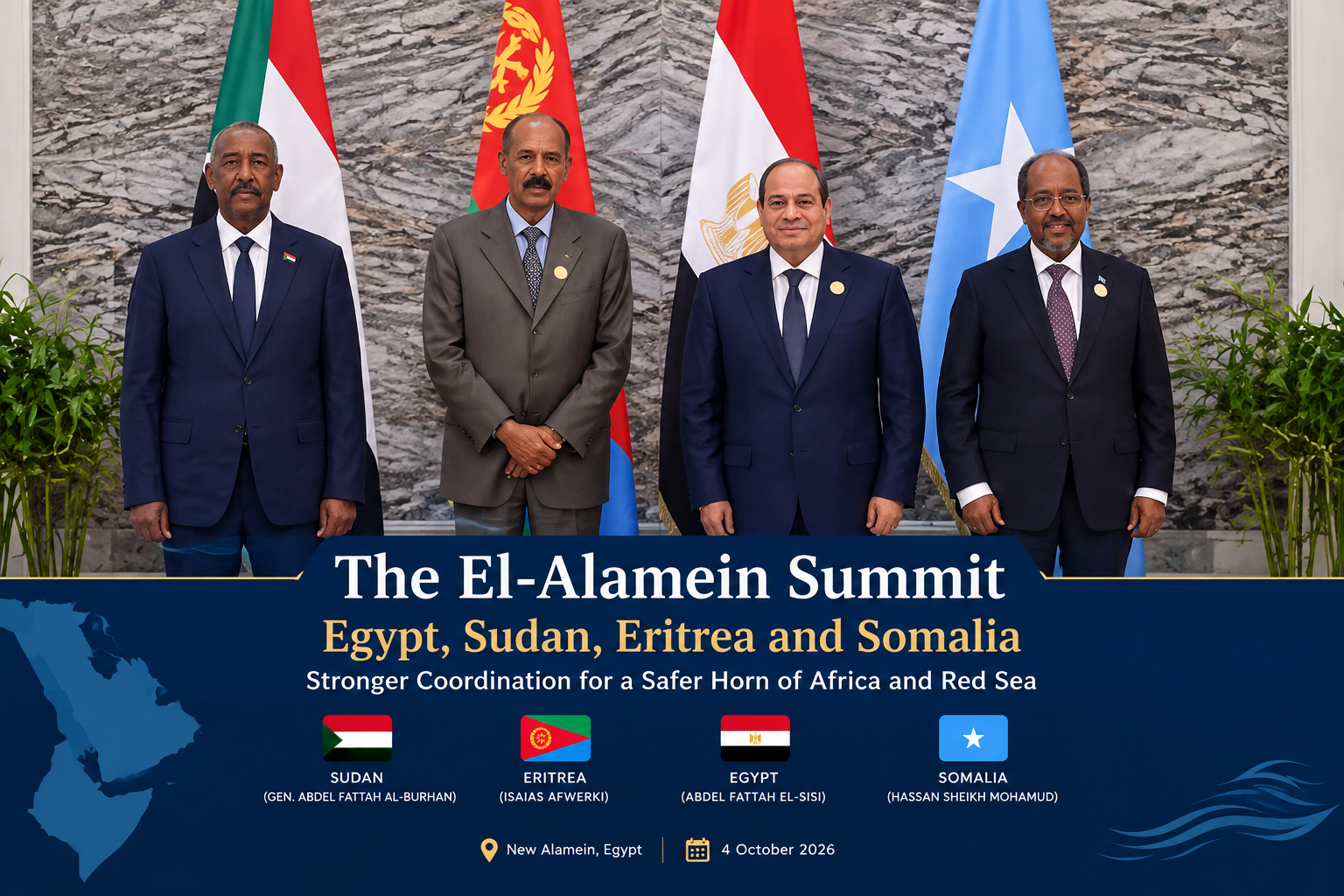
The El-Alamein Summit: Leaders of Egypt, Sudan, Eritrea, and Somalia meet in New Alamein, Egypt, to strengthen regional coordination on Horn of Africa and Red Sea security.
The 4 October 2026 Al-Alamein Summit brought together Egyptian President Abdel Fattah El-Sisi, Eritrean President Isaias Afwerki, Somali President Hassan Sheikh Mohamud, and Chairman of Sudan’s Transitional Sovereignty Council Abdel Fattah Al-Burhan. Their joint declaration addressed regional and international developments and called for greater political, economic, trade, and security coordination. It reaffirmed sovereignty, independence, territorial integrity, non-interference, good-neighbourly relations, respect for national institutions, peaceful political solutions, freedom of navigation, and the responsibility of Red Sea littoral states for the security and governance of the maritime corridor. Official Al-Alamein Joint Declaration
From Al-Alamein to Strategic Compression
The significance of the Al-Alamein declaration lies less in the creation of a new institution than in the principles it places together. Support for Sudan’s territorial integrity, Somali sovereignty, Red Sea littoral responsibility, and a negotiated framework for Nile governance creates a broad sovereignty-centred political environment.
For Sudan, the declaration reinforces support for national institutions, territorial integrity, and a Sudanese-owned political process. This position is particularly significant because Sudan’s war has increasingly become entangled with wider regional competition. Sudanese authorities have accused Ethiopia of facilitating support for the Rapid Support Forces, allegations Addis Ababa denies. The unresolved Ethiopia-Sudan dispute over Al-Fashaga further complicates the relationship.
Egypt’s interest in Sudan is simultaneously strategic, geographical, and hydraulic. Eritrea’s interest is connected to its western frontier and its security relationship with the Red Sea. Somalia expands the geographical reach of the emerging diplomatic configuration toward the Gulf of Aden. What connects these interests is not a common anti-Ethiopian doctrine but a shared concern with sovereignty, state authority, and the consequences of unilateral regional strategic change.
This distinction matters. Strategic compression does not require a coordinated campaign. It can emerge from several independent pressures that converge around the same state.
Ethiopia is experiencing precisely such a convergence.
The Nile dispute constrains its relationship with Egypt. The Sudan conflict complicates its western strategic environment. The deterioration with Eritrea affects its northern security and access to the Red Sea. Somalia’s opposition to arrangements involving Somaliland constrains its maritime options from the east. At the same time, the regional emphasis on littoral-state responsibility creates another layer of political sensitivity around Ethiopian access to the Red Sea.
The strategic effect is cumulative.
Ethiopia’s Maritime Imperative
Ethiopia’s search for maritime access is not a new ambition. What has changed is its strategic intensity.
As one of the world’s largest landlocked countries, Ethiopia has historically depended heavily on Djibouti for external maritime commerce. That dependence has generated an enduring strategic vulnerability. Diversification therefore represents more than an economic convenience. For Addis Ababa, it increasingly forms part of a broader project of national resilience and strategic autonomy.
Prime Minister Abiy Ahmed has repeatedly framed sea access within this larger national vision. His references to development, sovereignty, national capacity, and regional influence demonstrate that maritime access is being conceptualized as part of Ethiopia’s wider strategic position.
In parliamentary statements, Abiy has argued that Ethiopia’s development requires access to the sea and that the country should negotiate arrangements based on give-and-take to secure entry and exit through a port. The argument is fundamentally geographical. Ethiopia occupies a pivotal position between East Africa, the Red Sea, the Gulf of Aden, and the Indian Ocean system, yet lacks a sovereign coastline.
The loss of direct maritime access historically reduced Ethiopia’s strategic options and increased its dependence on neighbouring states. The current policy therefore seeks more than a port. It seeks the ability to combine economic development, sovereignty, military capacity, regional influence, and maritime connectivity.
The concept of Medemer—the combination and mobilization of national resources, institutions, and social forces—fits naturally within this strategic conception. Maritime diversification becomes another component of state capacity.
Abiy’s argument that Ethiopia’s neighbours should be natural friends is equally important. Addis Ababa does not necessarily present maritime diversification as a rejection of regional cooperation. Its proposition is that cooperation should not require permanent strategic dependence.
The Ethiopian objective can therefore be reduced to a simple proposition: cooperation without vulnerability and access without strategic dependence.
Berbera fits this logic.
Berbera and the Transformation of a Commercial Port into a Geopolitical Node
The Ethiopia-Somaliland relationship transformed the political meaning of Berbera. U.S. State Department background on the Ethiopia-Somalia sea-access framework
The relationship transformed it into a strategic question involving sovereignty, recognition, maritime access, and regional security. U.S. State Department: Ankara Declaration
This trajectory was already visible in earlier analyses of Somaliland’s growing strategic relevance, the Somaliland-Ethiopia relationship, the consequences for Egypt-Somalia relations, and Egypt’s increasingly hostile position toward Somaliland. Those developments demonstrated that Berbera could no longer be treated simply as a commercial port. It had become part of a wider strategic geography connecting Ethiopia, Somaliland, Somalia, Egypt, Eritrea, the Gulf of Aden, and the Red Sea.
The geography has not changed.
Its strategic meaning has.
The Sovereignty Problem
The most difficult aspect of the Berbera question is that commercial access, maritime security, and military access are increasingly being conflated.
They are not the same.
A landlocked state may require commercial access to international markets without requiring sovereign control of a port. It may participate in maritime-security arrangements without establishing a permanent military base. It may seek logistical access without seeking territorial control.
The distinction is particularly important in relation to Egypt.
Egyptian officials have distinguished legitimate commercial access from potentially destabilizing military access. Cairo’s concern is therefore not necessarily the existence of Ethiopian maritime commerce. It is the possibility that a commercial arrangement could evolve into a strategic or military presence capable of changing the balance of power around the Red Sea.
For Ethiopia, however, excessive dependence on a single maritime gateway is itself a strategic vulnerability.
For Somalia, arrangements involving Somaliland raise a question of territorial sovereignty.
For Eritrea, Ethiopian access to the Red Sea has direct implications for its national security.
For Somaliland, Berbera represents an opportunity to transform geography into economic and diplomatic leverage.
For the UAE, the port is part of a commercial and logistical network. DP World Berbera
For Israel, the Gulf of Aden and Bab el-Mandeb are increasingly central to maritime security.
The same port therefore has different strategic meanings for different actors.
That is precisely what makes it geopolitically important.
The Al-Alamein Declaration and Somalia’s Territorial Question
The declaration’s explicit support for Somalia’s unity, sovereignty, and territorial integrity directly affects the political environment surrounding Somaliland. Official Al-Alamein Joint Declaration
It also rejects recognition or support for Somaliland.
For Somaliland, this is a diplomatic setback in the recognition arena. Yet it simultaneously demonstrates the paradox at the heart of the regional debate: the stronger the political effort to marginalize Somaliland diplomatically, the more difficult it becomes to ignore the strategic significance of Somaliland’s geography.
Berbera cannot be politically erased by diplomatic declarations.
Its location on the Gulf of Aden remains unchanged. Its proximity to Bab el-Mandeb remains unchanged. Its relationship with Ethiopia remains strategically relevant. UAE investment and infrastructure remain physically present.
The political dispute therefore cannot eliminate the geographical reality.
The challenge for Somaliland is to ensure that this geography produces sustainable national benefits rather than turning Somaliland into an arena for competition among larger powers.
That requires strategic agency rather than passive alignment.
Ethiopia, Egypt, and Eritrea
The maritime question has become even more sensitive because of the deterioration in Ethiopia’s relations with Egypt and Eritrea.
Ethiopia has accused Egypt, Eritrea, and Sudan of supporting armed opposition. All have rejected the allegations.
Relations between Addis Ababa and Cairo remain dominated by the Nile dispute and competing interpretations of sovereign rights and transboundary water governance. Ethiopia views the GERD as essential to development and national sovereignty. Egypt and Sudan have demanded stronger guarantees concerning filling and operation.
The Ethiopia-Eritrea relationship has followed a different trajectory. The 2018 rapprochement produced hopes for a lasting strategic transformation, but relations deteriorated after the Tigray war and disagreements over the post-war regional order and Ethiopia’s Red Sea ambitions.
Recent reporting on Ethiopia-Eritrea tensions
The Al-Alamein Summit therefore took place against a background of renewed tension in northern Ethiopia. Ethiopia has accused Eritrea, Egypt, and Sudan of supporting elements associated with the Tigray conflict, while all three reject the accusations. Egyptian officials have denied involvement and attributed Ethiopia’s instability primarily to internal political and ethnic divisions.
The United States has urged restraint, emphasizing that the Horn cannot afford another major war and that sovereignty, territorial integrity, and dialogue remain essential.
The danger is that these disputes could become mutually reinforcing.
A new Ethiopia-Eritrea conflict would not remain confined to the northern border. It could affect the Red Sea, Sudan, Somalia, the Nile dispute, humanitarian stability, the Bab el-Mandeb, and the strategic calculations of Israel, Egypt, Turkey, the UAE, Saudi Arabia, China, and the United States.
This is why the current regional configuration should be treated as a systemic problem rather than a collection of isolated disputes.
The Berbera Axis
The emerging Berbera Axis is best understood as a geopolitical concept rather than a formal alliance.
It is neither a treaty organization nor a military bloc.
It is a functional alignment around a geographical node.
For Somaliland, Berbera provides strategic geography, economic integration, infrastructure, and potential diplomatic leverage.
For Ethiopia, it offers maritime diversification, an alternative corridor, and a potential reduction in dependence on Djibouti.
For the UAE, it provides commercial infrastructure, logistics, and maritime positioning.
For Israel, it potentially contributes to Red Sea awareness, maritime security, strategic depth, and connectivity around the Bab el-Mandeb.
The interests are therefore complementary but not identical.
The strength of the Berbera Axis does not derive from institutional unity. It derives from geographical convergence.
This is why it should not be confused with a military alliance.
Its strategic importance comes from the fact that several actors can pursue separate objectives through the same geographical space.
Israel and the Red Sea
Israel’s role has become increasingly relevant because the security of the Red Sea is directly connected to Israeli maritime interests.
The Bab el-Mandeb is a critical maritime artery linking the Indian Ocean with the Red Sea and Suez. Disruption affects shipping, energy, trade, and Israel’s access through Eilat.
The Houthi attacks have demonstrated the vulnerability of the corridor and reinforced the strategic importance of maritime monitoring and security.
Israeli naval activity has also highlighted the wider importance of Red Sea security. Times of Israel: Israeli Navy exercise in the Red Sea
Ethiopia is also increasingly important to Israel because of its demographic, economic, political, and geographical weight.
In February 2026, Israeli President Isaac Herzog visited Ethiopia and met senior Ethiopian leaders, reinforcing bilateral and strategic cooperation. Israeli Presidency: Herzog meets Ethiopia’s Prime Minister
In September 2026, Israeli Ambassador Avraham Neguise publicly stated that Israel firmly supports Ethiopia’s Red Sea access, linking the issue to economic development, sovereignty, regional security, and Red Sea stability. Ethiopian News Agency: Israel supports Ethiopia’s Red Sea access
These developments do not establish a formal Israel-Ethiopia military alliance over the Red Sea. They do, however, demonstrate that Ethiopia’s maritime position has become relevant to Israeli strategic calculations. Israeli naval preparations have also reflected the wider strategic importance of maritime security. Times of Israel: Israeli Navy exercise in the Mediterranean and Red Sea
Israel’s interest in Ethiopian maritime access, Ethiopia’s search for strategic autonomy, UAE infrastructure at Berbera, and Somaliland’s geographical position increasingly form a connected strategic picture.
Ntziv and the Israeli Reading of Al-Alamein
The strategic significance of the Al-Alamein Summit was reinforced by Israeli strategic commentary interpreting the quadrilateral configuration as potentially weakening Ethiopia while strengthening political and maritime restrictions on alternative strategic channels associated with Somaliland and Berbera. Read the Ntziv analysis
Such commentary should, however, be treated as evidence of strategic perception rather than proof of Israeli government policy.
Its importance lies in demonstrating how the Al-Alamein configuration may be understood from within Israeli strategic discourse.
Several implications follow.
First, the emphasis on Red Sea littoral governance could narrow the strategic space available to external actors seeking maritime-security influence.
Second, support for Somalia’s territorial integrity could politically constrain arrangements involving Somaliland even as Berbera becomes more strategically important.
Third, Nile-related principles strengthen Egypt and Sudan’s negotiating position toward Ethiopia.
Fourth, regional coordination potentially increases the diplomatic cost of unilateral Ethiopian initiatives.
In this sense, the declaration can be interpreted as a political architecture of constraint around Ethiopia, even though it is not a formal anti-Ethiopian alliance.
The Emerging Strategic Dilemma
The emerging configuration creates a strategic dilemma for Israel as well as for the wider region.
Israel has an interest in a secure Red Sea, reliable maritime connectivity, strong regional partnerships, and a stable strategic environment.
At the same time, excessive polarization between Ethiopia and its neighbours could undermine those objectives.
The same applies to the UAE.
Its commercial interests favour infrastructure, logistics, and connectivity. But if those networks become interpreted primarily through a military-security lens, the commercial advantages may become politically costly.
The same contradiction exists for Ethiopia.
Maritime diversification can reduce vulnerability, but if pursued through arrangements perceived as challenging the sovereignty of neighbouring states, it can generate the very strategic insecurity it seeks to overcome.
This is the fundamental paradox of the current regional order:
The pursuit of strategic autonomy by one actor can be interpreted as strategic insecurity by another.
Berbera sits at the centre of that paradox.
From Political Recognition to Geopolitical Relevance
The Somaliland question is therefore evolving beyond the conventional recognition debate.
Political recognition and strategic relevance are not identical.
A territory may lack broad diplomatic recognition while remaining strategically indispensable because of geography, infrastructure, trade routes, and security location.
Somaliland demonstrates this distinction clearly.
Its political status remains contested, but Berbera’s geographical position cannot be contested away.
This creates an important strategic opportunity for Somaliland, but also a significant risk.
If Somaliland becomes merely a platform through which external powers pursue their own strategic interests, its geographical advantage could become a source of vulnerability.
If Somaliland instead uses its geography to build diversified economic relationships, responsible maritime-security partnerships, and independent diplomatic agency, Berbera can become an instrument of national resilience.
The difference is agency.
The Contest Is Not Simply Somaliland Versus Somalia
The emerging regional contest should therefore not be reduced to Somaliland versus Somalia.
That framing is too narrow.
The deeper struggle concerns the architecture of maritime access, sovereignty, ports, corridors, recognition, and security.
Somalia seeks to preserve territorial integrity and state authority.
Somaliland seeks political recognition and strategic agency.
Ethiopia seeks maritime diversification and strategic autonomy.
Egypt seeks to protect the Nile and preserve regional balance.
Eritrea seeks to protect its sovereignty and Red Sea position.
The UAE seeks commercial and logistical connectivity.
Israel seeks a secure Red Sea and strategic maritime depth.
Turkey, Saudi Arabia, the United States, China, and other actors have their own interests in the evolving order.
These interests intersect around geography.
That is why Berbera matters.
The United States and the Danger of Bloc Formation
The United States has a particularly important role because the region is approaching a point where separate strategic networks could harden into competing blocs.
Washington has an interest in preventing a new Ethiopia-Eritrea war, stabilizing Somalia, supporting Sudanese peace efforts, maintaining freedom of navigation, protecting Red Sea commerce, and preventing the Nile dispute from becoming militarized.
The worst outcome would be a regional architecture in which Ethiopia’s search for maritime autonomy becomes linked to one military camp while Egypt, Eritrea, Somalia, and Sudan consolidate around another.
Such polarization would increase the probability of escalation across several theatres simultaneously.
A more sustainable regional approach would distinguish legitimate commercial access from military basing, economic connectivity from political recognition, and maritime-security cooperation from permanent military presence.
The strategic objective should not be to prevent Ethiopia from accessing the sea.
It should be to ensure that Ethiopian maritime diversification occurs through arrangements that do not transform the Red Sea into a new arena of military confrontation.
Toward a New Red Sea Order
The emerging contest can ultimately be understood through three competing principles.
The first is inherited sovereignty: internationally recognized borders, territorial integrity, state authority, and non-interference.
The second is strategic autonomy: Ethiopia’s desire to reduce dependence, diversify maritime access, strengthen national capacity, and expand regional influence.
The third is functional connectivity: ports, corridors, logistics, infrastructure, trade, and maritime-security networks that increasingly operate across political boundaries.
None of these principles can simply eliminate the others.
A regional order based entirely on sovereignty without accommodating economic interdependence will generate strategic frustration.
A regional order based entirely on strategic autonomy without sufficient regard for neighbouring sovereignty will generate conflict.
A regional order based entirely on infrastructure without political legitimacy will transform economic corridors into geopolitical fault lines.
The future of the Red Sea will therefore depend on whether these three principles can be reconciled.
Conclusion
The Al-Alamein Summit is significant not because it created an anti-Ethiopian alliance, but because it brought together a set of sovereignty-centred principles at a moment when Ethiopia is pursuing a more autonomous regional and maritime strategy.
The summit reinforces Somalia’s territorial integrity, Sudan’s state sovereignty, Egypt’s Nile position, and the principle of littoral responsibility for Red Sea governance.
Ethiopia, meanwhile, is pursuing maritime diversification, strategic autonomy, economic development, and greater regional influence.
Those two trajectories increasingly intersect at Berbera.
For Somaliland, Berbera is an instrument of strategic agency.
For Ethiopia, it is a potential alternative maritime corridor.
For the UAE, it is a commercial and logistical node.
For Israel, it is potentially relevant to Red Sea security and strategic depth.
For Somalia, it is inseparable from territorial sovereignty.
For Egypt, it forms part of a broader strategic environment involving the Nile, Ethiopia, and the Red Sea.
For Eritrea, it raises fundamental questions about Ethiopia’s future relationship with the coast.
The emerging contest is therefore not fundamentally about who owns or operates a port.
It is about who shapes the rules governing maritime access, sovereignty, infrastructure, security corridors, and strategic influence in the Red Sea and Horn of Africa.
Berbera has become the strategic hinge because it brings those questions into the same geographical space.
The central challenge for the region is now to prevent strategic compression from becoming military confrontation.
The central challenge for Ethiopia is to pursue maritime autonomy without converting legitimate strategic diversification into regional insecurity.
The central challenge for Somalia and Somaliland is to reconcile competing claims of sovereignty and political status with the geographical realities of the Gulf of Aden.
The central challenge for Egypt and Eritrea is to defend their strategic interests without closing every pathway through which regional economic integration can occur.
And the central challenge for external powers is to prevent the emerging functional alignments from hardening into opposing military blocs.
The geography has not changed.
Its strategic meaning has.
Berbera is therefore no longer simply a port on the Gulf of Aden.
It is becoming a test of how the next Red Sea order will be constructed
Related Topics
Related Posts