
Strategist and Diplomat Analyzing Somaliland and Horn Affairs
The Berbera Gambit: India Must Recognize Somaliland
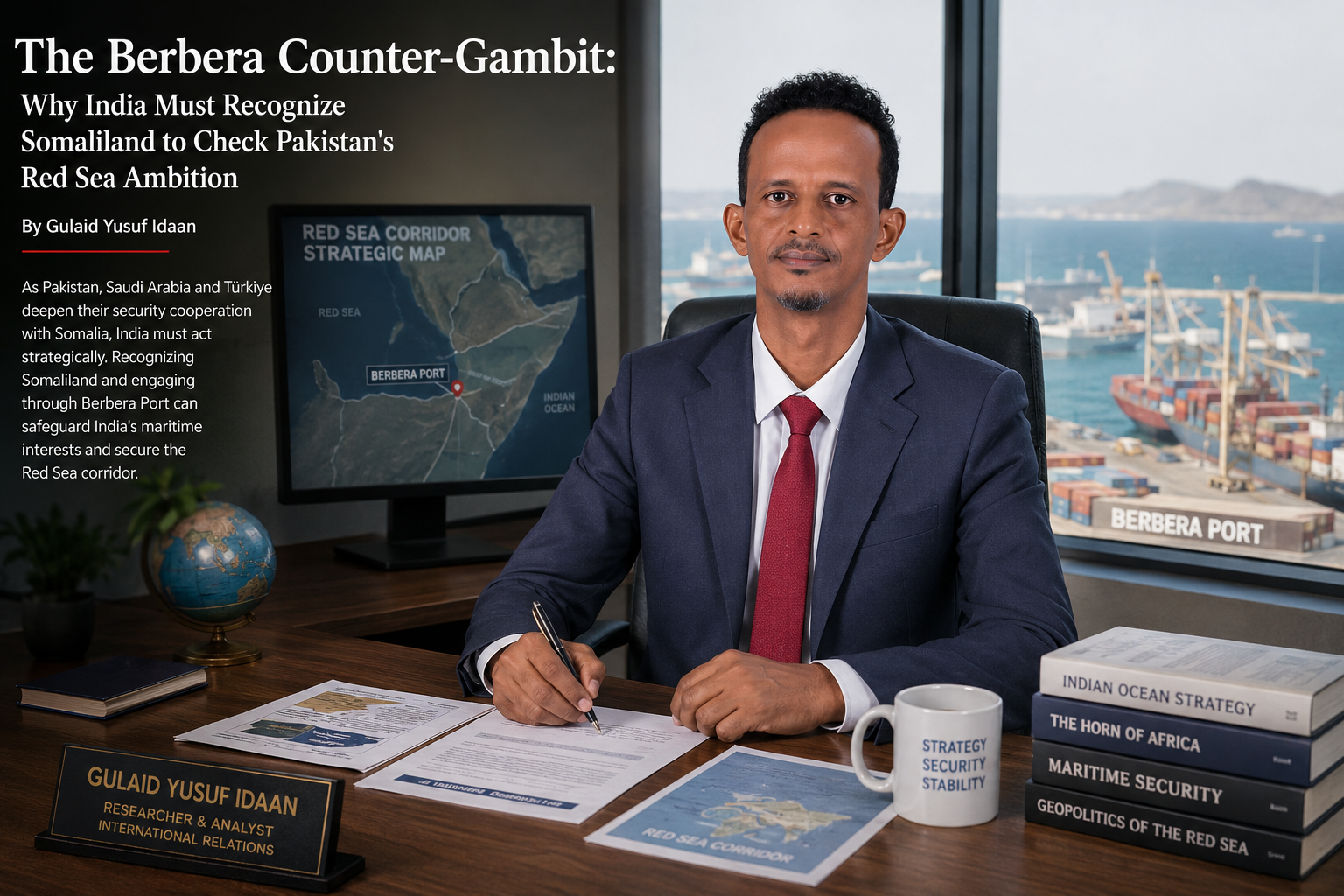
Berbera Port and the Horn of Africa are emerging as critical nodes in the strategic competition linking India, Pakistan, Türkiye, Saudi Arabia and the wider Red Sea region.
The strategic map around the Red Sea is changing faster than New Delhi can afford to ignore.
On 4 August 2026, Islamabad signed a defense cooperation agreement with Mogadishu covering counterterrorism, military training, exchanges of expertise and the development of Somalia‘s defense capabilities. Three days later, Pakistan, Saudi Arabia and Türkiye signed the Mecca Joint Defense Agreement, establishing that an armed attack against one signatory would be regarded as an attack against all three. The pact also envisages deeper defense cooperation across land, sea, air and cyber domains, including unmanned systems, electronic warfare and artificial intelligence.
Neither development, taken separately, amounts to a new military bloc controlling the Red Sea. Nor is there evidence that Pakistan has established a military base in Somalia or that the Makkah agreement is formally directed against India. Indeed, Pakistan and Türkiye have described the agreement as defensive.
But New Delhi should look beyond the labels.
The more consequential question is whether Pakistan is beginning to acquire a strategic position in the Horn of Africa at precisely the moment when the Red Sea, Gulf and western Indian Ocean are becoming interconnected theaters of competition. If that trend continues, India should reconsider one of its longest-standing diplomatic assumptions: that Somaliland can be left outside the architecture of Indian strategic planning.
The answer should be a Berbera counter-gambit — a calibrated Indian strategy centered on Somaliland’s port, maritime position and political institutions. Recognition of Somaliland should now be seriously considered not simply because of Somaliland’s own statehood claims, but because Berbera may become an increasingly important piece of India’s maritime-security architecture.
- The Pakistan Proposition: From South Asia to the Horn
Pakistan is not returning to Somalia out of African ambition. It is doing what it has always done: converting military capability into diplomatic leverage. Islamabad possesses a large armed force, decades of counterterrorism experience, and a growing defense industry capable of supplying affordable platforms like the JF-17 Thunder fighter aircraft — reportedly of interest to Mogadishu, potentially backed by Saudi financing. What Pakistan lacks — money, technology, and political weight — its new Mecca partners provide.
The equation is elegant in its asymmetry: Somalia provides geography, Pakistan provides military manpower and training, Türkiye provides defense technology and strategic reach, and Saudi Arabia provides financial resources and logistics for long-term deployments. Together, they form what can be termed an adaptable NATO shadow — exploiting Somalia’s governance vacuum to project power across one of the world’s most vital maritime corridors.
Pakistan’s traditional strategic environment has been South Asia. Its competition with India has centred on Kashmir, the western border, nuclear deterrence and the Indian Ocean. But Pakistan has increasingly sought relationships that extend its diplomatic and military influence beyond its immediate neighborhood. Somalia provides an attractive opportunity precisely because it sits beside one of the world’s most important maritime corridors connecting the Indian Ocean with the Red Sea and Suez.
The danger is not that Pakistan suddenly establishes a giant military base opposite India. The danger is more gradual. Training agreements become defense cooperation. Defense cooperation becomes intelligence cooperation. Intelligence cooperation becomes logistics. Logistics becomes port access. Port access becomes a durable strategic presence. By the time a strategic network becomes obvious, its foundations may already be difficult to reverse.
- The Turkish Archipelago: Camp TURKSOM and the Drone Littoral
No analysis of Pakistan’s Somalia gambit is complete without understanding the platform upon which it rests. Türkiye operates Camp TURKSOM in Mogadishu — its largest overseas military base — hosting Bayraktar TB2 drones, intelligence personnel, and a permanent contingent that has already trained over 15,000 Somali troops. Ankara controls critical nodes including Aden Adde International Airport and the Port of Mogadishu.
Pakistan’s trainers and cyber specialists are being inserted into an architecture that Turkey built. Islamabad is not creating a new sphere of influence; it is renting space inside Ankara’s. The implications are profound: a Turkey-Pakistan-Saudi consortium at the mouth of the Red Sea, with Turkish drones providing the eyes, Pakistani officers providing the hands, and Saudi riyals providing the fuel.
Ankara has reportedly proposed establishing a humanitarian drone hub in Berbera — a move designed to extend Turkish influence even into Somaliland’s strategic space. If realized, this would compromise the only credible alternative to Turkish-dominated Mogadishu.
III. The Saudi Financier: Riyadh’s Indirect Empire
Saudi Arabia’s role is often understated because it is indirect. Riyadh does not need troops in Mogadishu; it needs outcomes. The Kingdom looks across the Red Sea with growing concern, aware that instability in the Horn threatens its energy transit routes. By financing Pakistan’s African footprint while anchoring it within the Mecca Pact, Saudi Arabia gains a security partner without deploying its own forces.
But the Saudi position is not without friction. Riyadh’s opposition to Somaliland’s recognition stems from a desire to preserve the territorial integrity paradigm that underpins its own regional influence. Yet this very orthodoxy now traps Saudi Arabia into supporting a Somali federal government whose authority barely extends beyond Mogadishu’s perimeter. The Mecca Pact gives Saudi leverage over Pakistan and Turkey, but it also binds Riyadh to the strategic fiction that Mogadishu is a governable partner.
- The American Vacuum: Washington’s Retreat, Islamabad’s Advance
One of the most underappreciated dimensions of Pakistan’s August offensive is its timing. Washington remains an important security partner of Islamabad, yet Pakistan is deepening its Mogadishu engagement at a moment when US policy toward Somalia has become more restrictive. The Trump administration has imposed significant restrictions affecting Somali nationals, creating a perceptual vacuum that Pakistan is eager to fill.
Islamabad does not need to replace the United States; it only needs to occupy strategic space that others leave available. The US remains fixated on Mogadishu while the operational environment shifts beneath it. Pakistan, by contrast, acts on strategic geometry, not diplomatic protocol.
- The Chinese Shadow: Djibouti and the BRI
No Red Sea chessboard is complete without Beijing. China maintains its first overseas military base in Djibouti, just across the Gulf of Aden from Somaliland’s Berbera. Its Belt and Road Initiative has recalibrated Ethiopian and Djiboutian infrastructure dependencies. While China has not openly aligned with the Turkey-Pakistan-Saudi triangle, its presence creates a crowded field where Indian and Western passivity invites Chinese opportunism.
The strategic risk is not that China joins the Mecca Pact, but that it benefits from the instability the Pact’s rivals generate. If IMEC — the India-Middle East-Europe Economic Corridor — fails to secure its southern anchor, Beijing’s alternative routes through Djibouti become more attractive by default. Corridor governance in the 21st century is increasingly a competition not between armies, but between logistics platforms. China understands this. The question is whether India does.
- The Indian Dilemma: Pakistan at the Back Door
India’s $3.7 trillion economy relies on the Red Sea corridor. Approximately 12 percent of global oil and a significant portion of India’s container traffic pass through the Bab el-Mandeb. The Turkey-Pakistan-Saudi triangle now sits directly across these routes, with Pakistani cyber specialists and intelligence officers embedded in a country whose coastline overlooks India’s western maritime approaches.
New Delhi can no longer treat the Horn of Africa as a secondary theater. Prime Minister Narendra Modi‘s visit to Jerusalem in February 2026 and President Isaac Herzog‘s subsequent consultations in Addis Ababa signaled that Indian and Israeli strategists understand the danger. But understanding is not action.
The question India must answer is straightforward: Is Pakistan building a new strategic network across the Indian Ocean? The answer is no longer speculative. The 4 August defense agreement, the 7 August Mecca Pact, the Turkish base infrastructure, and the Saudi financing together constitute a network-in-formation. Strategic networks rarely appear overnight. They begin with training arrangements, then defense sales, then logistics relationships, then intelligence partnerships — until years later, they have become components of a much larger architecture. India is watching that architecture take shape in real time.
VII. The Ethiopian Variable: The Hinterland Imperative
Ethiopia is the indispensable hinterland of this drama. With a population exceeding 120 million, Addis Ababa’s search for reliable maritime access has made Berbera central to its national strategy. The 2024 Memorandum of Understanding between Ethiopia and Somaliland represents a pragmatic attempt to reduce dependence on Djibouti.
For decades, Djibouti has been Ethiopia’s principal maritime gateway. The emergence of alternative corridors through Somaliland gives Addis Ababa greater strategic flexibility. For India, this is valuable. Ethiopia is one of Africa’s most consequential states, both economically and geopolitically. A more diversified Ethiopian maritime-access strategy could reduce excessive dependence on a single corridor and create additional opportunities for Indian trade and investment.
Without Ethiopia, Berbera is a valuable port. With Ethiopia, it becomes transformative. This is why any Indian strategy for the Horn must treat Addis Ababa not as a peripheral partner, but as a co-anchor. Ethiopia’s access to Somaliland’s coastline opens the depth of the Horn to Indian security interests.
Berbera should therefore be considered not simply as a Somaliland project, but as part of a wider Horn of Africa connectivity strategy. Rather than presenting Somaliland recognition as a zero-sum confrontation with Mogadishu, New Delhi could frame engagement around trade, connectivity, maritime safety and regional economic integration.
VIII. The Israeli Precedent: Recognition as Strategic Weapon
On 26 December 2025, Israel became the first country to formally recognize the Republic of Somaliland. Prime Minister Benjamin Netanyahu‘s signature ended 33 years of diplomatic silence because Jerusalem understood a fundamental truth: in an era of corridor competition, strategic utility generates de facto centrality even in the absence of complete juridical recognition.
Israel’s move can gave it a foothold near the Bab el-Mandeb, an intelligence-sharing platform, and a means to dilute Turkish influence in the Horn. It also triggered predictable pushback from Egypt, Jordan, Djibouti, Saudi Arabia, Türkiye, and a coalition of twenty Middle Eastern and African states — proof that recognition is not merely a legal act but a strategic weapon.
This engagement is best understood through realist rather than legalist lenses: national interests, strategic geography, and the balance of power matter more than inherited diplomatic caution. India, which shares with Israel a robust partnership in missile defense, drones, cyber, and advanced technology, should draw the same conclusion.
For India, Israel’s recognition has altered the diplomatic environment. Before December 2025, recognition of Somaliland could be portrayed as an entirely hypothetical proposition. After Israel’s decision, the question has become concrete. New Delhi no longer has to ask whether recognition of Somaliland is an entirely hypothetical possibility. It can ask whether Indian interests justify following a path that another major strategic actor has already opened.
But India should not copy Israel. India has its own relationships, its own legal traditions and its own interests in Africa and the Arab world. Recognition would therefore need to be accompanied by serious diplomacy with Somalia, the African Union, Ethiopia, Gulf states and other regional actors.
- The Hellenic-Cypriot Anchor: EU and NATO’s Eastern Gate
The 10th Greece-Israel-Cyprus Trilateral Summit, held in Jerusalem on 22 December 2025, reaffirmed cooperation in energy, technology, connectivity, and security. This alignment — when extended southward — creates a coherent maritime chain: Indian production, Gulf logistics, Berbera access, Red Sea transit, Levantine security, and Hellenic-Cypriot entry into Europe.
Greece contributes naval capacity and commercial shipping weight. Cyprus contributes legal positioning and EU regulatory embeddedness. Together, they provide the institutional bridge between the Red Sea corridor and the European market. But this bridge requires a southern foundation. Without Somaliland, the Greece-Israel-UAE-Cyprus corridor lacks a stable anchor; without India, it lacks Indo-Pacific scale.
- The Centerpiece: Recognize Somaliland — India’s Only Decisive Counter
Pakistan’s network is forming in Mogadishu because Somaliland has been kept off the board by diplomatic orthodoxy. The way to counter Pakistan’s Red Sea gambit is not to compete for influence inside Somalia’s broken institutions, but to recognize and empower the one entity in the Horn that Pakistan, Turkey, and their Saudi partners cannot co-opt: the Republic of Somaliland.
This is not a peripheral recommendation. It is the central strategic imperative of India’s western maritime pivot.
Somaliland has operated with substantial autonomy since 1991 and has developed its own governmental institutions, security structures and electoral system. The November 2024 presidential election, where Abdirahman Mohamed Abdullahi “Irro” won with 63.92 percent of the vote, marked democratic continuity unmatched in the region. Somaliland has maintained 30-plus years of stable self-governance, with four peaceful transfers of power.
The port has undergone substantial modernization. DP World‘s $442 million investment helped modernize Berbera, increasing annual container capacity from 100,000 to 500,000 TEUs, with a 17-meter draft and a 400-meter quay. Vessel turnaround times have dropped from 64 hours in 2018 to 25 hours in 2024. Phase 2 is targeting 2 million TEU. Behind the port lies Ethiopia, a landlocked country of more than 120 million people seeking diversified access to international trade.
The strategic equation is therefore straightforward: Berbera + Ethiopia + Gulf of Aden = an alternative logistics architecture. For India, that matters because New Delhi’s interests are no longer confined to the Arabian Sea. Indian commerce depends on secure maritime connectivity linking the Indian Ocean to the Gulf and Europe. Disruptions in the Red Sea have already demonstrated how quickly instability around maritime chokepoints can generate global economic consequences.
Somaliland’s claim to statehood should not be reduced to its usefulness to India. It has its own historical, constitutional and political argument. Somaliland was a British protectorate before becoming independent on 26 June 1960. It subsequently entered into a union with the former Italian Somaliland. Following the collapse of the Somali state, Somaliland restored its separate political institutions in 1991. The 2001 referendum saw 97 percent vote for independence.
Since then, it has built its own governmental structures, security institutions and electoral system. The question of whether these circumstances satisfy the legal requirements for statehood is complex and contested. Somaliland meets the Montevideo Convention criteria — territory, government, population, and the capacity to enter relations — just as South Sudan did before AU recognition in 2011. The opposition of Egypt, Turkey and Saudi Arabia is rooted not in legal deficiency but in strategic convenience.
India should undertake a serious legal assessment rather than treating recognition as a purely geopolitical transaction. But the legal debate should not obscure the strategic reality: Somaliland exercises political authority, maintains institutions and controls a strategically important coastline. That makes it impossible to ignore.
Formal recognition would incorporate India into a web of reliable interlocutors — Israel, the UAE, Ethiopia, Greece, Cyprus, and the United States — at the precise location where the Turkey-Pakistan-Saudi convergence threatens Indian interests. It would give India logistical access, intelligence-sharing arrangements, and sea reach at the Bab el-Mandeb. It would secure maritime commerce for an economy that cannot afford chokepoint vulnerability. And it would deny the Mecca Pact uncontested depth across the southern Red Sea system.
The cost of continued ambiguity is not neutrality; it is strategic exclusion. Every month that India delays, Pakistan entrenches in Mogadishu, Turkey expands its drone footprint, and the space for a southern anchor narrow.
- What New Delhi Should Do Now
India should adopt a Berbera Strategy with the following immediate components:
First, extend formal recognition. Treat Somaliland as a sovereign interlocutor. The legal and strategic case is sound; the diplomatic cost of delay exceeds the cost of action. Recognition would transform ambiguity into a formal relationship with a strategically located partner at the entrance to one of the world’s most important maritime corridors.
Second, establish an embassy in Hargeisa. Parallel to recognition, open a permanent diplomatic mission. This signals commitment and provides the institutional backbone for deeper cooperation. Even if full diplomatic recognition is initially considered politically difficult, India should establish or expand an official presence in Hargeisa and develop regular political consultations.
Third, integrate Berbera into IMEC planning. Work with the UAE, Ethiopia, and Somaliland authorities to designate Berbera as a formal logistics node in the India-Middle East-Europe Economic Corridor, ensuring Indian commercial and naval access at the Bab el-Mandeb. Indian ministries, shipping companies, infrastructure firms and strategic institutions should assess the port’s commercial potential and its relationship with Ethiopian markets.
Fourth, deepen naval and intelligence cooperation. Initiate maritime domain awareness agreements, port visit protocols, and intelligence-sharing arrangements with Somaliland authorities, complementing India’s existing partnerships with Israel and the UAE. India should explore maritime-domain awareness, anti-piracy cooperation, search-and-rescue coordination and port-call arrangements, consistent with international law.
Fifth, coordinate with the emerging alignment. Use the Greece-Israel-Cyprus trilateral framework and the Abraham Accords network to multilateralism Somaliland’s integration, reducing individual diplomatic exposure while consolidating the southern flank of the Red Sea system. The Berbera corridor should be examined as part of a wider India-Gulf-Horn connectivity strategy rather than as a stand-alone Somaliland initiative.
Sixth, counter the narrative. Challenge Mogadishu’s claims to territorial integrity over Somaliland by emphasizing, in international forums, the distinction between colonial borders and consensual union.
Conclusion: Build the Alternative Before the Map Closes
Pakistan’s August 2026 agreements were not an end state; they were a test. Islamabad is probing whether military capability can be converted into geopolitical relevance beyond South Asia. The Mecca Pact gives it the financial and technological scaffolding to sustain that test. Turkey provides the hardware. Saudi Arabia provides the funding. Somalia provides the geography.
The response cannot be bilateral. India cannot match Pakistan’s military networking by acting alone. The answer must be equally networked: recognition of Somaliland, integration of Berbera into IMEC, naval and intelligence cooperation with Hargeisa, and alignment with the emerging Israel-UAE-Greece-Cyprus-Ethiopia axis.
India’s objective should not be an anti-Pakistan bloc in the Horn. That would be strategically counterproductive. Saudi Arabia remains an important Indian partner. Türkiye is too important to be treated simply as an adversary. Somalia is a sovereign state with which India has longstanding relations. Ethiopia is a major African partner.
India’s objective should instead be strategic diversification. If Pakistan expands its military relationship with Somalia, India should not respond by demanding that Somalia choose between New Delhi and Islamabad. It should create alternatives. If Türkiye expands its defense presence, India should deepen maritime and technological partnerships elsewhere. If Saudi Arabia finances regional security initiatives, India should increase its own economic and strategic engagement with Riyadh. And if Berbera becomes more important to the regional logistics system, India should ensure that Indian interests have a legitimate place there.
This is classic Indian statecraft: multiple partnerships, strategic autonomy and avoidance of unnecessary bloc politics.
The question is no longer simply, “Why is Pakistan going to Somalia?” The more important question is: “What kind of strategic network is Pakistan trying to build through Somalia?” And the corollary that New Delhi must answer is: “What network will India build to ensure that Pakistan does not build alone?”
The Pakistan-Turkey-Saudi triangle is building facts on the ground in Mogadishu. The only effective, affordable, and immediate counter is for India to build facts in Hargeisa. Recognize Somaliland. Establish the embassy. Secure the corridor.
The time to act is now.
Related Topics
Related Posts