London based entrepreneur, cybersecurity analyst doing a PhD in AI
The Birth of Ontology and it’s relevance to AI.
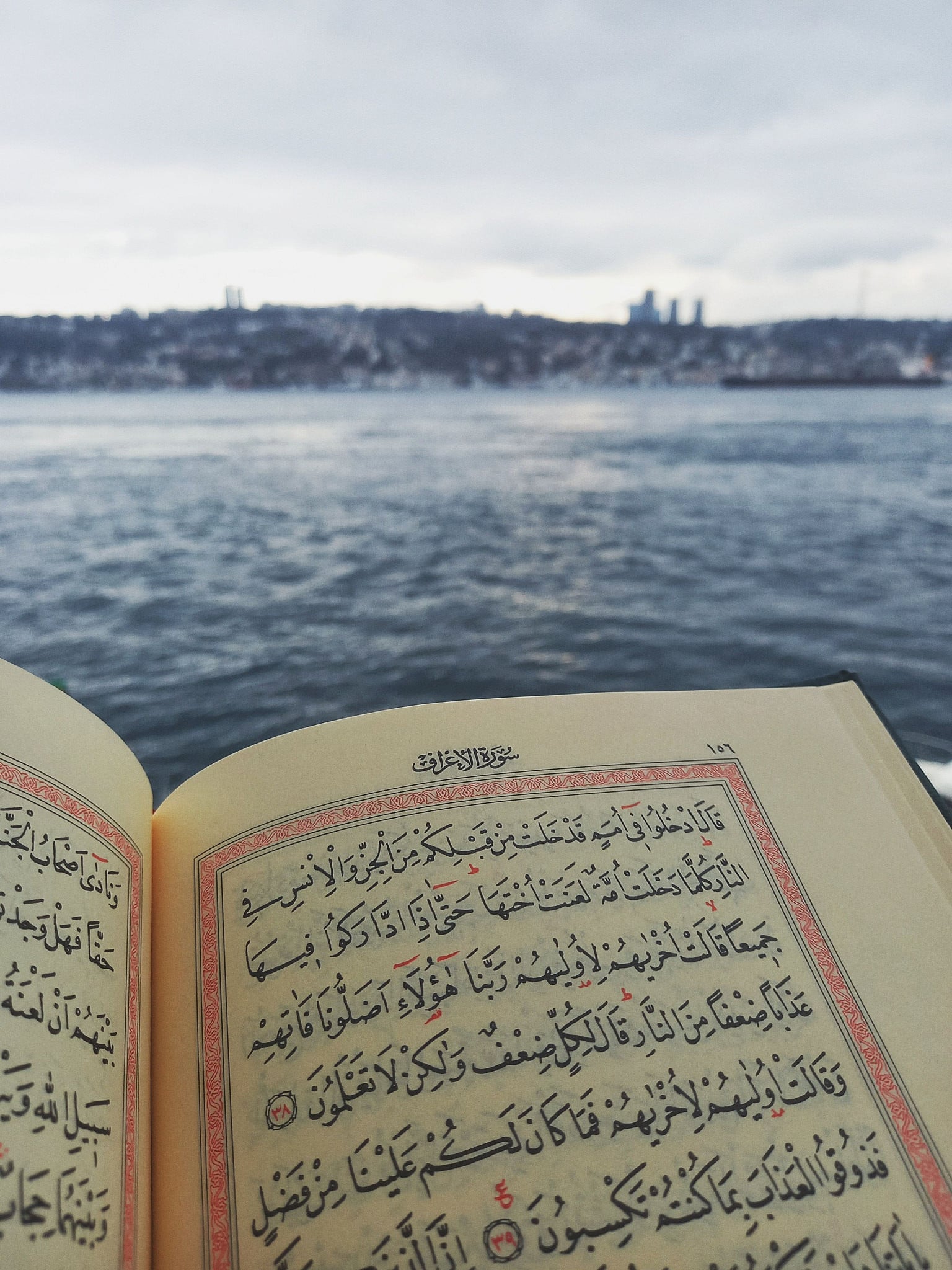
When God Taught Adam the Names of All Things
Before the first city, before the first library, before Aristotle drew up his categories, before a scientist classified a species, and long before an engineer constructed a knowledge graph, the Qur’an places an extraordinary scene near the beginning of the human story.
God teaches Adam.
Not first how to make a weapon.
Not how to build a house.
Not how to cultivate a field.
He teaches him names.
“And He taught Adam the names, all of them. Then He presented them to the angels and said, ‘Tell Me the names of these, if you are truthful.’”
Qur’an 2:31
It is easy to pass over the verse because naming seems ordinary.
We name things every day.
Tree. Water. Bird. Mother. London. Red. Mercy. Gravity.
But naming is not ordinary at all.
Take it away, and human knowledge begins to collapse.
Because the human being does not merely encounter reality.
We divide it.
Recognise it.
Classify it.
Abstract from it.
Name it.
And then, most importantly, relate one named thing to another.
A robin is a bird.
A bird has wings.
A wing enables flight.
Water sustains life.
A mother is related to a child.
London is located in England.
Evidence supports a proposition.
An effect has a cause.
Mercy is opposed to cruelty.
A promise creates an obligation.
Once we can name not only things but also qualities, actions, categories and relationships, the world ceases to be an undifferentiated stream of experience.
It becomes intelligible.
This is the philosophical possibility hidden inside the apparently simple act of naming.
And it gives Qur’an 2:31 an extraordinary resonance in the age of artificial intelligence.
Before Knowledge Comes Labels and Distinction
Imagine seeing a tree without possessing the concept tree.
You see colour.
Shape.
Movement.
Bark.
Leaves.
Then you encounter another tree.
It is taller. Its leaves are different. Its branches spread differently.
Without abstraction, these could remain two unrelated experiences.
But the mind performs something remarkable.
Olive tree.
Oak tree.
Different things, yet members of the same category:
Tree.
Now another relation becomes possible:
Tree → is a kind of → plant.
Then:
Plant → requires → water.
And:
Water → is necessary for → terrestrial life.
Within a few conceptual steps, perception has become classification, classification has become relation, and relation has become knowledge.
Philosophy has spent thousands of years wrestling with precisely this mystery.
Plato asked how many individual things could participate in a common reality or Form.
Aristotle systematised categories such as substance, quantity, quality and, crucially, relation.
The medieval dispute over universals asked whether categories such as humanity, redness and beauty correspond to realities or are constructions of the mind and language.
Locke examined the relationship between words and the ideas for which they stand.
Kant argued that the mind does not simply receive reality like a camera; it brings conceptual structures through which experience becomes intelligible.
Frege distinguished a linguistic expression from its sense and reference.
Wittgenstein redirected attention towards language, use and the forms of life within which words acquire meaning.
They disagree profoundly.
But they keep circling one fundamental problem:
How does the mind turn the overwhelming multiplicity of reality into something that can be known?
Naming is near the beginning of the answer.
Names Are Not Only Names of Objects
This is where Qur’an 2:31 becomes more interesting than a picture of Adam memorising a divine vocabulary list.
The Arabic is striking:
the names, all of them.
Classical exegetes differed over the precise scope, but major traditions understood the verse expansively. Ibn Kathīr records the explanation attributed to Ibn ʿAbbās (r.a.) that Adam was taught the names people use for human beings, animals, sky, earth, land, sea and other things. His discussion goes further, speaking of the names of things, their characteristics and what they do.
Just a quick note on why I prefer to always refer to Ibn Abbas (r.a.) when looking at Tafsir (explanation of the Quran) first. It is related to this Hadith :-
Ibn Abbas reported: The Messenger of Allah, peace and blessings be upon him, put his hand on my shoulder and he said, “O Allah, give him understanding in religion and teach him the interpretation of the Quran.”
Source: Musnad Aḥmad 2879, Grade: Qawi (strong) according to Al-Arna’ut
Back to the main core thesis of this article – that last point matters.
Because the intelligibility of the world does not consist merely of nouns.
Consider:
Bird.
That is a name.
But so are:
flight
above
below
movement
speed
cause
effect
similarity
difference
life
death
justice
mercy
truth
falsehood
number
time
possibility
obligation
None is simply another physical object lying on a table.
Human beings name abstractions.
We name properties: redness.
Processes: growth.
Relations: parenthood.
Actions: giving.
States: sleep.
Logical structures: if, then, and, not.
Temporal relations: before and after.
Moral realities: justice and injustice.
Even the relation “is a” can itself be identified and represented.
This is the leap from vocabulary to ontology.
The Qur’an does not say that Adam was taught OWL, RDF triples or Aristotelian metaphysics. To claim that would turn a profound verse into a bad scientific miracle argument.
The deeper proposition is stronger.
The human creature is presented as possessing a God-taught capacity to make reality conceptually intelligible.
And that is one of the foundations upon which civilisation rests.
Knowledge Is Names Plus Relationships
Here I would state my philosophical thesis carefully :-
A vast proportion of explicit human knowledge can be represented as named entities, concepts, properties and the relationships among them.
Not all human knowing is reducible to language.
A child can recognise her mother before she knows the word mother. A pianist possesses embodied knowledge that cannot be exhausted by sentences. You can know how to balance a bicycle without being able to state the equations governing it.
Michael Polanyi famously emphasised tacit knowledge: we know more than we can always explicitly say.
But something changes when knowledge must become explicit, communicable, disputable, searchable and transmissible.
Then names become extraordinarily difficult to escape.
Consider medicine.
Heart → pumps → blood.
Blood → carries → oxygen.
Coronary artery → supplies → myocardium.
Occlusion → can cause → infarction.
Or law:
Person → enters → contract.
Contract → creates → obligation.
Breach → may create → liability.
Evidence → supports → claim.
Or mathematics:
Triangle → has → three sides.
Square → is a → quadrilateral.
Prime number → divisible by → itself and one.
Or ethics:
Action → has → intention.
Promise → creates → obligation.
Injustice → harms → another.
Mercy → can modify → judgement.
Notice what has happened.
The relationships themselves have names.
Contains.
Causes.
Precedes.
Contradicts.
Belongs to.
Is part of.
Is greater than.
Is the mother of.
Is morally responsible for.
Reality is not merely a dictionary.
It is a graph.
And a dictionary without relationships would barely constitute knowledge at all.
Adam and the First Human Ontology
Now return to the Qur’anic story.
Immediately before the teaching of the names, God declares:
“Indeed, I am placing upon the earth a khalīfah.”
Qur’an 2:30
Then comes knowledge.
Adam (a.s.) is taught the names.
The angels answer:
“Glory be to You! We have no knowledge except what You have taught us.”
Qur’an 2:32
Then Adam is commanded to inform them of the names.
The sequence is beautiful:
earthly vocation → knowledge → naming → demonstration of knowledge.
This does not mean that naming alone explains Adam’s status or the whole meaning of khalīfah. Classical tafsīr is considerably richer than that.
But philosophically, the placement makes sense.
How could human beings cultivate the Earth without distinguishing one thing from another?
Agriculture requires seed, soil, water, season.
Medicine requires organ, symptom, disease, treatment.
Navigation requires place, distance, direction.
Law requires person, act, evidence, right, obligation.
Science requires measurement, category, cause, observation.
Civilisation cannot accumulate knowledge unless one generation can tell the next:
This is what this is called.
This is what we discovered about it.
And this is how it relates to everything else.
Naming becomes civilisational infrastructure.
Adam in Genesis: The Naming Creature
The Hebrew Bible contains a strikingly related account.
Genesis says that God brought the creatures before Adam:
“Whatever the man called each living creature, that would be its name.”
Genesis 2:19
Jewish interpretation noticed that naming implied more than arbitrary labelling.
Rabbeinu Bahya, drawing on midrashic tradition, describes Adam’s naming as demonstrating great wisdom, connecting the names with Adam’s understanding of the creatures’ natures and characteristics.
That is remarkably close to our philosophical problem.
To name properly requires distinction.
A lion is not a horse.
A horse is not a bird.
Recognition precedes classification.
The Genesis account emphasises Adam naming living creatures.
The Qur’an makes its own, broader formulation:
God taught Adam the names, all of them.
For Muslims, the difference also reveals something central to Qur’anic epistemology.
Adam knows because God teaches.
Human knowledge is magnificent.
But it is derivative.
The Most Beautiful Names
Then Islam does something even more profound with the concept of naming.
The Qur’an says:
“To Allah belong the Most Beautiful Names, so call upon Him by them.”
Qur’an 7:180
Al-Asmāʾ al-Ḥusnā. The Most Beautiful Names.
Al-Raḥmān — the Most Merciful.
Al-ʿAlīm — the All-Knowing.
Al-Ḥakīm — the All-Wise.
Al-Khāliq — the Creator.
Al-Razzāq — the Provider.
Here great theological care is required.
The Names are not human categories into which we have managed to squeeze God.
Nor does knowing a Divine Name mean comprehending the Divine Essence.
In Islamic theology, the Creator is not contained by the conceptual structures of creation.
The Names are revealed means by which finite human beings truly know something of their Creator without thereby encompassing Him.
That produces a striking reversal.
Adam receives names through which creation becomes intelligible.
God reveals His Names through which humanity may know and call upon Him.
The first movement runs horizontally through creation.
The second reaches vertically towards the Creator.
And the two must never be confused.
The tree is not God.
Mercy between creatures is not identical to the Divine attribute.
Human knowledge is not God’s knowledge.
But creation can be an āyah, a sign. Signs point to something.
The ontology points beyond itself.
Al-Raḥmān and the Raḥm
One example makes the architecture particularly beautiful.
Al-Raḥmān: الرحمن.
Al-raḥm: الرحم, the womb and, by extension, ties of kinship.
The Prophet Muhammad ﷺ reported a divine saying connecting raḥm with the Name Al-Raḥmān, and another hadith commands mercy while connecting the womb or kinship bond with Al-Raḥmān.
The Prophet (ﷺ) said, “The word ‘Ar-Rahm (womb) derives its name from Ar-Rahman (i.e., one of the names of Allah) and Allah said: ‘I will keep good relation with the one who will keep good relation with you, (womb i.e. Kith and Kin) and sever the relation with him who will sever the relation with you, (womb, i.e. Kith and Kin). Sahih al-Bukhari, 5988
Now watch the conceptual chain unfold.
Womb → kinship → care → mercy → Al-Raḥmān.
A physical reality is connected to a biological relationship.
The biological relationship carries a moral obligation.
The moral concept belongs to a semantic field that points towards a Divine Name.
This is why names cannot be reduced to labels stuck onto objects.
Language can connect matter, relationship, morality and theology.
A womb is physical.
Kinship is relational.
Mercy is abstract.
Al-Raḥmān is a Divine Name.
The human mind can distinguish every level while understanding the connections between them.
That is ontology in its richest sense: not merely what things are, but how different orders of meaning relate without becoming identical.
From Adam to the Knowledge Graph
Twenty-first-century computer science has returned to the same problem with machines.
Suppose we tell a computer:
Paris. France. City. Country.
We have supplied four labels.
We have not supplied knowledge.
Now add:
Paris → is a → city.
France → is a → country.
Paris → is located in → France.
France → contains → Paris.
Suddenly there is structure.
A knowledge graph represents entities or concepts as nodes and their relationships as edges.
An ontology goes further by formalising the categories and relations that are permissible within a domain.
A person may have a birthplace.
A city may be located within a country.
A medicine may treat a disease.
A gene may encode a protein.
An author may write a book.
The machine needs more than nouns.
It needs predicates.
And predicates are named relationships.
This becomes especially interesting in the age of large language models.
Modern neural systems can learn extraordinary quantities of implicit structure from statistical patterns in language. They do not need every fact manually entered as a traditional knowledge graph.
Yet explicit ontologies and knowledge graphs remain valuable precisely because relationships matter.
Paris is in France does not mean the same thing as France is in Paris.
Aspirin treats headache does not mean headache treats aspirin.
Direction matters.
Type matters.
Hierarchy matters.
Causality matters.
Negation matters.
Context matters.
The world cannot be represented faithfully by a bag of disconnected words.
It requires structure.
So after billions of dollars of computing infrastructure, enormous neural networks and trillions of tokens, artificial intelligence encounters a problem Adam’s story makes strangely familiar:
What is this?
What is it called?
What kind of thing is it?
What properties does it possess?
How does it relate to that?
The Qur’an as
Muhaymin
For a Jewish or Christian readership, the Islamic theological position should be stated plainly and respectfully rather than blurred for the sake of interfaith comfort.
Islam teaches that the Torah was originally revealed by God to Moses and that Jesus received revelation.
It also teaches that the Qur’an is the final revelation given to the Prophet Muhammad ﷺ.
Qur’an 5:48 describes the Qur’an as confirming previous Scripture and as muhayminan ʿalayhi, commonly rendered as an authority, guardian, witness or criterion over it.
From the mainstream Islamic perspective, therefore, the Qur’an confirms what remains true of preceding revelation, serves as the final criterion over it, and the Sharīʿah brought by the Prophet Muhammad ﷺ supersedes earlier legal dispensations where their rulings conflict.
That final legal supersession should not be collapsed into the single word muhaymin as though it were merely a dictionary translation; it emerges from the wider Islamic doctrine of final revelation and prophetic law.
This matters to Adam’s story.
Genesis presents Adam naming creatures.
Jewish tradition finds wisdom in his capacity to name according to their natures.
The Qur’an does not erase that Adamic inheritance.
It gives its final Qur’anic formulation:
“And He taught Adam the names, all of them.”
For Muslims, Moses, Abraham, Adam and Muhammad ﷺ do not belong to competing gods or disconnected religious histories.
They belong to one history of revelation culminating in the Qur’an.
The Birth of Ontology
The academic history of ontology does not begin with Adam.
We should not pretend otherwise.
As a formal philosophical discipline, its genealogy passes through Greek metaphysics, Aristotle’s categories, Islamic falsafah, medieval scholasticism, modern philosophy, logic and eventually computer science.
But revelation offers a different kind of origin story.
Not the history of the word ontology.
The beginning of the human epistemic vocation.
There stands Adam.
There stands the world.
And between mind and world comes the astonishing gift:
the name.
Once there is a name, there can be a distinction.
Once there are distinctions, there can be categories.
Once there are categories, relationships can be articulated.
Once relationships can be articulated, propositions become possible.
Once propositions exist, they can be compared.
True or false.
Cause or correlation.
Same or different.
Part or whole.
Before or after.
Necessary or contingent.
Just or unjust.
Reasoning becomes possible.
Knowledge can then leave one mind and enter another.
A child can inherit something discovered by someone who died a thousand years before she was born.
That is one of humanity’s great powers.
We do not merely experience the world.
We can make what we learn about it cumulative.
And names are among the handles by which civilisation carries knowledge through time.
The First Knowledge Graph
That gives us a cleaner way to describe the philosophical insight of Qur’an 2:31.
Do not imagine Adam merely standing before a celestial collection of flashcards:
camel. mountain. river. tree.
Think more deeply.
A mountain has height.
A river flows.
Water sustains life.
A creature inhabits a place.
A child descends from a parent.
An action has consequences.
Things possess characteristics.
Things perform actions.
Things belong to categories.
Things stand in relationships.
And we can name not only the things, but the relationships themselves.
The Qur’an does not call this an ontology.
Computer scientists do.
The Qur’an does not call it a knowledge graph.
We do.
The Qur’an makes the more fundamental claim:
God taught Adam the names.
And classical tafsīr gives us warrant to understand those names expansively enough to include things, their characteristics and what they do, while stopping us from pretending that medieval exegetes were secretly describing twenty-first-century computer science.
The analogy is ours.
The theological foundation is theirs.
And keeping that distinction intact makes the argument stronger, not weaker.
First the Name
Artificial intelligence now gives this ancient question a new urgency.
We are building machines that manipulate symbols, infer concepts, discover patterns and reconstruct relationships on a scale no unaided human mind could manage.
Yet these systems depend upon an intellectual inheritance older than computing.
Classification.
Language.
Logic.
Reference.
Relation.
Meaning.
Truth.
The machine can process the graph.
But humanity had to discover what it means for something to be a thing, for one thing to be related to another, and for a symbol to stand for something beyond itself.
The Qur’an places knowledge astonishingly early in the human story.
And then immediately places humility beside it.
When the angels are confronted with what they do not know, they answer:
“Glory be to You! We have no knowledge except what You have taught us.”
Qur’an 2:32
That may be the most important sentence in the entire ontology.
Because the Qur’anic vision of knowledge is neither anti-intellectual nor intellectually arrogant.
Study everything.
Name things.
Distinguish them.
Classify them.
Discover their properties.
Understand their relationships.
Build libraries.
Construct theories.
Create ontologies.
Train machines.
Map genomes.
Name galaxies.
But never confuse the map with the territory, the name with the thing, the model with reality, or the knower with the source of all knowledge.
We name stars we did not ignite.
We classify life we did not create.
We discover laws of physics we did not legislate.
We map relationships within a universe that existed before our first word for it.
And even our abstractions have names.
Truth.
Cause.
Number.
Relation.
Mercy.
Justice.
Knowledge.
Names connect to other names.
Concepts acquire meaning through distinctions and relationships.
Relationships form propositions.
Propositions form bodies of knowledge.
Bodies of knowledge accumulate into civilisation.
And now civilisation is teaching machines to manipulate those structures at extraordinary scale.
So the story that begins in Qur’an does not feel intellectually remote at all.
It begins with the question underneath philosophy, linguistics, science and artificial intelligence:
How does reality become intelligible to a mind?
The Qur’an answers with an image of extraordinary economy.
Adam.
The world before him.
And God teaching him the names.
First the name.
Then the distinction.
Then the relationship.
Then knowledge.
And before all of them:
the One who taught.
Related Topics