A Young Hindu-American With Indian Roots
The Birth of the American Übermensch
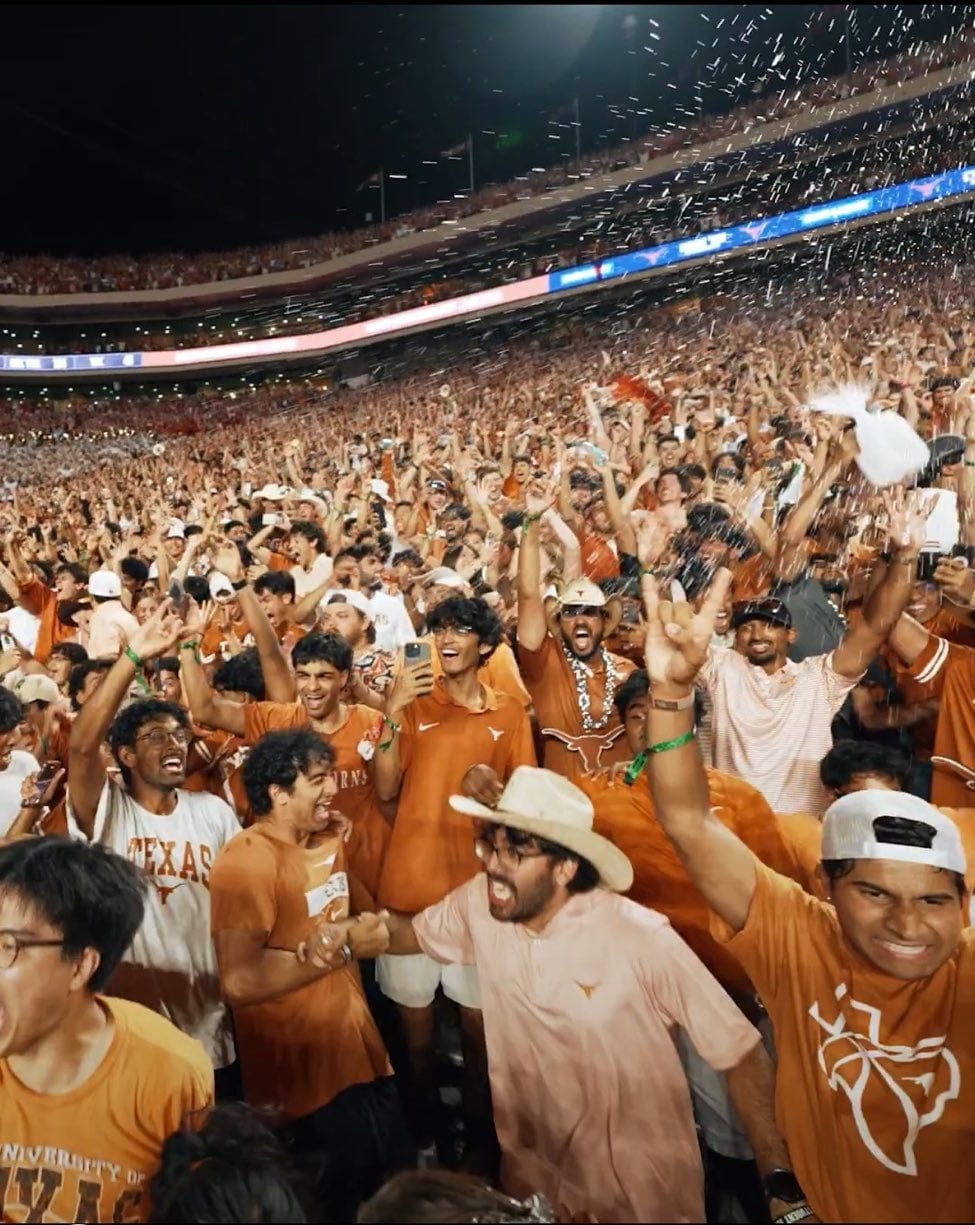
X/Bo French
The news of a planned (and barely averted) mass shooting at a Hindu temple in Aurora, Illinois, by a self-proclaimed White supremacist earlier this month exemplifies an uptick in anti-Indian hate in the United States. Much of the recent discourse surrounding Indian-Americans’ presence in the United States has been tethered to immigration and jobs. Many detractors of Indian immigration to (and presence in) the United States contend that the H1-B visa program—which has facilitated the entry of thousands of high-skilled Indian immigrants into America—contend that these immigrants are usurping jobs that Americans could otherwise perform.
Yet debates about the H1-B program have transformed into a broader conversation about Indian-Americans’ place in the United States. Take, for example, the now-(in)famous X post by Texas Railroad Commissioner candidate Bo French. French posted a picture of South Asian students at a UT Austin football game who were celebrating the Longhorns’ victory over Ohio State University. French’s post bemoaned the loss of an America—once dominated by White Americans—which was now supposedly being overtaken by hordes of Indian immigrants. As many observers have aptly pointed out, the irony of French’s post lies in what it depicts—UT Austin students exultantly pouring out a carton of milk as they bask in their school’s come-from-behind victory. These students are the proverbial poster child for assimilation, in that they joyfully celebrated a uniquely American sport—football—in the most conceivably American way. So what marks them, in French’s eyes, as un-American, and as a “problem” that needs to be solved? The answer is obvious: the color of their skin.
As has been noted, however, this brazenly racist discourse has upended the longstanding understanding that immigrants from across the globe would be welcomed into the United States and would become part of the American fabric, so long as they “assimilated” appropriately into American culture. What, though, is the benchmark of such assimilation? And is such assimilation even possible in the eyes of those who condemn the actions (and presence) of people of Indian descent in the United States? These questions are important, given that most racialized attacks aimed generally at “the Indians” do not distinguish between a recent immigrant on a work or student visa and the child of Indian immigrants who has spent their entire life in the United States.
To be clear, racist diatribes against both these groups must be condemned. Recent immigrants to the United States from India may exhibit elements of “Indianness”—an audibly Indian accent, more visible signs of their religious identity (such as a bindi, a mark that many Hindus wear on their foreheads), or a more collectivistic cultural lens that contrasts with American individualistic tendencies. The children of Indian immigrants who have been born and raised in the United States, however, are “American” in the truest sense of that term. They follow the NFL and the NBA religiously. They wait in virtual lines to snag tickets for a Taylor Swift or Bad Bunny concert in a city near them. When they travel to India, their American accent is often a dead giveaway that they are not locals. And—perhaps most importantly—they consider themselves to be Americans. Though India may be their ancestral homeland, America is their home, the land they know best. Again, these distinctions are of little import to the racist poster on X who, under the cloak of anonymity, proclaims, “All Indians must go back!” This discourse calls to mind the anti-Japanese hysteria which gripped the United States during the World War II era. This rhetoric swept in both first-generation Japanese immigrants (the Issei) and their American-born children (the Nisei). The Nisei generation’s American upbringing and cultural mores could not shield them from accusations of disloyalty and incarceration in wartime internment camps.
One observer, writing on the question of Indian-American assimilation, has posited that “what’s mistaken for a lack of assimilation is actually a quiet confidence in cultural rootedness,” pointing to Hindu festivals like Diwali and Holi that Indian immigrants celebrate. Perhaps this statement is true, insofar as it points to the religious elements of anti-Indian prejudice. (Take, for example, the virulent opposition in some quarters to the Statue of Union, a 90-foot depiction of the Hindu deity Hanuman which was erected in Texas in 2024.) This line of argument rests on the premise that the United States has its roots in, and is inextricably linked with, Judeo-Christian tradition. Thus, large or supposedly ostentatious public displays and celebrations of Hindu tradition run counter to America’s fundamental character. Indeed, in a recent article titled “Yes, assimilation is good,” popular opinion writer Noah Smith quoted Washington Post columnist Shadi Hamid’s argument that “assimilation tends to mean secularization.” The Statue of Union represents the antithesis of such secularization.
Though Smith (correctly) points out that secularization is not necessarily a prerequisite for assimilation, Hamid rightly observes that the two variables are correlated with one another. Take, for example, the case of Hindu temples in the United States, many of which were established by Indian immigrants who wanted to create spaces in their new home where they could communally worship. As Vishal Ganesan—who has written and spoken extensively on the question of Hindu American identity—has observed, “the temple in America was not built primarily for the transmission of religious doctrine across national and cultural boundaries, but rather as an act of reverential imitation” of famous Indian shrines. Put differently, American Hindu temples were mediums through which Indian immigrants could create a semblance of home in a foreign land. Indeed, Ganesan himself recollects growing up in America and attending a Hindu temple, which was to him “a window into a world that was no longer [his] to inhabit.”
As Ganesan has highlighted, many Hindu temples in the United States are looking ahead to a universe where the American-born descendants of their (aging) immigrant founders must soon take the reins. Yet, by and large, this American-born generation has not exhibited the same enthusiasm for being involved in temple management as their immigrant parents. Take, for instance, the Statue of Union, which was the brainchild of Chinna Jeeyar Swamiji, a Hindu monk from the Srivaishnava tradition who is based in India. The monastic’s vision was duly executed by his devotees in Texas, most of whom were likely Indian immigrants. I suspect that a contingent of devotees comprising principally of American-born Hindus may not have been as zealous in erecting the statue, for they would not have felt the same need to visibly assert their religious presence in the same, larger-than-life, format. For the immigrant generation, the statue epitomizes a large, towering, and unmistakable Hindu presence in their adopted homeland. And it bears witness to the material prosperity of the Indian immigrant community in the United States. The statue’s gilded facade visually reflects its funders’ pride in attaining the American Dream. Like many Indian immigrants (and other immigrants throughout American history), these donors likely achieved academic and material success in the United States after coming to the country with few means and much hope. “We’re American, too, and we’ve made our mark,” the statue proclaims.
Constructing such visually imposing religious structures, in the context of immigration, is not unique to the Indian-American community. Take, for instance, the Eldridge Street Synagogue in New York City’s Lower East Side. The synagogue, which was constructed in 1887, catered to Jewish immigrants who came to the United States in droves at the turn of the twentieth century. Its ornate structure and elegant glass windows distinguished it and made it a treat to behold. The Jewish immigrants who contributed to the synagogue’s construction—many of whom had been persecuted for practicing their faith in their homelands—now boldly asserted their faith in America. Yet, by midcentury, the synagogue fell into disrepair as fewer congregants actively patronized it. The future of Hindu temples whose construction and upkeep has, analogously, been sustained by immigrant communities remains to be seen.
For many Indian immigrants, Hindu religious practice in America—exemplified by elaborate rituals and regular temple attendance—has been bound up with memories of and connections to their motherland. For these immigrants’ American-born children, however, Hinduism has often become a matter of the “heart.” Indu Viswanathan, a Hindu-American writer and academic, recently authored a book titled “Hindu At Heart: Education, Faith, and What It Means to Belong in America.” The book’s title, in my view, is emblematic of the American Hindu experience today. For many American-born Hindus, Hinduism is a fitting corollary to the spiritual-but-not-religious stream of thought. Hindu concepts like dharma (“doing the right thing”), karma (“you reap what you sow”), and ahimsa (“don’t hurt others”) that American Hindus grew up learning about in Sunday School classes can serve as abstract guiding principles that conveniently track with ubiquitous truisms like the Golden Role.
Many of these Hindu concepts have entered the American mainstream—the term karma, for instance, is now commonplace in American parlance. Thus, these terms are buzzwords that American Hindus can call upon in conversations with Hindus and non-Hindus alike to establish their spiritual bona fides and present a degree of sophistication and multifacetedness. “Yes, I’m American, but I’m ‘cultured,’ too,” they signal. Ganesan astutely identifies “a growing segment of the Hindu American population” as “‘cultural Hindus,’ who don’t belong to a particular spiritual tradition or lineage, but will participate in various festivals and attend temples on special occasions.” This concept mirrors the phenomenon of the “secular Jew” in the American context—as of 2023, approximately 35% of American Jews were estimated to be “secular,” up from above 30% in 2008. In contrast, about 19% of American Hindus fall into this bracket.
For this population of cultural Hindus, their Hindu identity is principally enshrined within their hearts and is externally manifested from time to time when the occasion merits it. A bindi, for instance, would be appropriate to wear to the temple on the occasional visit but not every day to school or work. In such a secularized framework, celebrations of Diwali or Holi do not impede assimilation but instead facilitate it. Take Diwali, for example. Stripped of all religious complexity, it is a “festival of lights” that marks “the victory of good over evil”—a principle everyone can get behind, no matter their religious affiliation. Diwali offers an opportunity for Hindus and non-Hindus alike to enjoy a sumptuous Indian meal and come together to celebrate a time-honored Hindu tradition. In these contexts, the festival’s secular and communitarian elements doubtless take precedence over any sort of elaborate religious worship. “Cultural Hinduism” has also taken on increasing significance in the American context in light of the substantial rates of intermarriage between Indian-Americans and members of other racial groups. Data from the 2023 American Community Survey reflects that only 51% and 60% of Indian-origin males and females born in the United States, respectively, are married to other Indians. (I do not endorse the views that the compiler of this data, Jordan Lasker, has expressed on racial issues.) I expect the number of Indian-Americans who are part of interracial unions to increase in the years to come.
These interracial marriage statistics also support an inference that many American Hindus of Indian descent are marrying non-Hindus. Even if these Hindus do not adopt their spouse’s faith after marriage, they are more likely than not to already adhere to—or shift toward—some form of “cultural” Hinduism. A 2009 study of intermarriage among American Jews, conducted by two Trinity College professors, “cited intermarriage as one of the primary factors in the divergence from religious practice.” Intuitively, this trend makes sense. First, devout practitioners of a particular religious tradition are more likely to prioritize marrying within their faith because of its centrality in their lives and their desire to raise their children within it. Thus, those who enter into interfaith marriages are, at the outset, likely to be less observant of their own faith tradition. Further, a secularized approach to religion—which decenters faith’s overt role in daily life—reduces the possibility of religious friction in an interfaith union. Partners of different faiths can more easily paper over theological differences between their respective traditions by identifying certain universal values that their faiths share. Serving the poor and downtrodden, for instance, is a noble act that is exalted across faith traditions. Within the framework of “secular” or “cultural” religion, such shared values become conduits through which interfaith couples can sidestep religious differences and harmoniously expose their children to elements of both their faiths.
These universal values—which are only loosely associated, in this context, with the religions from which they are derived—provide the foundation for shaping children in the mold of an American Übermensch. In the 19th century, Friedrich Nietzsche conceived of the Übermensch as an individual who has transcended religious dogma to reach the pinnacle of human virtue and refinement. Nietzsche’s theory came in the wake of his famous proclamation that “God is dead” and Enlightenment-era disillusionment with the Church.
The American Übermensch is, likewise, academically and materially successful (as many Indian-Americans are), morally refined, and grounded in “American” values—indeed, they are the poster child of American achievement and assimilation. As I have previously discussed in the context of JD and Usha Vance, Americans of different ethnic backgrounds who encounter one another in elite institutional contexts are often (romantically) united by their shared pursuit of intellectual and professional excellence, coupled with their grounding in a common American identity. Racial and religious divides fade into insignificance against this backdrop. The American Übermensch’s value system may draw from religious doctrine, but religion is not at the heart of their identity. In his piece on assimilation, Noah Smith cites Richard Alba’s vision of the “gradual melding of America’s disparate groups into a unified ‘mainstream.’” The idea of the American Übermensch exemplifies the ideal product of this cultural fusion. The American Übermensch may certainly have multicultural accoutrements that add color to their profile, but their core identity is distinctly American (even as that Americanness is itself the product of a multicultural “melting pot.”)
Indian-Americans will undoubtedly play an important role in the creation of the American Übermensch. (Consider, for instance, the fact that almost 25% of the recently announced cohort of Presidential Scholars, who are high-achieving high school students recognized at the national level, was identified as Indian or South Asian American.) However, the development of the American Übermensch will likely come at the cost of Indian-Americans’ cultural and religious identity. Setting aside the thorny question of whether this is an optimal (or even necessary) sacrifice, I view it as the most likely possibility.
Alba’s vision of the unified mainstream is undoubtedly disquieting for two groups at opposite ends of the ideological spectrum. The first group is comprised of the likes of Bo French, who view America’s intrinsic identity as fundamentally White and Judeo-Christian. Those who subscribe to French’s ideology believe that Indian-Americans can never fully become part of the American body politic and that their inclusion in the American mainstream comes at the cost of White Americans’ prosperity and well-being. Thus, the multicultural composition of the American Übermensch flies in the face of French’s stance. On the other hand, the Indian-American and Hindu-American cultural and religious purists who seek to preserve a distinctive religious and cultural brand in the United States will also be sorely disappointed by the American Übermensch. While they will certainly take pride in their community’s contribution in shaping this behemoth, they will likewise bemoan what was lost in the process. “Must this sort of refinement and achievement necessarily require watering down one’s religious and cultural identity?” they may ask, with all the righteous indignation in the world. The answer to this question is, certainly “no,” for there will inevitably be counterexamples of Hindu-Americans who adroitly balance identity, faith, and material achievement alike. Yet the existence of such individuals will, increasingly. become more the exception than the rule.
The current spate of anti-Indian and anti-Hindu sentiment in the United States is alarming and should be roundly criticized by Americans of all backgrounds. I concur with Noah Smith’s perspective, though, in surmising that this turmoil is a temporary hiccup on the road to assimilation. Writing in the Indian Express about the recent landscape for Indian-Americans in the United States, Vamsee Juluri of the University of San Francisco has called for the community to “stop being just the machinery (or worse, a performative mercenary), and start thinking of what it means to be missionary.” I agree with Professor Juluri’s call to action, in that it underscores the fact that Indian-Americans have much to contribute to the evolution of American identity. But the old seems poised to be lost in the forging of the new American Übermensch—perhaps the epitome of what Professor Juluri terms “an altogether new American Dream.”
–
All views expressed in this article belong solely to the author.
Related Topics
Related Posts