Greek Jewish roots. New York voice. Unfiltered perspective.
The Celebrity Megaphone: Apparently, I Needed a Sequel

On August 29, I published “The Celebrity Megaphone and the Morning After,” the final installment of my three-part series examining what actually comes after “Delete Israel.”
I wrote about the responsibility that comes with a celebrity microphone.
I wasn’t planning to write a sequel.
The question was simple:
Why does everyone with a microphone suddenly need to have an opinion about Israel?
And if they choose to have one publicly, what responsibility comes with broadcasting it to millions of people?
I wasn’t arguing that celebrities shouldn’t speak.
Quite the opposite.
Speak.
But if millions of people are listening, the megaphone comes with homework.
Then, apparently, the universe decided I needed a case study.
Actually, several.
So here we are.
And by now you know me.
I brought receipts.
First, Macklemore Took the Microphone
Earlier this month, Macklemore opened for Ed Sheeran at MetLife Stadium in New Jersey.
During his set, he declared “Free Palestine,” spoke about Gaza and the West Bank and performed Hind’s Hall as images from the war and pro-Palestinian messages appeared behind him.
Then came the backlash.
The Israeli-American Council launched a petition calling for his removal. According to the tour promoter, venue owners for upcoming dates said they would not allow concerts to proceed with Macklemore on the bill.
Macklemore was removed from his remaining support dates.
And then something fascinating happened.
Other musicians began withdrawing from Sheeran’s tour.
Aaron Rowe.
Members of Beoga.
Lukas Graham.
Finneas.
They publicly explained their decisions as acts of solidarity with Macklemore or objections to his removal. (AP News)
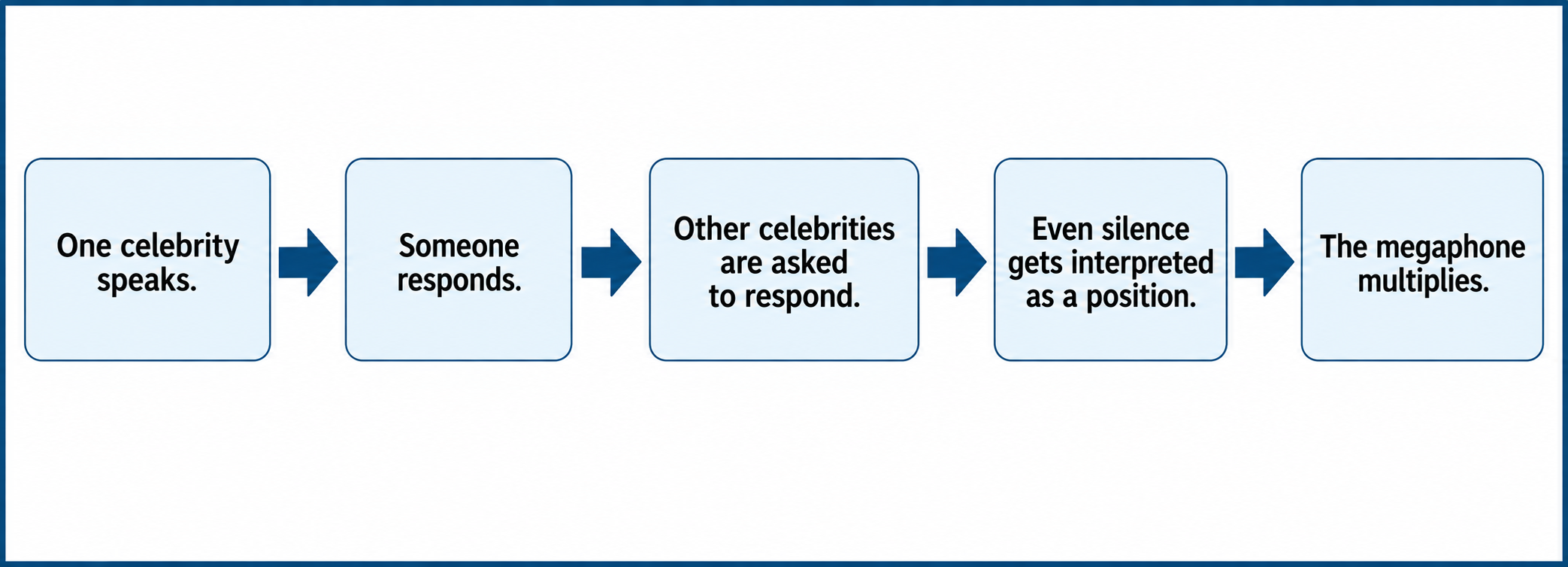
Which is almost exactly what I wrote about three weeks ago.
Except this time, it got personal.
My First Concert With My Kids
There’s another reason this story caught my attention.
An Ed Sheeran concert at MetLife was the first concert I ever took my children to.
And because, apparently, I keep receipts for my own life too, I went back through my phone.
There we are.
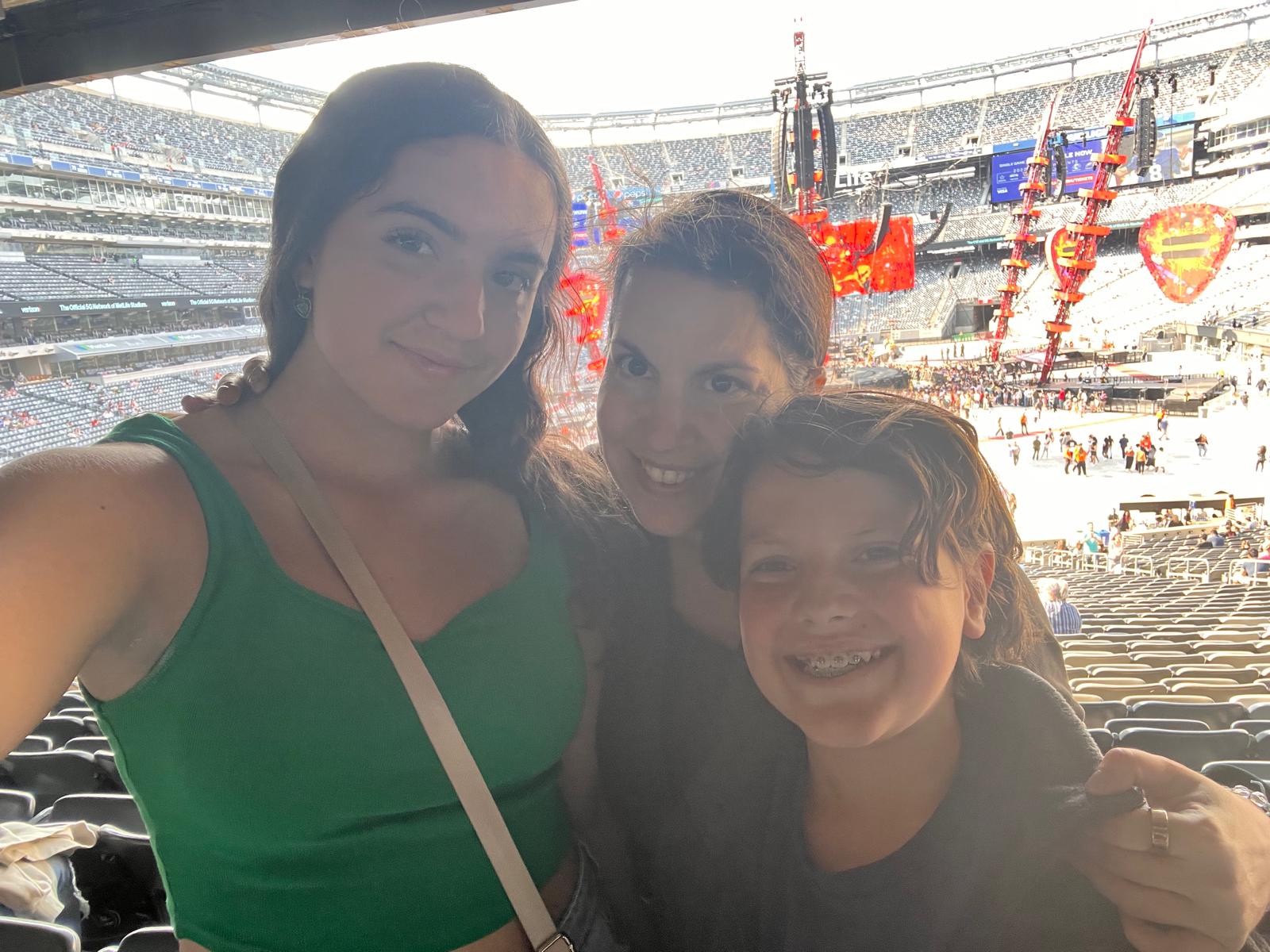
Me and my kids.
MetLife Stadium.
Ed Sheeran’s stage behind us.
And then I looked at the date.
June 10, 2023.
119 days before October 7.
We had absolutely no idea what was coming.
Of course we didn’t.
We were just a mother and her two kids at their first concert together.
Friendship bracelets.
Pictures.
Music.
A packed MetLife Stadium.
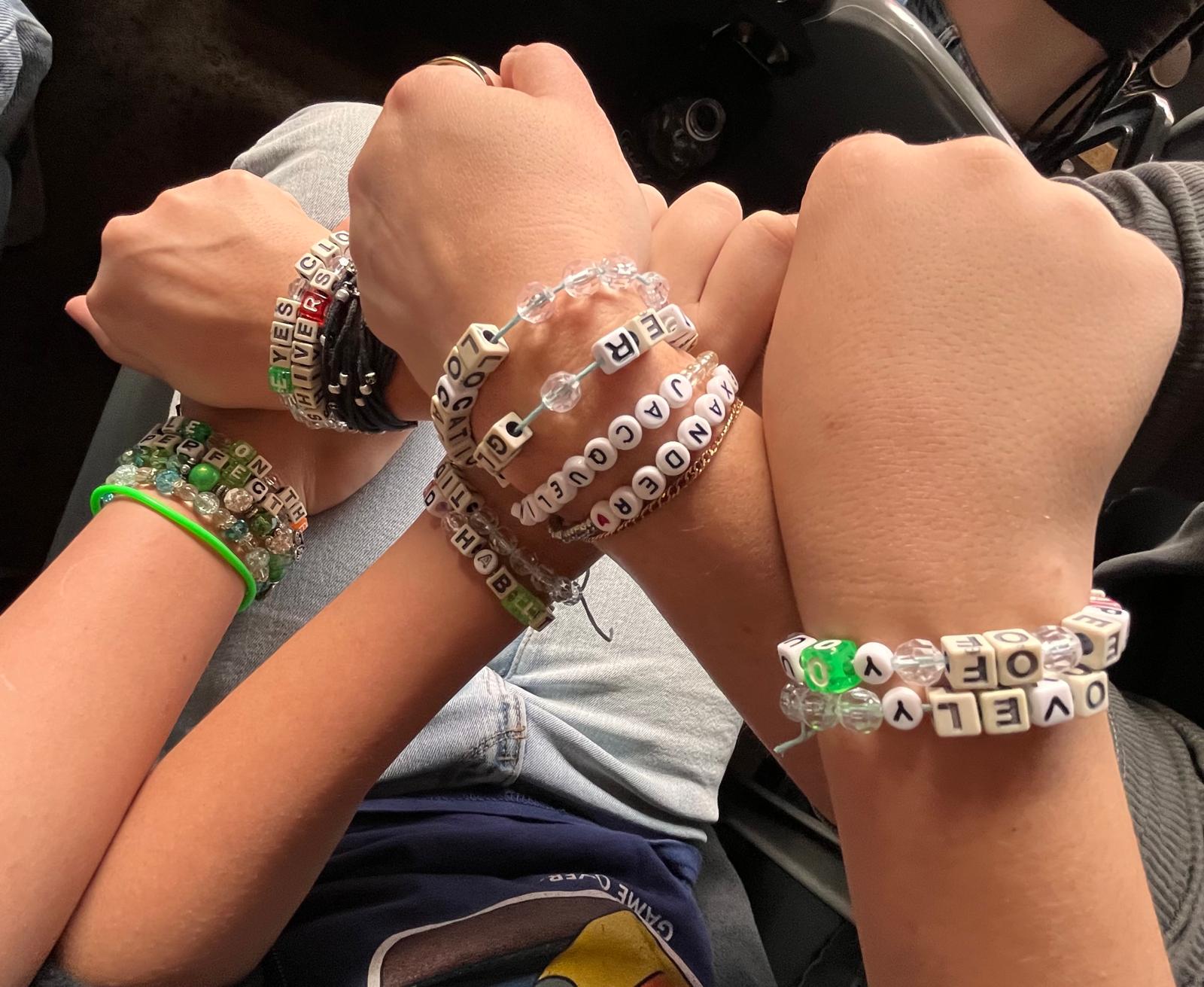
It was just a happy day.
And maybe that’s why looking at these photographs now hits me differently.
They are a receipt from my life before October 7.
Before every conversation about Israel seemed to become an argument.
Before murdered Israelis required footnotes.
Before hostages required context.
Before I found myself listening to the singer from my children’s first concert describe the war that followed October 7 as: “catastrophic and unjustifiable and disproportionate.”
But “catastrophic” cannot become a word that erases October 7, the hostages, Hamas, or the choices that brought Gaza to this moment.
And “unjustifiable”?
That word stopped me.
What exactly does “unjustifiable” refer to?
Israel going to war after October 7?
A particular Israeli military operation?
A particular strike?
Civilian deaths?
Those are very different claims.
And when millions of people are listening, a word that sweeping requires an explanation.
Because Ed Sheeran Has Said “I Stand With You” Before
Then, in the middle of all this, a video of Sheeran began circulating again.
I initially thought it was new.
It wasn’t.
It was better.
It was from March 2022.
Russia had invaded Ukraine.
The Ukrainian band Antytila contacted Sheeran before a fundraising concert.
Sheeran looked directly into the camera and said:
“To all Ukrainians, I love you, I stand with you.”
Four days later, Sheeran performed at the Concert for Ukraine, which was raising humanitarian funds for people affected by the Russian invasion. (ITVX)
And I have absolutely no problem with that.
Quite the opposite.
Ukrainians had been attacked.
He saw human beings suffering and said something remarkably simple:
I stand with you.
Standing with Ukrainians did not require endorsing every decision their government would make.
So I keep coming back to one question:
Where was that sentence on October 7?
Standing with Israelis who had just been murdered, kidnapped and attacked would not have required endorsing everything Israel subsequently did.
It didn’t with Ukraine.
Why should it with Israel?
Before We Call the War “Unjustifiable,” Read What Sinwar Expected
Here is some of the homework I wish entered this conversation more often.
Before October 7, Yahya Sinwar was already contemplating what Israel might do in response to the attack Hamas was planning.
Not afterward.
Before.
A handwritten August 24, 2022, memo attributed to Sinwar, recovered in Gaza and subsequently published, describes operational planning for a massive assault into Israel.
Sinwar contemplated catastrophic Israeli retaliation against Gaza and proceeded with the plan anyway.
Separate recovered material attributed to Sinwar describes instructions to create horrifying scenes, burn communities, deliberately document the violence and broadcast it rapidly.
It does not make an innocent Gazan child’s death one bit less tragic.
But it does make one fact impossible to erase:
Sinwar was contemplating catastrophic Israeli retaliation against Gaza before October 7.
So, if we are going to talk about responsibility for what happened to Gaza after October 7 — and we absolutely should — then Hamas’s responsibility belongs in that conversation too.
October 6 → October 7 → War
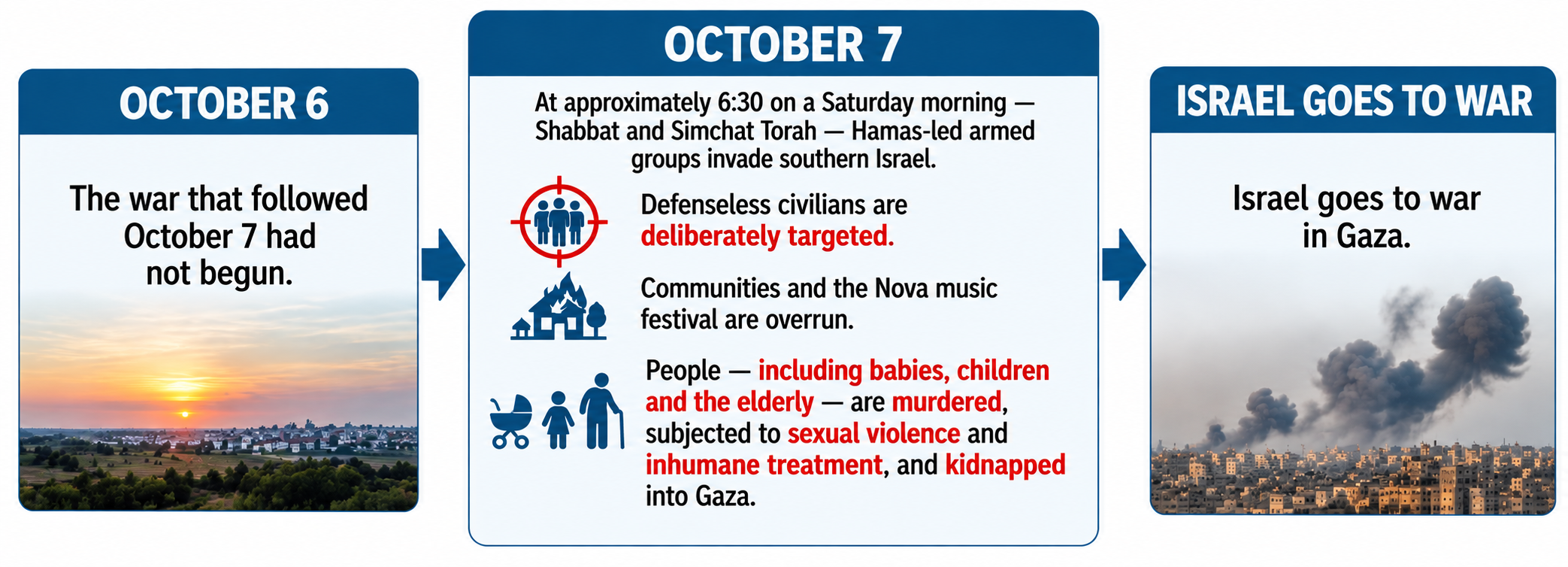 Human Rights Watch spent months investigating October 7, interviewing witnesses and analyzing hundreds of photographs and videos.
Its conclusion was explicit: the Hamas-led assault was designed to kill civilians and take hostages, and killing civilians and taking hostages were central aims of the planned attack rather than isolated acts or a plan gone wrong.
You can criticize Netanyahu.
You can scrutinize Israeli military operations.
You can mourn every innocent Gazan killed.
But you cannot reverse the arrow.
October 7 attack → Israel goes to war
Not:
Israel goes to war → October 7 attack.
That isn’t ideology.
It’s chronology.
They Didn’t Just Film October 7. Some of It Was Broadcast Live.
Three years later, I find myself watching people debate what happened on October 7 as though Israelis came home afterward and constructed a story about it.
But we watched portions of it happen.
In real time.
Attackers recorded themselves.
Some of the evidence of October 7 was created by the perpetrators themselves.
And in some cases, attackers used victims’ phones and social-media accounts to post or livestream material as the attack unfolded.
Independent investigators later authenticated hundreds of photographs and videos and documented deliberate attacks on civilians. (Human Rights Watch)
So when someone with tens of millions of followers explains how this war began, October 7 cannot become the footnote.
If We’re Talking About Civilians, Let’s Actually Talk About Civilians
Israel says that by March 31, 2024, its evacuation efforts in Gaza included approximately:
100,000 evacuation phone calls
9.3 million evacuation leaflets
15.5 million evacuation text messages
17 million recorded evacuation messages
Those are IDF figures, and they should be identified as such.
Which brings me to a question I almost never hear in the celebrity conversation.
Where are Hamas’s warnings?
Where is the leaflet over Ashkelon?
Where is the text to the mother in Sderot?
Where is the telephone call telling a family to take cover before a rocket is launched toward their city?
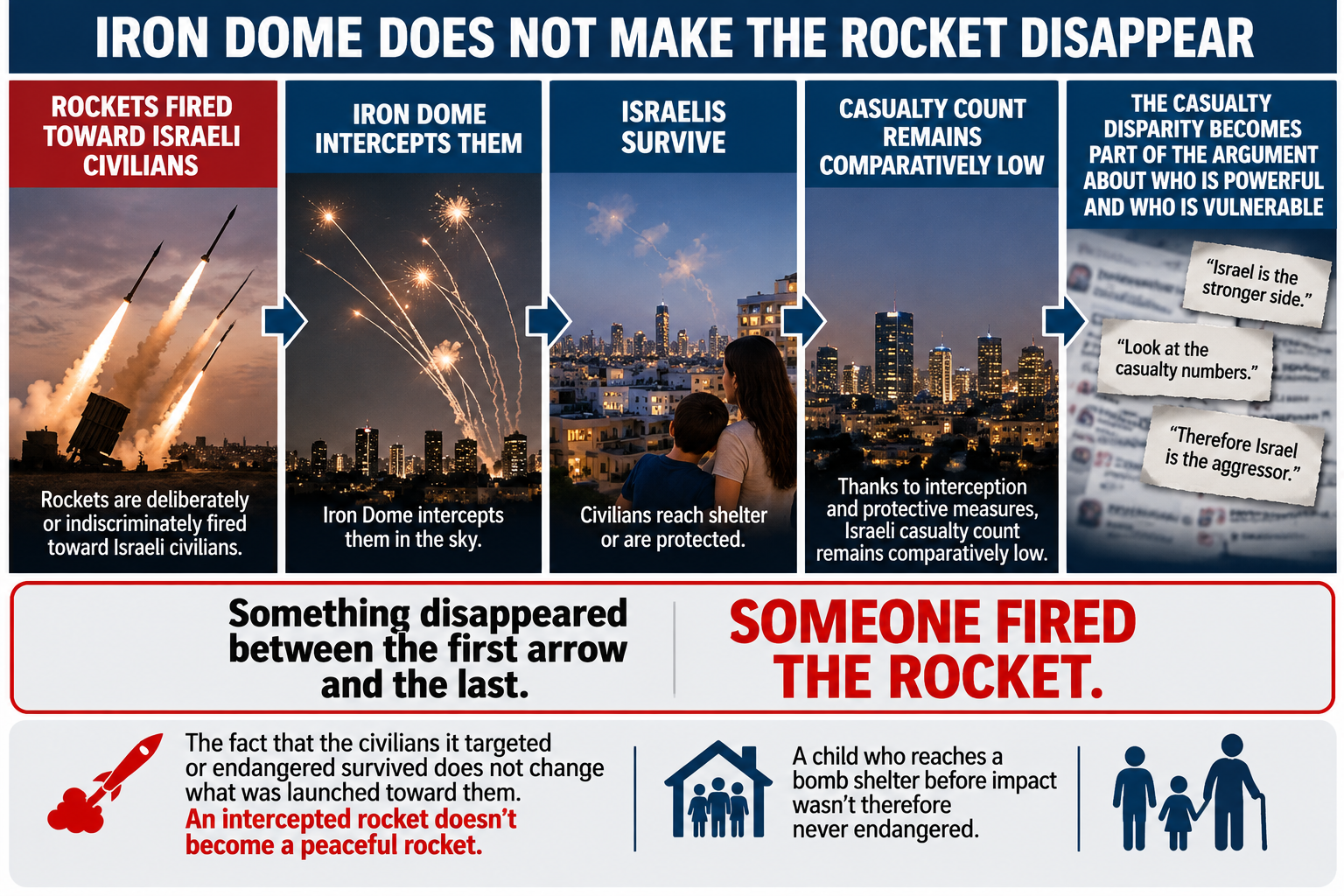 We have become so accustomed to Israelis surviving that sometimes we forget to ask who was trying to kill them.
Now Let’s Talk About the Tunnels
And then there are the tunnels.
Hamas built an enormous underground network for military operations, movement, weapons and hiding fighters and hostages. (The Washington Post)
In October 2023, senior Hamas official Mousa Abu Marzouk was asked why Hamas had built tunnels but not shelters for Gaza’s civilian population.
Abu Marzouk responded that the tunnels were built to protect Hamas fighters, not Gaza’s civilians, and argued that responsibility for protecting civilians rested with the United Nations and Israel.
Protection existed underground.
For Hamas.
So where were the shelters for Gazan families?
And why do so many celebrity conversations about Gazan civilians seem to stop precisely when the questions reach Hamas?
“Disproportionate” Does Not Mean Unequal Body Counts
There is another word in Sheeran’s statement that deserves homework:
Disproportionate.
Under international humanitarian law, proportionality is not a requirement that each side suffer roughly the same number of casualties.
It concerns whether anticipated incidental civilian harm from a particular attack would be excessive in relation to the concrete and direct military advantage anticipated.
That means proportionality is assessed in relation to particular attacks, not by comparing the overall body counts on opposing sides.
What was the target?
What military advantage was anticipated?
What civilian harm was foreseeable?
What precautions were taken?
Israel’s obligations toward Gazan civilians do not disappear because Hamas committed atrocities.
And Hamas’s crimes do not give Israel unlimited freedom either.
Both things can be true.
There Is Another Casualty Count
There is another group of human beings who rarely seem to fit neatly into the celebrity conversation.
Israeli soldiers.
It used enormous air power, yes.
It also sent soldiers into Gaza.
Into tunnels.
Into buildings.
Into booby-trapped neighborhoods.
Into close-quarters urban combat where Israeli soldiers themselves could be killed and wounded.
According to IDF data presented to a Knesset subcommittee, 279 IDF soldiers attempted suicide between January 2024 and July 2025. A Knesset Research and Information Center report also found a significant change in the proportion of IDF suicide deaths involving combat soldiers: 17% in 2023 and 78% in 2024. (Knesset)
Those numbers require care.
They do not establish that every suicide or attempt was caused by combat in Gaza, and the IDF has pointed to the enormous expansion of reserve service when interpreting wartime figures.
I am not presenting them to compete with Gazan suffering.
Human pain isn’t a contest.
The soldier who comes home traumatized does not cease being human because he wore an IDF uniform.
The Israeli child running to a shelter does not matter less because Iron Dome intercepted the rocket.
The hostage does not disappear because another tragedy happened somewhere else.
And a Gazan child does not become responsible for Hamas because she was born in Gaza.
Humanity isn’t a side.
And Then There Was Pink
Something else happened while I was researching this.
I started looking for the other celebrities.
Not politicians.
Not Jewish organizations.
Musicians.
Because once Macklemore was removed, musicians seemed perfectly capable of finding their voices.
Finneas withdrew.
Aaron Rowe withdrew.
Lukas Graham withdrew.
Members of Beoga withdrew.
They publicly explained why. (AP News)
So I went looking for singers publicly expressing another concern.
The Jewish concertgoers.
October 7.
Antisemitism.
The Israelis who were murdered and kidnapped.
I found Pink.
Pink criticized what happened at MetLife and later clarified that she was not objecting to Macklemore saying “Free Palestine,” nor demanding that he be silenced. Her concern included Jewish families in the stadium feeling frightened or targeted.
And then she wrote something that stopped me.
Standing up for her own people had been “lonelier” than she expected.
Pink is Jewish.
So I kept looking for another prominent singer publicly expressing comparable concern for Jewish or Israeli victims.
I haven’t found one.
That does not prove one doesn’t exist. If I find one, I will happily add the name.
But look at the public response I can document:
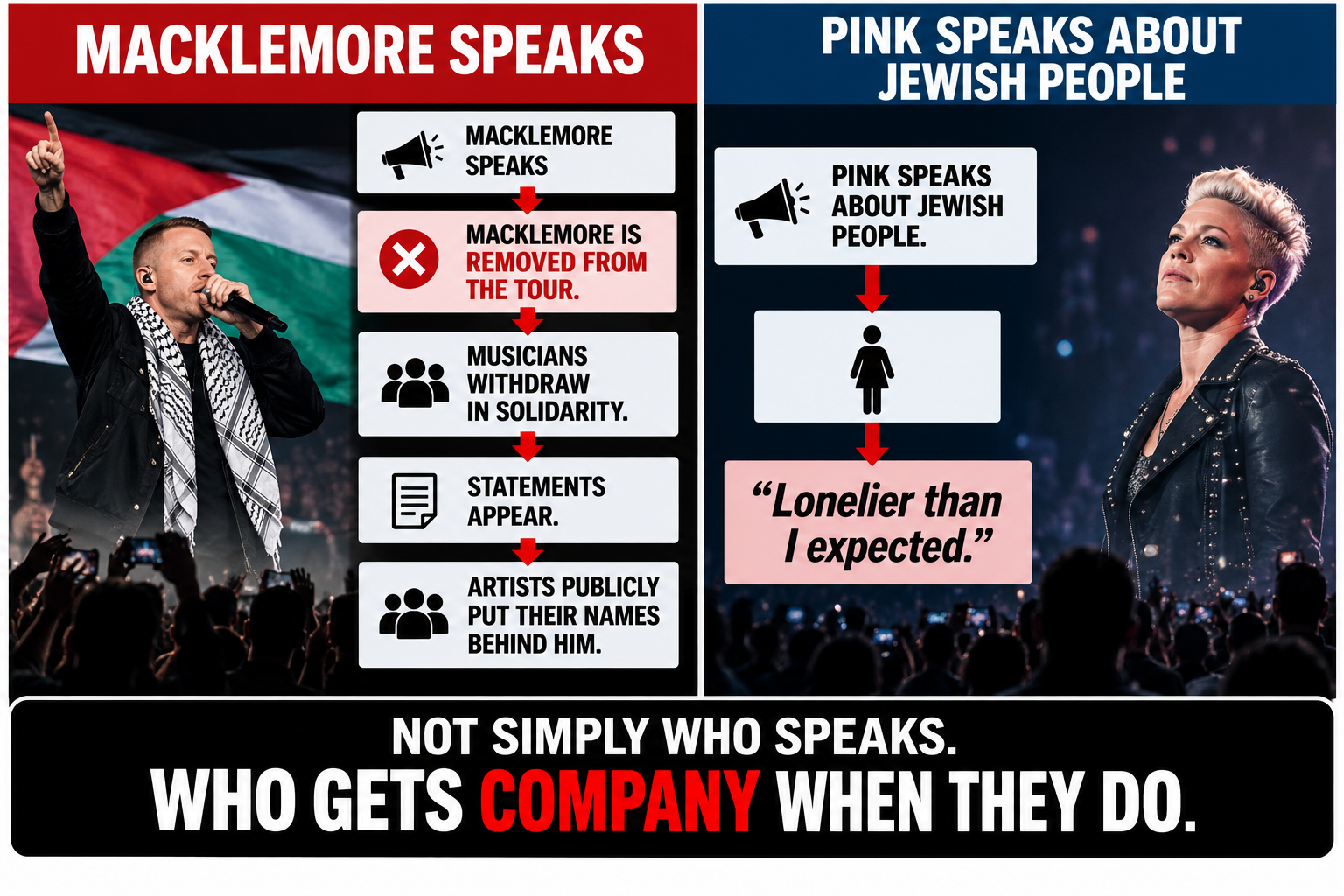 Maybe that is part of the celebrity megaphone story too.
And Then There Was Dua Lipa
In May 2024, Dua Lipa posted:
“Burning children alive can never be justified.”
She called what was happening an “Israeli genocide” and urged her followers to show solidarity with Gaza.
Let me start with the easy part.
Burning children alive can never be justified.
Israeli child.
Gazan child.
Any child.
Then, a few weeks later, Lipa explained how seriously she takes the responsibility that comes with speaking to an audience her size.
When she posts about political issues, she said, she “double-, triple-check[s]” herself.
Good.
That’s the homework.
So let’s do it.
Because if you “double-, triple-check” something before telling 88 million people who is responsible, then what exactly did the checking establish?
The images from Rafah were horrific.
Children and other civilians were killed in a fire after an Israeli strike.
That is true.
But Israel said the strike was directed at two senior Hamas operatives, not children. It said it used precision munitions and subsequently investigated why a fire far larger than expected erupted, including whether secondary explosions from nearby weapons contributed.
None of that makes the dead children less dead.
None of it makes their parents’ grief less unbearable.
But it matters enormously to what the evidence establishes.
Lipa did not explicitly say Israel deliberately targeted children in order to burn them alive. So I won’t put those words in her mouth.
But there is a difference between:
Gazan children were burned in a fire resulting from an Israeli military strike
and
Israeli civilians, including children, were deliberately attacked in their homes, and homes containing Israeli civilians were deliberately set on fire by Hamas-led attackers.
Those are not remotely the same factual circumstances.
A photograph can establish horror.
It cannot, by itself, establish intent.
And when you are speaking to 88 million people about responsibility for something this horrific, that distinction belongs in the homework too.
Especially because we have another event in this same war where the evidence about intent is extraordinarily clear.
October 7.
Hamas-led attackers did not accidentally stumble into civilian communities while aiming at something else.
Attackers sought civilians out.
They shot people trying to escape.
They threw grenades into shelters.
They attacked homes.
And they set houses on fire with people inside, burning and choking civilians and forcing others outside, where some were shot or captured.
Which brings me back to Dua Lipa’s sentence:
“Burning children alive can never be justified.”
Correct.
So why does the homework stop there?
Where was that moral clarity when Israeli families were trapped inside burning homes?
Where was the message to 88 million followers explaining that Hamas-led attackers deliberately targeted civilians?
Where was the insistence that kidnapping children, parents and grandparents could never be justified?
This is not an argument that Gazan children matter less.
They don’t.
It is precisely the opposite.
If we are going to insist that every child’s humanity matters, then we cannot change the evidentiary standard depending on whose child is in the photograph.
A Gazan child burned after an Israeli strike deserves our horror.
An Israeli child attacked deliberately on October 7 deserves our horror.
But if you are going to move beyond mourning the child and tell 88 million people who intentionally did what, then you have moved from compassion into a factual claim.
And factual claims require evidence.
Dua Lipa says she “double-, triple-checks.”
Good.
Then double-check the target.
Triple-check the intent.
And only then hand the conclusion to 88 million people.
That is what the megaphone coming with homework actually means.
Which Brings Me to Demi Lovato
And this one may bring us full circle.
In 2019, Demi Lovato visited Israel.
She was baptized in the Jordan River.
She visited Yad Vashem.
She described experiencing an extraordinary spiritual connection and called Israel “absolutely magical.”
Then came the backlash.
She apologized and explained that the trip had been intended as a spiritual experience:
“NOT A POLITICAL STATEMENT.”
Then people continued demanding a position.
And Lovato eventually asked a question I happen to agree with:
Why should an American singer be required to choose a side in a Middle Eastern conflict?
She wrote:
“I will not choose a side.”
Exactly.
She shouldn’t have had to choose a side because she visited Israel.
Going to the Western Wall is not a foreign-policy platform.
Visiting Yad Vashem is not an endorsement of an Israeli prime minister.
Being baptized in the Jordan River is not a position paper.
But fast-forward seven years.
During this Macklemore controversy, social-media screenshots circulated appearing to show Lovato’s verified Instagram account liking Macklemore’s statement about his removal from Sheeran’s tour.
I have screenshots.
I do not have a statement from Demi Lovato explaining her motive.
So I will not invent one.
Maybe her views changed.
People are allowed to change their minds.
But the chronology is fascinating.
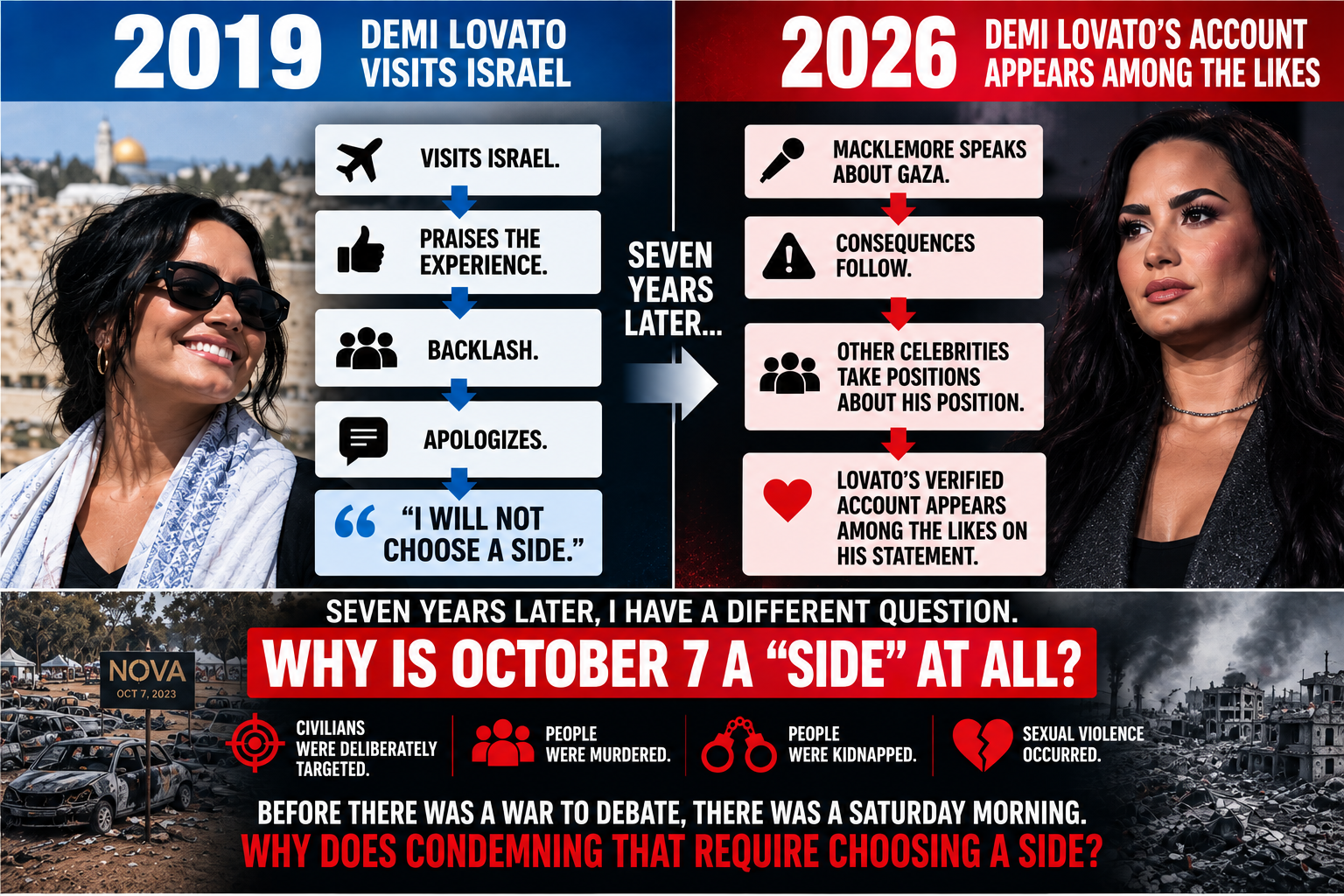 Maybe there is an even more uncomfortable question:
Are celebrities speaking because they independently reached these conclusions — or because celebrity culture has taught them which conclusions bring applause and which ones require an apology?
Apparently, the Microphone Wasn’t Finished
Three weeks ago, I wrote that celebrity itself isn’t the problem.
The megaphone is.
You don’t need a Ph.D. in Middle Eastern history before you are allowed to care.
You don’t need to visit Israel.
You don’t need to agree with me.
You don’t even need to speak.
There is nothing shameful about saying:
I don’t know enough.
Actually, I wish more people with enormous platforms said it.
But if you decide to explain this war to millions of people, then yes:
Know what happened on October 7.
Know what Sinwar contemplated before launching it.
Know that civilians were deliberately attacked and hostages were taken.
Know why Israelis live with bomb shelters and Iron Dome.
Know what Hamas built beneath Gaza and whom one of its own senior officials said those tunnels were built to protect.
Know what proportionality actually means.
Know that Israeli soldiers are human.
Know that Gazan civilians are human.
Know that a viral video is not automatically verified evidence.
Know the difference between evidence and content.
Then disagree with me.
My objection was never disagreement.
It was certainty without curiosity.
And now, after watching Macklemore, Sheeran, Pink, Dua Lipa, Demi Lovato and everyone around them get pulled into the same enormous social-media machine, I would add one more question:
If you’re going to use the microphone, what are you willing to leave out?
Because what you say matters.
What you verify matters.
And when millions of people are listening, what you leave out can matter just as much.
There aren’t “sides” to basic humanity.
There are human beings.
There are choices.
There are consequences.
And if you choose to put all of that through a microphone powerful enough for millions of people to hear:
The megaphone comes with homework.
Do it.
Then speak.
Related Topics