The cost of looking away
The cost of looking away
Yoni Kidorf is an undergraduate student at the University of Maryland double majoring in international relations and psychology and a CAMERA Fellow. Opinions expressed are those of the author and do not necessarily reflect those of CAMERA.
“I should’ve known today would be hell when I saw the Netanyahu d*** suckers.”
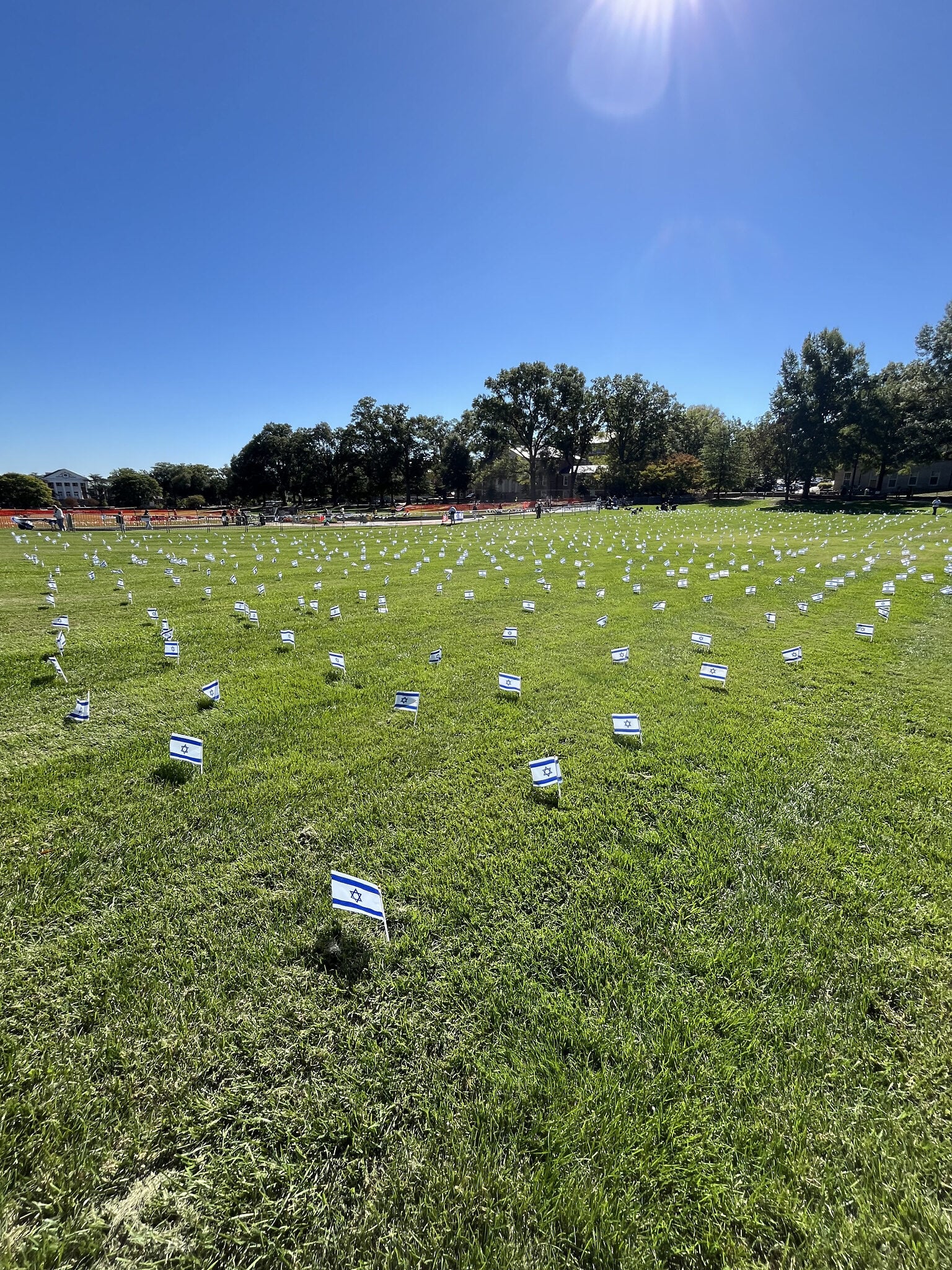
This was one of many anonymous messages posted in the University of Maryland’s Yik Yak, a hyperlocal social media platform, during the third anniversary of the Hamas-lead genocide earlier this month. Specifically, these comments were in response to Jewish UMD students setting up the memorial for the 1,200 individuals murdered. The prevalence of such posts suggests that hateful rhetoric targeting Zionists has become disturbingly normalized within this online campus environment.
In the thousands of comments I scrolled through that day, none even resembled a well-reasoned critique of Israeli policies. Just a frightening display of blatant degradation of an entire people for the crime of public mourning.
There are a few theories out there explaining how so many college students have adopted such evil beliefs – social media, activist professors abusing their influence, the amount of unchecked foreign funding higher education has received – and while all seem to have a little truth them, there are deeper psychological dynamics that I think are worth identifying. Psychology offers two ways to understand this: deindividuation, which helps explain why people act differently when they feel anonymous, and dehumanization, which helps explain how people learn to see others as less than human. Understanding these dynamics is a first step toward recognizing both why this rhetoric matters, and why we can’t afford to simply ignore it.
Last year, during student government elections a Yik Yak post was published depicting one of the Jewish candidates as a “Hitlerite” standing in front of a banner with a Swastika.When UMD President, Deryll Pines, sent a school-wide email condemning this post, the UMD students of Yik Yak were furious. Dozens of comments accused Benjamin Netanyahu of funding President Pines, suggesting that the only reason why a school official would come to a Jewish student’s defense is if the Jewish state paid them to do it.
The prevalence of these comments illustrates how an anonymous online outlet can lower the social costs of expressing hostility. Deindividuation offers one explanation. When people feel less identifiable and less personally accountable, they may become more willing to express views they otherwise would not.
Would these individuals make such statements in real life? It’s impossible to know for sure, but something tells me at least a few of those posters and the hundreds of users who gave them thumbs up would think twice if their real names were attached to their profiles.
This also likely explains the prevalence of masks on Palestinian protestors. While protestors often justify their keffiyehs or masks as a response to a fear of being doxxed or facing repercussions, the effect on the group is the same. When faces disappear, so does individual accountability, and the crowd’s norms take over. I will add that I am certainly ambivalent towards any cause that requires participants to hide their identity.
The question then arises: how do environments that produce such people form in the first place? Another recent tale from UMD Yik Yak provides an answer. In 2025, two female Jewish freshmen placed a thank you IDF sticker on their dormitory door. Not long after, one of them was greeted by a police officer in their chemistry lab, informing them that they had been doxxed. Somebody on Yik Yak posted “Brain dead monkeys in [dormitory] 2nd floor” accompanied with the students names and a picture of their door.
This was an act of dehumanization in a very literal sense. Rather than engaging with the students’ expressed political beliefs, the post compared them to animals and exposed their identities to a hostile environment. Such language can make it easier to treat people as legitimate targets of animosity rather than human beings deserving of dignity and consideration.
The normalization of this kind of behavior should worry all college students. Upon studying Jewish American college students, the American Jewish Committee found 34% of students conceal their visible expressions of Jewish identity due to fear of antisemitism. The same study found that 38% of students self censor about Israel.
It’s important to remember that in the 1930s, German universities were among the first places where Jews were systematically marginalized. Students organized campaigns against Jewish classmates and professors, Jewish student organizations were attacked, and the Nazi government enacted laws restricting Jewish enrollment.
These events are not equivalent to contemporary antisemitism on American campuses. The difference is that no law or university policy today mandates the exclusion of Jewish students. But the early stages look familiar. First hostility gets normalized, then exclusion gets tolerated, and without a response, the distance between the two shrinks.
When those who possess differing opinions than us are alienated and bullied, we must wonder when it ends. Is an environment without dialogue and understanding ideal? Shouldn’t college be an optimal time to expand our positions and identity?