
The Defiant Heart: Why Stoicism Is Not Enough for the Jewish Soul
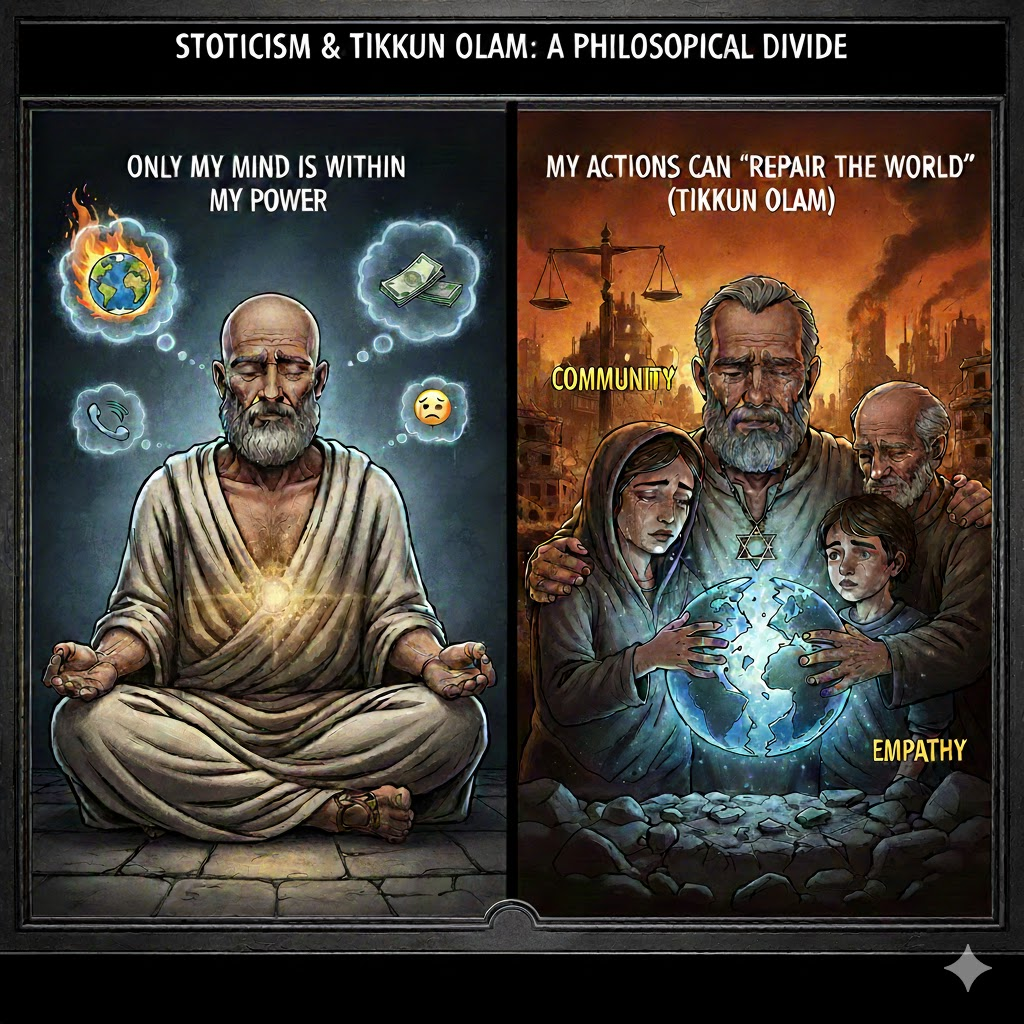
Stoicism has undeniable appeal. It teaches discipline of the mind, acceptance of what cannot be controlled, and emotional restraint in the face of hardship. “Only my thoughts are within my power,” the Stoics remind us. In moments of chaos or danger, this philosophy can be lifesaving. It steadies the pulse, quiets panic, and allows one to endure what would otherwise overwhelm them.
Once the philosophy of emperors and slaves—from Marcus Aurelius to Epictetus—Stoicism has re-emerged in modern culture, embraced by entrepreneurs, athletes, and psychologists seeking self mastery in an unstable world that feels increasingly beyond repair.
Global events like Stoic Week, in which thousands experiment with living Stoic principles in daily life, and podcasts, newsletters, and platforms that present Stoic ideas in modern language have now become du jour. Sales of Marcus Aurelius’s Meditations jumped dramatically from 12,000 copies sold in 2012 to over 100,000 in 2019, showing a measurable interest in Stoic literature.
For Jews, the Stoic posture is deeply familiar. Ours is a people forged in endurance. Across centuries of exile, persecution, and catastrophe, emotional restraint often meant survival. Silence could be a safeguard. Detachment could be prudent. In the darkest chapters of Jewish history, stoicism was not an abstract philosophy; it was a practical necessity, adopted instinctively rather than intellectually.
And yet, stoicism—while useful—is not enough for the Jewish soul.
Judaism is not a tradition of emotional withdrawal; it is a tradition of moral engagement. Where Stoicism advocates a protective distance to preserve the self, Judaism insists on the kind of engagement that risks the self to prevent harm from going unchecked. Where Stoicism teaches mastering yourself in the face of inevitable suffering, Judaism challenges the inevitability itself and asks what can be done about it.
This difference is not subtle; it is foundational.
Consider Stoicism’s embrace of fate—amor fati, (the love of one’s fate), be it the death of a loved one or the unraveling of the world, sorrow is acknowledged—Stoics do not deny pain but move past it, as soon as reason allows, with an inner steadiness that refuses to be undone by what cannot be altered. The reasoning is that what has come to pass is no longer within their control, and dwelling upon it amounts to a form of emotional enslavement and self-inflicted suffering.
Judaism moves in another direction. It does not rush the mourner toward serenity; it structures sorrow and gives it sacred time. Through ritual, remembrance, and communal obligation, grief is neither suppressed nor borne alone. Memory is not something to be managed and set aside; it is something we are asked to carry forward. The Torah insists on this again and again: remember that you were strangers in Egypt—therefore protect the stranger; remember what Amalek did—therefore resist cruelty; remember Miriam—therefore guard your tongue.
Likewise, in the face of injustice, violence, or moral collapse, Judaism does not ask how to remain untouched by what has occurred. It asks what responsibility has been awakened by it. This is why the Torah’s repeated command is not “remember so you may feel,” but “remember so you may act.”
Stoics practice Premeditatio Malorum (the premeditation of evils), which involves imagining everything that could go wrong so that when it does, you are not surprised.
Jerry Seinfeld, a vocal admirer of Stoicism, often speaks of emotional discipline and detachment as tools for navigating life’s irritations and disappointments. Stoicism, at its core, prizes self-command: the ability to remain calm, functional, and unruffled in the face of adversity and the broader upheavals of the world. Yet in recent years, Seinfeld has stepped squarely into the moral turbulence of the Middle East, speaking openly in support of Israel. His choice suggests a boundary within Stoicism itself. Inner calm may shape how one responds to the world, but it does not always justify silence when the world presses for moral clarity.
That tension—between inner composure and outward obligation—is precisely where Stoicism begins to strain, and where Judaism deliberately begins.
Jewish tradition places responsibility squarely in the realm of action. The Torah does not ask us to detach from the world’s brokenness or to observe it from a position of calm remove. We are here to feel its fractures, to grieve its wounds, and to respond with our hands and our voices. Inner steadiness matters—but it is not the end. Action is. Repair is. Tikkun olam is not a metaphor; it is a mandate.
Biblical Judaism is filled with voices that refuse stoic restraint. Abraham argues with God over the fate of Sodom, unwilling to accept destruction without protest. Moses repeatedly challenges divine decrees, insisting on mercy and accountability. Job does not endure quietly; he rages, questions, and demands answers. The Psalms are raw with anguish, fury, doubt, and grief—cries that refuse to be silenced. These are not stoic texts. They are defiant ones, insisting that suffering be named rather than swallowed.
Even Jewish mourning rituals reject stoicism. Shiva (mourning) requires the bereaved to sit and be seen, to receive visitors, to speak, or to weep without apology. Grief must be acknowledged aloud, in community. Kaddish, (prayer for the dead) when recited publicly, insists that loss be expressed through speech rather than silence. We are a people of Zachor—memory. To remember, in Judaism, is to remain accountable to the past and responsible for the future.
Where the Stoic seeks a state of Ataraxia (unshakable mental calm), the Jew seeks a state of Kodesh (holiness). And holiness in the Jewish tradition is rarely found in calm isolation. It is found in the noisy struggle of a covenantal people—the wrestling with God, the questioning of injustice, and the refusal to be silent in the face of suffering.
Ultimately, Stoicism is a philosophy of acceptance. Judaism is a theology of protest.
This distinction is of profound importance at this time. Calls for resilience and emotional restraint often carry an implicit warning: don’t react too strongly, don’t protest too loudly, don’t feel too deeply. Stoicism can become a way of bypassing—of avoiding the discomfort that moral clarity demands. It can anesthetize conscience just as easily as it calms fear.
But silence has rarely protected Jews in the long run. Our survival comes from voices raised, questions asked, and injustices named. From prophets who spoke truth at great personal risk, and from ordinary people who chose engagement over detachment.
There is wisdom in knowing what lies within our control. Our thoughts matter. Our inner life matters. Stoicism reminds us of this, and we would be foolish to dismiss it entirely. But Judaism presses further: inner discipline must bend toward action. Self-mastery is not a retreat from the world; it is strength gathered for the work of repairing it. It cultivates not indifference, but a quiet unwillingness to accept brokenness as final.
The Jewish path is the harder one—the path of the “Defiant Heart” that chooses to stay vulnerable, to stay angry at injustice, and to stay committed to the exhausting, messy, and deeply emotional work of Tikkun Olam.
To be Jewish is to live with the tension between acceptance and protest, between endurance and engagement. Stoicism may help us survive the storm, but the Jewish soul demands that once the storm passes, we step back into the world—not detached, but involved; not indifferent, but accountable.
As we navigate the complexities of 2026, the temptation toward Stoic detachment is strong. The world feels overwhelming, the news is often unbearable, and the weight of our history is heavy. It would be easier to build a fortress around our hearts and practice a quiet, logical indifference.
But that is not our way. Our history proves that we are at our best when we are most connected. We do not stand alone in a fortress of the mind; we stand together in a circle of shared fate.
Stoicism is a magnificent defense mechanism, but it is a poor engine for change. It can keep a person from drowning in a sea of sorrow, but it will never teach them to build a ship for others.
To be a Jew in this moment is to carry a paradox: to be strong enough to survive the unthinkable, yet soft enough to weep for one another. We must have the Stoic’s grit to face the darkness, but the Jewish soul to keep the light burning for the person standing next to us. In the end, it is not our ability to remain “unshaken” that defines us, but our courage to remain deeply moved—to keep speaking the hard truths and to plant seeds in soil some of us may never walk on.