

Consultant and writer exploring policy, society, and identity
The Diaspora Is Not an Incomplete Version of Israel
The debate over Dana Nessel (U.S. Michigan Attorney General) raises a larger question: who gets to define Jewish belonging?
The recent debate around Michigan Attorney General Dana Nessel asks a question that reaches well beyond an American election: how should Jews weigh responsibility for their own people against responsibility for the wider world? In her conversation with David Frum, Nessel describes feeling increasingly isolated within her own Democratic Party. Yet she also insists that democracy, climate and other shared dangers must influence Jewish political choices. The interview should be distinguished from her later remarks that prompted the blog responses.
Mijal Bitton challenges the treatment of Jewish survival as a mere interest rather than a moral value. Jaclyn Clark questions the use of Jewish voices to validate claims made about other Jews. Gary Fouse emphasizes the danger of subordinating Jewish safety. These are different arguments, but together they expose uncertainty about what Jewish belonging requires. My starting point is that Jewish life has value in itself. We do not have to justify our existence by proving our usefulness. But the meaning of that life cannot end with its preservation.
An inheritance still needs interpretation
I was born in Belgium, came to the United States for graduate study and now live in Hawaii. Geography has changed the setting of my Jewish life. It has not supplied a complete answer to what that life means. In my paper, From Lineage to Meaning, I explore how family records can become narratives of identity when we interpret choices, circumstances and relationships. An inherited connection and the meaning we give it are related, but different.
A family’s migration tells us where people went. Understanding what they carried, abandoned or rebuilt tells us more about who they became. The same applies to Jewish identity today. A passport, a synagogue affiliation or a political preference reveals something, but none reveals everything. This series therefore asks three connected questions:
– where do we belong,
– how do threats shape us, and
– what responsibilities do we choose to carry?
Israel matters without owning the whole story
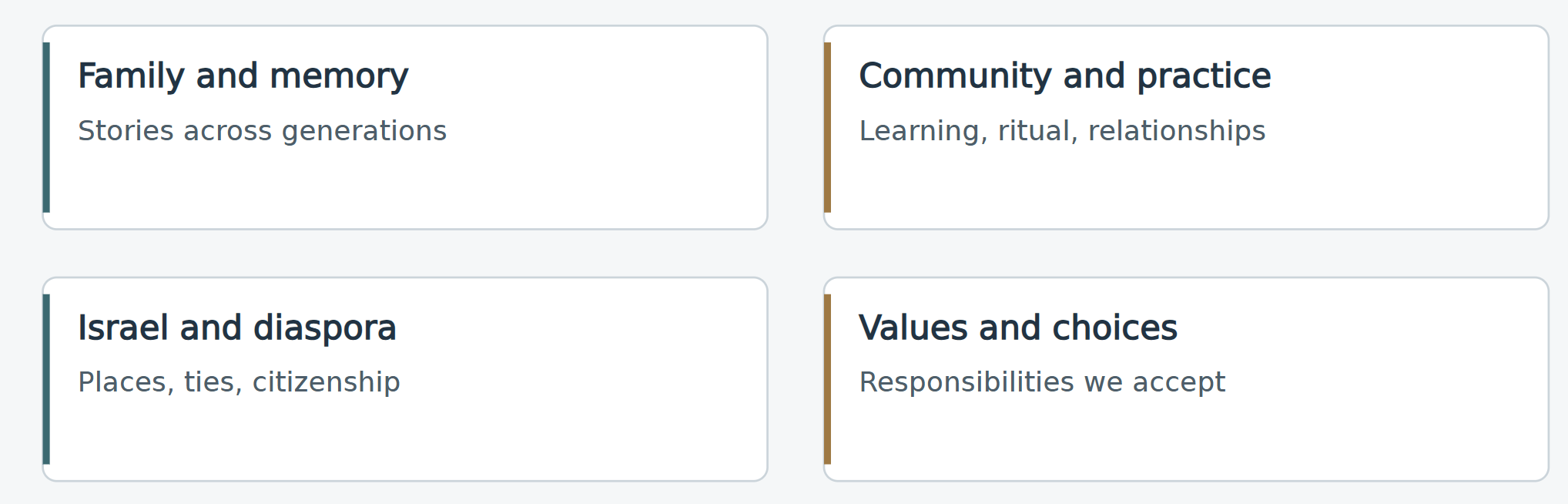
Israel gives Jewish peoplehood a national and civic expression. For many Jews abroad, it is also a place of family connection, religious memory and concern for the safety of other Jews. Those ties need not disappear when an Israeli government acts in ways they oppose. But diaspora communities are places where Jewish life is lived, taught and renewed. We are not simply populations waiting to become Israeli. Our relationships with surrounding societies create different experiences of citizenship, minority rights and moral obligation.
Nor are these two uniform camps: an Israeli secular Jew, an Israeli religious Jew and an American Reform Jew may share some commitments and disagree on others. Families frequently span the supposed boundary. Israelis bear the immediate responsibilities and dangers of their state’s decisions. Diaspora Jews bear consequences in their own societies without voting in those decisions merely by being Jewish. Recognizing both realities is a condition of a serious relationship. Jewish identity has several sources, and these sources overlap and change through life.
Attachment is not a government endorsement
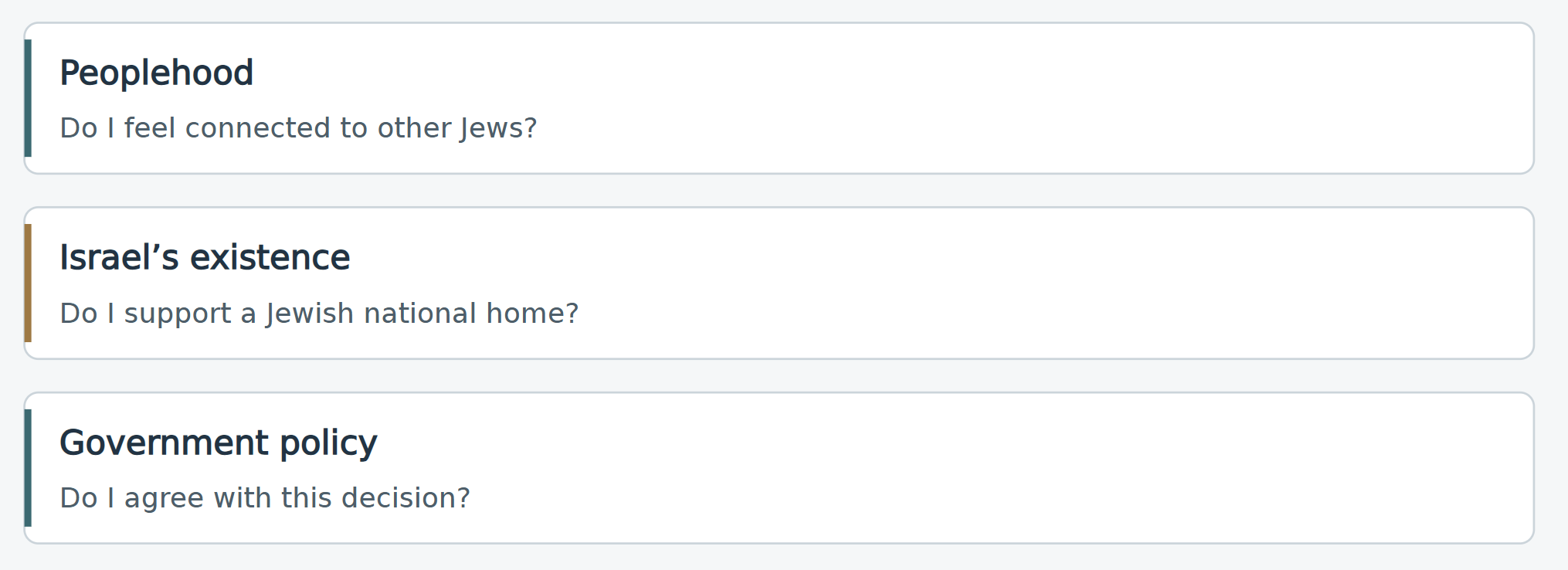
Nessel’s interview makes one distinction particularly useful: she expresses support for Israel’s existence while criticizing Benjamin Netanyahu and AIPAC, the American Israel Public Affairs Committee, a US advocacy organization. We need language that allows those positions to coexist. Concern for Israeli lives is not consent to every military operation. Criticism of an Israeli government is not necessarily rejection of Jewish peoplehood. Membership in a Jewish community should not require agreement with its most vocal political representatives.
This also applies within Jewish debate. Someone who speaks as a Jew offers a Jewish perspective; that person does not automatically speak for Jews. A majority view does not erase a minority view, and dissent does not erase membership. The obligation is reciprocal: Political movements should not require Jews to disavow Israel as the price of acceptance. Jewish institutions should not turn every disagreement over Israel into a test of a person’s authenticity. Answers can differ. None of these questions alone defines the whole person.
 A shared purpose can cross borders
For me, Tikkun Olam, the responsibility to repair the world—is Judaism’s most important concept. It is also how I understand being the Chosen People: an obligation to care for human beings, animals and all forms of life. This is my interpretation, not a claim that Jewish tradition has one uncontested definition. I will develop it in the third post. Here it offers a reason to resist reducing Jewish identity to a political location.
A person can sustain Jewish learning in Belgium, defend minority rights in the United States, work for humane public policy in Israel or care for vulnerable life elsewhere. These activities differ. They can nevertheless express an attachment that asks something of us. The relationship between Israel and the diaspora should make those possibilities larger. Neither should demand that the other disappear into its own account of Jewish life.
The next question is harder: when others threaten us because we are Jewish, how much freedom do we retain to define that life for ourselves?