Strategist and Diplomat Analyzing Somaliland and Horn Affairs
The Doolow Strike: Türkiye’s Intervention in Somalia
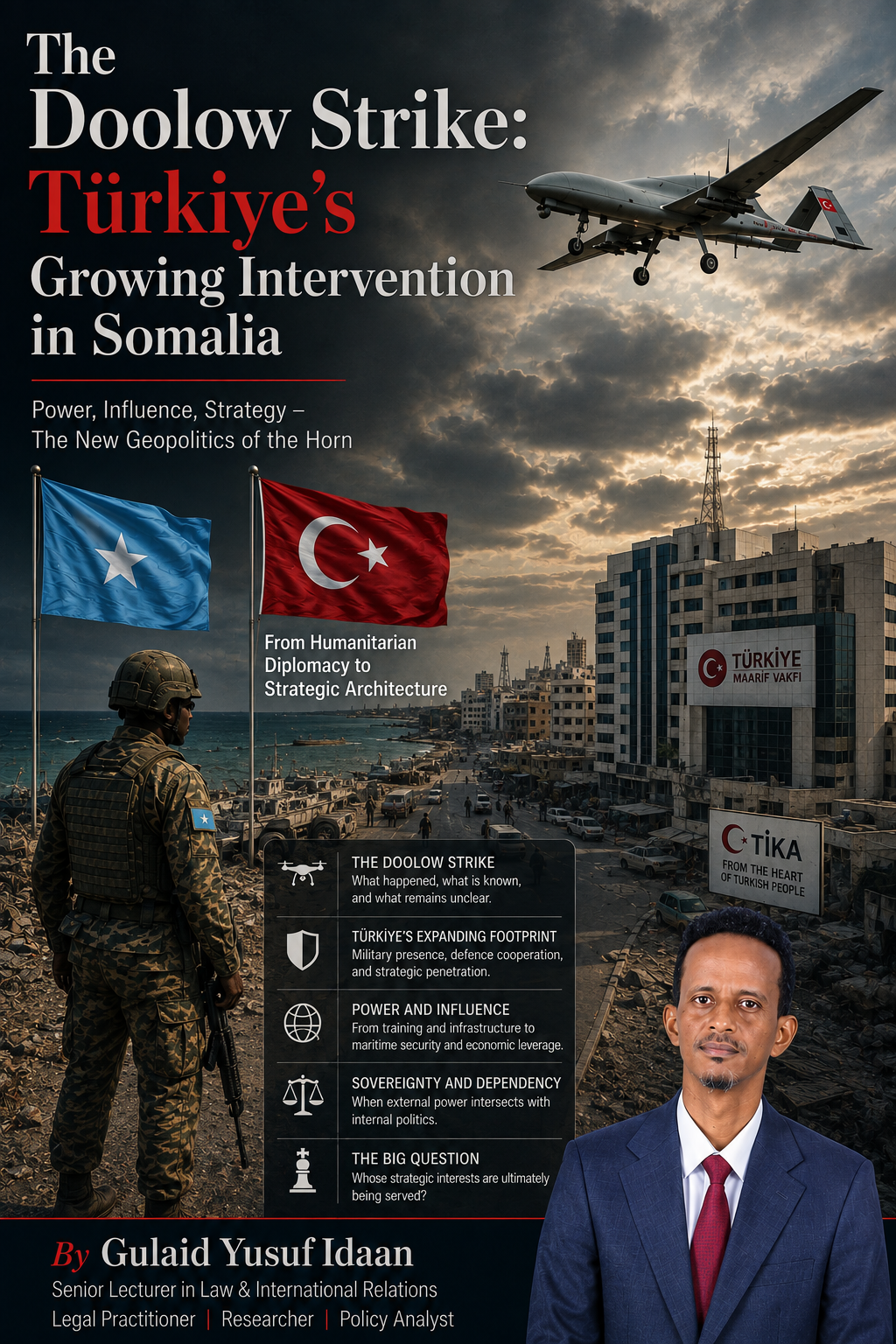
“Türkiye in Somalia: From Humanitarian Diplomacy to Strategic Architecture.”
The reported drone strike in Doolow targeting former Somali Custodial Corps commander General Mahad Abdirahman Shub has brought a much larger strategic question about Turkey’s role in Somalia into sharp focus.
The reported strike on General Mahad Abdirahman Shub’s residence in Doolow, Gedo, has been attributed by Somali political actors and local reporting to Turkish-operated or Turkish-supplied drones. Reports have identified the Bayraktar Akıncı among the systems associated with Turkey’s military relationship with Somalia — Somalia received two Akıncı UCAVs from Ankara in March 2025, officially to bolster the fight against Al-Shabaab. The Federal Government has denied any role in the strike, and General Shub survived with minor injuries while four civilians, including his wife, were wounded. Neither Ankara nor Villa Somalia had publicly established responsibility for the specific operation at the time of reporting.
The strike comes as Turkey’s security relationship with Somalia has expanded considerably. Ankara trains Somali forces through Camp TURKSOM — Turkey’s largest overseas military base, operational since 30 September 2017 — maintains a major military presence, supplies military equipment, and has developed defence cooperation involving maritime security and Somali naval capabilities. Turkish engagement has also extended into infrastructure, aviation, education, banking, humanitarian assistance, energy exploration, and commercial activity.
This is therefore no longer simply a story about development assistance, humanitarian diplomacy, or military training.
It is a story about power.
The central question is:
Whose strategic interests are ultimately being served by the power Turkey has accumulated in Somalia?
This is not primarily a question of whether Turkish engagement benefits Somalia. It clearly does in several areas. Turkish assistance has contributed to military training, infrastructure, connectivity, humanitarian programmes, education, commerce, and institutional development.
The deeper question is whether Turkish interests in Somalia are identical to Somalia’s national interests in Turkey.
They are not necessarily the same.
That distinction becomes particularly important when foreign military capabilities intersect with Somalia’s internal political competition. If capabilities supplied or operated through an external partnership are used against Somali political or military actors, the relationship moves beyond conventional defence cooperation and into the more difficult territory of sovereignty, command, accountability, and dependency.
An Argument I Have Made Before
The argument developed here is not new. For more than a year, I have examined Turkey’s expanding strategic presence in Somalia and argued that Ankara’s position toward Somaliland cannot be understood exclusively through the language of territorial integrity. A full archive of this work is available on my MuckRack page and my Times of Israel author page.
Turkey’s interests must also be examined through its institutional influence, economic investments, security relationships, maritime position, and wider regional strategy.
I first developed this argument in “How Somaliland Outsmarted Turkey in the Horn of Africa,” published by Horn Diplomat on 11 January 2026. I examined Turkey’s expanding position in Somalia and Somaliland’s emergence as a geopolitical space capable of complicating Ankara’s calculations.
I developed the argument further in “Sovereignty for Sale: Hypocrisy on Somaliland,” published by The Times of Israel on 13 January 2026, and through the argument of “Unity as a Mechanism of Influence,” examining how a political structure centred on Mogadishu can provide an institutional framework for political, security, and economic influence.
In “Republic of Somaliland and Corridor Power,” published by The Times of Israel on 17 March 2026, I placed the Turkish presence within the wider competition over the Red Sea, Gulf of Aden, Indian Ocean, ports, infrastructure, and maritime corridors.
In “Israel–Somaliland Engagement: A Realist Analysis,” published by The Times of Israel on 20 April 2026, I further examined Turkey’s centralized influence architecture, in which military cooperation, political relationships, infrastructure, and economic interests reinforce one another.
My June 2026 analysis, “The Alignment I Warned About: Saudi Arabia, Türkiye, Pakistan and the Battle for the Horn of Africa”, extended the argument into the wider regional environment. I argued that Turkey’s participation in an emerging Saudi–Türkiye–Pakistan relationship should not be interpreted as simply serving Riyadh or Islamabad. Ankara has its own strategic objectives.
Finally, in “Türkiye’s Somaliland Dilemma: Why Ankara Fears,” published by The Times of Israel on 31 August 2026, I argued directly that Turkey’s position in Somalia cannot be explained by territorial integrity alone. Ankara has developed strategic investment, institutional depth, security partnerships, infrastructure access, and political influence.
The Doolow incident brings this earlier argument from the level of strategic structure to the level of operational power. The question is no longer simply how Turkey has accumulated influence, but what happens when that influence becomes connected to military capabilities operating within Somalia’s internal political environment.
That is why Doolow matters.
From Humanitarian Diplomacy to Strategic Architecture
Turkey’s engagement with Somalia has undergone a significant transformation.
Ankara initially built considerable goodwill through humanitarian assistance and development projects. President Recep Tayyip Erdoğan’s August 2011 visit to Mogadishu — undertaken while he was prime minister, at the height of Somalia’s famine, and described by Somali officials as a watershed that “changed the destiny of Somalia” — became an important symbol of Turkey’s emergence as a major external actor. Turkey’s foreign ministry records that its humanitarian and development assistance to Somalia has since exceeded one billion US dollars.
The relationship subsequently expanded.
Diplomatic engagement was accompanied by infrastructure, education, aviation, banking, military training, commerce, maritime security, and energy interests.
The establishment of TURKSOM was particularly important because it gave Turkey a durable institutional position inside Somalia’s security sector and made Ankara a central partner in the training of Somali forces — more than 5,000 Somali security personnel have reportedly been trained there.
The significance of this relationship lies less in any individual project than in its breadth.
Turkey has developed influence through multiple channels operating simultaneously.
Military cooperation establishes security relationships. Economic projects create long-term commercial interests. Infrastructure establishes physical and institutional presence. Political relationships facilitate access. Maritime cooperation expands Turkey’s strategic relevance to Somalia’s coastline. Energy interests increase the importance of maritime security.
The result is a strategic architecture rather than a collection of unrelated projects.
This does not mean that Turkey controls Somalia, nor does every Turkish initiative represent coercion. Such conclusions would go beyond the available evidence.
The more defensible argument is structural: the deeper an external power becomes embedded across strategic sectors, the greater its ability to shape the environment in which domestic decisions are made.
That creates an important tension.
The same relationship can strengthen Somali state capacity while simultaneously increasing Turkey’s leverage.
Somali Benefit Does Not Automatically Mean Turkish Motive
This distinction is essential.
A Turkish hospital can improve healthcare. Turkish-trained soldiers can strengthen security institutions. Infrastructure can create employment and connectivity. Turkish Airlines can expand international access. Investment can contribute to economic activity.
None of these benefits, however, tells us by itself why Turkey is acting.
Foreign policy is generally driven by national interest. Turkey is no exception.
Ankara has interests in Somalia that include geopolitical influence, security partnerships, economic opportunities, diplomatic leverage, institutional access, and strategic depth along the Gulf of Aden and Indian Ocean.
The analytical mistake is to assume that because an action benefits Somalia, Turkish motivation must therefore be primarily altruistic.
The distinction is simple:
Somali benefit does not equal Turkish motive.
This does not invalidate the benefits.
Nor does it make Turkish engagement inherently illegitimate.
It simply requires a more realistic assessment of the relationship.
A defence agreement may improve Somali security while expanding Turkey’s institutional influence. Military training may increase Somali capabilities while creating dependence on Turkish expertise. Infrastructure may produce economic benefits while giving Ankara long-term access and influence. Maritime cooperation may strengthen Somali naval capacity while simultaneously advancing Turkey’s own strategic position.
These outcomes can coexist.
The relevant question is therefore not whether Turkey is helping or harming Somalia.
It is whether the relationship is developing as a balanced partnership or moving toward structural dependency.
A partnership expands capacity while preserving autonomy.
Dependency emerges when essential capabilities become difficult to maintain without one external actor.
That distinction should remain at the centre of Somalia’s strategic calculations.
The Geography Explains Much of the Strategy
Geography provides the foundation for understanding why Somalia matters to Turkey and other external powers.
Somalia occupies a strategic position between the Gulf of Aden, the Bab el-Mandeb, the Red Sea, and the Indian Ocean.
Its long coastline places it alongside some of the world’s most important maritime routes.
This gives Somalia value beyond its domestic economy.
It gives Somalia corridor value.
The competition concerns ports, shipping lanes, logistics, energy routes, military access, infrastructure, maritime resources, and commercial networks.
This is what I have described in earlier work as Corridor Power.
An actor able to influence strategic corridors can acquire leverage extending far beyond its immediate territory.
Turkey’s Somalia policy fits within this geographical logic.
Somalia offers Ankara a platform connecting its African engagement with the wider maritime environment of the Gulf of Aden and Indian Ocean.
The relationship also needs to be considered alongside Turkey’s broader presence in Qatar, Libya, Sudan, and the Eastern Mediterranean.
Somalia is therefore part of a wider Turkish effort to expand its strategic reach.
Its importance is not simply that it is a fragile state requiring assistance.
Its importance is that it sits in a strategically consequential geographical space.
Turkey’s Somalia Strategy Is Becoming Maritime
The maritime dimension represents an important evolution in Turkey’s relationship with Somalia.
The relationship has moved beyond land-based security training toward questions involving naval capabilities, maritime security, offshore resources, and strategic access. The February 2023 defence and economic cooperation framework reportedly gives Turkey responsibility for protecting Somali waters, building a Somali navy, and supporting offshore energy exploration.
This produces a convergence of interests.
Maritime security protects economic activity. Economic interests increase the value of maritime security. Infrastructure supports both. Military capabilities protect strategic investments. Political relationships provide the institutional environment in which these activities operate.
The significance therefore lies in the interaction between these sectors.
Turkey’s role cannot be understood adequately by examining military cooperation separately from energy, infrastructure, or maritime affairs.
The maritime dimension also increases Somalia’s geopolitical importance.
A country positioned beside major shipping routes and near the Bab el-Mandeb is not merely a recipient of external assistance. It can become a platform through which external powers project influence.
For Turkey, this creates strategic opportunities.
For Somalia, it creates bargaining power.
But it also creates a responsibility to ensure that foreign partnerships do not gradually substitute external capabilities for sovereign institutions.
From Influence to Operational Power
This brings the analysis back to Doolow.
There is a fundamental difference between possessing influence and exercising operational power.
For years, Turkey’s role in Somalia was most visible through training, diplomacy, infrastructure, investment, and institution-building.
The expansion of advanced military capabilities changes the equation.
The reported Doolow strike has placed the operational dimension of Turkey’s Somalia relationship at the centre of public debate.
The key issue is not simply the sophistication of Turkish technology.
It is the institutional system surrounding that technology.
Modern unmanned combat systems depend on intelligence, surveillance, communications, targeting, maintenance, training, logistics, and command. The Akıncı is a high-altitude long-endurance UCAV with a 6-ton maximum takeoff weight, a 7,500 km range, and satellite communication systems — a platform whose effective operation requires a full support ecosystem, not merely an airframe.
Consequently, dependency does not necessarily arise from ownership of a particular aircraft.
It can arise from dependence on the broader ecosystem required to operate it effectively.
This creates questions that are more important than the technology itself.
Who identifies the target? Who verifies the intelligence? Who authorizes the mission? Who determines the rules of engagement? Who reviews the consequences? Who accepts responsibility?
These are questions of command and sovereignty.
The Akıncı Question
The reported association of a Turkish-supplied Bayraktar Akıncı with the Doolow strike makes the incident particularly significant.
The Akıncı symbolizes the technological dimension of Turkey’s growing defence relationship with Somalia. Somalia has received advanced Turkish military equipment as part of a broader effort to strengthen its security forces.
But possession of a sophisticated platform does not automatically establish sovereign control over its use.
The central question is therefore:
Who controls the capability?
If Somalia provides the political authorization, intelligence, operational command, and legal accountability, the system can be understood as part of a Somali security architecture supported by Turkey.
If critical elements of those functions remain dependent on external actors, the balance becomes more complicated.
This is why the Doolow allegations deserve scrutiny beyond the immediate question of who physically operated the drone.
The issue is the architecture of authority surrounding the operation.
A sovereign state must ultimately know who can use force on its territory, under what authority, against which targets, and according to which legal standards.
That is the real Akıncı question.
Somaliland and the Turkish Strategic Calculation
This is where Somaliland becomes central to the wider strategic analysis.
Somaliland occupies a strategically important position along the Gulf of Aden and contains the port of Berbera — transformed by DP World into a modern terminal and positioned roughly 250 km from the Bab el-Mandeb, through which around 30 percent of the world’s oil is shipped — close to routes connecting the Indian Ocean, Gulf of Aden, Red Sea, and Bab el-Mandeb.
Its external relationships therefore have consequences beyond the question of formal recognition.
From Ankara’s perspective, a strategically connected Somaliland could alter the regional balance.
Israel’s recognition of Somaliland on 26 December 2025 — the first by any UN member state — has increased the significance of this development, but the underlying competition is broader. Somaliland opened its embassy in Jerusalem in June 2026, and its first ambassador presented credentials in May 2026.
If Somaliland deepens relations with Israel, the UAE, Ethiopia, India, Cyprus, and other external actors, an alternative network of ports, corridors, infrastructure, and security relationships could develop along the Gulf of Aden — a corridor already linked to the UAE’s wider base network across the Red Sea.
That possibility matters to Turkey because Ankara has invested heavily in a Somalia-centred strategic relationship.
Somaliland therefore represents not merely a diplomatic challenge but a potential alternative strategic node — a possibility that has already placed Berbera at the centre of regional competition.
This is where Corridor Power becomes useful analytically.
The question is not only who recognizes Somaliland.
It is who can connect ports, infrastructure, logistics, trade routes, energy interests, and security relationships into a coherent regional network.
The competition is consequently geopolitical as much as diplomatic.
Somalia’s Internal Political Competition
Turkey’s role must also be examined against Somalia’s internal political divisions.
Relations between the Federal Government and federal member states have repeatedly been affected by disagreements over constitutional authority, elections, security control, resources, and external partnerships. The Doolow strike came amid escalating confrontation in Gedo, where Jubaland authorities accused Mogadishu and its external partners of taking sides in Somalia’s political crisis.
These disputes create a difficult environment for foreign military assistance.
A foreign partner can provide valuable counterterrorism capabilities while simultaneously becoming entangled in domestic political competition.
The distinction is therefore critical:
Counterterrorism assistance is one thing.
Participation in an internal political struggle is another.
If Turkish-supported capabilities are employed against Al-Shabaab or another recognized armed threat, their role can be understood within a conventional counterterrorism framework.
If comparable capabilities are used against federal member-state forces or political opponents, the strategic meaning changes.
The concern then becomes whether external military power is influencing the internal distribution of political authority.
This is the broader significance of Doolow.
The incident, if the allegations are ultimately substantiated, would illustrate how an external security partnership can intersect with domestic political conflict.
That possibility requires transparency, legal scrutiny, and institutional accountability.
The Wider Regional Picture
Turkey’s Somalia strategy cannot be separated from the changing strategic environment of the Red Sea, Gulf, and Indian Ocean.
The emerging Saudi–Türkiye–Pakistan relationship adds another layer to this environment — a dynamic I examined in “The Alignment I Warned About: Saudi Arabia, Türkiye, Pakistan and the Battle for the Horn of Africa”.
Saudi Arabia has major interests in the Red Sea. Pakistan’s strategic outlook extends across the Arabian Sea and wider Indian Ocean environment. Turkey has developed an increasingly ambitious African and maritime policy.
Somalia lies at the intersection of these spaces.
This makes the Horn of Africa increasingly connected to developments beyond the continent.
Turkey’s participation in this environment should not be understood as simply an extension of Saudi or Pakistani strategy.
Ankara has independent interests.
It seeks geopolitical influence, strategic depth, economic opportunities, defence partnerships, and a stronger role as a regional power.
Somalia is valuable because its geography connects these interests.
The country’s coastline, maritime resources, ports, and proximity to the Bab el-Mandeb make it increasingly important to external powers.
That creates opportunities for Somali diplomacy.
It also creates risks of strategic competition being transferred into Somali institutions and political conflicts.
Doolow as a Strategic Warning
Doolow should therefore be understood as a warning about the consequences of deep external security dependence.
The significance of the incident is not limited to the fate of one individual or the circumstances of one reported strike.
It raises a broader institutional question: what happens when sophisticated foreign-supported military capabilities become intertwined with domestic political competition?
The answer depends on the strength of Somali institutions.
If command structures are transparent, targeting procedures are accountable, and political authorities are subject to legal constraints, external assistance can strengthen the state.
If those safeguards are weak, the same capabilities can become instruments of political power.
This is why the Doolow case deserves investigation rather than propaganda.
Neither automatic condemnation nor automatic justification is sufficient.
What is required is evidence.
Who ordered the operation? What intelligence supported it? What was the intended target? What legal authority existed? What role did Turkish personnel or systems play? What happened to civilians? What accountability mechanism exists?
These questions should be answered transparently.
The larger lesson is that foreign military assistance must strengthen state institutions rather than substitute for them.
The Final Question: Who Controls the Power?
The deepest question raised by Doolow is therefore not simply who launched a drone.
It is not simply whether Turkey has become Somalia’s most important external security partner.
The deeper question is:
Who ultimately controls the instruments of power in Somalia—and whose strategic interests do those instruments serve?
If Turkey trains Somali forces, Somalia gains capacity. If Turkey supports naval development, Somalia gains maritime capability. If Turkey invests in infrastructure and energy, Somalia gains economic opportunities.
But those gains should not be confused with strategic autonomy.
The ultimate measure of sovereignty is not the number of foreign partners a country possesses.
It is whether the state retains the capacity to make independent decisions when the interests of those partners diverge from its own.
That requires diversification.
Somalia should be able to cooperate with Turkey without becoming dependent on Turkey.
It should be able to cooperate with Gulf states without becoming strategically subordinate to them.
It should be able to work with Western powers, China, India, and other actors without allowing any single relationship to become indispensable.
Strategic autonomy does not mean isolation.
It means maintaining options.
This is especially important in the security sector, where dependency can become more consequential than in ordinary commercial relations.
A state that cannot maintain critical military capabilities without one foreign partner possesses less freedom of action than a state with multiple sources of training, equipment, intelligence, technology, and institutional support.
Doolow therefore raises questions about command, accountability, dependency, and sovereignty.
Conclusion: Somalia Must Know What Turkey Wants
The Doolow incident brings into sharper focus a Turkish presence in Somalia that has developed across security, infrastructure, politics, maritime affairs, investment, and institutional cooperation.
The relationship has produced substantial benefits for Somalia.
But benefits do not eliminate strategic interests.
Turkey has its own objectives, and Somalia must understand them clearly.
The appropriate response is not to reject Turkey.
Nor is it to treat Turkish involvement as inherently benevolent.
The appropriate response is strategic clarity.
Somalia should determine what it needs from Turkey, what Turkey expects in return, which areas require greater transparency, and where excessive dependence could constrain future policy choices.
This is particularly important as competition around Somaliland, Berbera, the Gulf of Aden, and the Red Sea intensifies.
The central strategic concept is increasingly Corridor Power: the ability to influence ports, logistics, infrastructure, maritime access, energy routes, and commercial networks.
Turkey understands the importance of this geography.
Somalia must understand it equally well.
Every military agreement creates institutional relationships.
Every major infrastructure project creates long-term interests.
Every security partnership creates forms of dependence as well as forms of protection.
The question is therefore not whether Turkey is a friend or an adversary.
That binary is inadequate.
The better question is what Turkey wants, what Somalia gains, what Somalia risks conceding, and whether the relationship remains compatible with Somali strategic autonomy.
Related Topics