
Carrie Bradshaw of the Middle East
The Elephant on the Date and in the House
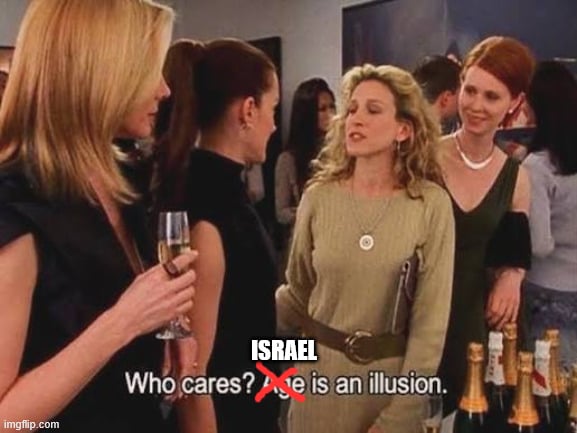
Adapted meme based on a scene from Sex and the City (HBO), included here for cultural commentary.
Boring Australian went on a strange tangent involving anarchy and South African apartheid as I sipped on my mezcal Negroni, making me realize there was no part of me that wanted to be on this date. It wasn’t just the incomprehensible white graphic on his plain black tee shirt. Being someone’s first date after a significant relationship is a heavy cross to bear. Boring and I had matched months earlier, before I had stopped seeing other people. I forced myself to do my eyeliner and get out there, hoping I would remember how to talk to someone who wasn’t the last guy.
I was ten minutes late, which is unlike me. That’s how much I was dreading it. Despite my reluctance, I have to admit I looked good, so I took a few commemorative selfies as if to mark a moment of silence. I was going to look this good to sit across another man.
Sure, there was nothing wrong with Boring. He had a decent job and seemed baseline stable, but that’s when you know you’re not into the guy– when you’re telling yourself he has a decent job. He was a writer who had been working in advertising for the better part of his career.
“Oh, that’s cool. I love advertising.”
“Yeah?”
“Not to brag, but I have seen all of Mad Men.”
He stared at me– unaware of my joke. I bit my tongue and picked up my mezcal Negroni, a drink I shouldn’t have been drinking since I associated it with my last relationship. He would have thought it was funny.
From the moment I saw this guy’s bad tee shirt, I knew I wouldn’t make it past one drink. He was wearing lazy jeans and didn’t offer me a seat. The last guy always put together a good outfit and pulled out my chair. It wasn’t really about fashion or chivalry. It was that every tiny difference feels significant when your brain is busy comparing someone new to someone you’re trying to get over.
As if his lack of knowledge of the song Wonderwall wasn’t enough, as I tried to suggest the conversation away from South Africa and his anarchist friends, Boring asked me, “Have you heard of Greater Israel?”
There it was. The other elephant. The elephant I had been expecting. The Middle East has been present at all of my dates for the past few years. I was more used to Israel at the table than an ex.
On Wednesday, almost half of Democrats in the House voted to eliminate U.S. aid to Israel as a party that struggles to find a distinct voice of opposition grapples with one of the issues dividing its voters. Some supporters of the measure suggested it’s their only way to protest Israel’s actions in Gaza and the West Bank.
Though the measure was eliminated, I couldn’t help but wonder: can it truly be opposition if Israel has expressed interests in changing its dependence on U.S. aid?
For years, Prime Minister Benjamin Netanyahu has argued that Israel should gradually wean itself off American military assistance over the next decade– not because the alliance should end, but because Israel should be able to stand on its own two New Jersey-sized feet.
Everyone seems to be struggling with what to do with Israel, not just the Democrats. Jews are unsure how to invite others into difficult conversations or create empathy for our safety net. American Jewish Organizations spend billions trying to draw lines between opposing policies and opposing the existence of a country. It turns out easier to oppose a foreign government that represents the maladies we see at home, than to unite a party that has become a large tent of leftists, liberals, and moderates under some sort of compromise.
It’s not that I’m against cutting aid to Israel, and it’s not that I’m in favor, though organizations I highly admire such as Israel Policy Forum suggest that the new MOU (Memorandum of Understanding), a geopolitical pinky promise, reflects easing off aid as U.S-Israel relations evolve. What just a year ago may have sent fear down the spines of many may very well be what the healthiest chapter of this relationship looks like. So, if the Israeli government and half of Democrats are so aligned, why does one person’s opposition look so much like another’s independence?
These weren’t things I thought about on my date with Boring. That conversation didn’t get much deeper, probably because the lower my drink got, the larger the elephant of my last relationship became. It was clear we weren’t disagreeing on policy. We were operating from completely different information ecosystems. Don’t get me wrong– the last guy and I disagreed on plenty, but we disagreed by getting curious and asking questions. Boring was more interested in announcing conclusions.
After a meaningful relationship ends, every first date isn’t really one date. It’s two. There’s the person sitting across from you, and there’s the invisible comparison sitting beside them. Back in my car, I texted a quick debrief to a friend. It had been one of the most unmemorable dates I had been on. Then I laughed. The person I really wanted to text was my ex. I wanted to tell him about this horrible date I had gone on because of him. He would have found that funny. I ran through the conversation in my head the whole drive home.
Related Topics
Related Posts