
Middle East Analyst
The Emerging Board of Peace: Invitations, Omissions, and Strategic Hesitation
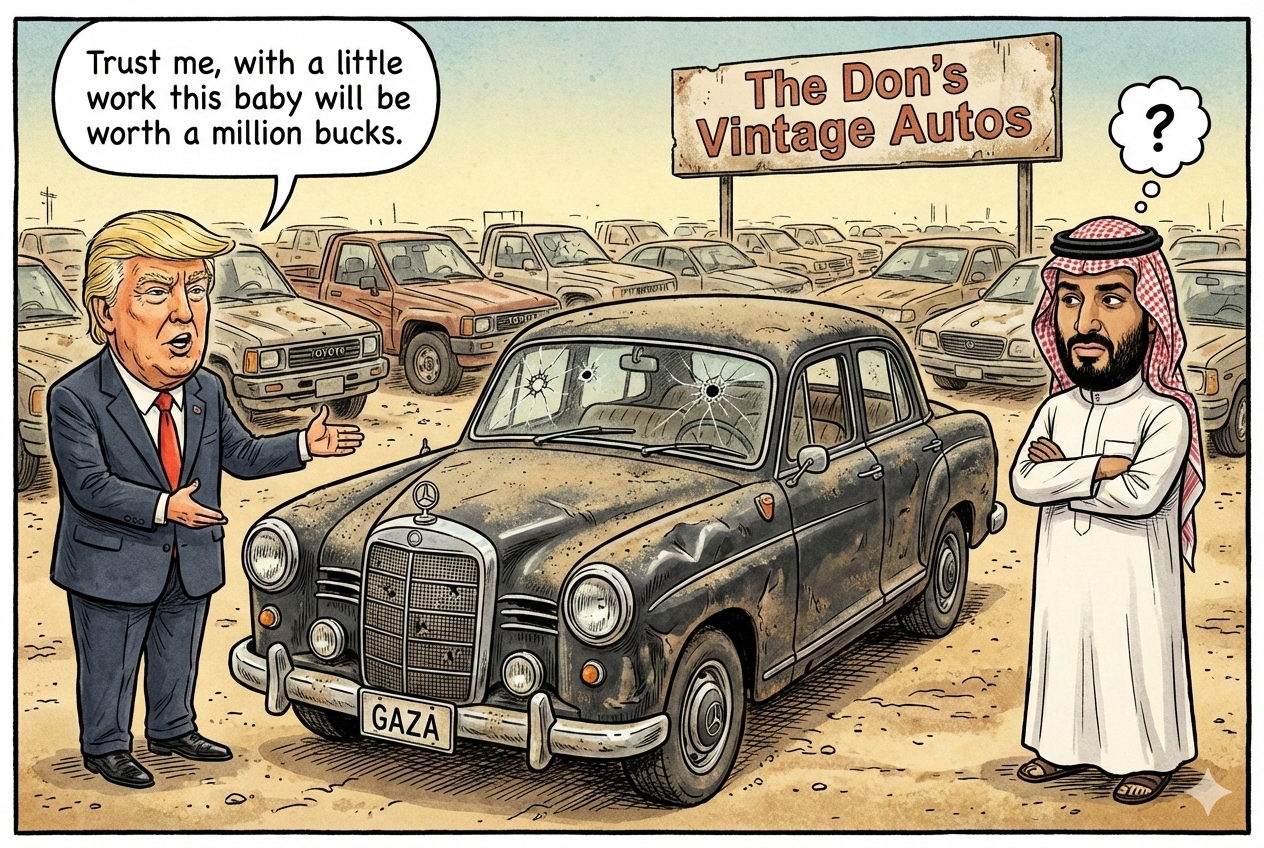
Graphic by author/Nano Banana
Recent reporting by Axios indicates that the Trump administration has issued invitations for a proposed “Board of Peace” to a select group of countries viewed as central to a post-conflict political framework for Gaza. The states cited as likely participants include the United Kingdom, Germany, France, Italy, Egypt, Qatar, Saudi Arabia, and Turkey. The list is broad, geographically diverse, and clearly designed to convey international legitimacy. Yet it is also notable for who is not included. The absence of the United Arab Emirates—a country deeply involved in regional diplomacy and closely aligned with Israel—is striking and likely consequential.
This omission may not be accidental. Even before the board formally exists, the composition under discussion is already shaping expectations, sensitivities, and rivalries. What is emerging is less a settled architecture than a fluid and contested process, one in which invitations, hesitations, and exclusions carry as much meaning as formal commitments.
It is also important to distinguish between joining the Board of Peace and contributing forces to a proposed International Stabilization Force (ISF). These are related but fundamentally different commitments. Participation in the board would allow states to influence the political direction of Gaza’s post-war governance without necessarily placing troops on the ground. Conversely, it remains conceivable—though politically unlikely—that a country could contribute to an ISF without holding a formal seat at the political table. Many states appear to be calibrating their engagement with this distinction in mind, weighing political exposure separately from military or financial risk.
Among the invited states, Saudi Arabia occupies the most pivotal and consequential position. Riyadh’s posture to date appears best described as conditional engagement rather than outright rejection. The first and most immediate Saudi concern is financial and legal risk. Saudi Arabia is widely expected to be a principal donor to any serious reconstruction effort in Gaza, potentially committing tens of billions of dollars over time. That role carries exposure. Recent US actions involving sanctions regimes, asset freezes, and legal assertions in cases such as Venezuela and Cuba—and even more unusual signals related to Greenland—have raised quiet but real concerns about the durability and predictability of US financial stewardship. From Riyadh’s perspective, the question is not only whether Gaza reconstruction is politically desirable, but whether Saudi funds would be legally insulated from shifting US political winds. If those protections are unclear, hesitation is likely. This concern is not uniquely Saudi; any perception that donor funds could become politically vulnerable would chill participation across the broader donor community.
A second Saudi concern relates to the political horizon, particularly the question of Palestinian statehood. Saudi Arabia has repeatedly linked normalization with Israel to a credible and irreversible pathway toward Palestinian statehood. Yet the outlines of a “Phase II” political process remain ambiguous. Key questions are unresolved: whether the Palestinian Authority would be reformed and empowered, replaced by a technocratic body, or sidelined altogether; what territorial or sovereign benchmarks might exist; and whether the process leads anywhere beyond interim arrangements. Joining the Board of Peace without clarity risks placing Saudi Arabia in the position of appearing to endorse a framework that falls short of its publicly articulated red lines.
A third, closely related Saudi concern centers on Turkey’s role in any stabilization force. Riyadh appears sensitive to arrangements in which Israel could effectively veto Turkish participation. From the Saudi vantage point, an ISF that excludes Turkey risks lacking both regional legitimacy and operational credibility. Turkey brings not only military capacity but also political signaling value, particularly in the eyes of Arab and Muslim publics. If Turkey is sidelined, the ISF could be perceived—fairly or not—as an extension of a US–Israel–UAE axis, a configuration that Saudi Arabia views with growing unease.
Turkey itself occupies an ambiguous position. While Axios lists Ankara among likely board participants, US officials have been more circumspect in describing Turkish commitments. Several factors may explain this caution. Israel has reportedly raised objections to Turkish participation in the ISF, citing security concerns and Ankara’s political posture toward Hamas. Turkey, for its part, appears uninterested in symbolic inclusion. Ankara is unlikely to join a board that limits its influence, excludes it from operational roles, or embeds it within a framework that constrains its strategic autonomy. Turkish participation would significantly enhance the perceived legitimacy of both the board and any stabilization force; its absence would weaken them in ways that go beyond troop numbers.
The United Arab Emirates presents a different kind of puzzle. Its absence from the list of likely participants is difficult to ignore given its activism in regional diplomacy. Several explanations are plausible and not mutually exclusive. Washington may be reluctant to formalize Emirati involvement before securing Saudi buy-in, aware of intensifying rivalry between Riyadh and Abu Dhabi. The UAE may prefer to shape outcomes through bilateral channels with Israel rather than through a multilateral body that diffuses influence. Saudi Arabia, for its part, may resist sharing a high-profile platform with the UAE at a moment when Saudi discourse—particularly on social media—has grown increasingly critical of Emirati and Israeli regional behavior. Abu Dhabi itself may be exercising caution, avoiding early visibility that could reinforce regional perceptions of Emirati overreach.
Israel’s position reflects two competing impulses: maintaining maximum control over Gaza’s post-war trajectory while avoiding political processes that could accelerate Palestinian statehood. Israeli leaders have signaled resistance to moving into Phase II before all hostages are returned and Hamas is fully dismantled. If the United States proceeds despite Israeli reservations, it may indicate a willingness to assert primacy over sequencing—an approach that could reshape Israeli calculations but also introduce friction. Israel is unlikely to openly oppose US plans, yet it retains indirect means of influencing outcomes. Disruptions to reconstruction logistics, particularly along Red Sea and Bab El-Mandeb routes, could occur through permissive environments or proxy dynamics rather than overt action, complicating implementation without direct confrontation.
Within this landscape, Turkey’s role emerges as a hinge variable for three critical actors: Saudi Arabia, the UAE, and Israel. Saudi Arabia appears to view Turkish participation as central to legitimacy and effectiveness. The UAE sees Turkey as a rival whose influence should be constrained. Israel views Turkey primarily through a security lens and seeks to limit its role. Until this question is resolved, each of these states is likely to continue hedging rather than committing.
The broader picture that emerges is one of strategic hesitation rather than outright rejection. Saudi Arabia remains engaged but conditional. Turkey is invited but unconvinced. The UAE is conspicuously absent but not disengaged. Israel is resisting timing and scope rather than the concept itself. The Board of Peace is being assembled in real time, amid unresolved questions of trust, sequencing, and authority. Whether it becomes a meaningful instrument or a largely symbolic forum will depend less on formal invitations than on whether these underlying tensions can be reconciled into a coherent and credible framework.
Related Topics
Related Posts