The Growing Threat of Disinformation and Information Warfare Against Somaliland
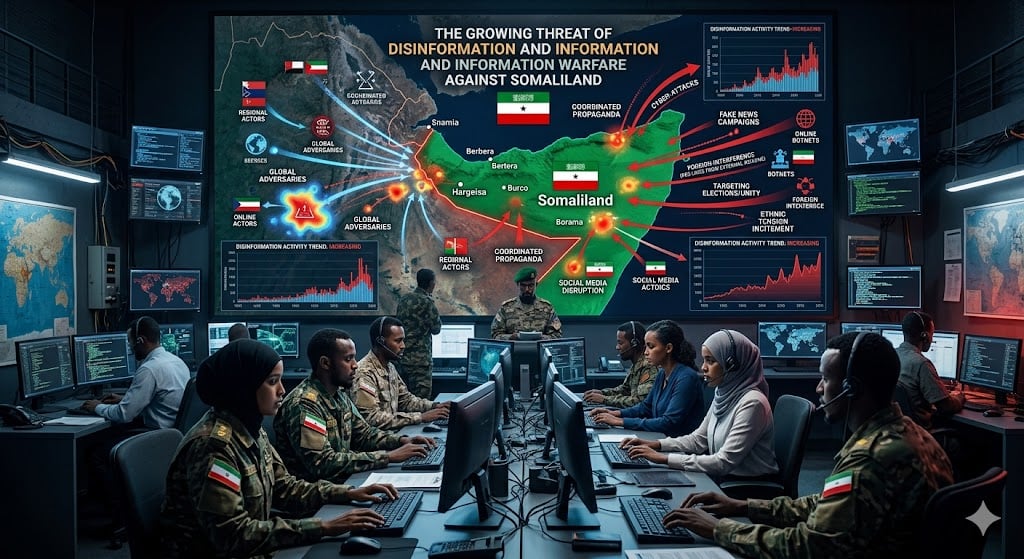
In today’s interconnected world, information has become one of the most powerful tools shaping public opinion, political decisions, and international relations. While technology and digital communication have created unprecedented opportunities for knowledge sharing and global engagement, they have also opened the door to a dangerous phenomenon: disinformation and information warfare. For Somaliland, a nation striving for peace, democracy, and international recognition, this challenge is becoming increasingly significant.
Understanding the New Battlefield
Traditionally, conflicts were fought with military force, economic sanctions, or diplomatic pressure. Today, however, battles are increasingly being waged in the digital sphere. Information warfare involves the deliberate use of false, misleading, or manipulated information to influence perceptions, create confusion, undermine institutions, and weaken public trust.
Disinformation differs from misinformation in one important aspect. Misinformation may be shared unintentionally by individuals who believe it to be true, while disinformation is intentionally created and distributed to deceive audiences and achieve political, economic, or strategic objectives.
For Somaliland, the spread of false narratives through social media platforms, online news outlets, and coordinated digital campaigns presents a growing threat to social cohesion, democratic governance, and international image.
Why Somaliland Is Vulnerable
Somaliland has achieved remarkable progress since reclaiming its sovereignty in 1991. Through locally driven peacebuilding, democratic elections, and relatively stable governance, it has built institutions that many conflict-affected regions aspire to emulate.
However, this progress has also attracted criticism and opposition from various actors with competing political interests. In recent years, online spaces have become increasingly saturated with misleading narratives targeting Somaliland’s political legitimacy, security institutions, economic prospects, and diplomatic engagements.
Several factors contribute to this vulnerability:
- Rapid growth of social media usage.
- Limited digital literacy among segments of the population.
- The speed at which false information spreads online.
- Difficulty in verifying sources.
- Increasing use of anonymous accounts and coordinated propaganda networks.
These factors create an environment where fabricated stories can quickly gain traction before facts have a chance to emerge.
The Impact on Society
The consequences of disinformation extend far beyond online debates. False information can deepen social divisions, fuel mistrust among communities, and undermine confidence in public institutions.
When citizens are repeatedly exposed to conflicting narratives, uncertainty begins to replace trust. This can weaken national unity and make it more difficult for governments, civil society organizations, and community leaders to address genuine challenges.
Moreover, disinformation campaigns often exploit sensitive issues such as clan relations, elections, security incidents, and diplomatic developments. By manipulating public emotions, hostile actors can create unnecessary tensions and distract attention from national priorities.
The International Dimension
Information warfare is not only directed at domestic audiences. It is increasingly used to influence international perceptions.
For Somaliland, global recognition remains one of the most important foreign policy objectives. Therefore, narratives circulating internationally can significantly affect how foreign governments, international organizations, investors, and development partners perceive the country.
Negative or misleading portrayals can overshadow Somaliland’s democratic achievements, economic potential, and contributions to regional stability. In some cases, strategic disinformation campaigns seek to shape international discourse by promoting distorted interpretations of political developments or security situations.
As a result, safeguarding Somaliland’s reputation requires not only traditional diplomacy but also proactive engagement in the digital information environment.
Social Media: Opportunity and Risk
Social media platforms have empowered ordinary citizens to participate in public discourse, share information, and hold institutions accountable. This represents a positive development for democratic societies.
However, the same platforms can also become vehicles for misinformation. Algorithms often prioritize content that generates strong emotional reactions, regardless of its accuracy. Sensational headlines, manipulated videos, and misleading posts can therefore spread rapidly and reach thousands of users within minutes.
The challenge is not the technology itself but how it is used. Responsible digital citizenship is becoming as important as traditional civic responsibility.
Building Resilience Against Disinformation
Combating information warfare requires a comprehensive and coordinated approach involving government institutions, media organizations, educational institutions, civil society groups, and citizens.
Several measures can strengthen Somaliland’s resilience:
First, promote media and digital literacy programs that help citizens identify unreliable sources and verify information before sharing it.
Second, strengthen professional journalism by supporting fact-checking initiatives, ethical reporting standards, and independent media institutions.
Third, improve strategic communication by ensuring that public institutions provide timely, accurate, and transparent information during critical events.
Fourth, encourage collaboration between government agencies, civil society, and technology platforms to address coordinated disinformation campaigns.
Fifth, invest in research and monitoring mechanisms that can identify emerging information threats and provide evidence-based responses.
The Role of Citizens
Every citizen has a responsibility in protecting the integrity of the information environment. Before sharing news, videos, or social media posts, individuals should ask simple but important questions:
- Is the source credible?
- Can the information be verified?
- Does the content appear designed to provoke anger or fear?
- Have reputable media outlets reported the same story?
A society that values critical thinking becomes far less vulnerable to manipulation.
Conclusion
The struggle against disinformation and information warfare is one of the defining challenges of the twenty-first century. For Somaliland, the stakes are particularly high. False narratives can undermine national unity, damage international reputation, and weaken public trust in institutions.
Yet Somaliland’s greatest strength has always been the resilience and wisdom of its people. By promoting media literacy, strengthening responsible journalism, supporting transparent governance, and encouraging critical thinking, Somaliland can successfully confront the growing threat of information warfare.
The future will belong not only to those who control information but also to those who can distinguish truth from falsehood. In that regard, protecting the integrity of information is not merely a technological challenge; it is a national responsibility.