The Houthis Just Set Up Israel’s Checkmate. Here’s the Move.
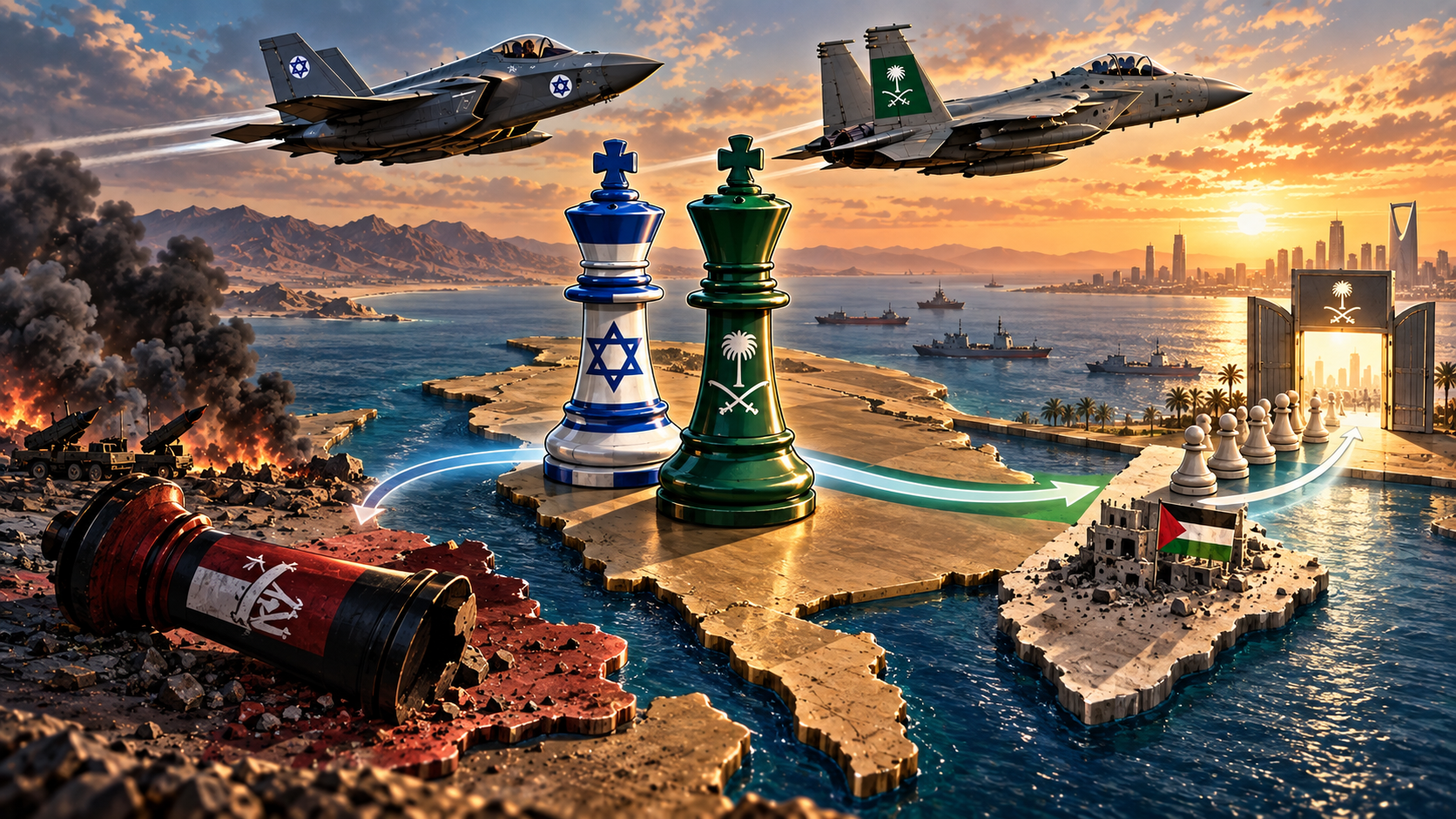
Israel helps Saudi Arabia in Yemen. Saudi Arabia recognizes Israel, opens its doors to Gazans, and declares the conflict over.
Earlier this month, Houthi missiles and drones hit southwestern Saudi Arabia. Dozens of civilians were wounded and energy facilities went offline. A few days later, Houthi fighters were in the port city of Mocha and on the Hanish islands, a short sail from the Bab al-Mandeb at the southern end of the Red Sea.
Israelis know this enemy well. The Saudis are now finding out what it means to face it on their own.
The timing is terrible for Riyadh. Iran is squeezing the Strait of Hormuz, so the Kingdom has been pushing far more of its oil out through the Red Sea. Saudi crude exports through the Bab al-Mandeb this year have run at many times last year’s levels. If the Houthis can threaten that route, they can threaten the Saudi economy.
Saudi Arabia’s biggest problem right now isn’t the Palestinian issue. It’s Yemen. And the country with the most recent and most relevant experience fighting the Houthis is Israel.
Israel should recognize that as leverage and use it. I’m not talking about a partial normalization or a statement of principles. I’m talking about a deal that actually ends this.
What Israel can offer
Since October 2023 the Houthis have fired hundreds of missiles and drones at Israel. Israel has shot them down, hit the port of Hodeidah, the Sanaa airport and the Houthi power grid, and gone after the group’s senior leadership. After three years of this, Israeli intelligence has a detailed picture of where the Houthis launch from, how they are supplied, and how Iran rearms them.
Saudi Arabia has an air force and deep pockets. What it hasn’t had in a decade of fighting is a way to win. Its new defense agreement with Turkey and Pakistan brings manpower, but not the kind of targeting intelligence and missile defense this war requires. Washington has its hands full with Iran. Israel is already fighting the Houthis anyway.
So Israel should put a concrete offer on the table: intelligence sharing on Houthi and Iranian assets in Yemen, cooperation on air and missile defense, coordination on Red Sea security, and Israeli strikes where Riyadh wants them.
In return, Israel should ask for three things.
1. Full recognition
Embassies, direct flights, trade, and a signed peace treaty. Both sides can present it for what it is, which is an agreement between two countries with a common enemy.
2. Permanent residency in Saudi Arabia for Gazans who want it
This is the most important part, and it’s where Saudi Arabia could do something no Arab country has done since 1948: actually help Palestinians build new lives instead of keeping them in limbo.
Gaza has been flattened. Even the hopeful reconstruction estimates run ten years or more. Two million people are being asked to live in tents and wait.
Saudi Arabia should offer permanent residency to any Gazan family that wants it, with real benefits and real opportunities. That means the right to live and work in the Kingdom permanently, help with housing, healthcare, schools for the kids, and the ability to open a business. The Kingdom already grants long-term and permanent status to foreigners through its Premium Residency program, so the legal machinery exists. So does the need. Vision 2030 requires a huge workforce, and Saudi Arabia already has more than 13 million foreign residents. Some of the money the Gulf states have pledged for Gaza reconstruction could fund the program, and Saudi security services would vet every applicant for ties to Hamas or other armed groups.
For 78 years, Arab governments have kept Palestinian refugees in camps. In Lebanon they are still shut out of many professions. Elsewhere they have lived on UNRWA handouts for generations. Keeping them there was a political choice, meant as a permanent argument against Israel. Permanent status, a job and an apartment in the richest country in the region would be more than most of them have ever been offered.
This is how refugee crises have ended elsewhere. People got to start over. Israel did exactly that with the roughly 850,000 Jews who left or were driven out of Arab countries after 1948.
The Saudis could say, and it would be true, that they did more for ordinary Palestinians than any Arab government before them. It would also take much of the air out of the “right of return,” a demand that no Israeli government of any stripe is going to accept.
3. A public call from the Crown Prince
The Saudi king holds the title Custodian of the Two Holy Mosques. In the Sunni world, nothing carries more religious and political weight. When Mohammed bin Salman signs the treaty, he should call on every Muslim country to recognize Israel, and he should say plainly that with Gazans given a future, the Arab-Israeli conflict is over.
Sadat’s visit to Jerusalem made peace with Egypt possible. The Abraham Accords showed that Arab states could make peace with Israel and nothing collapsed. A call from Riyadh would go further, because it would take away the religious cover that rejectionists have relied on for decades. Plenty of countries would hold out at first. But over time, refusing to recognize Israel would start to look like the odd position.
Who comes out ahead
Saudi Arabia gets real help in Yemen, the civilian nuclear agreement that Washington has now tied to recognizing Israel, and a place in history. Israel gets recognition from the most important Arab and Muslim country and a realistic path to the rest. Gazans get a choice they have never had. Iran loses ground in Yemen and loses the grievance it has exploited for decades.
The obvious objections
Isn’t this forced transfer? No. Nobody is forced to go anywhere. A family that wants to stay in Gaza stays. A family that wants permanent residency, a steady income and good schools in Riyadh can take it. The whole idea depends on people choosing it.
Hasn’t Riyadh said it needs a Palestinian state first? Yes, many times. But the Saudi leadership is pragmatic. A flag over a destroyed strip of land controlled by armed groups doesn’t do more for Palestinian families than a safe home, a job and a good school. Riyadh has room to redefine what solving the Palestinian problem looks like, and this version would give it far more to point to.
What if Gazans don’t want to go? Then they don’t go, and the offer stays open. But anyone who watched the crowds at the Rafah crossing over the past three years knows a lot of people would take a decent way out.
Why now
This opportunity won’t last. Saudi Arabia needs help right now. Washington has linked its biggest agreement with Riyadh to recognition of Israel. Iran and its proxies are weaker than they have been in decades. A year from now, the Houthis may be contained or dug in, and Israel’s leverage will be gone.
Israel should make this offer in public, spell it out, and set a deadline. Help in Yemen, in exchange for recognition, permanent Saudi residency for Gazan families who want it, and a call from the Custodian of the Two Holy Mosques declaring the conflict over.
We have been told for years that the way to Riyadh goes through Ramallah. Right now it goes through Yemen. This is the move that ends the game, and Israel should make it.