Journalist, Musician, Poet
The Intersection of Megalomania and Victimhood
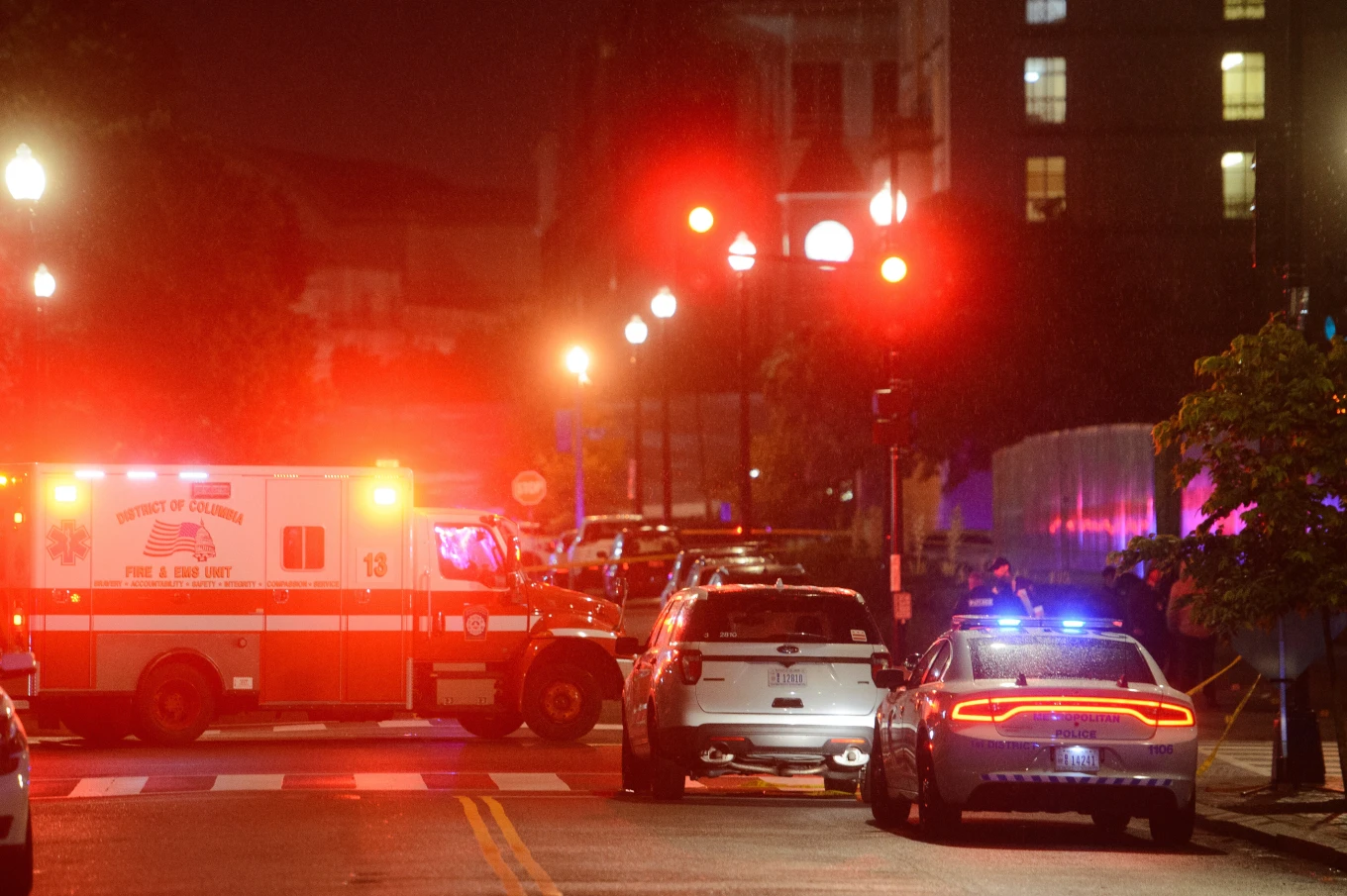
Law enforcement work the scene after two staff members of the Israeli Embassy in Washington were shot and killed outside the Capital Jewish Museum, Thursday, May 22, 2025, in Washington. (AP Photo/Rod Lamkey, Jr.)
The D.C. shootings, what sparked them, psychological insights into the alleged ‘manifesto’, the shooter’s politics, and what the Jewish-Marxist tradition taught us about antisemitism.
* * *
The late secular Jew Christopher Hitchens once remarked that, after traveling the world and reporting from various war zones, he eventually became accustomed to the sight of burning buildings and other common consequences of conflict. One grew used to it on a weekly basis, he would explain. After the pogrom of October 2023 and the sick games that have been played with hostages ever since, alongside the additional violence by freelance jihadists and ultra-leftists around the world that have also followed, a frustrating numbness settles-in for many when attacks like those of May 21 get reported.
In the wake of the overkill-style ambush murders of Israeli diplomats near the United States Capitol, the consensus among Israel’s friends is that we all knew something like this was bound to happen. The only uncertainty was when and where. Though our hearts and Kaddish this past Shabbat were directed toward their memory, it’s helpful now to separate our individual righteous anger from our cold, sober-minded political analysis.
Placing the events within the broader context of the ongoing war, it appears possible—though not yet legally confirmed—that this was an attempt to assassinate foreign diplomats, in order to alter the military or political situation on the ground. Whether the attacker deliberately targeted Yaron Lischinsky (30) and Sarah Milgrim (26), of blessed memory, remains to be seen.
In any event, the killing of diplomats which is a not too-common occurrence in global conflict signifies the entering of a new phase. While some dub this new period as the eighth front, I always thought that opened up in the opening seconds and hours of the invasion, with anti-Israel riots worldwide. At any rate, the act was a desperate expression of hatred and mania in defense of one side in a war that is bound to lose.
* * *
Let’s begin by recalling recent developments, because they provide the context here. What’s been happening the past few weeks in this war against Hamas? U.S. President Donald Trump completed a major tour of the Middle East, with expansion of the Abraham Accords a key topic. Meanwhile, the Iranian regime grows increasingly isolated, their regional allies dead or weakened, their strategic position more claustrophobic by the day. While the precise trajectory remains uncertain, what is undeniable is that generational, transformational change is underway in the region. Hamas has been decimated—and continues to be—as Israeli Defense Forces escalate operations once more.
Predictably, the usual suspects have amplified the libel that the IDF “deliberately” targets civilians. The global propaganda cycle churns on—frantic footage of chaos and bloodshed sent out to tens of millions through highly inflammatory ten-second clips, around the clock. It’s easy to see how this constant exposure begins to shape minds. The propaganda makes sense — at least in terms of the tragic consequences it inspires. Those consequences manifested at the Jewish Museum in Washington, D.C., and in other anti-Jewish and anti-Israeli attacks around the world—from Amsterdam to New York.
The chants and slogans of the last two years have proven tailor-made to attract the mentally unstable, the politically disoriented, the rage-filled individual seeking a scapegoat. Having personally confronted such individuals in south Texas — even getting into physical altercations — I can attest that when someone screams “Free Palestine” in my face, it feels eerily similar to standing in front of someone in the midst of a psychotic break, usually outside a gas station late at night. Then again, if you’re funding this hatred from afar and don’t wish to get your hands dirty, these are the kinds of societal elements you hope to attract and manipulate. And they have been.
U.S. and international media reports say the assailant came from a middle-class background in Chicago, earning an arts degree from a state university. His resume followed the familiar path of a leftist activist: working for “social justice”-oriented nonprofits and other activist circles. He was spotted at protests in Chicago as early as 2017 — including one outside then-Mayor Rahm Emanuel’s home, opposing the opening of an Amazon fulfillment center. His social media history further confirms his profile: a political activist seemingly radicalized by pro-Hamas content in the wake of the October 7 invasion of Israel.
Notice how many of these so-called “lone wolves” always seem to emerge from the middle classes. You never hear about an oilfield hand, a cafeteria worker, or a truck driver committing these atrocities. These tendencies of politically-motivated terrorism tends to be most prevalent within the middle-classes or those who no longer can be middle-class.
* * *
We still lack definitive confirmation, but a so-called manifesto has surfaced online, allegedly authored by the suspect. Whether or not it is genuine remains to be established.
Still, a brief look at the text can offer insight into the kind of worldview that may have fueled this violence. From the outset, the author displays narcissistic tendencies, indulging in lofty jargon and pseudo-intellectual grand analogies. It quickly becomes apparent that he likely consumed vast amounts of online propaganda — the endless “casualty porn” churned out on Instagram and TikTok. As the text states:
“The atrocities committed by Israelis against Palestine defy description and defy quantification. Instead of reading descriptions mostly we watch them unfold on video, sometimes live.”
A stunning admission, if true, of obsessive consumption of Hamas propaganda.
The statement then proceeds to cite figures from the so-called “Gaza Health Ministry” as though quoting gospel.
Oddly, there is no mention of recent Gaza-based protests (see my piece from last week, The Other Intifada). Was he unaware of them? Or was this omission intentional?
As the statement continues, the writer’s fractured psyche becomes clearer. There is a disturbing sadomasochism in the line: “We who let this happen will never deserve the Palestinians’ forgiveness. They’ve let us know as much.”
This is classic self-flagellation — a performative cry for punishment. Then there’s the confused use of “we” throughout the letter, as though he could not distinguish between himself and the actions of nation-states.
In psychological terms, this looks like a case of “identity disturbance.” That’s the inability to distinguish oneself from larger systems, coupled with delusions of grandeur and a disconnection from reality. The writer sees himself as partially responsible for U.S. foreign policy, a belief fused with megalomania and masochism.
The letter veers into a tangent about an alleged episode in Guatemala during a period of civil conflict and another episode involving an assassination attempt against former U.S. Secretary of State Robert McNamara.
It ends, amazingly, by claiming to serve as an arbiter of sanity. The writer insists that while such violence may have once been “illegible,” it is now “legible.” In the final line, the impending acts it says are “in some funny way, the only sane thing to do.”
It’s amusing, is it not, when the unwell declare themselves guardians of reason — especially after committing cold-blooded double homicide. That last line above underscores the dehumanization of Lischinsky and Milgrim, reduced to pawns in his “funny” game.
Although the killer may be psychologically disturbed, he is by no means so psychotic to the point where he is not compos mentis. According to witnesses at the scene, amidst the chaos, the shooter ingratiated himself among other shocked and afraid bystanders. They had no idea he was the assailant. He held his cover until police arrived and finished the final and perhaps most psychologically important part of his hell on Broadway type skit—removing a keffiyeh from his back pocket and shouting today’s equivalent of ‘Heil Hitler.’
This little act following the double-murder strongly suggests forethought and awareness of what was happening and what he was doing. While many mental illnesses may possess some genetic and other uncontrollable factors, refusing to get help and doubling down on your delusions is a personal choice.
Again, we do not yet know for certain whether this letter was written by the suspect now in custody. That distinction is vital, as we continue to make sense of nonsense and the senseless. Transparency from the courts and law enforcement agencies will therefore also be essential, moving forward, if we the public are to fully understand all the facts.
Either way, we know this individual was unwell, particularly if this manifesto proves authentic. We know he held warped political views. We also know he had some tangential, if only temporary and long severed, connections to Stalinist-aligned political groups such as the Party for Socialism and Liberation (PSL) and the ANSWER Coalition (AC).
* * *
The PSL is a splinter group from the Workers World Party (WWP), itself a breakaway from the Trotskyist Socialist Workers Party (SWP) of the 1950s. The WWP split from the SWP in 1956, in support of the Soviet invasion of Hungary — a foundational moment that signals their alignment with Stalinist politics.
ANSWER, for its part, is widely considered a front for the WWP, staffed by many who left to help build the PSL. One such figure, Eugene Puryear, made headlines on October 8, 2023, when he said at a rally in New York:
“And as you might have seen, there was some sort of rave or desert party where they were having a great time, until the resistance came in electrified hang gliders and took at least several dozen hipsters, and I’m sure they’re doing very fine despite what the New York Post says.“
His comments drew cheers from the crowd — a chilling moment that speaks volumes. In my mind, those comments inaugurated the current era we are now in.
The ANSWER Coalition’s history is long and dubious. Fronted in the early 2000s by former U.S. Attorney General Ramsey Clark, it defended Saddam Hussein before and after his downfall. Clark even served on Hussein’s legal team. ANSWER and its allies supported the post-invasion Baathist-Jihadist military alliance in Iraq — euphemistically called an “insurgency” by much of the press.
That the assailant’s father was an Iraq War veteran further suggests the depth of these episodes on his development.
* * *
Antisemitism, as we use the term today, emerged in the 1870s amid pogroms in Czarist Russia and rising official discrimination in parts of Western Europe, most famously during the Dreyfus Affair. Marxist thinkers of the late 19th and early 20th centuries observed that this wave of antisemitism surged alongside economic crises that would culminate in two world wars and the Holocaust.
During the revolutionary period in Russia (1905–1917), antisemitism was weaponized by the last Russian Czar in an effort to stave off social upheaval. Anti-Jewish propaganda particularly targeted Bolshevik leader Leon Trotsky, born Lev Davidovich Bronstein to Jewish farmers in the Ukrainian Pale of Settlement. But the Bolsheviks, under Lenin’s leadership, fought to inoculate the working class against such scapegoating. They countered the czarist incitement with political education and agitation aimed at uniting workers across religious and ethnic lines. With the Bolshevik victory, the czarist pogroms that had haunted generations of Jews—including Golda Meir’s family—were brought to an end.
A renaissance of Yiddish literature and theater emerged under Lenin’s policy of national self-determination, giving rise to both a cultural revival and new political capacities that would later contribute to the founding of Israel. After his exile by Stalin, Trotsky continued to warn of the fascist threat well before Western leaders finally dropped Franco and company. In Fascism: What It Is and How to Fight It, he analyzed fascism as a mass movement rooted in the petty bourgeoisie. A principled opposition to antisemitism remained central to the program Trotsky and his followers championed in the lead-up to World War II.
One of those followers was Abram Leon, born Abram Wajnsztok in 1918 Warsaw. Raised in a Zionist household and briefly relocated to Palestine, Leon returned to Europe and joined the left-wing Zionist youth movement Hashomer Hatzair. In Belgium, he encountered Trotskyist speakers and was won to Marxism by the late 1930s. He soon joined the Belgian section of the Fourth International, organizing clandestine resistance and writing anti-Nazi materials across occupied Europe. During this time, Leon authored a groundbreaking manuscript: a materialist history of the Jewish people that rejected religious frameworks.
In The Jewish Question: A Marxist Interpretation, Leon traced the development of Jewish communities as a social class throughout antiquity and into the capitalist era. He argued that modern antisemitism arose because capitalist society failed to economically integrate Jews, many of whom had been merchants and moneylenders under feudal regimes. As their social function became obsolete under industrial capitalism, Jewish communities became targets—culminating in the genocide we now know as the Holocaust.
Leon was arrested in Belgium in 1944 by the Gestapo. Though born in Warsaw, his final destination was Auschwitz. As a Jewish Marxist revolutionary, he was murdered in a gas chamber at the age of 26. He stands with the D.C. victims as a reminder of what young people can achieve during brief lifespans.
This tradition of Marxist opposition to antisemitism, unlike the Stalinist variant which often embraced it and whose descendants continue embracing it, lives on today in groups like the U.S. Socialist Workers Party. The SWP and its sister parties worldwide have supported Israel’s right to exist since the outbreak of the current war, and its campaign to defeat Hamas, earning them criticism from political circles with whom the assailant sympathizes. But the SWP does not back down.
They say antisemitism is not eternal, that it’s historically produced, a byproduct of capitalist rule that had a beginning. And because it had a beginning within human history, like the advent of class rule, it will also have an ending.
Related Topics
Related Posts