The Longer Repair
There is a midrash that says the Israelites fell asleep the night before they received Torah at Sinai. They had been waiting, and they were tired, and so they slept. In the morning God had to wake them. Tikkun Leil Shavuot is the Jewish tradition that grew up around that story. We stay up through the night of Shavuot, learning until dawn, as a way of correcting what happened at the foot of the mountain. We will not sleep through revelation again. We will be awake when it comes.
I think about what it means to do that with fifty teenagers and tweens in the Bronx at midnight. This year, I watched it happen.
The night began with ice cream sundaes and a question I put to the room: how do you build a container strong enough to hold something that matters, so that some part of it finds you later, on an ordinary day, in a moment you didn’t see coming? Then the learning began — teachers taught about what it means to have a “why” in Jewish life, about ayin tovah and seeing the world generously, about the way Ruth walked toward belonging with her whole body, about why counting the omer is a mitzvah that requires us together. The rooms were just for teachers and kids, no other adults, and at one point I stopped outside a doorway and saw my daughter, who is ten, sitting among the tweens, leaning forward slightly as she answered a question. I could not hear what she said, but I felt the energy of that moment reverberate deep in my bones.
This is the thing about staying up all night with people. Something loosens gradually, the performing stops, and the version of yourself you brought through the door starts to give way to something less managed. By midnight the floor already felt different. There were sweatshirts abandoned over chairs, empty seltzer cans gathered in corners, kids who had arrived as strangers now arguing about board game rules with the comfort of people who have known each other for years.
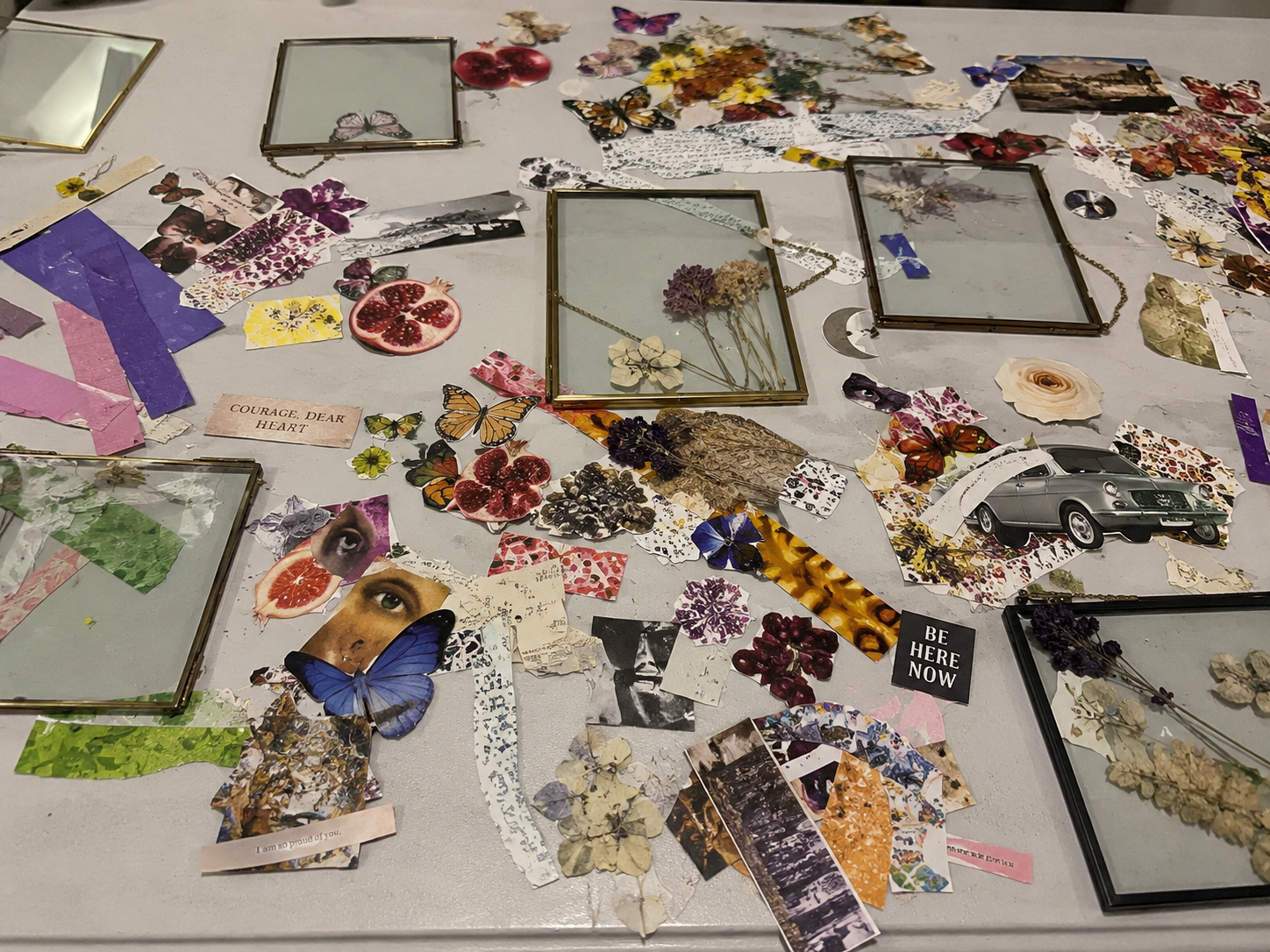
At midnight, there were images of butterflies, and fruit, and cars, and faces of strangers on a small round table in the center of the room. Strips of patterned paper wove between the images. Devon, a local Bronx artist, had laid it all out and I gave the prompt: inside a 5×7 paper frame, using only what you find here, tell the story of being Jewish right now, in this moment. Devon taught the art, and I gave the framing.
One of the girls showed me her finished frame. Inside it, strips of colored paper arranged into something she had made entirely her own. She looked at me and said: this is the moment I received Torah.
Sometime after that I dragged an armchair to the middle of the room and the “ask the rabbi” circle formed around it. This is my first year as a rabbi. A tween with dark eyes asked me why I wanted to become a rabbi. I answered. Then someone asked what I thought about the fact that other religions have other gods — and had I ever wondered if Hashem really is the one. The board game quieted. The volleyball game in the next room paused. One of the girls suddenly realized that I had taught her how to dance Zumba, when she was 4.
The questions kept coming. Do you think God gets angry? Can someone belong if they don’t believe everything? Do you ever doubt? One kid asked his questions so quietly that I had to lean in to hear him. Nobody laughed at anyone’s question, and everyone had space in the room. The girls who giggled their way through the first couple of sessions were now turned towards the center of the circle — listening, absorbing, containing.
At 3:15am about ten kids were still there. Tweens and teens from age ten to eighteen split into two teams of five for a Torah trivia game show with prizes. Something shifted the moment the teams formed. Kids who had orbited each other all night were suddenly leaning in together, pooling what they knew, arguing in urgent whispers about the right answer. A ten-year-old turned to a seventeen-year-old with complete confidence and the seventeen-year-old turned back with equal seriousness and somewhere in that exchange the distance between them collapsed entirely.
The next morning I was back in shul running programming for the little ones when parents started finding me . One parent told me her daughter had said it was one of the best Jewish experiences she’d ever had. Another told me his son, who had been reluctant to go, had asked when we were doing it again.
These tweens and teens came from all over — different day schools, public schools, complicated histories with Jewish learning, some brought by parents who had requested special permission for their children to join a night designed for slightly older students. They came. They stayed. They sat with enormous questions at midnight and made things with their hands and leaned toward each other at 3am over Torah trivia like it mattered, because it did. A kid finds a question that has been waiting for them. They stay long enough to sit inside it. They walk back out into the world carrying something — into their schools, their friendships, their sense of what being Jewish means and why it matters. When that happens, they leave with a why. And a person who knows their why walks back out into the world with their feet under them, standing a little more fully in who they are.
The Israelites fell asleep the night before Sinai. We stayed up — and a girl made something out of colored paper and called it the moment she received Torah.