
The road to Tehran’s downfall runs through Beirut
Back in March, it was not uncommon to hear confident – even euphoric – predictions that regime change in Iran was imminent. But these predictions ceased by April, and by now, President Trump claims that regime change was never his objective.
However, Israeli leaders – and in particular both retired Mossad director David Barnea and his replacement Roman Gofman – have not given up hope for regime change. Both Barnea and Gofman regard the replacement of the dictatorship in Tehran with a liberal pro-Western regime as both feasible and of the utmost importance.
I believe that Barnea and Gofman are right in their assessment, but it was never going to be easy. There is only one way to topple the Iranian regime. What is required is a “Color Revolution,” where mass protests and demonstrations lead to a regime’s collapse.
Color revolutions succeeded in Eastern Europe, and the Iranian Revolution of 1979 was itself a color revolution. That said, the “Arab Spring” and the mass street protests earlier this year in Iran were also color revolutions – and all of those failed.
The psychology of regime change
What differentiates successful color revolutions from those that fail? Counter-intuitively, the key to these “people power” movements is not the people, but the security forces. If the security forces refrain from firing on protestors when they fill the streets, a color revolution will be successful. If, however, security forces remain loyal to the regime, a color revolution will fail.
The obvious problem is that it is very difficult to convince security forces – particularly forces motivated by intense ideological conviction – that they should change sides. The only way to do so is to induce a profound sense of what psychologists call “cognitive dissonance.”
Cognitive dissonance is induced when humans identify a discrepancy between their beliefs and their perception of reality. According to those who research such matters, people literally cannot tolerate the sensation that cognitive dissonance engenders and will do anything to restore a sense of consonance between their perceptions and their beliefs.
Now, clearly, there are only two ways for a human being to ameliorate cognitive dissonance. Either they are going to have to change their perceptions, or they are going to have to change their beliefs. But which path will a person choose?
Obviously, that depends on the person, but in general, people would much rather change their perceptions than contemplate even the smallest change in the things that they believe. After all, your beliefs are an important part of who and what you are—central components of your identity. Your perceptions, however, are merely a part of what you think everything else is. By definition, those things are peripheral rather than central.
Manipulating perceptions rather than beliefs, however, can only work up to a point. If the gap between what is truly real and your perception of that reality grows too large, it becomes prohibitively expensive to maintain your illusions.
As an (admittedly comic) example, say that preservation of your ideological beliefs requires that you determine that the black swan you see in front of you is actually white. You can probably do that.
But what if your ideology requires you to determine that the black swan is actually an alien life-form that has traveled to Earth to confer upon you an honorary doctorate in cultural anthropology from a storied interdimensional academic institution that recently lost its accreditation due to a cheating scandal? Most people are simply unable to drink that much Kool-Aid in one gulp. As a result, it’s the beliefs rather than the perceptions that will be jettisoned.
This then is the challenge facing any Israeli attempt to topple the Islamic Republic. The campaign must induce a sense of cognitive dissonance so profound among the rank-and-file members of the IRGC and the Basij that they literally change their beliefs and decide that they now support the exact opposite of what they supported the day before.
This will be hard. But it is not impossible.
Humiliating setbacks
It helps that the Iranian regime has been its own worst enemy, conveniently engineering economic and environmental crises that undermine confidence in its leadership.
Furthermore, Iran has sustained a number of strategic setbacks over the past few years that have frustrated the Islamic Republic’s vision of dominating the region. Amongst the most important of these were the collapse of the Assad regime in Syria, the killing of Hassan Nasrallah and most of Hezbollah’s senior leadership on September 27, 2024, and the destruction of Iran’s nuclear program during the “12-Day War” of 2025.
But above all, humiliation is something that no dictatorship can ever afford. People are just not willing to fight and die in defense of Bozo the Clown, and Israel has inflicted some blows that have made the Iranian regime appear – in a very literal sense – ridiculous. These include September 2024 pager/radio attacks on Hezbollah, the targeted killing of Hamas’s Ismail Haniya in downtown Tehran, and the failure of the Iranian missile/drone attack of April 13, 2024, that was launched with considerable fanfare but inflicted no material damage on Israel.
The initial phase of the most recent war further undermined the authority of the Iranian regime. The regime’s “supreme leader” was killed in the opening attack, and that was followed up with relentless Israeli strikes on street-level security forces – claiming a reported 5000 enemy lives.
Reports suggest that much of the intelligence that Israel was using in its targeting was being received from social media tip-offs being provided by Iranian protestors. For the Basij’s bully boys – who signed up to impress girls, get into university, or snag a cushy government job – this is the kind of experience that can cause a personal rethink of beliefs and priorities.
Had the US and Israel stayed the course, continued their campaign, and focused on targeting the internal security forces, it was quite likely the Iranian regime would have collapsed in a color revolution.
Unfortunately, the ill-advised agreement between the US and Iran constitutes a serious setback. The agreement allows Iran to redefine the narrative surrounding its military failures. Rather than appearing to be “the gang that couldn’t shoot straight,” the story that the regime is circulating is that Iran took on the vastly stronger United States and won despite all odds, leading the Americans to accept a humiliating capitulation to all Iranian demands.
To reinforce this narrative, the Iranians are continuing to harass shipping in the Hormuz while bullying American allies in the Persian Gulf, creating the appearance that it is the Americans and not the Iranians who are in retreat.
This narrative will inevitably bolster the morale of the Iranian regime’s security forces. And it is an easy narrative to promote because, frankly, it isn’t far from the truth.
So the question is whether Israel can regain the initiative and press on with a campaign to topple the Iranian regime?
Iran’s most important proxies
At this point, Iran’s main vulnerabilities are its proxy militias in Lebanon and Iraq. The elimination of these proxies would both weaken the Islamic Republic militarily while undermining its narrative of inevitable victory.
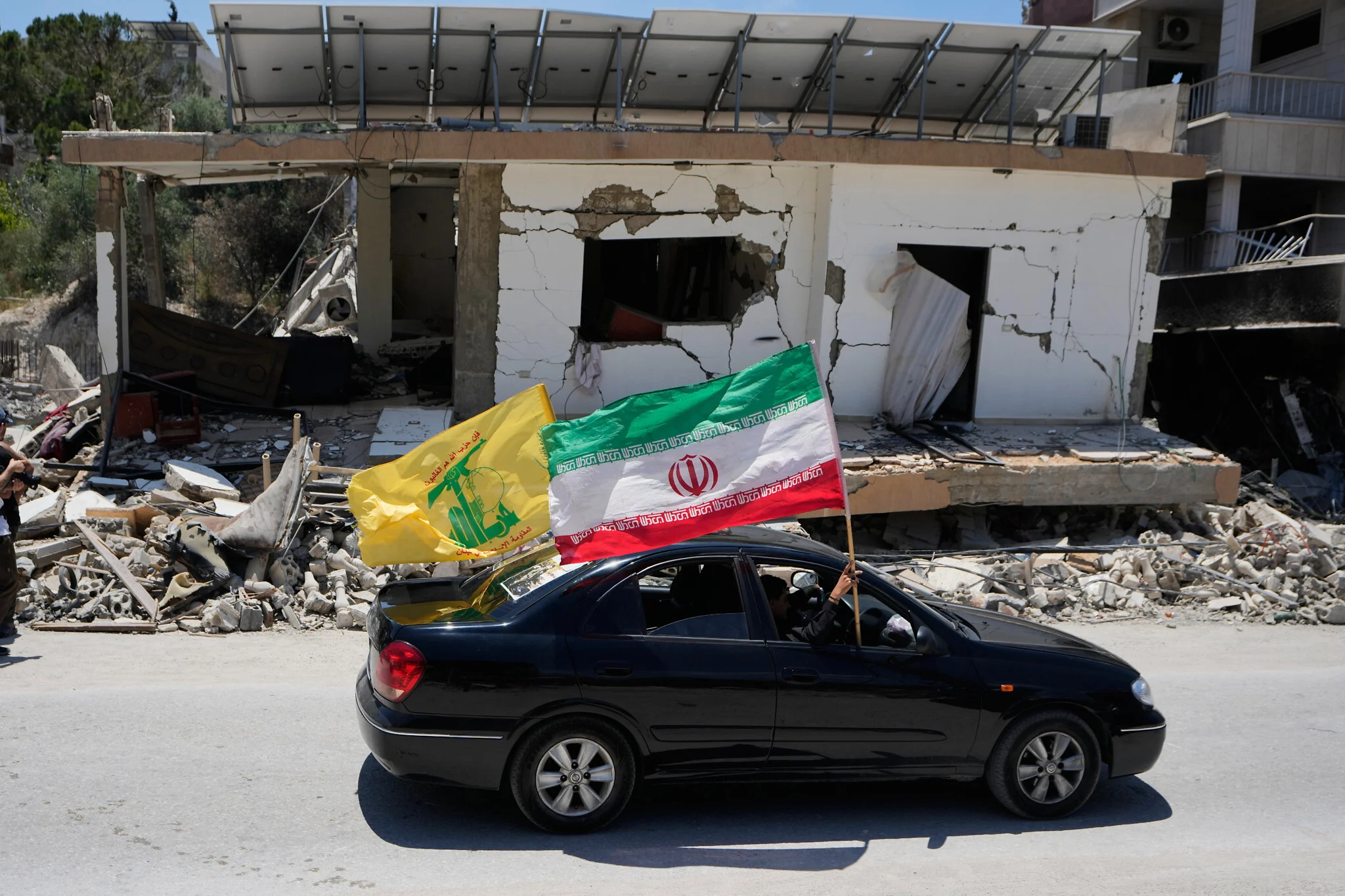
There is little that Israel can do to influence what happens in Baghdad except to hope for the best. But there is a lot that Israel can do – and is doing – to eliminate Hezbollah. Both the recent IDF campaign and the US-brokered agreement between Israel and Lebanon are entirely consistent with a strategy of completely defeating Hezbollah. Should Israel achieve that objective, it will be impossible for the Islamic Republic to spin a positive – let alone heroic – narrative for domestic consumption. And the optics will be even worse if, as is likely, the elimination of Hezbollah results in an Israeli flag flying over a new embassy in Beirut.
To be sure, the defeat of Hezbollah will not, in and of itself, be sufficient to topple the Iranian regime. What it will do is allow Israel to regain the initiative that was frittered away by the cease-fire agreement. How should that initiative be exploited? I suspect that Barnea and Gofman have some ideas about that.
But right now, the road to Tehran runs through Beirut.