The views expressed herein are solely mine.
The Sand Paradox: Power Built on Foreign Ground
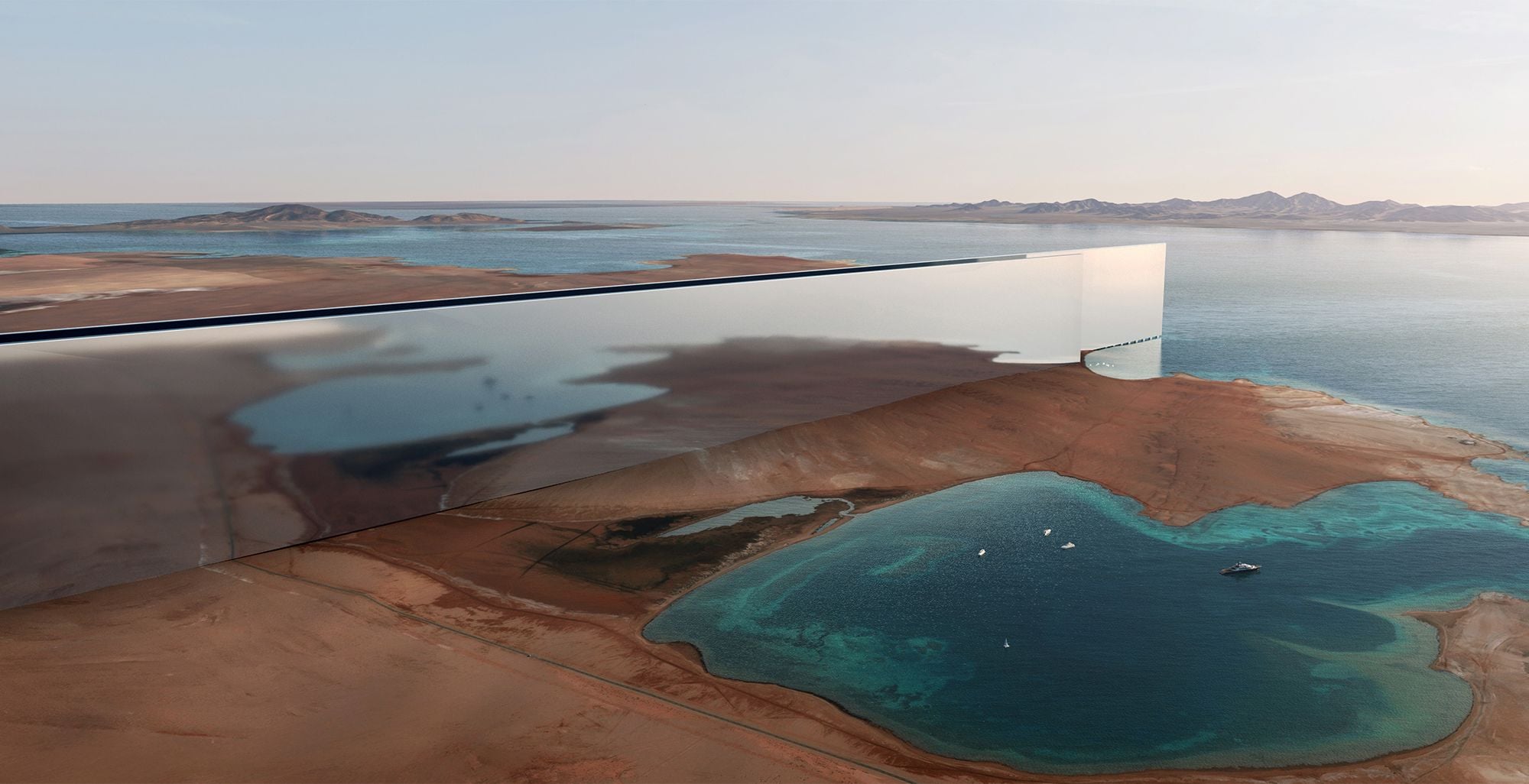
Mirror-encased skyscrapers extending over 170 kilometers (more than 100 miles), known collectively as The Line, at the planned Neom city in Saudi Arabia, unveiled by Crown Prince Mohammed bin Salman on July 25, 2022. (Neom.com).
The Gulf sells a powerful illusion—endless desert, limitless resources, and cities rising effortlessly from the sand. Dubai’s skyline and Saudi Arabia’s NEOM project demonstrate permanence and control. Yet the deeper you look, the more that image fractures, revealing a contradiction at the core of modern power.
Because the desert sand is useless.
Not symbolically, but materially. Desert sand, shaped by wind over millennia, is too smooth to bind into concrete. It cannot hold weight or sustain the infrastructure meant to project Gulf power. The region’s defining feature cannot actually build it—forcing dependence where abundance appears.
And that is where the illusion breaks.
Instead of relying on what they have, Gulf states import what they need—at scale. In fact, the United Arab Emirates became the world’s largest sand importer in the 2000s, bringing in tens of millions of tons for projects like the Burj Khalifa and the Palm Islands. Meanwhile, Saudi Arabia is now accelerating demand through NEOM, a $500 billion megaproject, as well as parallel Vision 2030 developments such as The Line, the Red Sea Project, and Qiddiya—each of which depends on massive volumes of construction-grade materials that the desert itself cannot provide.
This matters because modern power is not built on oil alone—it is built on concrete, and concrete depends on a specific type of sand: coarse, angular, and found not in deserts but in rivers and coastlines. What seems trivial becomes strategic.
The skyline, then, is not local. It is imported.
And the scale is staggering. The world consumes 40 to 50 billion tons of sand and gravel every year—second only to water—with demand tripling since the early 2000s. Every tower in Dubai and expansion in Riyadh is not just architecture, but logistics: a supply chain embedding Gulf ambition into other nations’ environments.
The consequences are already visible.
In Cambodia, more than 500 million tons of sand were exported between 2007 and 2017, leaving behind eroded rivers and collapsing ecosystems. In India, illegal sand mining has become a multi-billion-dollar black market tied to violence and political protection. Thus, what looks abundant is, in practice, being depleted and contested.
In tandem, the United Nations Environment Programme’s Global Sand Observatory initiative and its updated sand sustainability assessments warned that by 2026 extraction in key regions is exceeding natural replenishment rates, confirming that this is not a future shortage but a present structural deficit.
However, some states are starting to react.
In 2007, Indonesia banned sand exports to Singapore after the islands were partially stripped for land reclamation. Malaysia and Vietnam followed with restrictions. What was once background material is now triggering early resource nationalism—a preemptive indicator that control over construction inputs is quietly entering the geopolitical domain.
This is what scarcity looks like before it is recognized.
And the Gulf is not behind this shift—it is already operating within it. Saudi Arabia and the United Arab Emirates are defined not by what they have, but by what they can secure, move, and convert into infrastructure and influence. Vision 2030 is not just an economic diversification plan—it is a material strategy, one that depends on sustained access to external resources to physically construct its geopolitical ambitions.
This is the real model of power in the 21st century: not possession, but access; not geography, but logistics.
And yet, much of the Western policy and media ecosystem continues to treat resources like sand as trivial inputs rather than strategic assets—missing, or choosing to ignore, the fact that the physical foundations of global power are being reconfigured in real time, often far from public scrutiny. This is not a passing trend—it is the early stage of a structural realignment in how power is built and sustained.
The desert is not a weakness. It is a catalyst—forcing a system built on external sourcing and global reach. And once that capability is mastered, geography stops being a constraint.
This is where the sand paradox becomes geopolitical.
The Gulf’s rise is not just about oil or capital—it is about control over the materials that make modernity possible. Sand is everywhere, but the sand that builds power is not.
And in a world racing to urbanize, that distinction is becoming decisive.
Unequivocally, the Gulf does not rise from its desert. Today, it rises from what it can extract beyond it.
Related Topics
Related Posts