Greek Jewish roots. New York voice. Unfiltered perspective.
The Sun Rose, and He Kept Walking
Reflections on Parashat Vayishlach
There is something extraordinary about the way the Torah sometimes illuminates our lives not by providing answers to the questions we are asking, but by revealing connections we had not previously recognized.
When I sat down to write this week’s Torah reflection, I realized that, without consciously intending to, I had been writing a much larger story over the past three weeks.
In my reflection on Toldot, The Strength to Know When to Stop, I explored the strength required to exercise restraint. In Vayetzei, The Detours Were Never the End of the Road, I considered how the unexpected detours in our lives might not be interruptions to our purpose, but part of discovering it.
And now, in Vayishlach, I find myself confronting perhaps the most consequential question of all:
Who have we become along the way?
Three consecutive parashot. Three seemingly independent reflections. And yet, together, they tell a story of personal evolution.
Sometimes we are so immersed in living our lives that we fail to recognize the narrative taking shape beneath our experiences. Only retrospectively do seemingly unrelated encounters, disappointments, decisions and opportunities begin to reveal their continuity.
Preparing for a Future We Cannot Control
As Vayishlach opens, Yaakov is preparing to encounter his brother Esav after years of separation. There is history between them, unresolved grievances and uncertainty about what awaits him.
He sends messengers ahead. He prepares gifts. He divides his camp. He prays.
He does everything within his power to prepare for an outcome that ultimately remains beyond his control.
There is an important distinction in Jewish thought between hishtadlut, our responsibility to make an effort, and emunah, the faith that allows us to acknowledge the limitations of that effort.
Preparation is not control. Faith is not a guarantee that what we desire will materialize in precisely the form we imagine. And surrender is not the abandonment of effort; it is the relinquishment of the belief that our efforts entitle us to dictate the outcome.
Over the past six years, much of my spiritual work has revolved around understanding this distinction.
I began examining not only what had happened to me, but how I had participated in my own life. What had I tolerated? What had I accepted out of habit rather than conviction? Where had I compromised aspects of myself in an effort to preserve something I believed was worth preserving?
Rather than concentrating exclusively on what I hoped life would bring me, I began asking myself a different question: Who did I need to become to meaningfully participate in the life I envisioned?
Not every meaningful encounter is intended to become permanent. Some clarify what we value; others deepen our discernment, challenge our assumptions or introduce new possibilities.
With perspective, even experiences that did not unfold as I anticipated have prompted three words of genuine gratitude:
Thank you, Hashem.
Not because every outcome was desirable, but because I can appreciate what an experience taught me without insisting it become what I imagined.
Equally, I am learning to welcome new possibilities without feeling compelled to define them prematurely.
I have learned that I can recognize what feels like divine timing without presuming to know divine intention.
Perhaps part of emunah is learning to nurture what is meaningful quietly, without requiring external validation or certainty about what comes next.
Personal growth is not simply about attracting the relationships, experiences or opportunities we desire. It is about becoming someone capable of nurturing them while living meaningfully in the meantime.
The same applies to professional and creative aspirations: we develop ideas, knowledge and skills before knowing where they might lead.
Perhaps timing is as much about who we have become as when an opportunity arrives.
Hishtadlut is doing the work before the opportunity presents itself. Emunah is trusting that the work has value even before you know what opportunities it will produce.
Perhaps the greatest victory is not changing what awaits us, but changing the person who arrives to meet it.
The Years No One Witnessed
The Torah tells us:
וַיִּוָּתֵר יַעֲקֹב לְבַדּוֹ
Vayivater Yaakov levado.
“And Yaakov was left alone.” (Genesis 32:25)
Yaakov’s defining transformation does not take place in front of an audience. He wrestles throughout the night, and as morning approaches, he receives a new name.
Before anyone else encounters Yisrael, Yaakov must encounter himself.
For much of the past six years, I lived quietly. I withdrew from the public eye, made myself smaller and diminished my voice, not because I had nothing to say, but because I no longer had the emotional bandwidth to defend what I had to say.
And quietly, deliberately and largely without an audience, I began putting myself back together.
The people who have come to know me recently may see a woman who writes publicly, speaks unapologetically, advocates passionately, builds new relationships and embraces unfamiliar opportunities.
They did not necessarily witness the years it took to become her.
There is a difference between finding one’s voice and reclaiming it. Mine was never entirely absent. I had simply grown accustomed to lowering its volume.
Today, I can defend my convictions without requiring others to share them, disagree passionately without denying another person’s humanity, and welcome perspectives that challenge my own.
Changing my position because someone has expanded my understanding is intellectual growth. Changing it because I fear losing their approval is self-abandonment.
Being secure in who I am does not require me to remain fixed in what I think. Being unapologetically myself does not mean believing I am infallible.
Authenticity is not a strategy for gaining acceptance. It is a commitment to remaining recognizable to yourself, even when acceptance is withheld.
This week, watching two-time Paralympic gold medalist Ezra Frech win Dancing with the Stars, I found myself equally captivated by footage of him as a little boy.
Born with limb differences, he refused to let others’ assumptions determine the boundaries of his aspirations.
His dignity was never contingent upon his achievements. What fascinates me is the continuity between the little boy and the young man we celebrate today.
The trophy recognized his performance. It did not create his character.
Public recognition has a date. Personal transformation rarely does.
We celebrate championships, graduations, successful companies, marriages and promotions. But how often do we consider the thousands of private decisions that preceded those visible milestones?
We meet Yisrael in the morning without fully appreciating what Yaakov endured during the night.
The world celebrates the arrival. Rarely does it understand the becoming.
The morning made visible what the night had transformed.
When We No Longer Need to Wrestle
There is a profound difference between silence born of self-preservation and restraint born of self-possession.
There was a time in my life when silence was often a consequence of emotional exhaustion. Today, I understand that silence can also be a deliberate expression of strength.
Outwardly, the behavior may appear identical. Internally, it could not be more different.
How much energy do we devote to defending our character or explaining intentions our actions have already demonstrated?
At what point do we recognize that another carefully constructed explanation is unlikely to accomplish what years of lived experience have not?
We do not need to continually audition for the understanding of people who have already been given ample opportunity to know us.
This does not preclude self-examination, acknowledging mistakes or meaningful conversations. It requires distinguishing between opportunities for understanding and conversations that merely drain our emotional energy.
Sometimes we do not recognize how much we have changed until life presents us with a familiar situation and we discover that our response is no longer familiar.
Forgiveness does not require an endorsement of what has transpired. Silence is not necessarily an admission. And stepping away need not be an act of retaliation.
Sometimes it is an act of self-respect.
We can remain open to meaningful reconciliation while recognizing that accountability, reflection and repair require the participation of more than one person.
We can extend forgiveness unilaterally, but we cannot rebuild a relationship unilaterally.
The length of a relationship does not exempt it from accountability, just as the brevity of a relationship does not diminish its significance.
When Yaakov finally encounters Esav, the Torah tells us that Esav runs toward him, embraces him, kisses him, and they weep. (Genesis 33:4)
Yaakov had made extensive preparations. But Esav, too, moves toward him.
There is something profoundly significant about that physical movement.
Meaningful reconciliation requires a willingness to move toward one another. One person cannot traverse the emotional distance for both.
Yet even after their embrace, the brothers ultimately continue in different directions. Reconciliation does not necessarily require restoring a relationship to its previous form.
We can leave a door open without spending our lives standing beside it, waiting for someone to walk through.
There is a life beyond that doorway that deserves to be lived.
An open heart does not obligate us to put our lives on hold. And loving someone does not require us to do the emotional work that belongs to them.
Perhaps personal growth is not about becoming less willing to love, but becoming less willing to abandon ourselves in the process of loving someone else.
Here Toldot and Vayishlach intersect: the strength to know when to stop becomes so integrated into our identity that restraint no longer requires an internal struggle.
Sometimes the evidence that we have prevailed in our own wrestling is that we no longer feel compelled to wrestle with everyone else.
The Blessing and the Wound Coexist
Yaakov receives a blessing, but he also walks away limping.
The Torah does not portray his emergence as an uncomplicated triumph. It preserves his vulnerability.
There is a tendency to romanticize adversity, suggesting that we should be grateful for every painful experience because it contributed to the person we have become.
But there are experiences I would never willingly choose, losses I would reverse in a heartbeat and betrayals I would never wish upon another human being.
As a mother navigating the dissolution of my marriage, I also had to witness my children experience the consequences of their father’s decision to withdraw from their lives — a decision that was his alone.
I could take responsibility for my own healing and create a space in which my children could begin to heal. What I could not do was compel another parent to participate in their lives, provide explanations I did not possess or answer questions that remained unanswered for all of us.
What I could do, however, was teach my children how to navigate circumstances beyond their control without allowing those circumstances to determine their sense of self-worth or their capacity to experience joy, trust and meaningful relationships.
I could not give my children the answers they deserved, but I could teach them that the absence of answers need not become an obstacle to moving forward.
How often have we postponed happiness, delayed decisions or remained emotionally tethered to the past while waiting for answers someone else might never provide?
And how much of our lives have we relinquished in the process?
Wanting answers is human. Making them a prerequisite for living is something else entirely.
We cannot allow someone else’s decision to withhold answers to become our decision to withhold life from ourselves.
Perhaps the answers will come one day. Perhaps they never will.
Moving forward without answers does not mean that the questions no longer matter. It means recognizing that our lives matter, too.
Perhaps this is another dimension of emunah: trusting that we can continue building a meaningful life without understanding every circumstance that brought us to where we are.
Yaakov did not emerge from his night of wrestling with assurances about everything that awaited him. He still had to encounter Esav. He still had an uncertain future before him.
And yet, when the sun rose, he continued walking.
The absence of certainty did not require the absence of movement.
As a mother, I could choose the example I set and the home I would continue to create: one defined not by who was absent, but by the love, laughter, generosity, meaningful conversations and extraordinary experiences that remained.
I could acknowledge the absence without allowing it to eclipse everything else.
I could not rewrite the circumstances of my children’s childhood, but I could help ensure that those circumstances did not write the entirety of their story.
My hishtadlut was in my deliberate daily choices as their mother. My emunah was in trusting those choices mattered, before I could see their impact.
Today, I watch how my children show up for one another, how they value their friendships and how they navigate their own relationships.
I could not determine every experience they would have, but I could be intentional about the example they would have in me.
As a mother, I find myself contemplating the remarkable reality that my children and I are undergoing different forms of becoming at the same time.
I am raising a teenage son who is discovering the young man he wants to become, while witnessing my daughter, now a young adult, create an independent life of her own.
And alongside their respective journeys, I am continuing my own.
I am not simply raising them. They are also witnessing me grow.
Motherhood has not marked the conclusion of my becoming. It has become one of its most meaningful dimensions.
There is something beautiful about allowing our children to witness our curiosity, aspirations and personal growth rather than postponing our own evolution until we believe our responsibilities as parents have been fulfilled.
I want my children to understand that adulthood is not the conclusion of becoming. That responsibility and aspiration can coexist. That caring for others does not require neglecting ourselves. And that the ability to begin again is something we can exercise throughout our lives.
Perhaps some of the most meaningful lessons we teach our children are not communicated through instruction, but through the way they witness us living.
I am increasingly less interested in measuring my children’s success exclusively by what they accomplish and more interested in observing who they become.
How do they treat people who can do nothing for them? Can they acknowledge when they are wrong? Do their actions reflect their words? Do they show up for the people they love when doing so is inconvenient?
Achievements may introduce our children to the world, but their character will determine how they move through it.
Perhaps the blessing that emerges from our struggle is not always something we receive directly. Sometimes it is something the next generation inherits.
We do not have to be grateful for everything that happened to us to be grateful for who we have become.
The Name Changed. The Person Was Not Erased.
After wrestling throughout the night, Yaakov receives a new name: Yisrael.
Hashem later reaffirms that name (Genesis 35:10), and yet the Torah continues to refer to him as Yaakov. The Talmud, in Berakhot 13a, considers this distinction: Yisrael becomes the principal name, but Yaakov is not rendered obsolete.
Perhaps growth is not a replacement of the self, but an expansion of it.
I entered this world as Sara Matathias. Over the course of my life, I became Sara Matathias-Thayer, then Sara Thayer, and eventually returned to the name with which my story began.
But returning to my original name did not mean returning to my original self.
And although Thayer is no longer the name I carry, my children carry that name, and within them lives Matathias, too.
I cannot erase a chapter of my life without erasing something that contributed to the people I love most.
Interestingly, I was supposed to have a middle name: Jacqueline. My parents never recorded it on my birth certificate, and so I grew up without one.
At twelve years old, I decided that if I ever had a daughter, I would name her Jacqueline.
Years later, I did precisely that.
Jacqueline was a name I never carried on paper, but one I carried in my heart until I had a daughter to give it to.
And then there is my father, Asher J. Matathias, whose middle initial stood for Jacob — Yaakov, the very patriarch whose transformation I find myself contemplating this week.
Some names we inherit. Some we choose. Some we relinquish. Some we reclaim. And some, though never officially ours, we carry long enough to give to someone else.
There is a Sara from every chapter of my life who still lives within me. Some made decisions I would no longer make. Some tolerated things I would no longer tolerate. But each worked with the understanding she possessed at the time.
I owe something to every one of them.
Who I am today is not a repudiation of who I once was. She is the culmination of every woman I have ever been.
There is a difference between becoming someone the world has never met and finally allowing the world to meet someone who has been there all along.
The Foundation Within
When my father, a Holocaust survivor and the patriarch of our family, died on September 13, 2026, on Rosh Hashanah, I felt as though the foundation upon which so much of my life had been built had cracked.
Yesterday, we celebrated our first Thanksgiving without him.
There was food, laughter, gratitude and the warmth of being surrounded by people I love.
And there was an absence.
Experiencing joy does not diminish my grief. Creating new memories does not dishonor the memories I shared with my father. Moving forward does not mean moving away from him.
The blessing and the wound coexist.
I am beginning to understand that rebuilding does not require replacing the man who laid that foundation. It requires recognizing how much of what he built already exists within me.
His teachings. His convictions. His commitment to Jewish identity. His insistence on remembering where we came from.
Perhaps there comes a moment in our lives when we discover that the foundation we thought was beneath us has, over the years, become part of us.
I thought I had lost the foundation. I am beginning to realize that I am also its continuation.
Yisrael does not remain merely the name of an individual. It becomes the name of a people.
One man’s transformation becomes part of an intergenerational identity.
We are not simply the recipients of what previous generations established. We are also entrusted with determining how that inheritance continues.
I am not beginning from nothing.
I am beginning from everything.
The Sunrise
I am fortunate to regularly witness the sunrise over the water.
The landscape is familiar. The horizon is familiar. And yet, no two mornings are precisely identical.
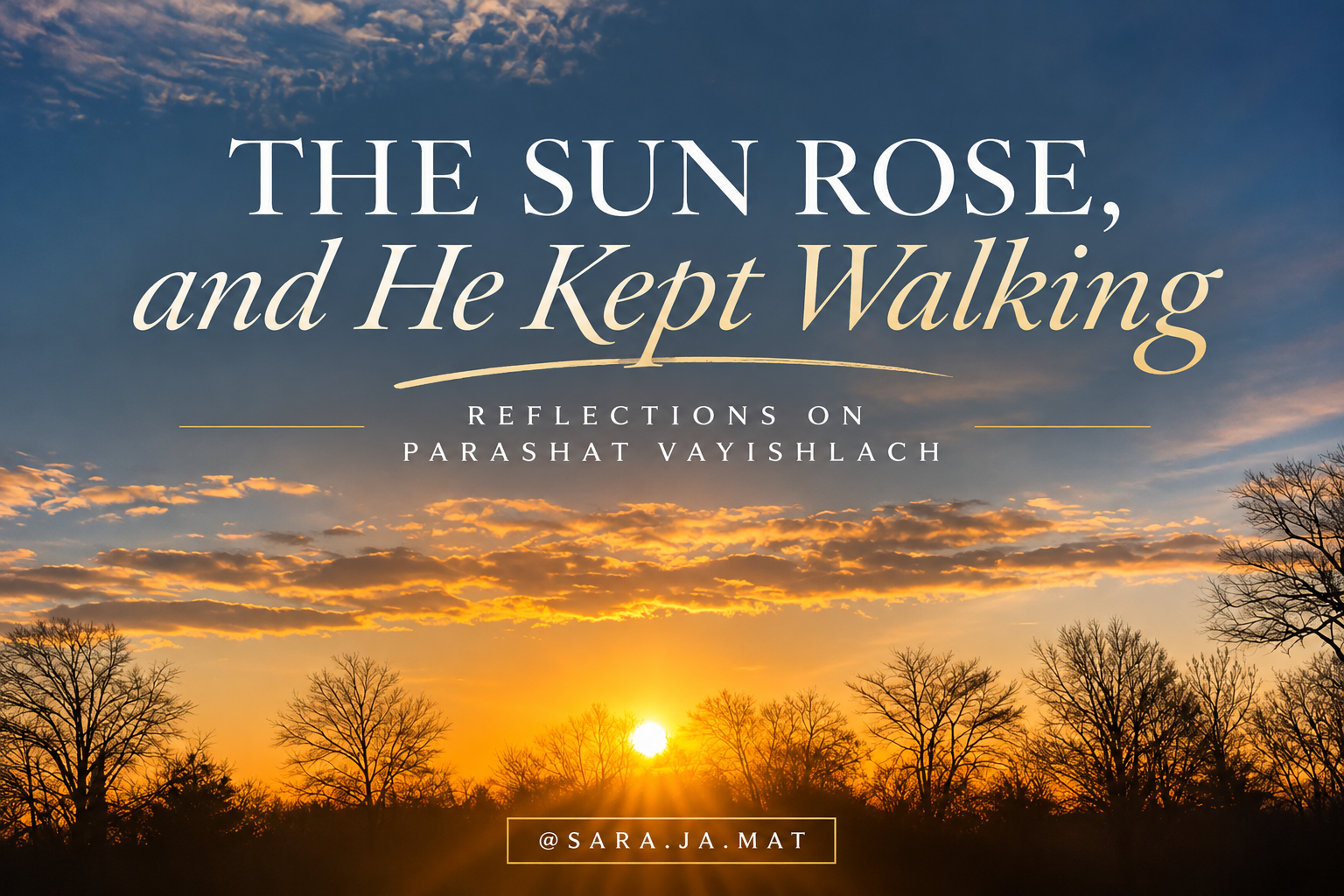
 The same horizon, a different morning. A quiet reminder that becoming is never finished.
(An AI-assisted illustration inspired by an original photograph by Sara Matathias.)
The arrival of light does not erase what occurred during the night. It changes what becomes visible to us.
In Genesis 32:32, the sun rises upon Yaakov as he passes Penuel, limping because of his injury.
He has received a new name, but his previous name remains part of his identity. He has prevailed, but he has not emerged without consequence.
He has received his blessing, but he has not yet lived its promise.
I find myself recognizing something of my own life in that image.
I am learning to experience gratitude alongside grief, to embrace possibility alongside uncertainty, and to appreciate the present without requiring assurances about the future.
I do not need every question answered, every relationship resolved or every aspiration realized before allowing myself to experience the beauty of the life I am living.
I do not know precisely what the next chapter will look like.
But I no longer need to know how the story ends to trust myself to live it.
Perhaps the miracle of Vayishlach is not that Yaakov survived the night. Nor is it simply that he received a new name.
Perhaps the miracle is that when the sun rose, he still had somewhere to go.
He did not wait until the wound disappeared. He did not wait until every uncertainty was resolved. He did not wait for life to become what it had been before.
He carried his blessing. He carried his wound. And he continued toward a future he could not yet see.
And perhaps that is what emunah looks like.
Not knowing what awaits us, but refusing to let what lies behind us become the limit of what lies ahead.
Related Topics
Related Posts