Greek Jewish roots. New York voice. Unfiltered perspective.
Vayetzei: The Detours Were Never the End of the Road
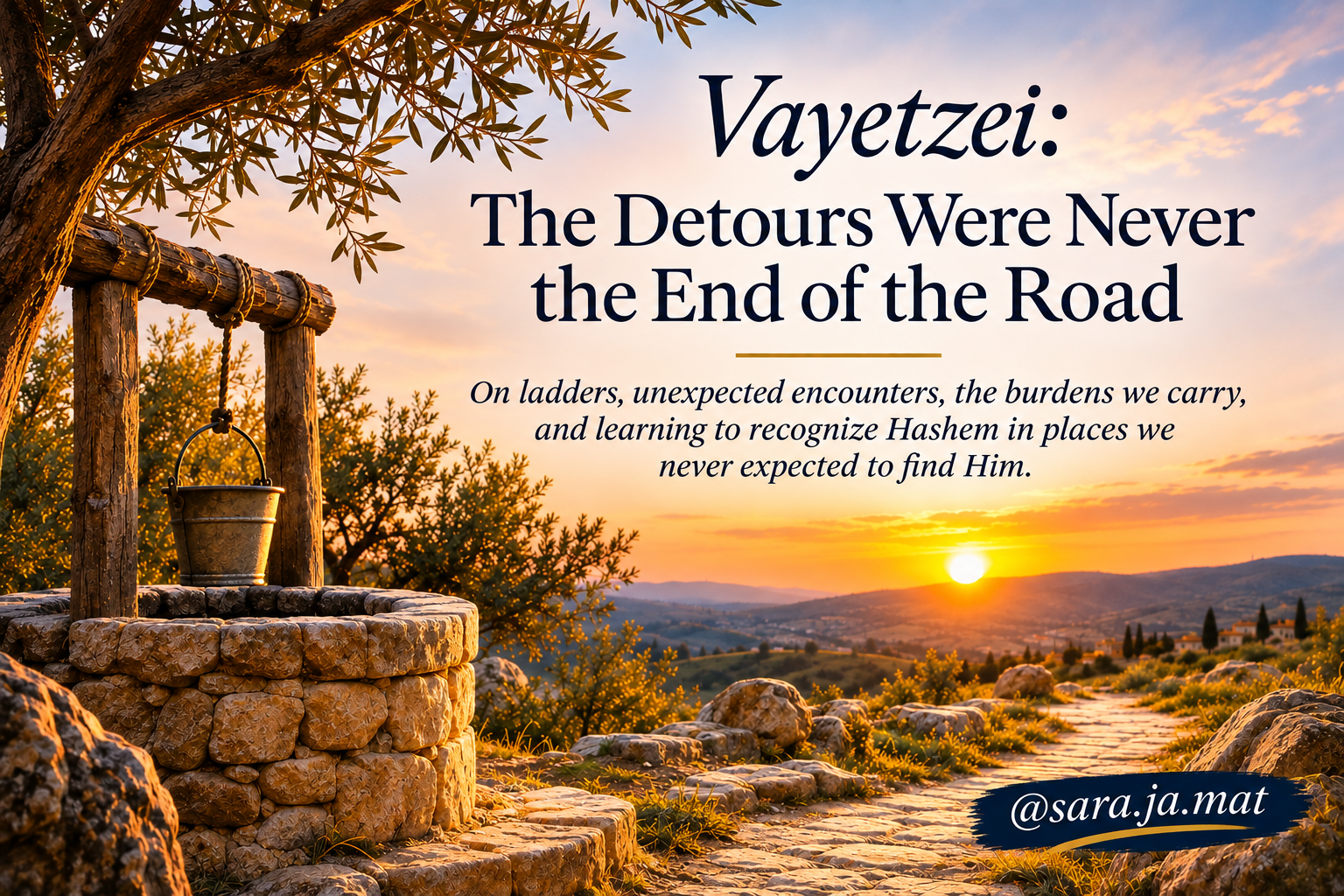
On ladders, unexpected encounters, the burdens we carry, and learning to recognize Hashem in places we never expected to find Him.
I’ve spent much of this past year climbing a ladder I couldn’t always see.
Some days I climbed. Other days I descended. There were detours, delays, unexpected turns, and moments when the distance between where I stood and where I hoped to be seemed impossibly far.
But I’ve come to believe something I might not have understood a year ago.
The detours aren’t necessarily punishment. Sometimes, they’re preparation.
At least, that’s how I choose to see them.
In this week’s parasha, Vayetzei, Yaakov leaves everything familiar behind and sets out toward an uncertain future.
Along the way, he stops for the night, rests his head upon a stone, and dreams of a ladder connecting heaven and earth, with angels ascending and descending.
What strikes me isn’t simply that the ladder reaches toward heaven.
It’s that there’s movement in both directions.
Up and down. Forward and backward. Progress and setbacks.
And yet, the ladder remains.
I’ve learned that progress doesn’t always look like progress while we’re experiencing it. Sometimes the path we thought was ours closes, forcing us to discover another.
Sometimes the very thing we believe is delaying us is preparing us for what comes next.
And sometimes, we don’t recognize any of this until much later.
When the Road Changes
For months, I’ve been working to build a company around something deeply personal: the power of finding and using our voices.
I’ve developed collections, explored collaborations, worked with designers, consulted attorneys, and imagined possibilities that extend years into the future.
And just when I thought I had found the right direction, trademark obstacles forced me to reconsider the name.
More than once.
Each time, I returned to the drawing board.
Not because I had lost faith in the vision, but because I believed there was still a way forward.
Then life presented something no business plan could prepare me for.
I lost my father.
Suddenly, questions about logos, trademarks, collections, and launch dates seemed insignificant beside the enormity of his absence.
There are losses that don’t become easier simply because time passes. We learn to carry them differently, but the space they leave remains.
My father believed in the next generation. He believed in education, opportunity, responsibility, and the importance of leaving the world better than we found it.
I carry those values into everything I do.
And while I would never suggest that losing him was somehow necessary for my growth, his absence has made me think more deeply about how I want to spend the time I’ve been given.
Eventually, I returned to building.
The company was still there. The vision was still there.
And this week, after another conversation with my attorneys, I finally received the green light to move forward with the trademark process.
It wasn’t the destination.
It was another rung on the ladder.
But this time, I recognized it for what it was.
Progress.
Not because everything had gone according to plan.
Because I had continued despite the fact that it hadn’t.
Hashem Was in This Place
After Yaakov awakens from his dream, he declares:
“Surely Hashem is in this place, and I did not know it.” (Genesis 28:16)
I’ve been thinking about those words all week.
How often do we move through life so focused on where we’re going that we fail to recognize the significance of where we are?
How many conversations do we dismiss as ordinary?
How many encounters do we overlook because we cannot immediately identify their purpose?
And how often do we assume that if something matters, we’ll recognize its importance the moment it happens?
This week taught me otherwise.
Earlier in the week, I hosted a fundraiser for Ma’agalim, an Israeli organization that mentors young people and helps them discover their potential.
It was an extraordinary evening, filled with meaningful conversations, moving stories, and people coming together to invest in the next generation.
But as anyone who has ever organized an event knows, hosting is a very different experience from attending.
When you’re responsible for bringing everything together, you’re constantly thinking about what comes next. Is everyone comfortable? Is everything running smoothly? Have I forgotten anything? Is there something else I should be doing?
I didn’t yet realize how much the distinction between hosting and attending would come to mean to me.
The Strangers at the Well
In Vayetzei, Yaakov arrives at a well and begins speaking with shepherds he has never met.
He asks where they’re from. He asks about Lavan. He asks about the flocks.
An ordinary conversation among strangers.
Then Rachel arrives.
And Yaakov’s life takes an unexpected turn.
What fascinates me about this passage isn’t only what happens afterward. It’s how everything begins.
With a conversation.
With the willingness to engage with people he has never met.
Through my involvement with Ma’agalim, I had the opportunity to spend time with two young graduates visiting America for the first time.
Neither had ever boarded an airplane before this trip.
I also spent time with an Israeli actor who was generously lending his voice and time to support the organization.
What began as a series of professional introductions became something far more meaningful: genuine conversations, shared laughter, and the opportunity to get to know people beyond their titles, accomplishments, or circumstances.
I was reminded how little we sometimes know about what another person has endured.
And how important it is to approach people with compassion rather than assumptions.
We don’t always know the weight someone else is carrying.
We don’t always know what a conversation might mean to them.
And we certainly don’t know what an unexpected encounter might mean to us.
Not every person who crosses our path is meant to remain in our lives forever. But that doesn’t mean their presence was insignificant.
Some encounters become lasting friendships.
Others become professional collaborations.
And some simply remind us of something we needed to remember.
That the world is full of people whose stories we have yet to hear.
That connection begins with curiosity.
And that sometimes, the most meaningful moments happen when we stop trying to make something happen and simply allow ourselves to be present.
When I Finally Became the Guest
A few days after hosting my fundraiser, I attended another event supporting Ma’agalim.
But this time, I wasn’t the hostess. I was a guest.
And I decided I was going to embrace that distinction.
I dressed comfortably but stylishly, choosing what made me feel most like myself rather than worrying about making an impression.
I went with a friend, and before we even arrived, I’d made a conscious decision.
I wasn’t going to spend the evening organizing, worrying, or trying to make something happen.
I was simply going to be present.
That may sound unremarkable.
For someone accustomed to planning events, solving problems, raising funds, connecting people, and making sure everyone else is taken care of, it was almost revolutionary.
For once, I didn’t have to make the evening happen. I could simply allow myself to experience it.
I wanted to enjoy the evening.
And I did.
But what I hadn’t anticipated was just how deeply I would be moved.
As I sat listening to the stories being shared, I found myself completely absorbed.
There were moments of laughter, moments of extraordinary honesty, and moments when the emotion in the room was almost impossible to put into words.
I listened to people speak about experiences that had shaped their lives, the challenges they’d faced, and the strength it had taken to continue moving forward.
And I cried.
Not because I believed I could fully understand what they had endured.
I couldn’t.
But because sometimes, when another human being allows us to glimpse the weight they’ve carried, something within us responds before we can find the words.
I had spent so much of the week focused on what I could do for others.
Yet here I was, receiving something I hadn’t expected.
The gift of listening.
The gift of perspective.
The reminder that everyone carries a story we cannot see.
And perhaps most importantly, the realization that being present can be just as meaningful as being the person making everything happen.
I hadn’t needed to organize the evening to be changed by it.
I only needed to show up.
The Detour I Never Planned
As the evening was drawing to a close, I found myself in conversation with an elderly gentleman I’d met that evening.
What began as an ordinary exchange soon became one of those unexpected conversations that reminds us how little we know about the people whose paths cross our own.
We spoke about life, experiences, and the different journeys that bring us to where we are.
There was something particularly meaningful about the exchange, although I couldn’t have anticipated where the evening would lead.
Sometimes, the significance of an encounter has nothing to do with what we were seeking, but everything to do with what we were open to discovering.
And as it turned out, the evening still had another surprise waiting.
The gentleman kindly offered my friend and me a ride with his driver toward Penn Station.
On the way, we made an unexpected stop at his home, where a visiting rabbi from Israel was staying.
It was supposed to be a ten-minute visit.
It became something much longer.
And far more meaningful.
During our conversation, the rabbi spoke about burdens I’d carried over the years.
The end of my marriage.
The painful questions surrounding relationships that changed without explanation.
Difficult family dynamics.
The responsibilities of raising two children, working, volunteering, fundraising, building a company, and trying to be available to the people who depend on me.
Some of his observations were deeply personal.
And as I listened, I realized something.
I had become so accustomed to carrying everything that I’d almost forgotten how heavy it all was.
He encouraged me to protect my peace, maintain healthy boundaries, and continue moving forward without allowing negativity to consume my energy.
He also gave me chapters of Tehillim to read.
Eventually, my friend and I continued to Penn Station and took the train home.
But I wasn’t quite the same person who had arrived at the event earlier that evening.
I’d gone expecting to listen to stories about other people’s journeys.
Instead, I found myself reflecting on my own.
And then, today, another unexpected development.
I was asked whether I could host a gathering for the rabbi during his visit, giving others the opportunity to meet him and receive his blessings.
I thought about the irony.
A ten-minute detour on the way to a train station had become another invitation to open my home and bring people together.
I couldn’t have anticipated any of it.
And once again, I found myself thinking about Yaakov’s words:
“Surely Hashem is in this place, and I did not know it.”
How often do we become frustrated when life interrupts our plans?
When the journey takes longer than expected?
When someone suggests an unexpected stop?
We assume we’re being delayed because we’re focused on where we intended to go.
But what if, occasionally, the detour is precisely where we’re meant to discover something?
I thought I was on my way to Penn Station. Perhaps I was also on my way to a lesson I didn’t yet know I needed.
And the most extraordinary part?
The story is still unfolding.
The People Who Teach Us to Find Our Voice
This realization extends beyond the events of one extraordinary week.
Some people enter our lives and remain for decades.
Others are present for a season.
And some, even when their role in our lives changes, leave us with lessons that become part of who we are.
Over the past year, I’ve learned a great deal about relationships, reciprocity, boundaries, and self-respect.
I’ve learned that caring deeply for someone doesn’t mean abandoning my own needs.
That being generous doesn’t require accepting relationships in which the effort flows only one way.
That I can appreciate what someone awakened in me without needing that person to remain in my life.
Perhaps most importantly, I’ve learned to believe in myself more fully.
To use my voice confidently.
To stop waiting for someone else’s validation before recognizing my own worth.
These lessons weren’t always comfortable.
But they’ve changed me.
And perhaps that is another way of understanding the ladder.
Sometimes growth isn’t about acquiring something new.
Sometimes it’s about returning to ourselves with greater clarity.
Faith Is Not the Absence of Difficulty
Yaakov’s life after the dream is hardly easy.
He works for years. He experiences deception. He faces uncertainty and conflict.
The promise of divine accompaniment doesn’t spare him from hardship.
And I find that deeply reassuring.
Because faith doesn’t mean life will unfold exactly as we want.
It doesn’t mean we won’t experience heartbreak, disappointment, grief, or uncertainty.
It doesn’t mean we will understand why something happened.
I’ve learned this year that believing everything is ultimately for the highest good doesn’t require me to pretend that everything feels good.
There are things I still don’t understand.
There are questions I may never have answered.
And there are losses I would never describe as blessings in disguise.
But I can believe that Hashem remains with me even in the places I would never have chosen to go.
I can trust that my inability to see the whole picture doesn’t mean there is no larger picture.
And I can continue doing my hishtadlut while releasing the illusion that I can control every outcome.
That’s the distinction I’ve come to appreciate.
Emunah allows me to believe. Hishtadlut requires me to act. Bitachon teaches me to trust what happens after I’ve done my part.
The Blessing of Being Still
As if the evening hadn’t already given me enough to reflect upon, I was unexpectedly asked whether the two young Israeli graduates could spend Shabbat in my home before returning to Israel.
Of course, I said yes.
And almost immediately, my mind began racing.
My daughter was returning home from college. The house needed cleaning. There were meals to prepare, challah to bake, and a seemingly endless list of things to accomplish.
I wanted everything to be special.
And then I caught myself.
Hadn’t I just spent the evening reflecting on how much I’d been carrying?
Hadn’t I just realized that perhaps I needed to learn how to rest?
Yet here I was, already adding another dozen things to my list.
And then something occurred to me.
Perhaps their coming wasn’t another responsibility. Perhaps it was another invitation.
An invitation to open my home, certainly.
But also an invitation to stop.
Because once the candles are lit, the cooking is finished, and Shabbat begins, there will be nothing left to organize.
No calls to make. No emails to answer. No business decisions to finalize. No next event to plan.
Just my mother, my daughter and son, our guests, the warmth of our Shabbat table, and the opportunity to be fully present.
To listen.
To laugh.
To share stories.
To simply be.
And suddenly, I found myself returning to Yaakov’s ladder.
For so long, I’d focused on the angels ascending and descending.
The movement. The effort. The determination to keep climbing.
But before Yaakov dreamed of that ladder, he stopped to rest.
Perhaps that’s the lesson I needed most.
Not every moment of our lives needs to be spent climbing. Sometimes the most meaningful thing we can do is stop long enough to recognize the blessings already surrounding us.
And perhaps this Shabbat, with two young people who were strangers only days ago now sitting around my table, I’ll be reminded of something Yaakov discovered long before me.
“Surely Hashem is in this place, and I did not know it.”
Maybe the extraordinary isn’t always waiting at the top of the ladder.
Sometimes it’s sitting right beside us at the Shabbat table.
Related Topics